What to See in Erfurt, Germany: Free Audio Guide
Things to Do in Erfurt: A Self-Guided Tour of the Historic City
Erfurt is the capital of Thuringia, known for its medieval old town, historic churches and monuments, and connections with Martin Luther and Napoleon. Its compact centre brings together Gothic architecture, political history, quiet chapels and distinctive landmarks, making it rewarding to explore on foot. Neywo has a free audio guide for Erfurt with 130 narrated places.
What to See in Erfurt
The best things to do in Erfurt are spread across the old town and several nearby districts. The following places reveal the city’s religious, political and cultural history, roughly following the way its sights appear across the city.
Erfurt Cathedral and St. Severi
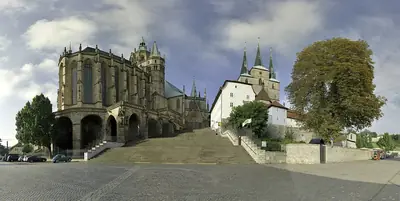
Erfurt Cathedral, known in German as the Erfurter Dom, stands on a hill in the city centre and has roots reaching back about 1,200 years. The cathedral rises to 81.26 metres and is especially known for the Gloriosa, described as the world’s largest free-swinging medieval bell.
Immediately beside it, St. Severi forms one of Erfurt’s most recognisable architectural ensembles. The church is a Gothic, five-aisled stepped hall church, with rising rooflines that create a distinctive profile. Inside is an artistically important sarcophagus holding the remains of Severus of Ravenna. Together, the two buildings create a striking contrast: St. Severi has a stepped elevation, while the cathedral is a hall church without it.
Erthal Obelisk
The 18-metre Erthal Obelisk rises from Domplatz and is one of Erfurt’s oldest monuments. It was erected around 1777 to mark the first visit of Friedrich Karl Joseph von Erthal, the Archbishop of Mainz and Erfurt’s lord. Made of Wandersleben sandstone on a square granite base, it carries a portrait, name, coat of arms and other details at its base.
Maria-Magdalenen-Kapelle and Allerheiligenkirche
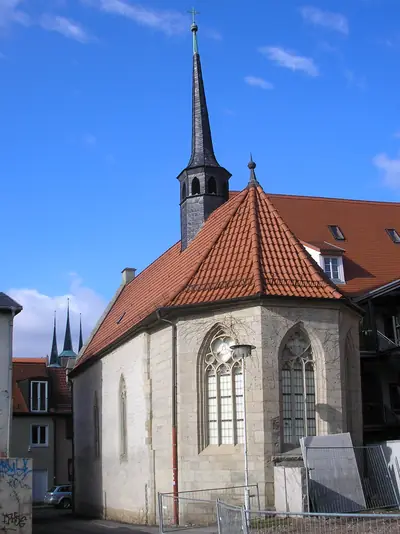
The small Maria-Magdalenen-Kapelle, or Magdalenenkapelle, is a quieter detail of the old town. Originally built as a cemetery chapel, it belongs to the cathedral parish and now serves as a columbarium rather than a church.
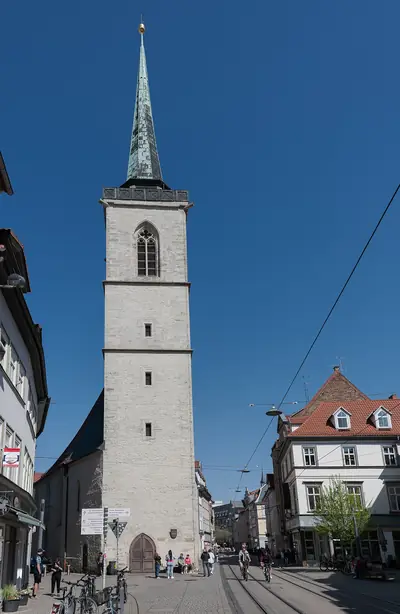
The Allerheiligenkirche, or Church of All Saints, is another of the historic churches in Erfurt’s city centre. It offers a small but worthwhile point of interest while walking through the surrounding old-town streets.
Luther Memorial
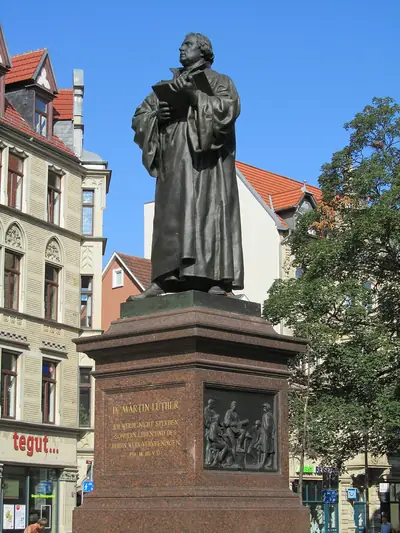
Before St. Gregory’s Merchants’ Church on the Anger, the Luther Memorial recalls Martin Luther’s strong connection with Erfurt. Luther lived in the city from 1501 to 1511, studied at the University of Erfurt and became a monk at the Augustinian Monastery.
The six-metre-high monument was unveiled on October 30, 1889. Luther is shown holding an open Bible in his left hand, with his right hand reaching towards the book. The statue’s expression suggests discovery rather than a formal declaration.
Kurmainzische Statthalterei
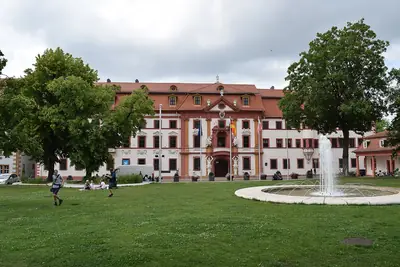
The Kurmainzische Statthalterei is a three-storey Baroque complex arranged in four wings around an inner courtyard. From 1699 to 1802, it was the residence and workplace of the Electoral Mainz governors, who administered Erfurt on behalf of the Prince-Archbishop of Mainz.
Its later history is equally significant. The building became a Prussian administrative centre and, from 1816 to 1933, served as the government headquarters for the Erfurt administrative district. It also played a role in the Erfurt Congress of Princes in 1808, when Napoléon Bonaparte lived and worked there and met Johann Wolfgang von Goethe. Today, after extensive restoration, it houses the Thuringian State Chancellery and serves as the seat of the Minister-President of Thuringia.
Barfüßerkirche
West of the Schlösserbrücke, beside the Breitstrom, an arm of the Gera, stands the surviving part of the Barfüßerkirche. The church was built in the fourteenth century as the monastery church of the Franciscans, also known as the Barefoot Friars, and was dedicated to Saint John the Baptist.
A bombing raid in 1944 destroyed much of the building. Its choir was reconstructed in the 1950s, leaving visitors with a tangible reminder of the important church that once stood here.
Kaisersaal
The Kaisersaal is a traditional cultural and convention centre within a protected historic ensemble on Futterstraße. Its story includes several major political gatherings. In 1808, Emperor Napoleon the First and Tsar Alexander the First met here during the Erfurt Congress of Princes.
The building also hosted the Erfurt Party Congress of the SPD in 1891. On April 12, 1946, Communists and Social Democrats gathered here and adopted a resolution supporting the local merger of the KPD and SPD into the Socialist Unity Party of Germany, or SED.
St. Thomas’ Church
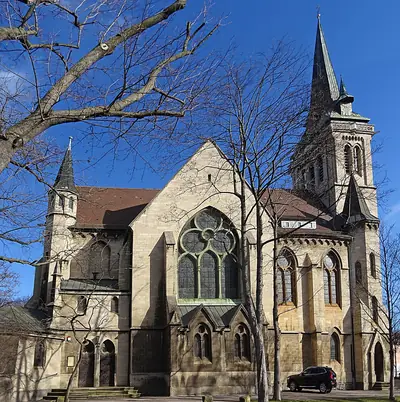
St. Thomas’ Church, or Thomaskirche, stands in a park on Schillerstraße in Erfurt’s Löbervorstadt district. Its Neo-Gothic design and 72-metre tower make it a prominent landmark; the tower is the second-highest church tower in Erfurt.
Inside, the Gothic altarpiece dating from 1445 is one of the church’s most notable features. It is considered one of the four valuable carved altarpieces in Erfurt.
Sibyllentürmchen
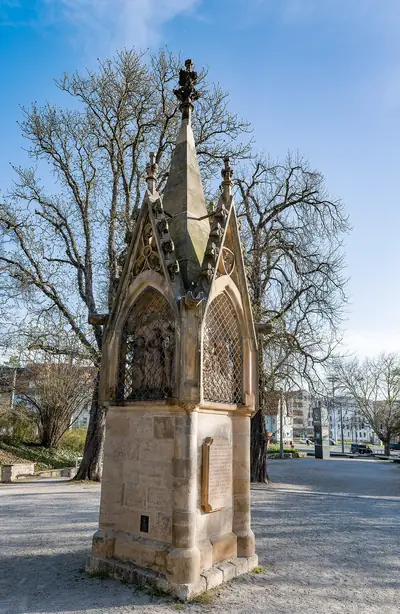
At Gothaer Platz, below Cyriaksburg in western Erfurt, the Sibyllentürmchen is a small Gothic devotional column created around 1370 to 1380. It is the only surviving devotional column from that period in Erfurt.
Four stone reliefs cover its sides, showing scenes from the Passion of Christ: Christ praying in a rocky garden, the Kiss of Judas, the Crucifixion and the Lamentation of Christ. The monument was restored in 1716 and again in 1993. The origin of its name is not recorded, although different explanations connect it either with the lifting of Erfurt’s siege in 1375 or with a local legend about Sibylle of Käfernburg.
Schloss Molsdorf
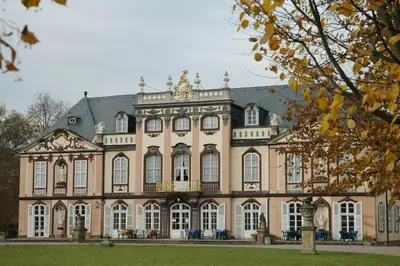
South of Erfurt, in the district of Molsdorf, Schloss Molsdorf offers a destination beyond the central streets. The Baroque castle stands beside the River Gera and is surrounded by an extensive park.
Its present character dates from 1734, when Gustav Adolf von Gotter transformed it into a pleasure palace. The richly decorated festival rooms survive, and the castle contains a permanent exhibition devoted to the Thuringian painter Otto Knöpfer. Its collection of erotic art adds an unusual dimension to the setting.
Kartause Erfurt
The Kartause Erfurt, or Carthusian Monastery of St. Salvatorberg, stood south of the city centre near the former Löbertor. It belonged to the Carthusian order and existed from 1374 until 1803. For more than four centuries, monks carried out religious services here, making the site part of Erfurt’s long religious history.
Angerturm
At the Stadtbahn depot on Magdeburger Allee, the Angerturm preserves a small piece of Erfurt’s traffic history. The former traffic-control tower is just under five metres high, with a curved staircase leading to a glazed control cabin.
It was built in 1961 on Anger, where traffic police used a microphone system and a roller control to direct trams, trolleybuses and cars. After Anger became a pedestrian zone in 1974, the tower was moved and later used to monitor transit traffic through the German Democratic Republic. It was dismantled and restored in 1996, with the restoration completed in August 2002.
Heiligen Mühle
In Erfurt’s northern Ilversgehofen district, the Heiligen Mühle is a historic mill on Mittelhäuser Straße. It provides another perspective on the city beyond its central churches, squares and administrative buildings.
Explore Erfurt with Neywo
For an Erfurt self-guided walking tour, download Neywo and choose the route that suits your interests. The app offers six walking tours, one bus route and one bike route, with 55 narrated stops in total across the tours.
The walks include:
- From the Cathedral Hill to the Merchants’ Bridge: 1.24 km, 120 minutes and 11 stops.
- Luther, Napoleon and the Old University: 2.14 km, 117 minutes and 11 stops.
- Fortress, Flowers and a Gothic Wayside Column: 3.74 km, 107 minutes and 8 stops.
- Towers of Lost Churches: 2.05 km, 69 minutes and 8 stops.
- Woad, Water and Bronze Animals: 1.39 km, 79 minutes and 9 stops.
- The Southern Old Town and the Charterhouse: 2.02 km, 71 minutes and 7 stops.
There is also Bus 9 along the Anger, covering 1.9 km in 8 minutes with 4 stops, and Cycle Lane from Kaffeetrichter to the Citadel Hill, covering 2.5 km in 12 minutes with 5 stops.
Neywo tells the story of each place as you reach it, at your own pace, with no group and no schedule. The narration is available in 11 languages, so you can explore Erfurt independently while connecting the city’s churches, monuments and historic districts.
If you are planning a wider trip through Germany, Erfurt can also be combined with other German destinations such as Goslar, Quedlinburg or Berlin.
Places with an audio guide in Erfurt
8 places in Erfurt with a Neywo audio guide. Each one starts telling its story as you reach it.
Self-guided tours in Erfurt
8 tours in Erfurt, free in the Neywo app. Each stop tells its story as you reach it.
- Bike ride
Cycle Lane from Kaffeetrichter to the Citadel Hill
A ride along Erfurt's signed cycle infrastructure through the Gründerzeit south of the old town: a bronze bather, the Kaffeetrichter crossroads, the neo-Gothic Thomaskirche, the Christuskirche and on to the Gothic wayside column under Cyriaksburg.
Badende · Kaffeetrichter · St. Thomas' Church · Christuskirche (Erfurt) · Sibyllentürmchen
Open this tour: Cycle Lane from Kaffeetrichter to the Citadel Hill - Bus ride
Bus 9 along the Anger
EVAG city bus 9 from Nordbahnhof to Daberstedt runs through Erfurt's central promenade. Get off at Luther's statue on the Anger, the Baroque Angermuseum and a bronze bather by the Gera, a cheap way to see the old town's eastern side.
Leipziger Platz · Luther memorial Erfurt · Angermuseum · Badende
Open this tour: Bus 9 along the Anger - Walk
From the Cathedral Hill to the Merchants' Bridge
Climb the steps of the Domberg to two Gothic giants side by side, cross the cathedral square past the Minerva fountain and the obelisk, then drop into the old merchant quarter. Renaissance houses and a bronze Roman on the Fischmarkt lead to a medieval synagogue, a ritual bath and the only inhabited bridge in Europe.
St. Severi (Erfurt) · Erfurt Cathedral · Minervabrunnen · Erthal-Obelisk · Haus Zum Breiten Herd (Erfurt) · Kunsthalle Erfurt …
Open this tour: From the Cathedral Hill to the Merchants' Bridge - Walk
Luther, Napoleon and the Old University
Erfurt was the city where Luther studied and became a monk, where Napoleon met Goethe and where the SPD wrote a programme. Walk from the governor's Baroque palace past the Franciscan choir and the Preachers' church to the lost university, the Emperor's hall and the Luther statue on the Anger.
Kurmainzische Statthalterei · Barfüßerkirche · Preacher's Church · Collegium Maius · Kaisersaal · Kaufmannskirche (Erfurt) …
Open this tour: Luther, Napoleon and the Old University - Walk
Fortress, Flowers and a Gothic Wayside Column
Start at the Gründerzeit crossroads of Kaffeetrichter and the neo-Gothic Thomaskirche, then leave the old town for Erfurt's green hill. A rare 14th-century devotional column, a Prussian-era citadel, Germany's horticultural museum in its barracks and egapark, the garden show with Europe's largest continuous flower bed. A small modern chapel by Otto Bartning ends the walk.
Kaffeetrichter · St. Thomas' Church · Christuskirche (Erfurt) · Sibyllentürmchen · Citadel Cyriaksburg · German horticultural museum …
Open this tour: Fortress, Flowers and a Gothic Wayside Column - Walk
Towers of Lost Churches
Erfurt once had dozens of parish churches, and many survive only as a tower. Start at the Romanesque abbey church on the Petersberg, pass the Stasi prison memorial, then follow the stumps and steeples of the Andreas quarter and the old town's north side to the city museum in the House zum Stockfisch.
Peterskirche · St Leonard's Church · Memorial and Education Centre Andreasstrasse · Andreaskirche (Erfurt) · Georgskirche · Nikolaikirche …
Open this tour: Towers of Lost Churches - Walk
Woad, Water and Bronze Animals
Woad made Erfurt rich, and its storehouses are still here. Pass the Town Musicians of Bremen, the former woad warehouses that are now a museum and a theatre, the cemetery chapel and the church tower of Paulskirche, then reach the last working mill of the city and a basking badger beside the Gera.
Town Musicians of Bremen · Natural History Museum of Erfurt · Waidspeicher · Allerheiligenkirche (Erfurt) · Maria-Magdalenen-Kapelle · Paulskirche …
Open this tour: Woad, Water and Bronze Animals - Walk
The Southern Old Town and the Charterhouse
From the Fountain Church and Herrmannsplatz to the quiet southwest of the old town: a Cistercian convent site, the Alte Oper, the vanished Carthusian monastery and the new synagogue standing where the Great Synagogue burned.
Brunnenkirche (Erfurt) · Schauspielhaus · Herrmannsplatz · Martinskloster Erfurt · Alte Oper · Kartause Erfurt …
Open this tour: The Southern Old Town and the Charterhouse
Walk Erfurt with Neywo
Neywo turns Erfurt into a self-guided audio tour. Stories arrive as you reach the place they belong to, and the route reshapes when you wander off it.


More in Germany
Elsewhere in Germany
- Baden-BadenBaden-Württemberg
- BlaubeurenBaden-Württemberg
- Esslingen am NeckarBaden-Württemberg
- FreiburgBaden-Württemberg
- HeidelbergBaden-Württemberg
- KarlsruheBaden-Württemberg
- Kirchheim unter TeckBaden-Württemberg
- Leutkirch im AllgäuBaden-Württemberg
- StuttgartBaden-Württemberg
- TribergBaden-Württemberg
- AugsburgBavaria
- BambergBavaria