Visiting Dresden, Germany: Top Sights on Foot
Things to Do in Dresden: What to See in Saxony’s Historic Capital
Dresden is the capital of Saxony, a city known for Baroque architecture, royal collections, museums and the Elbe River. Its historic centre combines carefully rebuilt landmarks with places that tell the story of wartime destruction and renewal, while districts such as Neustadt and Loschwitz reveal a livelier, more varied side of the city. Neywo offers a free audio guide for Dresden with 128 narrated places.
What to See in Dresden
The best way to discover Dresden is to move through its historic centre and then explore some of the districts beyond it. These are the main places to include when deciding what to see in Dresden.
Church of Our Lady
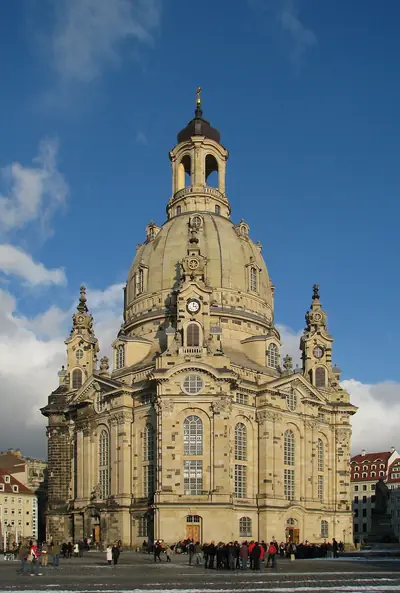
The Church of Our Lady, or Frauenkirche, stands at Neumarkt and is one of Dresden’s best-known landmarks. Its enormous Baroque dome rises 91 metres and was created between 1726 and 1743 under the direction of George Bähr.
The church was destroyed during the Allied firebombing of Dresden towards the end of the Second World War and remained a ruin for decades. Reconstruction began in 1994 and was completed in 2005, with the church reconsecrated on 30 October that year. Original plans from the 1720s and salvaged stones were used in the rebuilding, so darker historic fragments can be seen beside newer material. The dome is traditionally known as the Stone Bell, or die Steinerne Glocke.
Dresden Cathedral
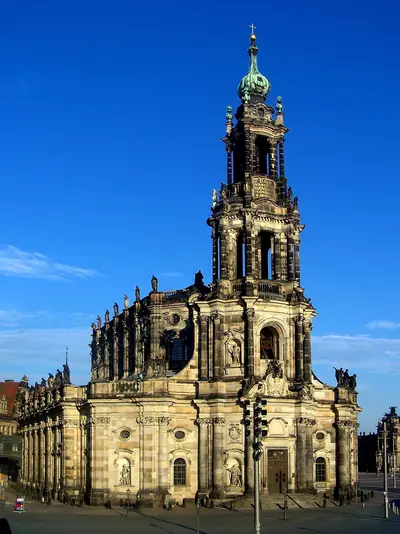
Dresden Cathedral is also known as the Katholische Hofkirche and, since 1980, as the Kathedrale Sanctissimae Trinitatis. The Baroque cathedral was built between 1739 and 1755 under Elector Friedrich August II of Saxony, following a design by Gaetano Chiaveri.
Its connection with Saxony’s rulers is particularly strong. The cathedral contains the Wettinergruft, the historical burial place of the Electors and Kings of Saxony, as well as members of the House of Wettin and Polish monarchs. Inside, notable features include the monumental altarpiece by Anton Raphael Mengs and the Baroque pulpit.
Semperoper
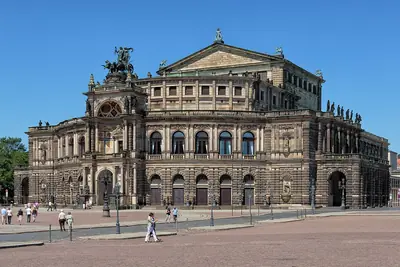
On Theaterplatz, near the Elbe, the Semperoper is one of Dresden’s defining cultural buildings. It is named after its architect, Gottfried Semper, who built the present opera house for King Johann between 1871 and 1878 in a Neo-Renaissance style.
The building’s history began with an earlier opera house constructed in 1841. After a devastating fire in 1869, it was rebuilt and completed in 1878. Its façade combines early Renaissance, Baroque and Greek classical revival influences, with Corinthian pillars, a Panther quadriga and a statue of Dionysos. The Semperoper remains associated with opera and ballet.
Zwinger
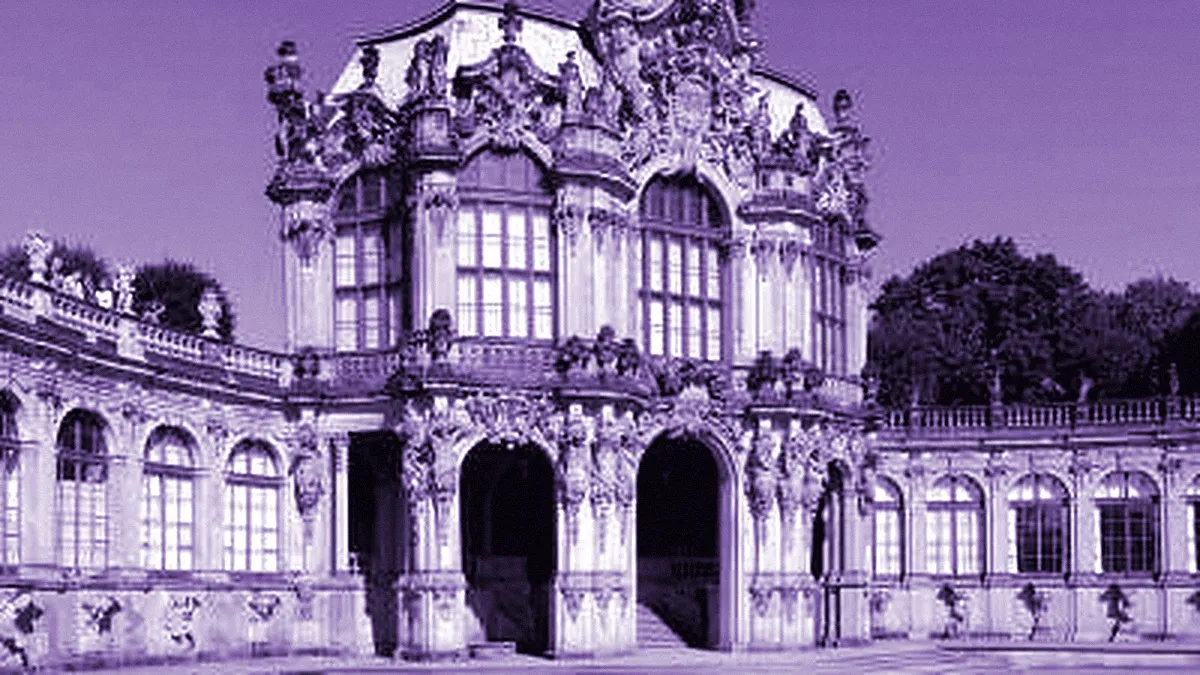
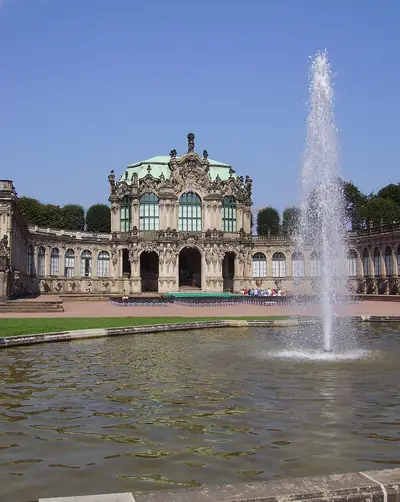
The Zwinger is one of Dresden’s most famous Baroque landmarks: a palace complex of pavilions, galleries, gardens, fountains and richly decorated balustrades. Matthäus Daniel Pöppelmann began the project in 1709 as an orangery and garden for court festivals.
It was originally planned as a forecourt for a new castle between the Zwinger and the Elbe, but that larger project was abandoned after the death of Augustus the Strong. Gottfried Semper later completed the complex towards the river with the Semper Gallery. When it opened in 1855, it helped establish the Zwinger as an important museum complex.
The complex is also home to the Gemäldegalerie Alte Meister, or Old Masters Gallery. Its collection focuses on European painting from the 15th to the 18th centuries, including Italian Renaissance works, Dutch and Flemish paintings, and examples of old German, French and Spanish art. Italian works are displayed against intense red walls, while Dutch and Flemish paintings are shown against green backgrounds.
Dresden Castle
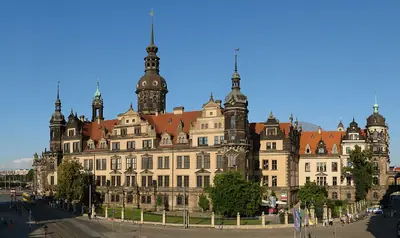
Dresden Castle, or Residenzschloss Dresden, served for almost 400 years as the residence of Saxony’s electors and kings, as well as the kings of Poland. Its architecture brings together several periods, from its beginnings as a 13th-century Romanesque keep to later Renaissance, Baroque and Neo-Renaissance additions.
The four-wing complex was begun in 1548 by Elector Moritz, with Caspar Vogt von Wierandt involved in the Renaissance design. A fire damaged the castle in 1701, after which Augustus the Strong rebuilt it and added ornate Baroque collection rooms. Further renovations between 1889 and 1901 gave parts of the building their Neo-Renaissance appearance.
Kreuzkirche
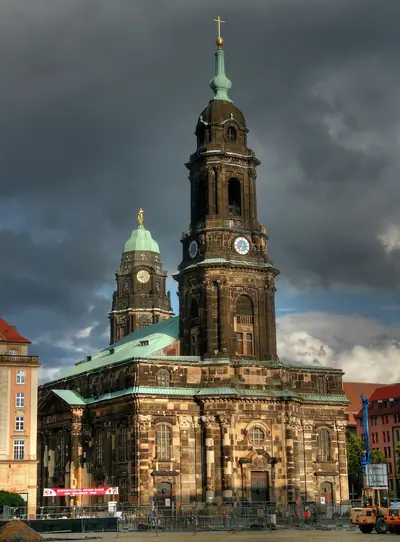
Near Altmarkt, the Kreuzkirche is Dresden’s Lutheran main church and the seat of the Landesbischof of the Evangelical-Lutheran Church of Saxony. It is also closely connected with music through the Dresdner Kreuzchor and the Kreuzorganists.
A church stood on this site as early as the 12th century, and it was formally dedicated to the Holy Cross in 1388. The building has been destroyed and rebuilt five times. The final major destruction came during the bombing of Dresden on 13 February 1945; its exterior was reconstructed between 1946 and 1955, while parts of the interior remain connected to the rebuilding process. The tower rises 92 metres and includes a balcony with a 36-degree view.
Albertinum
The Albertinum is a Renaissance Revival building in sandstone, constructed between 1884 and 1887 by Adolph Canzler for King Albert. Originally built for the sculpture collection and the main state archives, it now houses the Galerie Neue Meister and the Sculpture Collection of the Dresden State Art Collections.
The museum’s focus extends from Romanticism to the present, bringing together paintings and sculpture from roughly two centuries. The building was damaged in 1945, rebuilt in 1953 and later affected by flooding from the Elbe in 2004. Restoration added flood protection and a new courtyard while preserving the original façade.
Loschwitz Bridge
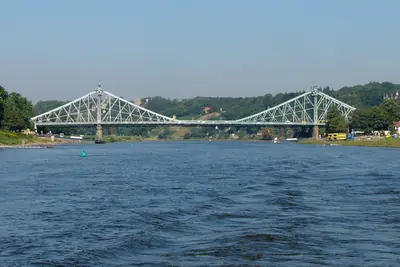
The Loschwitz Bridge, officially the Loschwitzer Brücke, connects Blasewitz and Loschwitz across the Elbe. Built between 1891 and 1893, it was originally named König-Albert-Brücke in honour of Albert, King of Saxony.
The bridge became known as the “Blue Wonder” because of its unusual appearance and engineering. It crossed the river without supporting piers, a notable achievement at the time, and was originally painted a sky-blue colour. The bridge offers a different perspective on Dresden from the grand monuments of the Old Town.
German Hygiene Museum
The German Hygiene Museum was founded in Dresden in 1912 and today functions as a public forum for science, culture and society. The present building opened in 1930, suffered severe damage during the bombings of February 1945, was rebuilt during the DDR period and underwent major renovation between 2001 and 2005.
Despite its name, the museum is not focused on cleaning products. Its exhibitions explore the human body, its functions and healthy living. The collection contains over 45,000 exhibits, including a transparent human model showing the organs and how they work. The museum’s history also includes its use for Nazi propaganda connected with racial ideology and eugenic research, followed after the war by its role as a centre for public health information.
Palace of Dresden Grand Garden
The Palace of Dresden Grand Garden, or Palais im Großen Garten, is a Baroque pleasure palace set within the Großen Garten. Construction began in 1679, making it one of the earliest Baroque buildings in the German-speaking world.
The palace is also considered the first major civil building in Saxony constructed after the Thirty Years’ War. Its setting in the wide green space at the edge of Dresden’s city centre gives the city’s architectural heritage a more spacious and tranquil context.
Taschenbergpalais Dresden
Taschenbergpalais Dresden was built as a Baroque residence for the nobility from 1705. Designed by Johann Friedrich Karcher, it was later expanded and modified, including the addition of fountains in front of the entrance between 1747 and 1750.
The palace was destroyed during the devastation of 1945 and reconstructed from 1992. It reopened in 1995 as a luxury hotel. Surviving elements of the original structure include parts of the façade and the staircase, while the interior has been modernised.
Neustadt and the city’s musical side
Across the Elbe, Neustadt offers a contrasting atmosphere, with historic streets, cafés, bars and cultural venues. The area includes the Golden Rider, the Japanese Palace and the Three Kings Church.
For an evening focused on music, Jazzclub Neue Tonne occupies the cellar of the Kurländer Palais. The palace was built in 1728 and 1729 by Johann Christoph Knöffel for Count August Christoph von Wackerbarth and is considered Dresden’s first Rococo building. After being destroyed down to its outer walls during the Second World War, it was rebuilt between 2006 and 2008. The jazz venue has hosted performances in the palace cellar since 1981.
Explore Dresden with a Free Audio Guide
A Dresden self-guided walking tour lets you explore the city independently while hearing its history at the places where it happened. Neywo has six walking tours and one bike route in Dresden, with narration available in 11 languages.
The walks range from 1 km and 51 minutes to 5.62 km and 180 minutes. They include routes through the Zwinger, Semperoper and Royal Palace; the Frauenkirche and Albertinum; Neustadt; Altmarkt, the Kreuzkirche and Brühl’s Terrace; and Loschwitz, the Blue Wonder and the funiculars. The bike route through Neustadt covers 3.3 km in 16 minutes. Across these tours, the routes include between 5 and 15 narrated stops.
Download Neywo and explore Dresden at your own pace. The app tells the story of each place as you reach it, with no group and no schedule. Dresden is an excellent starting point for discovering Germany, and Leipzig and Meissen offer further destinations within Saxony.
Places with an audio guide in Dresden
8 places in Dresden with a Neywo audio guide. Each one starts telling its story as you reach it.
Self-guided tours in Dresden
6 tours in Dresden, free in the Neywo app. Each stop tells its story as you reach it.
- Bike ride
Neustadt by Bike: from the Yenidze to the Erich Kästner Museum
A short, flat ride on Neustadt's cycle paths. Start at the Yenidze, the cigarette factory dressed as a mosque, then ride to the Erich Kästner micromuseum in the Villa Augustin, the Schiller monument and the site of Dresden's first railway station.
Yenidze · Erich Kästner Museum · Schillerdenkmal (Dresden) · Leipziger Bahnhof
Open this tour: Neustadt by Bike: from the Yenidze to the Erich Kästner Museum - Walk
The Frauenkirche and the Albertinum
The church that was left as rubble for fifty years and rebuilt from it, stone by numbered stone, with the Albertinum's Romantic and modern painting a few hundred metres away and the Brühl terrace sculptures in between.
Moritzmonument, Dresden · Böttger-Denkmal · Kurländer Palais · Albertinum · Sculpture of Gottfried Semper · Kunsthalle Dresden …
Open this tour: The Frauenkirche and the Albertinum - Walk
Neustadt: the Golden Rider and the Japanisches Palais
Four and a half kilometres across the Elbe into the other Dresden — the gilded equestrian August the Strong, the Japanese palace he built for his porcelain, the Dreikönigskirche, the folk art museum and the old Jewish cemetery.
Dresden Central Station · Formsteinwand · Anne’s Church · Polish-Saxon Post Milestone in Dresden · Staatsschauspiel Dresden · Japanisches Palais …
Open this tour: Neustadt: the Golden Rider and the Japanisches Palais - Walk
Altmarkt, the Kreuzkirche and Brühl's Terrace
The rebuilt market square where the firestorm dead were burned in 1945, the Kreuzkirche with its boys' choir, the new synagogue on the site of Semper's, and out along the terrace above the Elbe.
Dresden City Museum · Gewandhaus · Kreuzkirche · Altmarkt · Kulturpalast Dresden · Fortress Dresden …
Open this tour: Altmarkt, the Kreuzkirche and Brühl's Terrace - Walk
Loschwitz: the Blue Wonder and the funiculars
A kilometre in the villa suburb upriver: the 1893 steel bridge the locals call the Blue Wonder, the suspension railway up the hillside, and a small museum in the house where Schiller finished his Don Carlos.
Loschwitz Bridge · Joseph-Herrmann-Denkmal · Loschwitzer Kirche · Dresden Suspension Railway · Leonhardi-Museum (Dresden, Germany)
Open this tour: Loschwitz: the Blue Wonder and the funiculars - Walk
The Zwinger, the Semperoper and the Royal Palace
August the Strong's Dresden, and the densest concentration of it. The Zwinger's pavilions, the Old Masters gallery with Raphael's Sistine Madonna, the Green Vault's treasury, the cathedral and the opera house — all within a kilometre.
Sächsisches Ständehaus · Georgentor · Dresden Cathedral · Dresden Castle · Green Vault · Schinkelwache …
Open this tour: The Zwinger, the Semperoper and the Royal Palace
Walk Dresden with Neywo
Neywo turns Dresden into a self-guided audio tour. Stories arrive as you reach the place they belong to, and the route reshapes when you wander off it.

