Trier, Germany: Self-Guided Walking Tour
Things to do in Trier
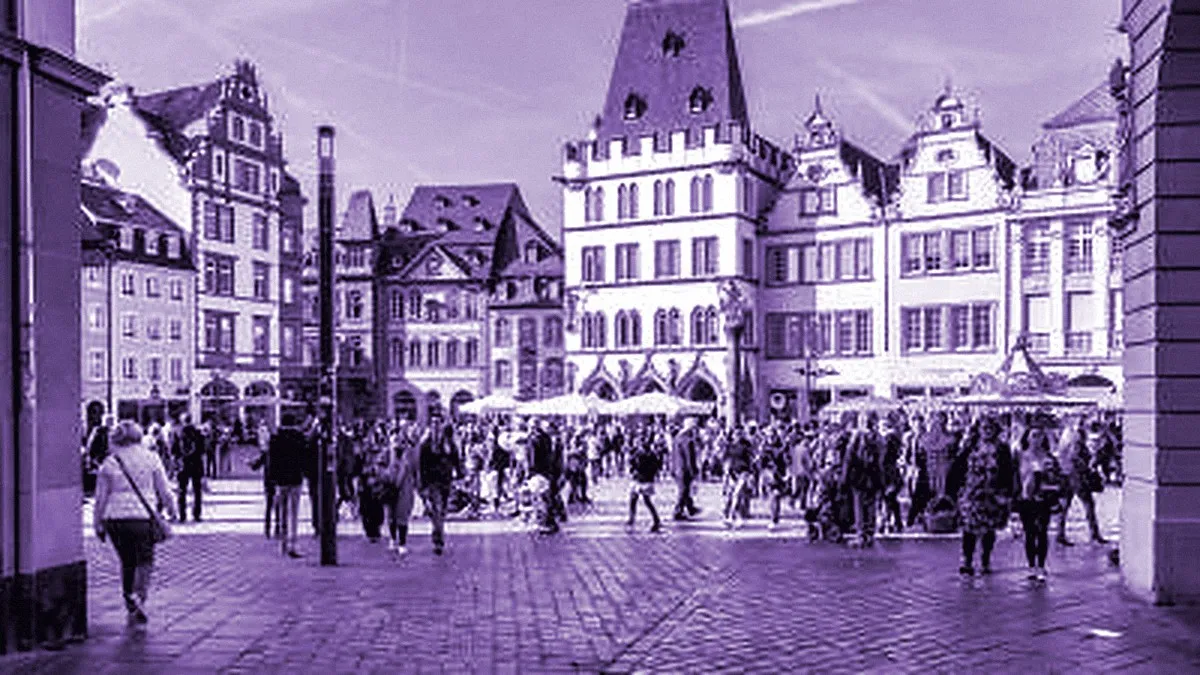
Trier is Germany’s oldest city, set on the Moselle River in the Rhineland‑Palatinate region, famous for its Roman monuments, medieval churches and the birthplace of Karl Marx. Its compact historic centre lets you walk from ancient gates to baroque churches in a few minutes. Neywo offers a free audio guide for Trier with 97 narrated places, so you can explore the city at your own pace.
Porta Nigra
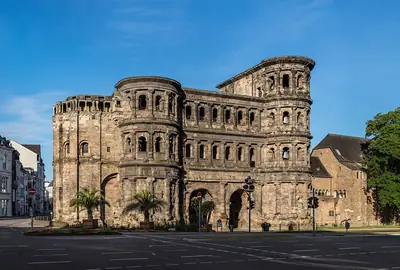
The Porta Nigra is a monumental Roman city gate that has stood since around 170 AD as the northern entrance to Augusta Treverorum. Built from sandstone blocks without mortar, it measures about 36 m long, 21.5 m wide and 29.3 m high. Its name, meaning “Black Gate” in Latin, comes from the dark colour the stone acquired over the centuries. Since 1986 it has been part of Trier’s UNESCO World Heritage site.
Aula Palatina
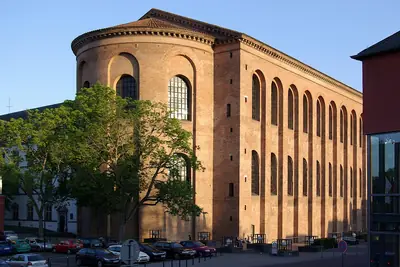
Also known as the Basilica of Constantine or the Church of the Redeemer, the Aula Palatina began as an imperial audience hall in the Roman palace of Augusta Treverorum. The hall is 67 m long and 33 m high, making it the largest surviving covered hall from classical antiquity. Over the centuries it served as a bishops’ residence, was incorporated into the Electoral Palace, and was restored between 1844 and 1856. On 28 September 1856 the restored building was handed permanently to the Protestant congregation.
Cathedral of Trier
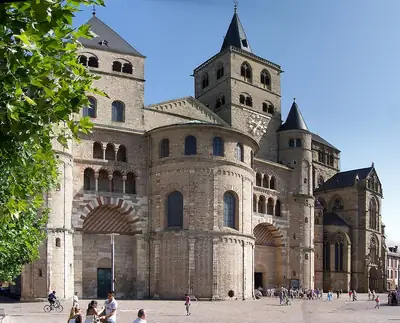
Trier Cathedral, or the Cathedral of Saint Peter, is Germany’s oldest cathedral and the city’s largest religious building. It stretches about 112 m in length and 41 m in width and has been the seat of the Catholic Diocese of Trier continuously since its foundation. The earliest parts date to a fourth‑century basilica linked to Emperor Constantine the Great, with Roman brickwork still visible in the nave. The present structure is mainly Romanesque with an imposing western façade and, together with the Church of Our Lady, forms part of the UNESCO World Heritage site since 1986.
Liebfrauenkirche
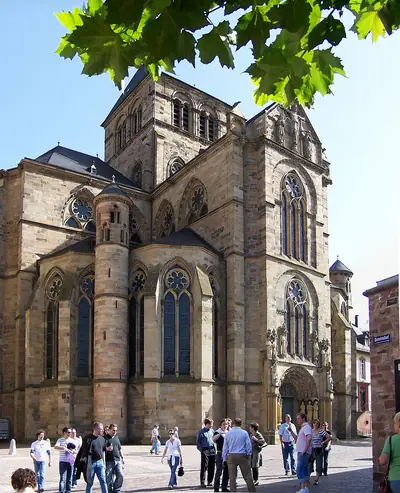
The Liebfrauenkirche (Church of Our Lady) stands directly beside the cathedral, sharing a wall with it. Its Gothic design features a rose‑shaped crossing that alludes to the Virgin Mary as the Rosa Mystica, with twelve sections representing the tribes of Israel and the Apostles. The richly decorated west portal is framed by sculptures and religious symbols. Inside, twelve columns hold fifteenth‑century paintings of the Apostles and the articles of the Apostles’ Creed, arranged to be viewed from a point marked by a golden star. The church also contains the tomb of the local nobleman Karl von Metternich (died 1636). The present building was erected between 1235 and 1260 after the southern part of an earlier Roman double church fell into disrepair, with French builders from Champagne commissioned for the work.
Roman Bridge
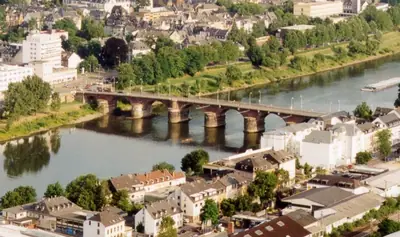
The Roman Bridge (Römerbrücke) is Germany’s oldest standing bridge and the oldest Roman bridge north of the Alps. Its nine massive stone pillars, dating from the second century AD, are made of black basalt from the Eifel mountains and have pointed fronts to resist ice and floods. Earlier wooden crossings existed as far back as 17 BC, with the first stone bridge built in 45 AD. In Roman times a wooden roadway sat about 14 m above the normal water level, allowing ships to pass without lowering their masts. The stone arches visible today were added during the Middle Ages (roughly 1190–1490). The bridge was badly damaged in 1689 when French troops blew it up during the Nine Years’ War; its arches were subsequently rebuilt.
Saint Paulin Church
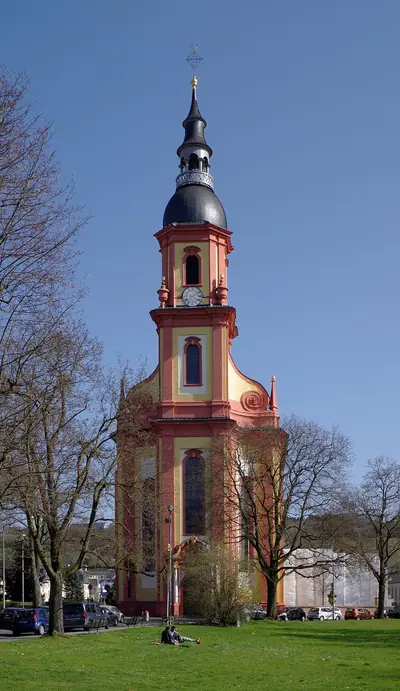
Saint Paulin Church presents a remarkable Baroque interior. The current building was erected between 1734 and 1753, with the interior designed by Johann Balthasar Neumann. The site has hosted churches since the fourth century, the earlier ones linked to the Theban Legion, whose soldiers are venerated as early Christian martyrs. The present church is dedicated to Paulinus of Trier, a fourth‑century bishop; his tomb lies in the crypt together with twelve relics associated with the Theban Legion. The nave ceiling bears a fresco by Christoph Thomas Scheffler depicting scenes from Paulinus’s life and the martyrdom of the Legion, surrounded by Rococo stucco work and elaborate altars.
St. Matthias’ Abbey
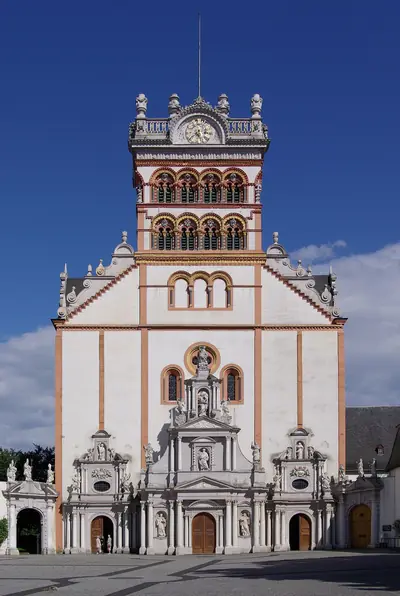
St. Matthias’ Abbey is a Benedictine monastery and an important pilgrimage destination centred on the tomb of Saint Matthias the Apostle. Originally dedicated to Saint Eucharius, Trier’s first bishop, the crypt preserves the tombs of Eucharius and his companion Valerius. The monastic community traces its roots to a fifth‑century oratory founded by Cyrillus of Trier; around 977 the abbey adopted the Benedictine Rule and in the twelfth century became a centre for manuscript production, including the Collectaneum of Sedulius Scottus. The Romanesque basilica has held the title of Basilica minor since 1920, serves as a Marian shrine with a cherished icon of the Virgin Mary, and its Chapel of the Cross contains a thirteenth‑century reliquary of the True Cross that can be visited on guided tours.
Jüngerer Moselkran
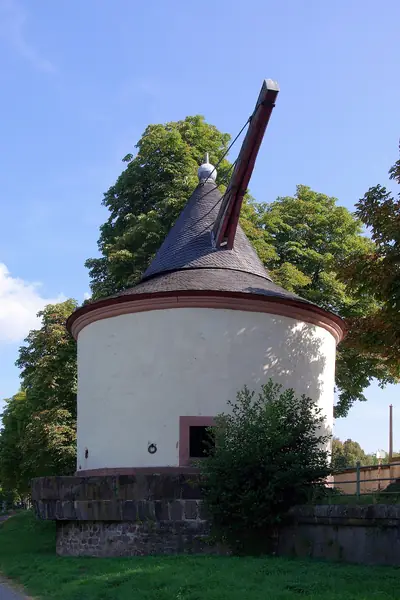
The Jüngerer Moselkran, also known as the Zollkran or Alter Zollkran, is a Baroque stone crane on Trier’s right bank of the Moselle near the historic customs office. Built in 1774 by engineer John Seiz, its double‑arm design and rotating roof allowed cargo to be moved with less reliance on manual labour, marking an advance in the city’s shipping technology. It replaced an earlier land‑based crane from 1413 (the Old Crane or Alter Krahnen) that was no longer dependent on the river’s water level. The Zollkran operated until 1910, was restored in 1984, and now stands as a monument to Trier’s harbour heritage and the evolution of cargo‑handling technology.
Irscher Burg
Irscher Burg is a historic castle located in Trier’s Irsch district. It formerly served as the provostry of St. Martin’s Abbey and stands on the street that bears its name.
Trier Imperial Baths
The Trier Imperial Baths (Kaiserthermen) survive as an archaeological park in the city centre, with walls that reach up to 19 m in height. Construction began in the early fourth century under Constantine I, when Trier was an important imperial residence. The baths were planned as one of the largest Roman bath complexes north of the Alps, with original dimensions exceeding 200 m in length and 100 m in width. Intended for public bathing, the hot‑water pools were designed to reach about 40 °C. The preserved apses display a Roman opus mixtum pattern of white stone and red brick, a technique later copied in medieval structures such as the Frankenturm. The complex was never completed or put into full service.
Barbara Baths
The Barbara Baths (Barbarathermen) comprise the remains of one of the most impressive Roman bath complexes north of the Alps. At over 42 000 square metres, it was the largest such complex in the region. Built in the second century and used into the fourth century, the site later served as a castle before its materials were reused for a Jesuit College erected in 1610. A visitor walkway presents reconstructions of the bath architecture and follows the course of a typical bathing day. Only about one third of the ruins has been excavated, so the foundations and tunnels hint at a far larger subterranean complex.
Karl‑Marx‑House Museum
The Karl‑Marx‑House (Karl‑Marx‑Haus) is the Trier home where Karl Marx was born in 1818. The building dates from 1727 and has been renovated many times; it has been dedicated to preserving Marx’s memory since 1947, with exhibitions renewed in 2018 for the bicentenary of his birth. The museum traces his life from family origins and personal belongings—including his favourite armchair—through his work in sociology, economics, journalism and philosophy, and ends with his influence on the labour movement. The collection includes a bust sculpted by his great‑grandson and a first edition of Das Kapital. Outside, a garden holds three life‑size Marx statues installed in 2008 by the sculptor Klaus Kammerlich.
Martinskloster
Martinskloster lies a little farther along the Moselle, where Trier’s monastic past meets modern student life. The surviving west wing of the former Abbey of St. Martin probably originated in a fourth‑century church attributed to Martin of Tours; Benedictine monks were present by the tenth century at the latest. The abbey was dissolved in 1802 during Napoleonic rule, and today its west wing forms part of one of Trier’s six student residences. A modern building that had been part of the complex was demolished in 2020 and is slated for replacement.
Bischöfliches Dom‑ und Diözesanmuseum Trier
Located just near Trier Cathedral, the Museum am Dom (formerly the Episcopal Cathedral and Diocesan Museum) opens a window onto the religious and artistic history of the Diocese of Trier. It investigates the late antique buildings that preceded the cathedral, described as Germany’s oldest episcopal church. One of its highlights is the Constantinian ceiling: painted panels discovered beneath the cathedral after the Second World War and reassembled over ten years, their scenes blending mythology and philosophy. The museum’s collection also includes liturgical vestments, devotional works and images of Christ and Mary, showing both the ceremonial side of religious life and how faith was expressed through art.
Electoral Palace
The Electoral Palace (Kurfürstliches Palais) displays Renaissance and Rococo forms that contrast with the neighbouring Roman Basilica of Constantine. It served as the residence of Trier’s prince bishops and electors from the seventeenth century until 1794. Construction began in the early 1600s; the lower palace was finished around 1650 and the Red Tower dates from 1647. Work on the upper palace was interrupted during the Thirty Years’ War. The palace stands partly on the foundations of the Roman basilica; its west wing was demolished in the nineteenth century to allow the restoration of the Basilica of Constantine, while the south wing was preserved with its elegant interior and impressive staircase. After the prince electors were dispossessed under Napoleon, the building was used as barracks by French and Prussian troops, suffered damage in the Second World War, and much of the lower palace was demolished thereafter.
Visit Trier with Neywo
Neywo’s free audio guide lets you discover Trier at your own pace, with no group and no schedule. The app offers three walking tours, one bus route and one bike route, each narrated in 11 languages.
- “Emperors, Archbishops and the Black Gate” – 1.26 km, 108 minutes, 7 stops: Porta Nigra, Dreikönigenhaus (Trier), Steipe, Cathedral of Trier, Liebfrauenkirche, Aula Palatina, Electoral Palace.
- “Marx, Cranes and a Roman Bridge on the Moselle” – 1.98 km, 77 minutes, 6 stops: Karl‑Marx‑House museum, Roter Turm, Barbara Baths, Roman Bridge, Jüngerer Moselkran, Alter Krahnen.
- “Gladiators and Bathers: Rome’s Northern Capital” – 1.56 km, 48 minutes, 4 stops: Forum baths, Trier Imperial Baths, Rheinisches Landesmuseum Trier, Roman amphitheatre of Trier.
- Bus 81: Porta Nigra to the Roman Bridge – 4.1 km, 18 minutes, 4 stops: Roter Turm (Trier, Konstantinplatz), Porta Nigra, Karl‑Marx‑House museum, Roman Bridge.
- Moselle Riverside Ride: Cranes and Abbeys – 1.4 km, 7 minutes, 4 stops: Roman Bridge, Jüngerer Moselkran, Alter Krahnen, Martinskloster.
As you approach each stop, the app plays the story of that place, allowing you to linger or move on as you wish. Download Neywo to enjoy these tours and the 97 narrated sites across Trier, and explore the city’s Roman, medieval and modern heritage whenever you like.
You can also plan day trips to nearby cities such as Mainz or Koblenz, both located in the beautiful Rhineland-Palatinate region of Germany.
Places with an audio guide in Trier
8 places in Trier with a Neywo audio guide. Each one starts telling its story as you reach it.
Self-guided tours in Trier
5 tours in Trier, free in the Neywo app. Each stop tells its story as you reach it.
- Bike ride
Moselle Riverside Ride: Cranes and Abbeys
A flat ride on the Moselle cycle path through Trier. Start at the Roman Bridge, pass the two historic harbour cranes where wine barges once loaded and end at the former abbey of St Martin on the riverbank.
Roman Bridge · Jüngerer Moselkran · Alter Krahnen · Martinskloster
Open this tour: Moselle Riverside Ride: Cranes and Abbeys - Bus ride
Bus 81: Porta Nigra to the Roman Bridge
Trier's city bus 81 is a cheap way to cross the old town from north to south and on to the Moselle. Ride from the Electoral Palace's Red Tower past the Black Gate and the birthplace of Karl Marx to the Roman Bridge, Germany's oldest, where the line carries on towards Igel and its Roman monument.
Roter Turm (Trier, Konstantinplatz) · Porta Nigra · Karl-Marx-House museum · Roman Bridge
Open this tour: Bus 81: Porta Nigra to the Roman Bridge - Walk
Emperors, Archbishops and the Black Gate
Trier was a capital of the Roman Empire, and its heart still shows it. Start at the Porta Nigra, the best-preserved Roman gate north of the Alps, cross the medieval market square, then reach Germany's oldest cathedral, a Gothic jewel beside it and Constantine's vast throne hall.
Porta Nigra · Dreikönigenhaus (Trier) · Steipe · Cathedral of Trier · Liebfrauenkirche · Aula Palatina …
Open this tour: Emperors, Archbishops and the Black Gate - Walk
Marx, Cranes and a Roman Bridge on the Moselle
Walk from the birthplace of Karl Marx to the river that made Trier rich. Pass a medieval tower on the green belt, the vast Barbara Baths, then reach Germany's oldest bridge and the old harbour cranes that once loaded wine barges.
Karl-Marx-House museum · Roter Turm · Barbara Baths · Roman Bridge · Jüngerer Moselkran · Alter Krahnen
Open this tour: Marx, Cranes and a Roman Bridge on the Moselle - Walk
Gladiators and Bathers: Rome's Northern Capital
Three Roman monuments and the museum that explains them. Stand above the first baths of Augusta Treverorum, walk the huge walls of Constantine's unfinished Imperial Baths, see the model of the Roman city in the archaeological museum and end in the arena where 20,000 spectators once watched gladiators fight.
Forum baths · Trier Imperial Baths · Rheinisches Landesmuseum Trier · Roman amphitheatre of Trier
Open this tour: Gladiators and Bathers: Rome's Northern Capital
Walk Trier with Neywo
Neywo turns Trier into a self-guided audio tour. Stories arrive as you reach the place they belong to, and the route reshapes when you wander off it.

