Things to Do in Goslar, Germany: Walking Guide
Things to Do in Goslar: A Self-Guided Journey Through History
Looking for things to do in Goslar? This historic German city combines a remarkably preserved old town with imperial architecture, centuries of mining heritage, churches, and distinctive half-timbered buildings. From the Imperial Palace to the former Rammelsberg mine, Goslar is worth visiting for the way its medieval and industrial past remains visible throughout the city.
Neywo has a free audio guide for Goslar with 67 narrated places, available in 11 languages.
What to See in Goslar
Mönchehaus Museum of Modern Art
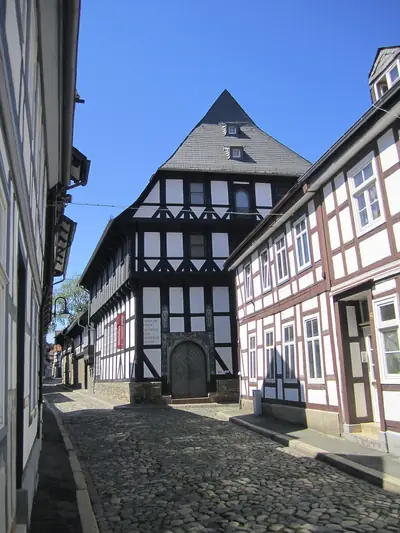
The Mönchehaus Museum brings contemporary art into a historic half-timbered house in Goslar’s old town. Built in 1528, the three-storey building is an impressive example of the farmhouses that once stood in the historic centre.
Founded in 1978, the museum presents five exhibitions each year. Its rooms and sculpture garden display works by artists including Rebecca Horn, Christo and Jeanne-Claude, and Victor Vasarely. The building itself forms part of the UNESCO World Heritage site that includes Rammelsberg Mine, Goslar’s old town, and the Upper Harz Water Management System.
Rammelsberg Mine
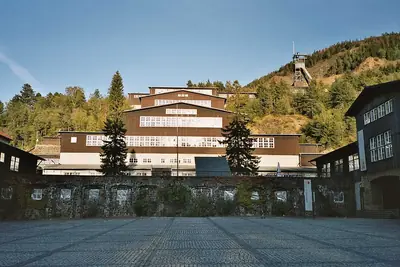
The former Rammelsberg mine tells the story of more than a thousand years of mining south of Goslar. Mining continued there almost without interruption until the mine closed in 1988, making Rammelsberg the only mine to have operated continuously for more than a millennium.
Today, the site is a mining museum and visitor mine. Its heritage extends beyond the shafts and buildings: tunnels, streams, reservoirs, and water wheels formed an ingenious system for powering pumps and removing water. In the seventeenth century, this technology allowed miners to dig deeper than at other mines.
Rammelsberg became part of the UNESCO World Heritage Site in 1992. Since 2010, the designation has also included Goslar’s old town and the Upper Harz Water Management System.
Imperial Palace of Goslar
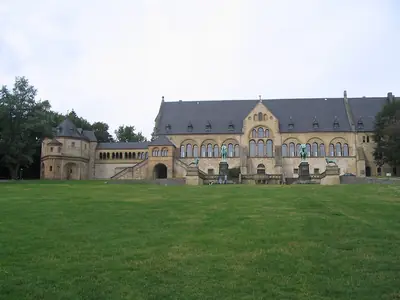
The Imperial Palace, or Kaiserpfalz, is one of Germany’s most important medieval palace sites. At the foot of Rammelsberg, it once served as a residence for emperors of the Holy Roman Empire and helped make Goslar an important centre of imperial power.
The complex covers about 340 by 180 metres and originally included the Kaiserhaus, the collegiate church of St. Simon and St. Jude, the Palace Chapel of St. Ulrich, and the Church of Our Lady. The Kaiserhaus is its centrepiece and is described as Germany’s largest and best-preserved secular building from the eleventh century.
The palace was extensively restored in the late nineteenth century, but its importance was already recognised in the Middle Ages. The chronicler Lambert of Hersfeld called it the most famous residence in the empire.
Domvorhalle
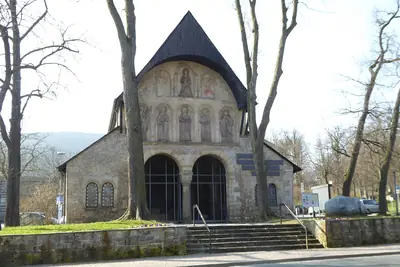
The Domvorhalle is the surviving northern porch of Goslar’s former collegiate church, also known as Goslar Cathedral or the Collegiate Church of Saint Simon and Saint Jude. The church itself was demolished between 1819 and 1822, leaving the northern entrance as a striking remnant of the former building.
Because it belonged to the Imperial Palace district, the porch offers a direct connection with Goslar’s medieval religious and imperial history.
Kaiserworth and Market Square
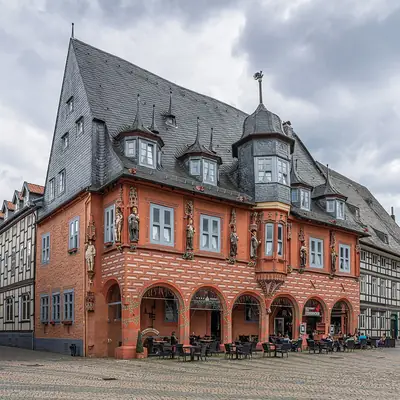
On Goslar’s Market Square, Kaiserworth is one of the buildings that defines the central setting. This historic guild house at Am Markt 3 reflects the city’s built heritage and its commercial past.
The square is also associated with the Marktkirche St. Cosmas und Damian, Goslar’s main parish church and historic council church. Its tower can be climbed daily from April onward, offering a different perspective on the historic centre.
St. Stephani
St. Stephani, or Stephanikirche, is an Evangelical Lutheran church in Goslar’s historic old town. It forms part of the architectural character that makes a walk through the centre so rewarding, where churches and half-timbered buildings appear among the old streets.
Christuskirche
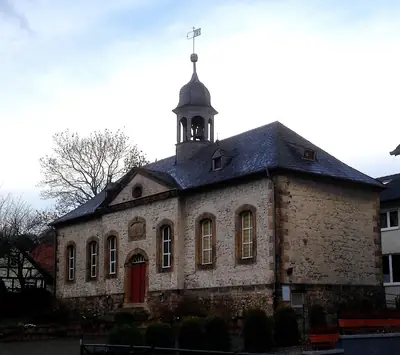
Christuskirche is home to Goslar’s Evangelical Free Church congregation. Its history reaches back to a chapel connected with the Siechenhof, a thirteenth-century leper hospital dedicated to Saint Pancras. The present church building dates from 1750.
St. Peter and Paul Church on Frankenberg Hill
At the western end of Goslar’s historic old town, St. Peter and Paul Church is also known as the Frankenberger Kirche. Originally a monastery church, it is now an Evangelical Lutheran parish church.
The building is Romanesque at its core, with later Gothic and Baroque alterations. Its different architectural periods can be read together in the church visitors see today.
Neuwerk Church
Neuwerkkirche is a beautifully preserved former monastery church and one of Goslar’s notable twelfth-century buildings. Now a Protestant parish church, it retains its Romanesque form throughout, giving visitors a direct impression of a medieval church in Goslar.
St. Jakobi
St. Jakobi, or Jakobikirche, is dedicated to Saint James the Elder and remains the parish church of Goslar’s Catholic community. The stop also includes Und man sieht nur die im Lichte, a sculpture by Walter Kaune. Its title, translated as “And one sees only those in the light,” adds a contemporary artistic detail to this historic setting.
St. George’s Collegiate Church
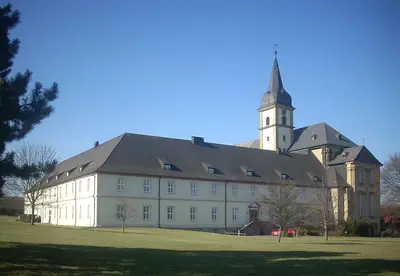
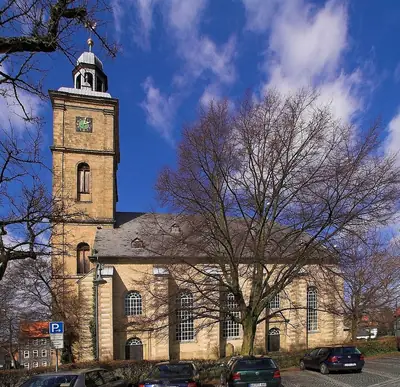
Stiftskirche St. Georg is a Baroque church southeast of Goslar’s Hahndorf district. It once formed part of the Augustinian Canons’ monastery of St. George and remains an important Baroque building in the Goslar area.
Gustav Adolf Stave Church
In Hahnenklee, a borough of Goslar in the Harz Mountains, the Gustav Adolf Stave Church offers one of the city’s most unusual sights. Its design is a free adaptation of the medieval stave church at Borgund in Norway, with wooden forms and decoration inspired by medieval Norwegian churches.
Construction began in 1907, and the church was consecrated on 28 June 1908. It was designed as a parish church with space for 240 seats and built from spruce trunks harvested on nearby Bocksberg mountain. Inside, carvings include dragon and serpent forms, while shipbuilding references appear in details such as a chandelier resembling a ship’s wheel and upper windows suggesting cabin windows.
Explore Goslar with a Free Audio Guide
A Goslar self-guided walking tour lets you explore the city’s history without joining a group or following a fixed schedule. Neywo offers two walking tours and one bus route:
- Emperors and Merchants of Goslar: a 1.29 km walk lasting 103 minutes, with 12 narrated stops.
- Miners, Monks and Half-Timbered Streets: a 3.89 km walk lasting 115 minutes, with 8 narrated stops.
- Bus 809: Around Goslar’s Old Town: a 5.5 km route lasting 24 minutes, with 7 narrated stops.
The walks connect places such as the Imperial Palace, Domvorhalle, Kaiserworth, Marktkirche, Mönchehaus Museum, and St. Peter and Paul Church. The bus route offers another way to reach sights including the old town churches and Mönchehaus Museum.
Download Neywo and explore Goslar at your own pace. The app tells the story of each place as you reach it, with no group and no schedule. If you are planning a wider trip through Germany, Goslar also makes a memorable stop alongside historic cities such as Quedlinburg, Erfurt, and Hanover.
Places with an audio guide in Goslar
8 places in Goslar with a Neywo audio guide. Each one starts telling its story as you reach it.
Self-guided tours in Goslar
3 tours in Goslar, free in the Neywo app. Each stop tells its story as you reach it.
- Bus ride
Bus 809: Around Goslar's Old Town
Goslar's city bus 809 loops from the station around the medieval centre. Ride it past the market church, the surviving porch of the imperial collegiate church, the churches of the old merchants' quarter and the half-timbered house that now holds contemporary art.
Johanniterkommende Zum Heiligen Grab · Marktkirche St. Cosmas und Damian · Domvorhalle · Love Hate · Mauerläufer · St. Jakobi …
Open this tour: Bus 809: Around Goslar's Old Town - Walk
Emperors and Merchants of Goslar
For centuries Goslar was one of the favourite residences of the Holy Roman emperors, and silver from the Rammelsberg mine made its burghers rich. Walk from the great imperial palace through the market square, with its Romanesque bronze fountain, guild house and town hall, past the carved facades of merchants' houses.
Siemenshaus · Imperial Palace of Goslar · Friedrich I. Barbarossa · Domvorhalle · Jongleur · Zinnfiguren-Museum Goslar …
Open this tour: Emperors and Merchants of Goslar - Walk
Miners, Monks and Half-Timbered Streets
Away from the market, Goslar's western and northern quarters keep the chapel of the Rammelsberg miners, Romanesque monastery churches, a half-timbered house now full of contemporary art, and the ruins of the foundations destroyed in the unrest of 1527.
Klauskapelle (Goslar) · St. Peter- und Paul-Kirche auf dem Frankenberge (Goslar) · Johanniterkommende Zum Heiligen Grab · Neuwerkkirche · Mönchehaus-Museum für Moderne Kunst · St. Jakobi …
Open this tour: Miners, Monks and Half-Timbered Streets
Walk Goslar with Neywo
Neywo turns Goslar into a self-guided audio tour. Stories arrive as you reach the place they belong to, and the route reshapes when you wander off it.


More in Germany
Elsewhere in Germany
- Baden-BadenBaden-Württemberg
- BlaubeurenBaden-Württemberg
- Esslingen am NeckarBaden-Württemberg
- FreiburgBaden-Württemberg
- HeidelbergBaden-Württemberg
- KarlsruheBaden-Württemberg
- Kirchheim unter TeckBaden-Württemberg
- Leutkirch im AllgäuBaden-Württemberg
- StuttgartBaden-Württemberg
- TribergBaden-Württemberg
- AugsburgBavaria
- BambergBavaria