Visiting Saarbrücken, Germany: Top Sights on Foot
Things to do in Saarbrücken: what to see in the city
Saarbrücken, the capital of Saarland, brings together Baroque architecture, historic churches, riverfront heritage and the distinctive character of a city shaped by its proximity to France. The best things to do in Saarbrücken include exploring Saarbrücken Castle, admiring the Ludwigskirche and walking through the districts of Alt-Saarbrücken and St. Johann. Neywo offers a free audio guide for Saarbrücken with 145 narrated places, so you can discover the city while you walk.
What to see in Saarbrücken
Saarbrücken Castle and the Baroque centre
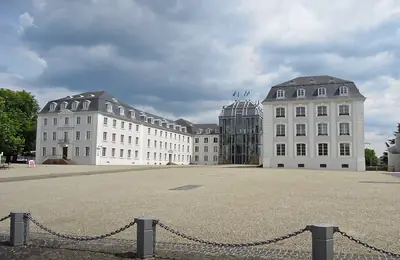
Saarbrücken Castle, or Saarbrücker Schloss, stands in Alt-Saarbrücken on the left bank of the Saar. The present Baroque château continues a much longer history on the same site: a medieval castle was followed by a Renaissance castle before the current building took shape.
The castle is one of the city’s defining landmarks and a natural starting point for exploring Saarbrücken’s historic centre. Nearby, the Schlossplatz and the former palace buildings form part of the cityscape associated with Friedrich Joachim Stengel’s Baroque Saarbrücken.
Ludwigskirche on Ludwigsplatz
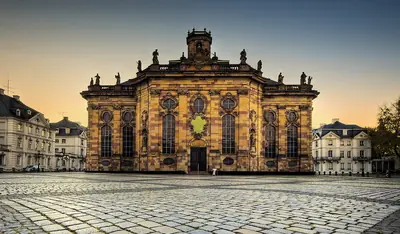
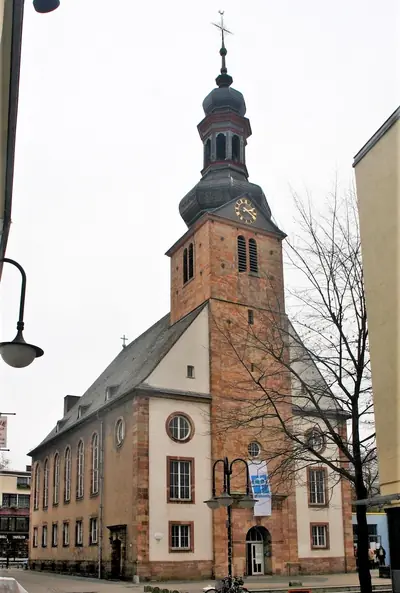
The Ludwigskirche is one of Germany’s most important Protestant Baroque churches. It stands on Ludwigsplatz and was commissioned in 1762 by Prince Wilhelm Heinrich of Nassau-Saarbrücken. Friedrich Joachim Stengel designed the church, while Prince Ludwig of Nassau-Saarbrücken completed the work; the building takes its name from him.
The church and the square belong together, making Ludwigsplatz an essential stop for anyone interested in what to see in Saarbrücken. The Ludwigskirche is often discussed alongside Dresden’s Frauenkirche and Hamburg’s St. Michael’s Church as one of Germany’s finest Protestant Baroque churches.
Saarkran Saarbrücken
On the left bank of the Saar, south of the Wilhelm-Heinrich Bridge, the Saarkran recalls Saarbrücken’s former river port. The original crane was built in 1761 and 1762 for Wilhelm Heinrich of Saarbrücken-Nassau, following plans and direction by Friedrich Joachim Stengel.
The structure now standing there is a reconstruction on the original site. It is a land-based treadwheel crane, known as a Hauskran, rather than a floating crane or crane ship. Its position beside the river makes it a particularly tangible reminder of the city’s commercial and engineering history.
St. Johann and the Marktbrunnen
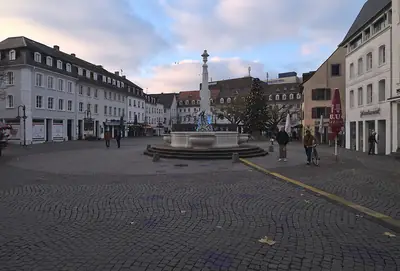
Across the river, St. Johann offers a different side of Saarbrücken’s heritage. At St. Johanner Markt, the St. Johanner Marktbrunnen, also called the Marktbrunnen, stands as an individual protected monument.
The square is also a useful base for exploring the former Old St. John’s Church. The historic church building is now part of the Saar University of Music, connecting its religious past with musical education. Its protected status makes it an important part of Saarbrücken’s built heritage.
Johanneskirche
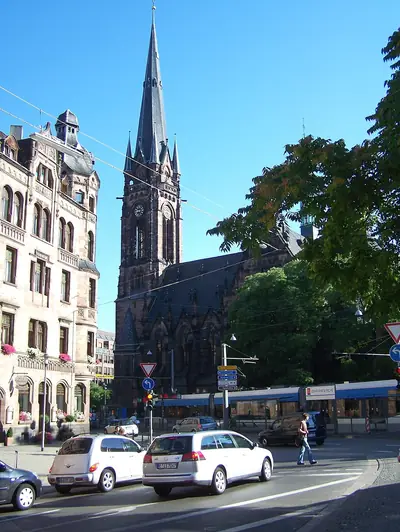
The Johanneskirche, or Citykirche Johanneskirche, is one of St. Johann’s most prominent landmarks. Its neo-Gothic tower rises 74 metres opposite the St. Johann Town Hall. Heinrich Güth designed the church, which was built between 1894 and 1898 and completed in 1898.
The Johanneskirche is listed as an individual monument in Saarland’s register of protected monuments. It also has a remarkable wartime history: although air raids destroyed much of Saarbrücken between 1942 and 1945, the church survived almost entirely without damage. Its appearance was later simplified during a postwar redesign.
Deutsch-Französischer Garten
The Deutsch-Französischer Garten, also known as the Jardin Franco-Allemand, is a landscaped park combining open-air relaxation with several entertainment facilities. It was created as part of Franco-German rapprochement and reflected the need for reconciliation after the 1955 referendum on the Saar’s future.
In that referendum, 67.7 percent of Saarland’s residents voted for reunification with Germany. The garden therefore has significance beyond its paths and open spaces: it represents a particular chapter in the relationship between Saarland, Germany and France.
St. Arnual and Christkönig-Kirche
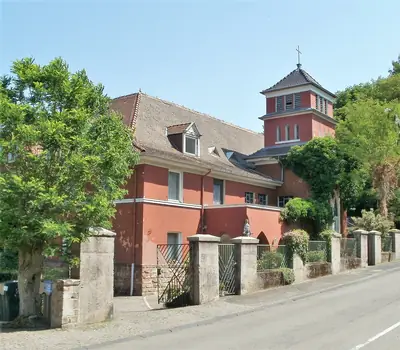
In St. Arnual, the Christkönig-Kirche is a protected Roman Catholic parish church dedicated to Christ the King. It forms part of the monument ensemble known as An der Christ-König-Kirche.
The church is especially notable for its religious imagery and its unusual architectural language. Its design combines an expressionist interpretation of Romanesque and Byzantine forms, giving the building importance in both theological and art-historical terms.
Historic churches in Saarbrücken’s districts
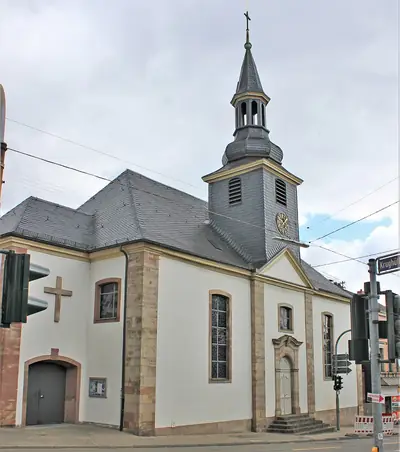
Saarbrücken’s heritage extends beyond its central landmarks. In Gersweiler, the Protestant Church is a protected historic religious building and a listed monument within the district’s built heritage. Malstatt is home to the Evangelical Church of Malstatt, a protected individual monument that once belonged to the Malstatt parish. It was formally deconsecrated on 25 May 2025.
In Brebach-Fechingen, the Stummsche Kapelle, also known as the Stumm Church or Stummsche Kirche, was commissioned by the Protestant Stumm industrial family. The former church is now used for agriculture and remains protected as an individual monument within the Stummstraße monument ensemble.
Altenkessel has St. Johannes Baptista, the Catholic Parish Church of St. John the Baptist. It is listed as an individual monument on the Saarland heritage list and serves as the parish church of St. Nicholas, created in 2013 through the combination of parishes in Altenkessel-Rockershausen.
Further historic sites
Several additional sites reveal the breadth of Saarbrücken’s architectural and religious history:
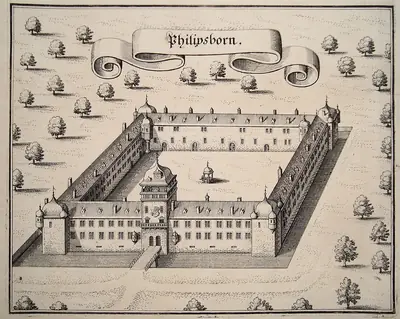
- Jagdschloss Philippsborn, also known as Jagdschloss Neuhaus, was a hunting lodge belonging to the Counts of Nassau-Saarbrücken. The original lodge was later demolished; Forsthaus Neuhaus now occupies the site.
- The former Oblatenkloster, or Rotenbühlkloster, in the residential Rotenbühl district was a Roman Catholic monastery of the Oblates of the Immaculate Virgin Mary and belonged to the Diocese of Trier.
- St. Mauritius in Alt-Saarbrücken was formerly a Roman Catholic parish church belonging to the Diocese of Trier.
Together, these places show that Saarbrücken’s story is not confined to one palace or one central square. Its districts preserve traces of princely rule, religious life, industrial families and the city’s changing institutions.
Explore Saarbrücken with a self-guided audio tour
A Saarbrücken self-guided walking tour is a practical way to connect the city’s landmarks without joining a group. Neywo’s free audio guide lets you listen as you reach each place, at your own pace, with no group and no schedule. Narration is available in 11 languages.
The app includes:
- Three walking tours
- A 1.69 km route lasting 114 minutes, with 11 narrated stops, through the Baroque centre, including the Ludwigskirche, Saarbrücken Castle and the Saarkran.
- A 2.19 km route lasting 117 minutes, with 10 stops, through St. Johann, including the former Old St. John’s Church, St. Johanner Marktbrunnen and Johanneskirche.
- A 3.58 km route lasting 105 minutes, with 9 stops, through St. Arnual, including the Stiftskirche St. Arnual and Römerkastell Saarbrücken.
- One bus route of 6.2 km and 27 minutes, with 8 narrated stops, running from the town hall to Neue Bremm.
- One bike route of 3.3 km and 16 minutes, with 3 stops, following the Saar from Johanneskirche to the Willi Graf Memorial.
Download Neywo and explore Saarbrücken
Download Neywo to turn your visit into a free audio guide through Saarbrücken. With 145 narrated places, three walking tours, one bus route and one bike route, the app lets you explore the city’s castle, churches, squares, riverfront and districts in your own time. Each story begins as you reach the place it describes, so you can stop, continue or change your route without a group or a schedule.
Saarbrücken is one destination within Germany, and Neywo makes it easy to experience its history one place at a time.
Places with an audio guide in Saarbrücken
8 places in Saarbrücken with a Neywo audio guide. Each one starts telling its story as you reach it.
Self-guided tours in Saarbrücken
5 tours in Saarbrücken, free in the Neywo app. Each stop tells its story as you reach it.
- Bike ride
Along the Saar: Johanneskirche to the Willi Graf Memorial
A short ride on Saarbrücken's cycle lanes from the Johanneskirche past the Maria-Helena theatre ship on the river, south to the memorial for the resistance fighter Willi Graf.
Johanneskirche · Maria-Helena (ship, 1911) · Willi Graf Memorial
Open this tour: Along the Saar: Johanneskirche to the Willi Graf Memorial - Bus ride
Line 109: From the Town Hall to Neue Bremm
A city bus from the St. Johann Town Hall across the Saar into Alt-Saarbrücken and south towards the French border. Ride it past the Johanneskirche, the baroque Saarkran, St. Jakob, the old Jewish cemetery and the Teutonic Knights' chapel to the memorial at the Neue Bremm Gestapo camp.
Rathaus Saarbrücken · Johanneskirche · Saarkran Saarbrücken · St. Jakob · Alter Jüdischer Friedhof · Deutschherrenkapelle Saarbrücken …
Open this tour: Line 109: From the Town Hall to Neue Bremm - Walk
Stengel's Baroque Saarbrücken: Castle, Church and the Invisible Monument
Walk through Alt-Saarbrücken, the baroque town of Prince Wilhelm Heinrich and his architect Friedrich Joachim Stengel. See the famous Ludwigskirche and its palace, the castle forecourt with its hidden memorial, two museums, a stingy baker in the palace wall, the rebuilt treadwheel crane on the Saar and the oldest bridge in Saarland.
Ludwigskirche · Palais Lüder · Altes Rathaus (Saarbrücken) · Schlossplatz · Museum am Schlossplatz · Historisches Museum Saar …
Open this tour: Stengel's Baroque Saarbrücken: Castle, Church and the Invisible Monument - Walk
St. Johann: Market Square, Basilica and Neo-Gothic Towers
Cross the river to the lively heart of St. Johann. Start at a theatre ship on the Saar, pass the opera house and the old church that now belongs to the music school, then the market fountain, Stengel's baroque basilica, a fire station turned theatre, the 1951 synagogue, the neo-Gothic Johanneskirche and town hall, and a sandstone corner house with a nightlife past.
Maria-Helena (ship, 1911) · Theater Saarbrücken · Former Old St. John's Church, Saarbrücken · St. Johanner Marktbrunnen · Basilica of St. John the Baptist, Saarbrücken · Alte Feuerwache …
Open this tour: St. Johann: Market Square, Basilica and Neo-Gothic Towers - Walk
St. Arnual: Roman Walls, a Collegiate Church and 1950s Utopias
Leave the centre for the eastern bank, where Saarbrücken's oldest layers sit beside its boldest postwar ideas. See a baroque pavilion, a women's residence and a semicircular 'vertical garden city' inspired by Le Corbusier, cross the harbour bridges to the remains of a Roman fortress and end at the collegiate church that anchors old St. Arnual.
Maltitz-Pavillon · Frauenwohnheim · Stockenbruch 10 · Daarler Brücke · East Harbour Bridge Saarbrücken · Römerkastell Saarbrücken …
Open this tour: St. Arnual: Roman Walls, a Collegiate Church and 1950s Utopias
Walk Saarbrücken with Neywo
Neywo turns Saarbrücken into a self-guided audio tour. Stories arrive as you reach the place they belong to, and the route reshapes when you wander off it.


More in Germany
Elsewhere in Germany
- Baden-BadenBaden-Württemberg
- BlaubeurenBaden-Württemberg
- Esslingen am NeckarBaden-Württemberg
- FreiburgBaden-Württemberg
- HeidelbergBaden-Württemberg
- KarlsruheBaden-Württemberg
- Kirchheim unter TeckBaden-Württemberg
- Leutkirch im AllgäuBaden-Württemberg
- StuttgartBaden-Württemberg
- TribergBaden-Württemberg
- AugsburgBavaria
- BambergBavaria