Things to Do in Blaubeuren, Germany: Walking Guide
Things to do in Blaubeuren: the Blautopf, Abbey and Swabian Jura
The best things to do in Blaubeuren include seeing the turquoise Blautopf spring, exploring Blaubeuren Abbey and discovering prehistoric sites, castle ruins and viewpoints in the surrounding Swabian Jura. This small town in Baden-Württemberg combines striking natural scenery with medieval history and some of Europe’s most important Ice Age discoveries. Neywo has a free audio guide for Blaubeuren with 11 narrated places, available in 11 languages.
What to see in Blaubeuren
The following sights bring together the town’s most important natural, historic and archaeological landmarks.
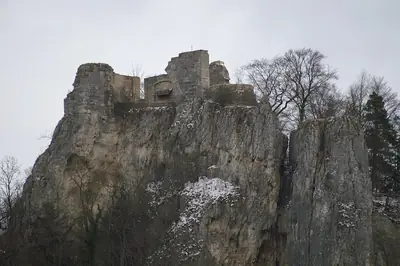
Ruine Hohengerhausen
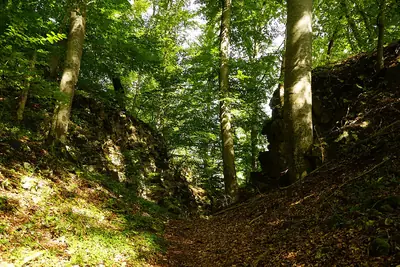
High above Blaubeuren’s Gerhausen district are the ruins of Hohengerhausen, also known locally as Rusenschloss. The remains belong to a medieval hill castle that once commanded views across the Alb-Donau region. Its elevated position makes the site part of Blaubeuren’s wider landscape of rocky heights and historic fortifications.
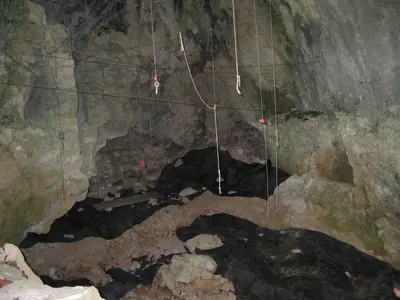
Geißenklösterle
Geißenklösterle is a modest rock shelter in the limestone cliffs of the Achtal valley, just south of Weiler. Archaeologists first investigated the site in 1963 and found evidence of human presence dating back 43,000 years.
The shelter is especially significant for its Ice Age art and music discoveries. Finds include animal figurines carved from mammoth ivory, fragments of bird-bone and mammoth-ivory flutes, and the small ivory figure known as the “Adorant”, one of the oldest known depictions of a human being. What appears to be a shallow overhang from the outside is therefore one of Europe’s most important sites for understanding early human creativity.
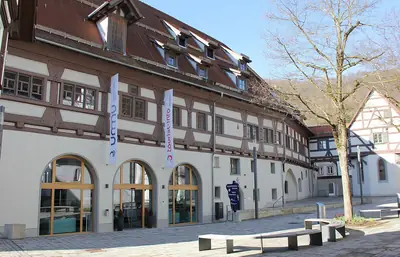
Museum für Urgeschichte und Eiszeitkunst
The Museum für Urgeschichte und Eiszeitkunst, also known as the Urgeschichtliches Museum, explores the Paleolithic period—the Old Stone Age—and the archaeological discoveries made in the caves of the Swabian Alb. As a branch of the Archaeological State Museum of Baden-Württemberg, it connects local excavations with some of the oldest figurative art known to humanity.
For anyone interested in the region’s prehistoric caves, the museum provides essential context for the objects and discoveries associated with Geißenklösterle and other nearby sites.
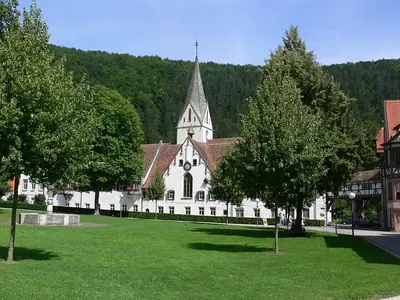
Blaubeuren Abbey
Beside the Blautopf stands Blaubeuren Abbey, a Benedictine monastery founded around 1085. Much of the complex visible today dates from an extensive reconstruction carried out between 1466 and 1501. Historical records from 1099 refer to the monastery by its Latin name, Monasterium Burensis.
The Reformation brought a major change: the monastery passed to the Dukes of Württemberg and became a Protestant seminary, a role it still fulfils. Visitors can explore three principal areas free of charge: the vaulted cloister, the monastery church and a museum on the grounds. The result is a historic complex that remains connected to active religious and educational life.
Burgrest Sirgenstein
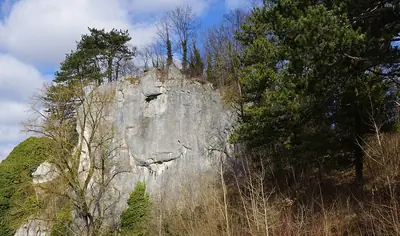
At Sirgenstein, a sheer limestone rock rises 45 metres above the valley floor. A medieval tower castle once stood on its summit, while a cave at the base of the rock had sheltered Stone Age hunters thousands of years earlier.
The castle dates from the thirteenth century. Only fragments remain, including sections of the curtain wall, a rusticated ashlar block and the deep neck ditch that once separated the fortress from the ridge behind it. The natural rock face formed much of the castle’s defence, with masonry added where the cliff was not steep enough.
Blautopf
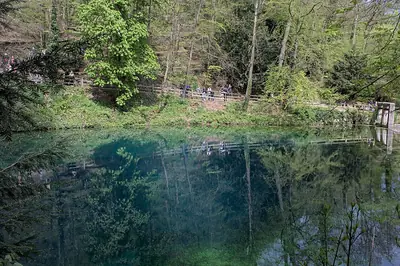
The Blautopf is Blaubeuren’s most famous sight and the source of the river Blau, which flows onwards to join the Danube. It is a karst spring, fed by water rising through the limestone landscape beneath the Swabian Jura.
Its intense colour changes with the light, shifting between deep sapphire and bright turquoise. The name means “blue pot”, an apt description of the spring’s vivid appearance. On a still day, the water can reveal depths of more than 20 metres before disappearing into the rock, offering a glimpse of the underground landscape that lies beneath Blaubeuren.
Burg Blauenstein
Burg Blauenstein was a former spur castle on the Blaufelsen above Blaubeuren. It occupied a strategic position at 654 metres above sea level, on a rocky spur protected naturally on several sides. Although the castle no longer stands intact, the site belongs to the network of elevated fortifications that shaped the history of the surrounding valleys.
Burg Ruck
The ruins of Burg Ruck, also known as Burg Rugge, are located high on the Bismarckfelsen. Like the other castle sites around Blaubeuren, the ruin reflects the area’s use of steep limestone outcrops for defence and observation.
Ruckenkreuz
The Ruckenkreuz is a memorial cross on a rocky mountain above Blaubeuren. Built to honour local people who died in the First World War, the reinforced-concrete cross was completed on 21 November 1926. It is 8.4 metres tall and 2.8 metres wide, and its position makes it visible for miles across the valley.
Pfarrkirche Mariä Heimsuchung
The Catholic Parish Church of the Visitation, Mariä Heimsuchung, stands in the heart of Blaubeuren. It serves the local Catholic community within the Ehingen-Ulm deanery of the Diocese of Rottenburg-Stuttgart.
The church is protected as a cultural monument by the State Office for Heritage Conservation in Baden-Württemberg. In November 2019, the Baden-Württemberg Heritage Foundation recognised it as its Monument of the Month.
Stadtkirche Blaubeuren
Stadtkirche St. Peter und Paul is Blaubeuren’s main Protestant church. The building is listed as a cultural monument by the Baden-Württemberg State Office for the Preservation of Monuments and forms an important part of the town’s religious and architectural heritage.
Together with the abbey, the two churches show how strongly Blaubeuren’s identity is shaped by its long religious history.
Explore Blaubeuren with a free audio guide
A Blaubeuren self-guided walking tour with Neywo lets you discover the town independently, without joining a group or following a fixed schedule. The app tells the story of each place as you reach it, at your own pace.
Neywo offers two walking tours in Blaubeuren:
- The Blue Pot and the Abbey: Blaubeuren’s Old Town — 1.63 km, 53 minutes and 6 narrated stops. It includes Burg Blauenstein, the Blautopf, Blaubeuren Abbey, Stadtkirche Blaubeuren, the Museum für Urgeschichte und Eiszeitkunst and Pfarrkirche Mariä Heimsuchung.
- Crosses, Cliffs and Castle Ruins above the Valley — 2.08 km, 53 minutes and 4 narrated stops. It includes Pfarrkirche Mariä Heimsuchung, Ruckenkreuz, Burg Ruck and Ruine Hohengerhausen.
Download Neywo to explore Blaubeuren with a free walking tour in Blaubeuren: the narration starts as you arrive at each stop, with no group and no schedule. When planning a wider trip through Germany, Blaubeuren can also be combined with other destinations in the region, including Stuttgart and Heidelberg.
Places with an audio guide in Blaubeuren
8 places in Blaubeuren with a Neywo audio guide. Each one starts telling its story as you reach it.
Self-guided tours in Blaubeuren
2 tours in Blaubeuren, free in the Neywo app. Each stop tells its story as you reach it.
- Walk
The Blue Pot and the Abbey: Blaubeuren's Old Town
Start on the rock above the Blautopf, then drop down to the impossibly blue spring that gave the town its name. Continue through the cloister of a Benedictine abbey that still runs as a school, past two churches, and finish at the museum that unlocks the Ice Age art of the Swabian Jura.
Burg Blauenstein · Blautopf · Blaubeuren Abbey · Stadtkirche Blaubeuren · Museum für Urgeschichte und Eiszeitkunst · Pfarrkirche Mariä Heimsuchung
Open this tour: The Blue Pot and the Abbey: Blaubeuren's Old Town - Walk
Crosses, Cliffs and Castle Ruins above the Valley
Climb out of town to a concrete war memorial that can be seen for miles, then follow the cliff tops to two medieval ruins. The views over the Alb-Donau landscape are the reward.
Pfarrkirche Mariä Heimsuchung · Ruckenkreuz · Burg Ruck · Ruine Hohengerhausen
Open this tour: Crosses, Cliffs and Castle Ruins above the Valley
Walk Blaubeuren with Neywo
Neywo turns Blaubeuren into a self-guided audio tour. Stories arrive as you reach the place they belong to, and the route reshapes when you wander off it.

