What to See in Baden-Baden, Germany: Free Audio Guide
Things to do in Baden-Baden: a self-guided guide to the spa town
Baden-Baden is a historic spa town in Baden-Württemberg, known for thermal waters, grand 19th-century architecture, museums and castles above the Black Forest. The best things to do in Baden-Baden range from exploring the old town and its Roman foundations to following Lichtentaler Allee and discovering the city’s art collections. Neywo’s free audio guide for Baden-Baden includes 40 narrated places.
What to see in Baden-Baden
Stiftskirche and the old town
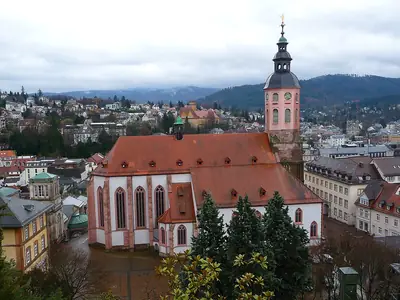
The Stiftskirche, or Collegiate Church, stands beside the cobbled Marktplatz in the heart of Baden-Baden’s old town. Its pink sandstone walls and twin onion domes make it one of the city’s most recognisable landmarks.
The church is the oldest continuously used building in Baden-Baden. It was first mentioned in 987 and has been rebuilt and extended over the centuries. Its tower combines a 13th-century Romanesque lower section with a late Gothic choir and nave added between 1453 and 1474. The Baroque onion domes followed the city fire of 1689.
The building also preserves several layers of local history: its foundations incorporate remains of the ancient Roman baths, while the choir served as the burial place of the Margraves of Baden between 1391 and 1793.
Rathaus Baden-Baden
The Rathaus occupies a building that once housed the Jesuitenkolleg, a Jesuit college and school. After the order was suppressed in the late 18th century, the building passed into civic hands. It now contains the mayor’s office and municipal administration.
Its earlier role in Catholic education gives the town hall a history that reaches beyond Baden-Baden’s spa culture.
Friedrichsbad and the Roman bath ruins
Baden-Baden’s thermal tradition reaches back to Roman times. The remains of the Roman baths, incorporated into the foundations of the Stiftskirche, are a reminder that bathing and healing have shaped the city for centuries.
Friedrichsbad represents a later chapter in that tradition. Together with the Roman ruins, it helps explain why Baden-Baden became one of Europe’s celebrated spa resorts.
Kurhaus of Baden-Baden
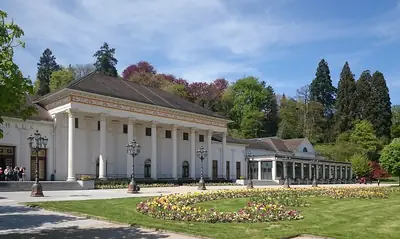
The Kurhaus is one of the city’s defining buildings and a central stop for anyone interested in Baden-Baden’s elegant resort heritage. Friedrich Weinbrenner designed the building in 1824 in a grand neo-classical style, replacing an earlier promenade house dating from 1766.
Corinthian columns frame the entrance, while a frieze of paired griffins adds a distinctive detail above it. The interiors continue the classical character. The building became internationally famous for its casino, particularly after gambling was banned in France in the mid-1830s. Among the visitors associated with its tables was Fyodor Dostoyevsky, whose losses contributed to the inspiration for The Gambler. Marlene Dietrich also spent time in these rooms.
Trinkhalle
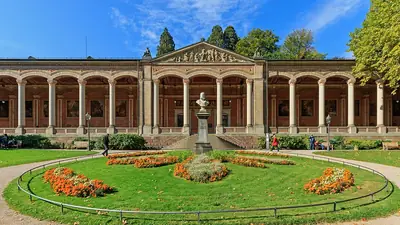
Next to the Kurhaus, the Trinkhalle completes the historic spa complex. Heinrich Hübsch designed it between 1839 and 1842. Its 90-metre open arcade is supported by 16 Corinthian columns and lined with 14 murals by Jakob Götzenberger.
The paintings depict myths, legends and excursion destinations from the surrounding region. The arcade once served as the pump room, where spa visitors gathered to drink the thermal waters. Benches remain along the arcade, preserving something of that earlier atmosphere.
Augusta Square and Goldenes Kreuz
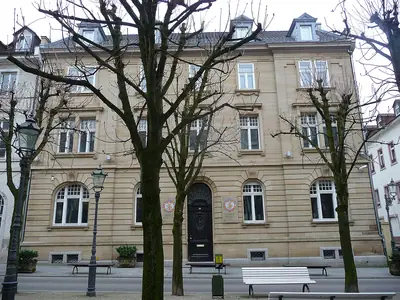
Augusta Square takes its name from Empress Augusta, a frequent 19th-century visitor whose presence contributed to Baden-Baden’s reputation as a leading spa destination. The square began as a medieval commercial suburb before becoming an elegant area of villas and stately buildings.
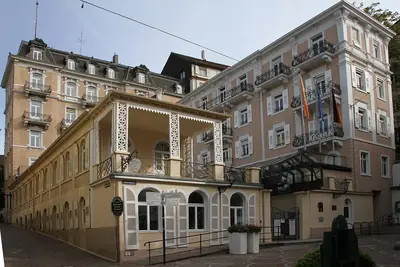
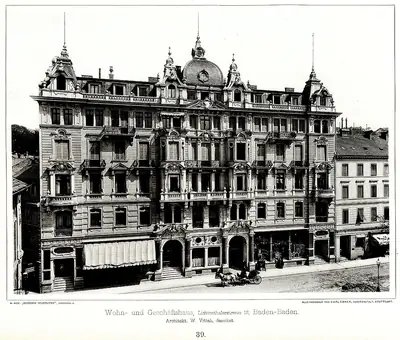
At one corner stands the Goldenes Kreuz, a five-storey building with a neo-Baroque façade. Wilhelm Vittali designed it between 1891 and 1893. Its street façade uses white sandstone from the Murgtal valley, with Swedish granite at the ground-floor entrances.
Stourdza-Kapelle
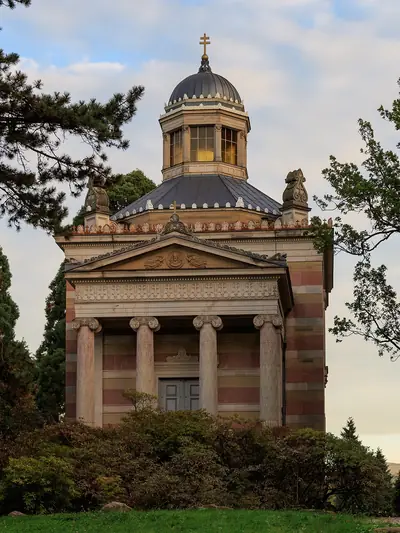
The Stourdza Chapel, also known as the Chapel of the Holy Archangel Michael, sits on the Michaelsberg. Built between 1863 and 1866, it is a Romanian Orthodox chapel in a dignified neoclassical style.
Its design is associated with Leo von Klenze and Georg von Dollmann, two important figures in German architecture.
Fabergé Museum
The Fabergé Museum is a private museum dedicated to Russian jeweller Peter Carl Fabergé and his workshop. Alexander Ivanov opened it on 9 May 2009 after acquiring and renovating the building.
The collection contains more than 1,500 objects. Its best-known piece is the Rothschild Fabergé egg, acquired at auction in London in 2007. The permanent exhibition Gold of the World, added in 2012, brings together more than 100 gold artefacts from the sixth century BC to the mid-20th century, including ancient Iranian, Greek, Aztec, Inca and British works alongside Fabergé pieces.
Museums along Lichtentaler Allee
Lichtentaler Allee brings several of Baden-Baden’s most important cultural institutions together in a park setting.
The Museum Frieder Burda opened in 2004 in a white building designed by Richard Meier. Its collection contains roughly 1,000 works from the 20th and 21st centuries, including paintings, sculptures, photographs and works on paper. The focus is on Classical Modernism and contemporary art, with a particularly important collection of Pablo Picasso’s later works.
The Staatliche Kunsthalle Baden-Baden opened in 1909. Unlike a traditional museum, it has no permanent collection of its own, allowing it to organise changing solo and thematic exhibitions in classical, modern and contemporary art.
At the Stadtmuseum, the history of Baden-Baden unfolds from its Roman beginnings to the present. Its displays focus on bathing culture and the city’s 19th-century heyday as an international spa. Specialist collections include Bohemian glass, historical toys, coins and medals. A glass pavilion houses stone monuments and sculptures from Roman times to the modern era, including late Gothic portal figures from the Stiftskirche.
Hohenbaden Castle
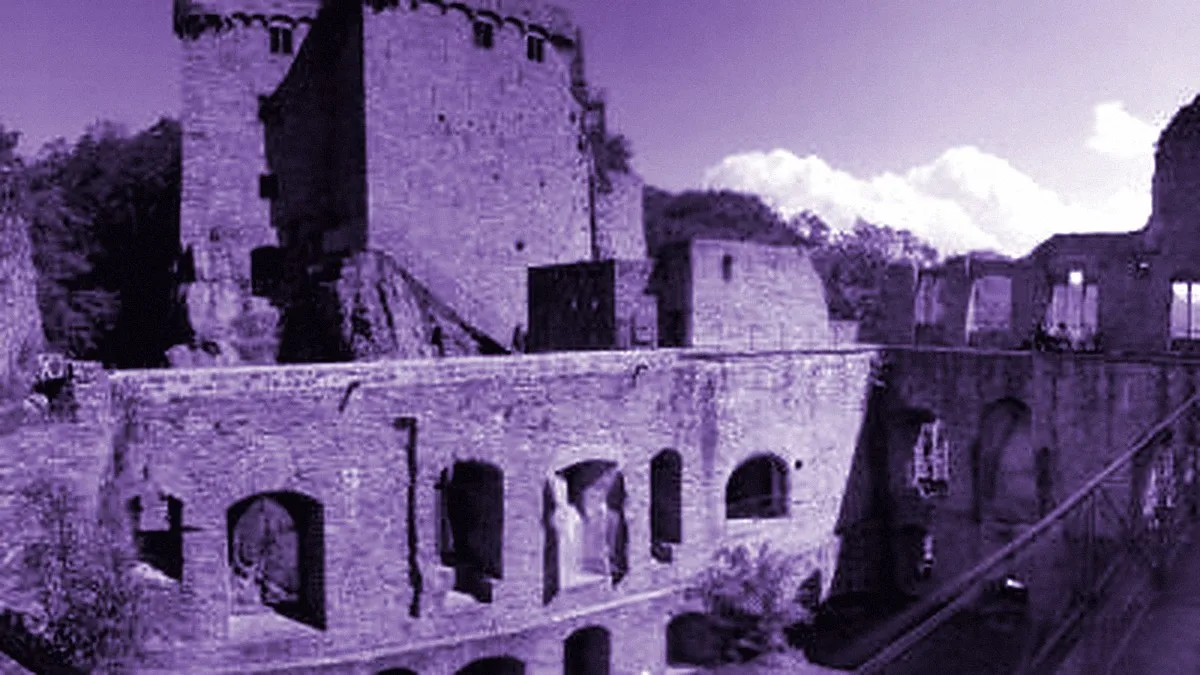
Hohenbaden Castle, known as the Old Castle, stands on Battert rock above the city. The Margraves of Baden used it as their seat for almost 400 years. Its beginnings date to around 1100, when Herman II chose the hillside for a fortress.
The complex expanded over time, including the addition of a Gothic lower castle in the early 15th century. By the late 15th century, it had more than 100 rooms. The court moved to the New Castle in 1479, and a devastating fire in 1599 left Hohenbaden in ruins.
Today, the romantic remains offer views across the Black Forest and the Rhine Valley. The castle is one of the clearest ways to connect Baden-Baden’s urban history with the landscape around it.
Neues Schloss Baden-Baden
The Neues Schloss, or New Castle, rises on the Florentinerberg above Baden-Baden. Construction began around 1388, and the site developed from a medieval fortress into a princely residence.
From the late 15th century until the end of the 17th century, it served as the seat of the Margraves of Baden. After 1535, it became the residence of the Margraves of Baden-Baden. Rebuilt and extended several times, the complex still shows the influence of different periods.
Yburg Castle and the Bernharduskirche
Yburg Castle is a medieval hilltop ruin on the Yberg at the western edge of the Black Forest. Its elevated position was chosen for defence and provides views across the Rhine Valley towards the Vosges mountains on a clear day.
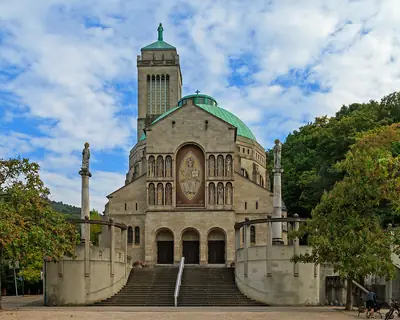
Back in the city, the Bernharduskirche adds a different architectural note. Built between 1911 and 1914, it is a Catholic church in the Jugendstil style, Germany’s version of Art Nouveau. It is dedicated to Blessed Margrave Bernhard II of Baden.
Explore Baden-Baden with Neywo
Download Neywo to follow a Baden-Baden audio guide independently. The city has 2 walking tours, 1 bus route and 1 bike route, with 40 narrated places in total:
- Romans, Margraves and the Healing Waters: a 1.59 km walk lasting 75 minutes, with 8 narrated stops.
- Casino Glamour and the Art Mile: a 2.66 km walk lasting 102 minutes, with 11 narrated stops.
- Bus 208: The Panoramic Spa Loop: a 12.9 km bus route lasting 55 minutes, with 7 narrated stops.
- Lichtentaler Allee by Bike: a 1.7 km bike route lasting 8 minutes, with 6 narrated stops.
The app tells the story of each place as you reach it, at your own pace, with no group and no schedule. Narration is available in 11 languages. When planning a wider trip through Germany, Baden-Baden also makes a useful stop alongside cities such as Karlsruhe, Freiburg and Heidelberg.
Places with an audio guide in Baden-Baden
8 places in Baden-Baden with a Neywo audio guide. Each one starts telling its story as you reach it.
Self-guided tours in Baden-Baden
4 tours in Baden-Baden, free in the Neywo app. Each stop tells its story as you reach it.
- Bike ride
Lichtentaler Allee by Bike
Lichtentaler Allee is a bicycle street where cyclists have priority. Ride it from the Kurhaus past the Burda museum and the Stadtmuseum to the Russian church, under old plane trees and along the Oos river.
Kurhaus of Baden-Baden · Goldenes Kreuz · Museum Frieder Burda · Stadtmuseum · Russian Church · St. Josef Baden-Baden
Open this tour: Lichtentaler Allee by Bike - Bus ride
Bus 208: The Panoramic Spa Loop
The city's own panoramic line starts at Augustaplatz and loops past Leopoldsplatz, the Bäderviertel and the Marktplatz up to the Neues Schloss. For the price of a bus ticket you see the Stiftskirche, the Fabergé museum, the Trinkhalle and Kurhaus quarter and the Lichtentaler Allee museums from the window.
Goldenes Kreuz · Fugue-Fougue · Stiftskirche · Fabergé Museum · Trinkhalle Baden-Baden · Theater Baden-Baden …
Open this tour: Bus 208: The Panoramic Spa Loop - Walk
Romans, Margraves and the Healing Waters
Climb from the Margraves' New Castle to the thousand-year-old Stiftskirche, then drop down to the Roman soldiers' baths and the Friedrichsbad that still keeps the ritual alive. Fabergé treasure, the old town hall and the Goldenes Kreuz close a compact circuit through the oldest quarter of the spa town.
Neues Schloss Baden-Baden · Stiftskirche · Roman bath ruins, Baden-Baden · Friedrichsbad · Spitalkirche Baden-Baden · Fabergé Museum …
Open this tour: Romans, Margraves and the Healing Waters - Walk
Casino Glamour and the Art Mile
Gamblers once lost fortunes here, and Dostoyevsky wrote a novel about it. Walk from the Stourdza Chapel past the Trinkhalle arcade and Kurhaus, then along Lichtentaler Allee's museums, from Richard Meier's white Burda museum to the Russian church with its golden dome.
Stourdza-Kapelle · Trinkhalle Baden-Baden · Kurhaus of Baden-Baden · Theater Baden-Baden · Philemon and Baucis · Museum für Kunst und Technik des 19. Jahrhunderts …
Open this tour: Casino Glamour and the Art Mile
Walk Baden-Baden with Neywo
Neywo turns Baden-Baden into a self-guided audio tour. Stories arrive as you reach the place they belong to, and the route reshapes when you wander off it.

