Rethymno, Greece: Self-Guided Walking Tour
Things to do in Rethymno: what to see in the historic city
The best things to do in Rethymno include exploring its Venetian and Ottoman landmarks, visiting historic monasteries, and discovering archaeological sites across the surrounding region. The city’s old town brings several centuries of history together in a compact area, while the wider Rethymno district offers fortresses, churches, museums, and ancient settlements. Neywo has a free audio guide for Rethymno with 32 narrated places.
Rethymno is one of the distinctive historic cities of Crete. It has been inhabited since antiquity and is believed to have developed on the site of the earlier city of Rhithymna. Its present-day character was shaped particularly by Venetian rule, while Ottoman-era buildings add another important layer to the town.
What to see in Rethymno
Rethymno’s Old Town
Rethymno’s old town is the natural place to begin exploring. Its streets preserve the atmosphere of the city’s Venetian period, while buildings and monuments also reveal the later Ottoman presence. The historic center is not an isolated monument: it remains part of the city, with its streets and buildings forming the setting for everyday life.
Among the most important landmarks are the Fortezza, historic fountains, Orthodox churches, and former mosques. Together, they show why Rethymno is known as the City of Letters and why its history is so visible in the urban landscape.
Fortezza of Rethymno
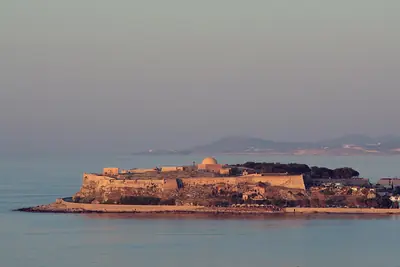
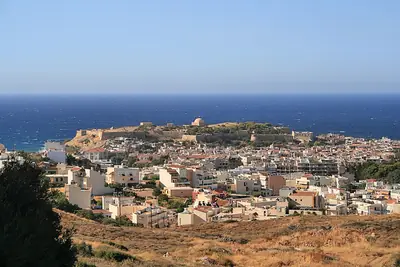
The Fortezza is a fortified citadel on a hill beside the sea and the old town. The Venetians built it in 1573 as the fortified acropolis of Rethymno. Its name comes from the Italian word for fortress.
The Ottomans captured the citadel in 1646, beginning another chapter in its history. Houses were later built inside the acropolis, but many were demolished after the Second World War. The historic buildings that remain are enclosed within a citadel that is now in good condition and open to the public.
Church Megali Panagia
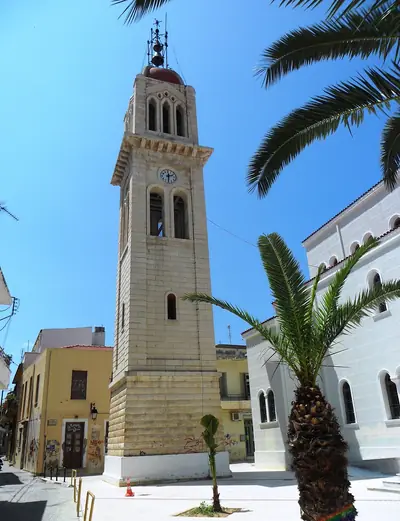
Church Megali Panagia is Rethymno’s Orthodox cathedral. Its full name refers to the Presentation of the Virgin Mary in the Temple, and it serves as the cathedral of the Metropolis of Rethymno and Avlopotamos.
The cathedral is a three-aisled basilica on the square that bears its name. The central aisle is dedicated to the Presentation of the Virgin Mary in the Temple, the northern aisle to the Three Hierarchs, and the southern aisle to the Holy Apostles. Construction began in 1844 and ended in 1856. Its bell tower was added in 1899.
The building was heavily damaged by bombing during the Second World War, demolished in 1956, and rebuilt during the 1960s. The cathedral now measures 32.5 meters in length and 13.3 meters in width. Its bell tower reaches 23.3 meters.
Rimondi Fountain
In Rimondi Square, the Rimondi Fountain is one of the most distinctive surviving monuments from Venetian Rethymno. It was built around 1626 and named after Alvise Rimondi, the city’s governor at the time. His family crest remains visible above the monument.
Four Corinthian columns support an entablature with part of a Latin dedication. The surviving words refer to generosity and springs. Water once flowed through three openings between the columns, each decorated with a lion’s head.
Kara Musa Pasha Mosque
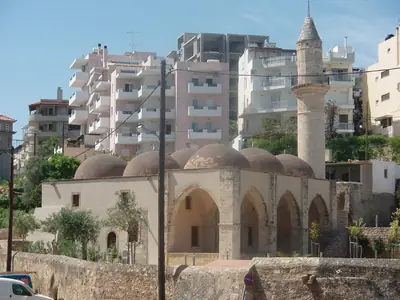
The Kara Musa Pasha Mosque preserves a visible chapter of Rethymno’s Ottoman-era history. It was built after the Ottoman conquest of the city in 1646 and named for Kara Musa Pasha, who commanded the conquering fleet.
Before the Ottoman period, the site was occupied by a monastery dedicated to Saint Barbara. The building is crowned by one large dome and three smaller domes. The ruins of its former minaret remain, while a nearby domed fountain has an entrance beneath its canopy leading into the mosque courtyard.
Veli Pasha Mosque
The former Veli Pasha Mosque, also known as the Mastaba Mosque, now houses the Paleontological Museum of Rethymno. The building dates from around the middle of the seventeenth century, shortly after Rethymno came under Ottoman rule, and replaced an earlier Venetian Catholic church dedicated to Saint Onuphrius.
Its square plan and roof with nine domes give it a distinctive appearance. The minaret, added around 1789 or 1790, is the oldest surviving minaret in Rethymno.
Arkadi Monastery
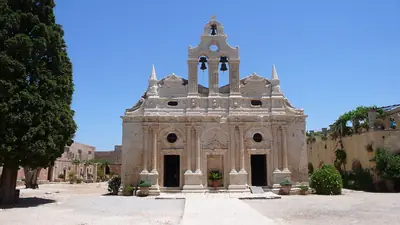
About 23 kilometres southeast of Rethymno, near the community of Amnatos, Arkadi Monastery is one of Crete’s most powerful symbols of resistance. Its thick defensive walls surround a site where religious life, learning, art, and history developed together.
The monastery’s earliest form may date either to the years between 961 and 1014 or to the first years of Venetian rule. By the sixteenth century, it had become a center of science and art, with a school and a rich library. Its katholikon, or main church, dates from the sixteenth century and combines Renaissance influence with Roman and Baroque elements.
Arkadi is especially remembered for the Cretan revolt of 1866, when 943 Greeks, most of them women and children, sought refuge in the monastery. After three days of fighting and faced with the prospect of surrender, the defenders followed the abbot’s order to ignite the powder magazine.
Museum of Ancient Eleutherna
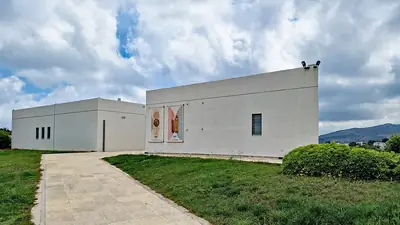
The Museum of Ancient Eleutherna stands within the archaeological park of Eleutherna in the Rethymno region. Its collections bring together discoveries from the nearby ancient city and the necropolis of Orthi Petra.
The modern building covers about 1,800 square metres and is arranged in three halls. Construction began in 2012, and the museum opened in 2016. It was the first museum building in Crete to operate directly in connection with an archaeological site, allowing visitors to continue from the galleries into the archaeological park.
Ancient Lappa
Near the modern village of Argyroupoli, Ancient Lappa is the site of an ancient Cretan city. Lappa was a city and city-state, or polis, on the island of Crete. The site offers another way to explore the region’s history beyond the monuments of Rethymno itself.
Monasteries around Rethymno
Several monasteries add depth to a journey through the Rethymno district.
The Monastery of Agia Irini stands on the slopes of Mount Vrysinas, in the village that bears its name. This Orthodox nunnery is dedicated to Saint Irene and is considered one of Crete’s oldest monasteries. Founded during the island’s second Byzantine period, before 1204, it was first recorded with certainty in 1362. Its fortified complex includes the newer Church of Saint Irene, a chapel dedicated to Raphael, Nicholas, and Irene, monks’ cells, an olive press, workshops, and a monastery museum.
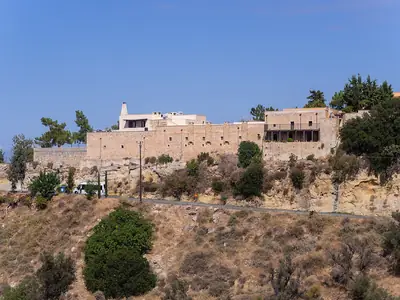
Chalevi Monastery lies on a hill near Chromonastiri. The monastery complex was completed during the sixteenth century and remained active until near the end of the Ottoman occupation of Crete. Today, only its principal church, the katholikon, survives.
Moni Arseniou is an Orthodox monastery dedicated to Saint George, near the village of Pagkalochóri. It is believed to have been founded in the latter half of the sixteenth century. Its katholikon has a cross-shaped plan and a dome, with a carved wooden iconostasis and wall paintings created between 1987 and 1990. The monastery also contains an ecclesiastical museum with religious objects and old manuscripts.
Near Roustika, Moni Prodromou Ilia is a fortified Orthodox monastery dedicated to the Prophet Elijah. Its fortress-like architecture is its defining feature.
In Myriokefala, the Myriokefalon Monastery, also known as the Monastery of Antifonitria, remains one of the region’s principal pilgrimage sites. Its katholikon dates from the Byzantine period and was built around 1020 by John Xenos. The cross-shaped church has a dome, while surviving wall paintings date from the eleventh, twelfth, and fourteenth centuries. The other monastery buildings date from the eighteenth and nineteenth centuries.
Bonriparo Fort
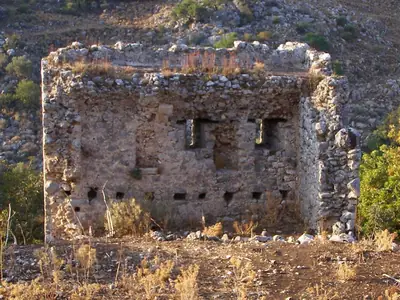
Bonriparo Fort, also known as Bonriparo, Monopari, Kastelos, or Κάστελος, is a medieval fort in Crete. It offers a glimpse into the island’s fortified past and complements the larger citadel of the Fortezza in Rethymno.
Explore Rethymno with a free audio guide
For a Rethymno self-guided walking tour, download Neywo and explore the city at your own pace. The app has one walking tour: a 2.15-kilometre route lasting 112 minutes, with 12 narrated stops. It covers landmarks including Veli Pasha Mosque, Kara Musa Pasha Mosque, Church Megali Panagia, Rimondi Fountain, the Fortezza of Rethymno, and other historic sites in the old town.
Each story plays as you reach the place, so you can walk without a group and without a schedule. Neywo’s narration is available in 11 languages. Download the app and discover Rethymno’s Venetian streets, Ottoman domes, churches, and fortress with the city’s story unfolding around you.
Places with an audio guide in Rethymno
8 places in Rethymno with a Neywo audio guide. Each one starts telling its story as you reach it.
Self-guided tours in Rethymno
1 tour in Rethymno, free in the Neywo app. Each stop tells its story as you reach it.
- Walk
Venetian Stone and Ottoman Domes: Rethymno's Old Town
Rethymno kept both of its conquerors' fingerprints. This walk starts among the domed mosques south of the old town, threads through the lanes of the Venetian quarter past its fountain, churches and conservatory-turned-mosque, and ends inside the Fortezza, the 1573 citadel above the sea. Twelve stops, flat and easy, with the best views saved for the last.
Veli Pasha Mosque · Kara Musa Pasha Mosque · Four Martyrs Church of Rethymno · Valide Sultana Mosque (Rethymno) · Church of Agia Varvara, Rethymno · Church Megali Panagia …
Open this tour: Venetian Stone and Ottoman Domes: Rethymno's Old Town
Walk Rethymno with Neywo
Neywo turns Rethymno into a self-guided audio tour. Stories arrive as you reach the place they belong to, and the route reshapes when you wander off it.

