Shillong, India: Self-Guided Walking Tour
Things to Do in Shillong: What to See in Meghalaya’s Hill Capital
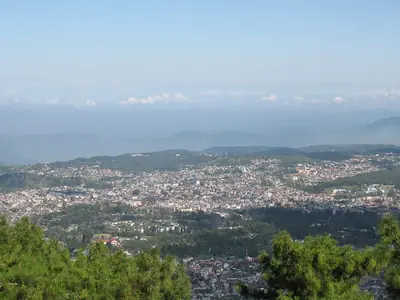
Looking for things to do in Shillong? Meghalaya’s capital is a mountain city in the Khasi Hills, set at roughly 1,500 metres above sea level and known for pine forests, waterfalls, streams, and a strong local identity. Its history, religious landmarks, and position at the centre of East Khasi Hills make it a worthwhile place to explore in northeast India.
Shillong has a free Neywo audio guide with 5 narrated places. You can listen as you walk, with each story playing when you reach the place.
What to See in Shillong
Shillong’s history in the Khasi Hills
Shillong became a civil station for the Khasi and Jaintia Hills in 1864. Ten years later, it was selected as the headquarters of the newly formed Chief Commissioner’s Province of Assam. Its location between the Brahmaputra and Surma rivers, along with its cooler mountain climate, helped make it an important administrative centre.
The city remained the capital of undivided Assam until Meghalaya became a separate state on 21 January 1972. Shillong is now both the capital of Meghalaya and the administrative headquarters of East Khasi Hills district. The district itself was created from the Khasi Hills on 28 October 1976 and was later reduced when parts of it were used to form Ri-Bhoi district.
Shillong’s past also includes a major natural disaster. An earthquake destroyed the city in 1897, after which it was rebuilt.
Pine forests, waterfalls and mountain streams
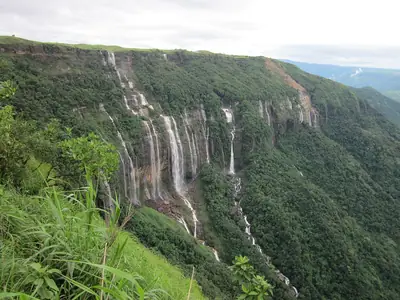
The natural setting is one of the defining reasons to visit Shillong. The city stands among the Khasi Hills, surrounded by pine forests, waterfalls, and mountain streams. The wider region is associated with heavy rainfall and forested slopes, giving the capital a cool mountain character.
The landscape also connects Shillong to the wider story of Meghalaya, whose name means “the abode of clouds.” The state lies between Assam and Bangladesh and includes the Khasi Hills, Jaintia Hills, and Garo Hills. It became a separate Indian state on 21 January 1972.
Meghalaya is also known for its distinctive cultural and natural heritage. A speleothem from Mawmluh Cave was chosen as the boundary marker for the Meghalayan stage, the late part of the Holocene epoch, recording evidence of a worldwide climate event around 2250 BCE.
Cathedral of Mary Help of Christians
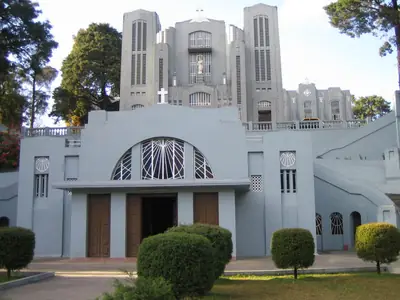
The Cathedral of Mary Help of Christians is the cathedral church of the Roman Catholic Archdiocese of Shillong and the seat of the Metropolitan Archbishop. It is also the principal church serving the Catholic community across the archdiocese.
Built more than 85 years ago, the cathedral remains an important religious landmark in the city. The archdiocese covers East Khasi Hills and Ri-Bhoi and includes 49 church districts, or parishes. The cathedral visit also includes the Grotto Chapel, another place to look out for within the grounds.
Grotto Chapel
The Grotto Chapel forms part of the Cathedral of Mary Help of Christians visit. Its inclusion gives visitors another place to explore within one of Shillong’s most significant Catholic sites.
Together, the cathedral and chapel reflect the religious importance of Shillong and the wider archdiocese. They are also among the city’s most notable places for understanding its institutional and community life.
Madina Mosque
Madina Mosque is a striking four-storey building defined by glass. It is recognised as India’s only glass mosque and is reputed to be the first of its kind in Asia. The building is the largest mosque in Meghalaya and one of the largest in northeast India.
Its glass dome and glass minarets give the mosque a bright, distinctive appearance. The prayer arrangements can accommodate more than two thousand worshippers for congregational prayers.
The congregation began in 2008 with a prayer hall at the Idgah that welcomed both male and female worshippers. The mosque opened on 18 October 2012, with its opening and inauguration involving Sayeedullah Nongrum, Salman Khurshid, Shamim Akhtar, and Vincent Pala.
East Khasi Hills and the wider region
Shillong is best understood as part of East Khasi Hills rather than as an isolated city. The district headquarters and the Meghalaya capital share the same urban centre, while the surrounding area connects the city to forested hills, local trade, and the cultural traditions of the Khasi region.
Products associated with the wider area include oranges, cotton, and potatoes. This setting gives Shillong a close relationship with the landscapes and communities around it, from the hill environment to the state’s wider identity as Meghalaya, “the abode of clouds.”
Explore Shillong with Neywo
Neywo’s free audio guide lets you explore Shillong independently. It includes 5 narrated places, with each story playing as you reach the place. You can walk at your own pace, without joining a group or following a schedule, and narration is available in 11 languages.
Download Neywo before exploring the city and let the app tell you the story of each place as you arrive. It is a simple way to discover Shillong’s history, religious landmarks, and mountain setting while keeping your route flexible.
Places with an audio guide in Shillong
4 places in Shillong with a Neywo audio guide. Each one starts telling its story as you reach it.
Walk Shillong with Neywo
Neywo turns Shillong into a self-guided audio tour. Stories arrive as you reach the place they belong to, and the route reshapes when you wander off it.

