Kintamani, Indonesia: Self-Guided Walking Tour
Things to do in Kintamani: volcanoes, temples and Lake Batur
The best things to do in Kintamani are centred on Mount Batur, Lake Batur and the sacred traditions of Bali’s highlands. This dramatic volcanic district combines caldera landscapes, living Hindu temples, geological history and the remarkable Subak water-management system. Neywo has a free audio guide for Kintamani with six narrated places, so you can explore while learning the stories behind what you see.
Kintamani is part of Bali, in Indonesia’s Bangli Regency. It is particularly well known for the landscape formed by Mount Batur and its surrounding caldera, as well as for the cultural importance of water, agriculture and worship in the region.
What to see in Kintamani
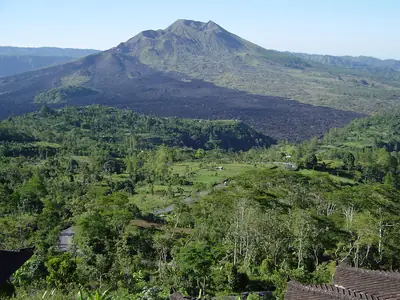
Mount Batur
Mount Batur is one of Bali’s iconic active volcanoes. It rises about 700 metres above Lake Batur, which occupies the southeastern part of a vast volcanic caldera measuring roughly 10 by 13 kilometres. Inside it lies a smaller caldera, about 7.5 kilometres wide.
These enormous depressions were created when the volcano’s magma chamber collapsed. The larger collapse took place around 29,300 years ago, while the inner caldera collapsed again roughly 20,150 years ago. Some estimates associate the formation of the inner caldera with the Bali ignimbrite eruption, between about 23,670 and 28,500 years ago.
Mount Batur’s first documented eruption was in 1804, and its most recent eruption was in 2000. Since the first recorded event, it has been frequently active, with mild to moderate explosive activity and, at times, lava flows. Basaltic lava from summit vents and the volcano’s flanks has reached the caldera floor, helping to shape the dark, rugged landscape around the mountain.
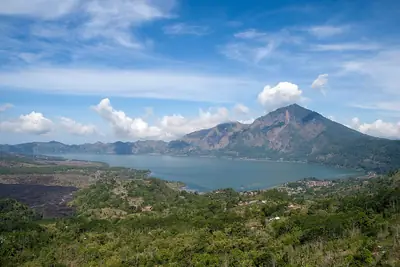
Lake Batur
Lake Batur, also known locally as Danu Batur, is the largest lake in Bali. It lies inside Mount Batur’s caldera, at an elevation of roughly 1,050 metres above sea level, and covers about 16 square kilometres.
The altitude gives the lake area a cooler climate than many other parts of the island. Around the shoreline, the landscape includes lush vegetation, Bukit Sari, Gunung Abang and several smaller hills. The lake sits on the southeastern side of Mount Batur and is about 30 kilometres northeast of Ubud, making it a popular destination for a day trip from there.
Lake Batur is also central to the spiritual identity of the area. Pura Ulun Danu Batur is dedicated in part to Dewi Danu, the goddess associated with the lake, while the surrounding agricultural traditions reflect the importance of water in Balinese life.
Pura Ulun Danu Batur
Pura Ulun Danu Batur is one of Bali’s most important temples. It belongs to the Pura Kahyangan Jagat, a group of nine temples believed to maintain the harmony and stability of the island.
The temple represents Bali’s northern direction and is dedicated to Vishnu and Dewi Danu, the goddess of Lake Batur. Its original complex was destroyed during an eruption of Mount Batur before being rebuilt in its present location in 1926.
This remains a living place of worship rather than simply a historic monument. During the full moon of the tenth month, known as Purnama Kadasa, special ceremonies honour Dewi Danu. The temple offers an important way to understand how the volcanic landscape, the lake and Balinese Hindu belief are connected.
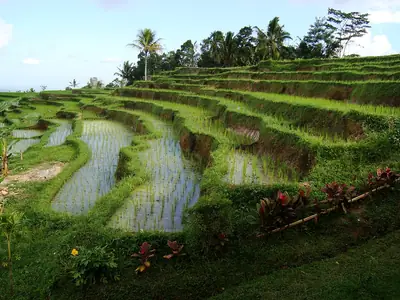
Subak
Subak is Bali’s traditional system for managing the water that feeds its rice paddies. It is more than an irrigation network: it is a community organisation shaped by the principle of Tri Hita Karana, which emphasises harmony between people, nature and the spiritual world.
The system dates back to the 9th century and has continued as a form of agricultural cooperation for more than a thousand years. Subak covers nearly 20,000 hectares of terraced rice fields across Bali. Farmers coordinate the distribution of water while also maintaining a network of religious practices connected to the land.
Each Subak has its own temple, often called Pura Uluncarik or Pura Bedugul, dedicated to Dewi Sri, the goddess of prosperity and fertility. These temples form the spiritual heart of the system. Seeing Subak in the context of Kintamani helps explain why water is both a practical resource and a sacred part of the island’s culture.
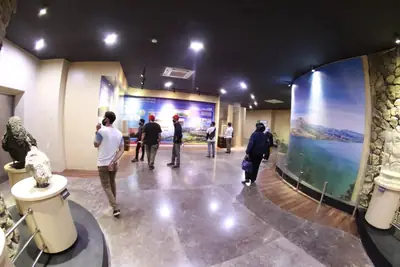
Batur Geopark Museum
The Batur Geopark Museum stands on the southern shore of Mount Batur, along Jalan Raya Penelokan in Kintamani. Its exhibitions explain the volcanic and geological forces that created the surrounding landscape, as well as information about geoparks in Indonesia and around the world.
The museum was originally known as the Mount Volcano Museum. It was later developed through cooperation between Indonesia’s geological and volcanology authorities and the Bangli Regency government. The foundation stone was laid on March 26, 2004, and the museum was officially inaugurated on May 10, 2007.
Set on a plot of approximately 1.09 hectares, the museum provides useful context before or after visiting the volcano and lake. Its displays connect the visible landscape of Kintamani with the geological processes that formed it.
Pura Puncak Penulisan
Pura Puncak Penulisan is a temple in Sukawana and a place of quiet spiritual significance. It is a living place of worship, so its atmosphere is defined by tradition and devotion rather than by exhibits or formal interpretation.
A visit adds another dimension to Kintamani’s cultural landscape. Alongside the major temple dedicated to Dewi Danu, Pura Puncak Penulisan shows how sacred places are woven into the highland environment and remain part of everyday religious life.
Explore Kintamani with Neywo
Download Neywo’s free Kintamani audio guide and discover six narrated places around the district. The app tells the story of each place as you reach it, at your own pace, with no group and no schedule. Narration is available in 11 languages, making it an easy way to explore Kintamani independently while connecting its volcanoes, lake, temples and traditions.
Kintamani is one of the places that reveals a different side of Indonesia: a landscape where geology, agriculture and spirituality are closely linked. If your trip continues elsewhere on the island, you can also explore Denpasar, Canggu or Lovina with Neywo.
Places with an audio guide in Kintamani
4 places in Kintamani with a Neywo audio guide. Each one starts telling its story as you reach it.
Walk Kintamani with Neywo
Neywo turns Kintamani into a self-guided audio tour. Stories arrive as you reach the place they belong to, and the route reshapes when you wander off it.

