Visiting Jakarta, Indonesia: Top Sights on Foot
Things to Do in Jakarta: What to See in Indonesia’s Capital
Jakarta is Indonesia’s capital, a vast city where national history, religious landmarks, colonial heritage, museums and modern urban life meet. The best things to do in Jakarta range from exploring Old Batavia and its canals to visiting the National Monument, discovering Indonesian collections and seeing how different traditions shape the city. Neywo offers a free audio guide for Jakarta with 168 narrated places.
What to See in Jakarta
Merdeka Square and the National Monument
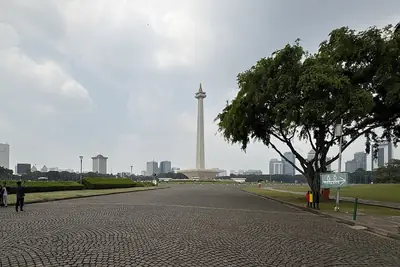
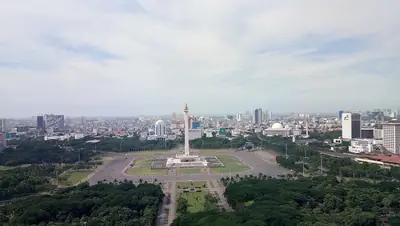
Begin with Merdeka Square, one of Jakarta’s great open spaces. Known in Indonesian as Medan Merdeka, the square surrounds the National Monument, or Monumen Nasional, usually called Monas. Its central paved area has hosted national events, military and float parades, and civic demonstrations, while the surrounding park gives residents a place to exercise and relax.
The National Monument rises 132 metres from the centre of the square. Construction began on 17 August 1961 under President Sukarno, and it opened to the public in 1975 during the presidency of Suharto. Its gold-leaf-covered flame represents the burning spirit of the Indonesian people’s struggle for independence. The site also includes St John church, a former Armenian church in Jakarta.
Look for the musical fountain and the deer enclosure in the southeast corner of Merdeka Square. The square has had several names: during the Dutch East Indies period, it was Koningsplein, or King’s Square; it later became known as Medan Merdeka and Lapangan Merdeka.
The National Museum of Indonesia
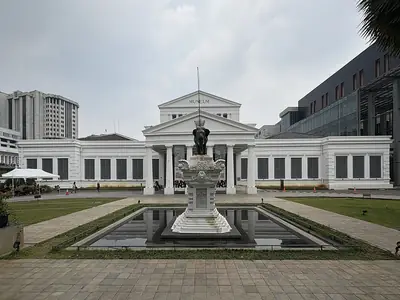
The National Museum of Indonesia, also known as Museum Nasional or the Elephant Museum, offers a broad introduction to the country’s heritage. Its collections cover archaeology, history, ethnology and geography, with about 141,000 objects ranging from prehistoric artefacts to coins, ceramics and ethnographic material.
The elephant statue in the forecourt explains the museum’s nickname and is an easy feature to spot before entering. Inside, stone statues from the classical Hindu and Buddhist periods of ancient Java and Sumatra stand alongside extensive collections of Asian ceramics. The museum has worked to preserve Indonesia’s archaeological, historical and cultural record for two centuries.
Istiqlal Mosque and Jakarta Cathedral
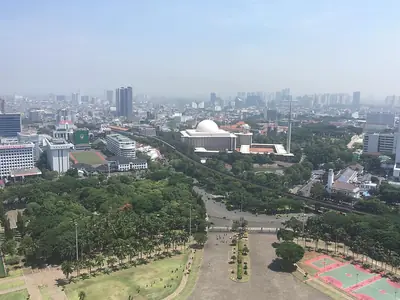
Two major religious buildings stand side by side near Merdeka Square: Istiqlal Mosque and Jakarta Cathedral. Istiqlal is Indonesia’s national mosque and the largest mosque in Southeast Asia. Its name comes from the Arabic word for independence, reflecting its role as a monument to Indonesian independence.
The mosque was designed by Friedrich Silaban in a formalist and international architectural style. Marble covers its walls and floors, while geometric stainless-steel ornaments add detail. The main building has five floors and one basement level, a 45-metre-diameter dome supported by twelve columns, and a minaret reaching 96.66 metres. The foundation stone was laid by Sukarno on 24 August 1961, and the mosque opened to the public on 22 February 1978.
Jakarta Cathedral, officially the Church of Our Lady of the Assumption, provides a striking contrast. Its present building was consecrated in 1901 and follows the neo-Gothic architecture of Europe. It replaced an earlier church inaugurated in 1810, which burned down in 1826. The cathedral is noted for its resemblance to Saint Peter and Saint Paul’s Church in Ostend, Belgium.
Kota Tua and the Jakarta History Museum
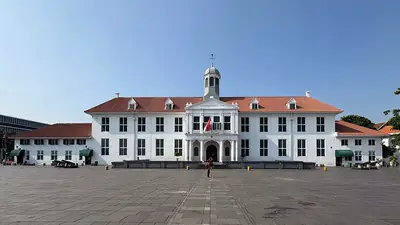
Kota Tua, Jakarta’s Old Town, preserves some of the city’s clearest links with Batavia. The Jakarta History Museum stands on the south side of Fatahillah Square in the former city hall of Batavia. Built in 1710 as the Stadhuis, the building is believed to have been modelled on Dam Palace.
Its collections cover the region’s prehistoric period, the founding of Jayakarta in 1527 and Dutch colonisation from the sixteenth century until Indonesian independence in 1945. The museum’s position on Fatahillah Square makes it a natural starting point for exploring the historic district.
The Wayang Museum stands alongside it. The building began as the Dutch church known as the oude Hollandsche Kerk, erected by the VOC in 1640. After an earthquake destroyed it in 1808, the rebuilt structure opened as the Batavia Museum in 1939. It became the Wayang Museum in 1975.
Around 6,000 puppets represent traditions from across Indonesia, including Surakarta, Yogyakarta, Cirebon, Sunda, Betawi, Banyumas and Banjarmasin. The collection also includes puppets from Europe, India, America, Cambodia and Thailand. Look for wayang kulit, flat leather shadow puppets; wayang beber, painted scroll figures; wayang golék, three-dimensional wooden puppets; and wayang klitik, thin wooden figures. A puppet depicting the proclamation of independence shows Bung Karno and Bung Hatta.
Toko Merah and the old canal district
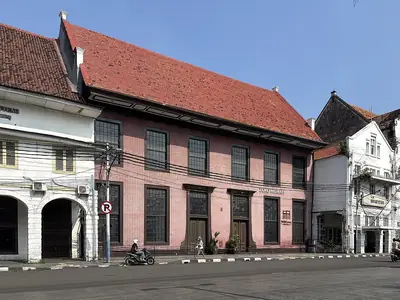
Toko Merah, or the Red Shop, is one of Jakarta’s oldest surviving buildings. It has stood beside the Kali Besar canal since 1730, when the waterway was the commercial artery of Batavia. Its deep red façade remains one of the most distinctive sights in the old harbour district.
The building’s history also includes a maritime connection: William Bligh, the captain of HMS Bounty, was one of its famous guests during his time in the Dutch East Indies.
The Maritime Museum and Sunda Kelapa
Near the old Sunda Kelapa harbour, the Maritime Museum occupies former Dutch East India Company warehouses. Its collections explore Indonesia’s relationship with the sea, including maritime life, fishing and the importance of the ocean to the country’s economy.
Among the displays are fishing-boat models and objects from different parts of Indonesia. The Pinisi schooners of the Bugis people of South Sulawesi are especially notable: they represent one of the last sea-going sailing fleets in the world. The museum was inaugurated in 1977. In January 2018, much of it was destroyed by a fire caused by an electrical short circuit.
More museums and landmarks
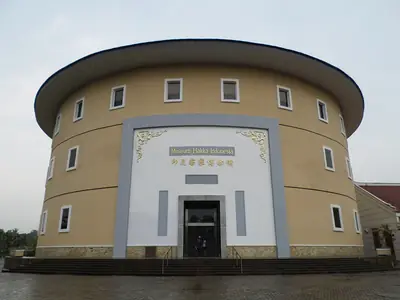
Jakarta’s cultural attractions continue beyond its central historic districts. At Taman Mini Indonesia Indah, the Indonesian Hakka Museum presents the history and heritage of the Hakka people of Indonesia.
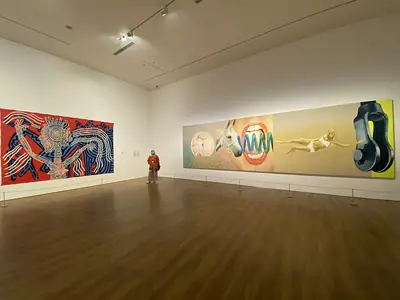
Museum MACAN, the Museum of Modern and Contemporary Art in Nusantara, opened in November 2017. It was the first museum in Indonesia to hold a collection devoted to both modern and contemporary Indonesian and international art. Its galleries cover about 4,000 square metres within a total floor area of 7,107 square metres.
The Textile Museum, or Museum Tekstil, introduces the variety of textiles made across Indonesia’s many islands. It opened in 1976 in an old building on Jalan K.S. Tubun in South Jakarta’s Palmerah district.
At Lapangan Banteng, the West Irian Liberation Monument commemorates the Trikora fighters and the people of West Irian who chose to become part of the Republic of Indonesia. The postwar modernist monument is a 35-metre bronze statue commissioned by President Sukarno in 1963.
The National Library of Indonesia is another distinctive landmark near Merdeka Square. Its new library services building rises 126.3 metres and has 24 floors, as well as three underground parking levels. Inaugurated in 2017, it belongs to the institution established in 1980 through the merger of four libraries.
For football and major sporting events, Gelora Bung Karno Main Stadium forms part of the Gelora Bung Karno Sports Complex. The stadium opened in 1962 and has hosted football matches, including games involving the Indonesia national football team and Persija Jakarta. Its name honours Soekarno, Indonesia’s first president.
Explore Jakarta with Neywo
A Jakarta self-guided walking tour is an easy way to connect the city’s landmarks without joining a group. Neywo’s free audio guide includes three walking tours and one bus route, with narration available in 11 languages. Each story plays as you reach the place, at your own pace: no group and no schedule.
The Jakarta tours are:
- Old Batavia: Harbour, Castle, Canals and Dutch Banks — a 3.16 km walk lasting 109 minutes, with 11 narrated stops.
- Merdeka Square: Independence, Faith and the National Museum — a 2.92 km walk lasting 105 minutes, with 8 narrated stops.
- Menteng: The Houses of Independence — a 4.66 km walk lasting 107 minutes, with 8 narrated stops.
- Transjakarta 5C: From Kramat to the National Museum — a 4.3 km bus route lasting 18 minutes, with 4 narrated stops.
Download Neywo to explore Jakarta with its story playing as you arrive at each place. You choose the pace, the route and the stops, while the app provides the context of the city around you. When your travels continue through Indonesia, the same audio-guide approach can help you discover more of the country’s cities.
Places with an audio guide in Jakarta
8 places in Jakarta with a Neywo audio guide. Each one starts telling its story as you reach it.
Self-guided tours in Jakarta
4 tours in Jakarta, free in the Neywo app. Each stop tells its story as you reach it.
- Bus ride
Transjakarta 5C: From Kramat to the National Museum
A regular Transjakarta BRT line from Cililitan to Juanda. Between Kramat and Gambir it passes the Youth Pledge Museum, the Tugu Tani monument and ends beside the National Museum with King Chulalongkorn's elephant, a cheap ride through Jakarta's independence-era heart.
Sacred Heart Church, Kramat · Youth Pledge Museum · Patung Pahlawan · King Chulalongkorn's Elephant statue, National Museum of Indonesia
Open this tour: Transjakarta 5C: From Kramat to the National Museum - Walk
Old Batavia: Harbour, Castle, Canals and Dutch Banks
Start at the old VOC warehouses of the Maritime Museum by Sunda Kelapa harbour, then walk to the site of Batavia Castle and into Kota Tua. Cross cobbled Fatahillah Square between the city hall museum and the puppet museum, pass the red-fronted Toko Merah on the Kali Besar canal and the grand bank buildings, and end at Gereja Sion, the oldest working church in Jakarta.
Maritime Museum · Batavia Castle · Malacca Gallery · Fatahillah Square · Jakarta History Museum · Wayang Museum …
Open this tour: Old Batavia: Harbour, Castle, Canals and Dutch Banks - Walk
Merdeka Square: Independence, Faith and the National Museum
Walk the civic heart of modern Indonesia, from the old cemetery museum of Taman Prasasti and the National Museum with its elephant statue, across Merdeka Square to the towering Monas. Finish where the Istiqlal Mosque and Jakarta Cathedral, with its balcony museum, stand face to face.
Taman Prasasti Museum · National Museum of Indonesia · King Chulalongkorn's Elephant statue, National Museum of Indonesia · Merdeka Square · National Monument of Indonesia · Istiqlal Mosque …
Open this tour: Merdeka Square: Independence, Faith and the National Museum - Walk
Menteng: The Houses of Independence
Menteng's leafy streets hold the houses where Indonesia's independence was drafted and where its generals lived. Visit the residences of generals Ahmad Yani and Nasution, the villa where the Proclamation text was formulated, the Gedung Joang 45 museum and the Tugu Tani monument, and end at the old medical school that became the Museum of National Awakening.
Sasmita Loka Ahmad Yani Museum · Museum Perumusan Naskah Proklamasi · Great General DR. Abdul Haris Nasution Museum · Cut Mutiah Mosque · Gedung Joang 45 · All Saints Church, Jakarta …
Open this tour: Menteng: The Houses of Independence
Walk Jakarta with Neywo
Neywo turns Jakarta into a self-guided audio tour. Stories arrive as you reach the place they belong to, and the route reshapes when you wander off it.

