Yogyakarta, Indonesia: Self-Guided Walking Tour
Things to Do in Yogyakarta: A Guide to the City’s Royal and Cultural Heritage
Yogyakarta is a city in Java where royal traditions, museums, military history and contemporary art meet. The best things to do in Yogyakarta include exploring the Sultan’s palace, entering the former Water Castle and discovering the museums that preserve the region’s Javanese, Indonesian and international heritage. Neywo offers a free audio guide for Yogyakarta with 31 narrated places.
What to See in Yogyakarta
Kraton Ngayogyakarta Hadiningrat
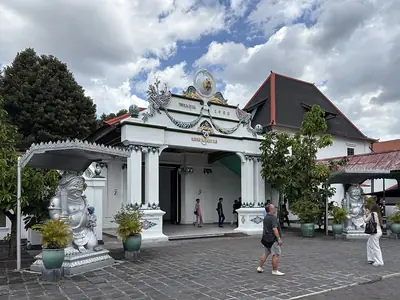
The Kraton Ngayogyakarta Hadiningrat is the official residence of the Sultan of Yogyakarta and the living centre of Javanese culture. The palace was established after the Treaty of Giyanti by Sultan Hamengkubuwana I, marking the birth of the Yogyakarta Sultanate.
The kraton covers about 144 hectares, while its inner core, the kedhaton, covers 13 hectares. Inside the outer walls are seven main complexes, including Siti Hinggil Lor, Sri Manganti, Kedhaton and Siti Hinggil Kidul. The site also includes a moat, bastions and the water palace of Taman Sari. Many of the buildings seen today were expanded or rebuilt under later rulers, including Sultan Hamengkubuwana VIII.
The palace has also witnessed turbulent moments. During the British interlude in 1812, troops under Thomas Stamford Raffles attacked it and destroyed the gunpowder house in the northeastern bastion. That bastion was reconstructed in 2020.
Taman Sari, the former Water Castle
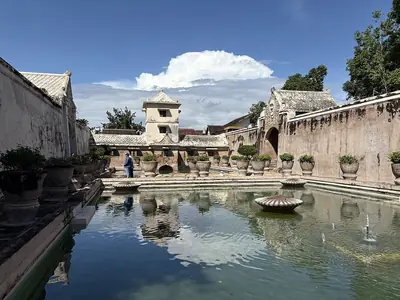
Taman Sari was the former royal garden of the Yogyakarta Sultanate. Covering more than twelve hectares, the complex once contained nearly sixty buildings, including bathing pools, pavilions, suspension bridges and an artificial lake with islands.
Its four main sections include a western lake with islands and pavilions, the central bathing complex of Umbul Binangun, a southern area of pools and pavilions, and a smaller eastern lake. Construction began under Sultan Hamengkubuwana I between 1758 and 1765 and was completed during the reign of Hamengkubuwana II.
One of Taman Sari’s most distinctive features is Sumur Gumuling, an underground well believed to have been used for meditation or worship. The complex was built on a site associated with the sacred spring Umbul Pacethokan, used since the time of Panembahan Senapati.
Benteng Vredeburg
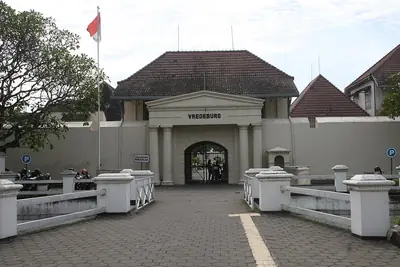
Opposite the Sultan’s palace and the presidential palace, Benteng Vredeburg is a historic fort that now operates as Museum Benteng Vredeburg. Its exhibitions and dioramas present episodes from Indonesian history, including the scene shown in Diorama 2.
The fort has a perfect square layout, a watchtower at each corner and its original moat. It was built in 1765 by the Dutch VOC to protect the colonial governor and serve as an administrative centre during Dutch rule. The moat could also be drained to release water from the city. The fort is sometimes known as Vredenburg or Rustenburg.
Sonobudoyo Museum
Sonobudoyo Museum preserves one of the most complete collections of Javanese culture outside Jakarta. Its collections also cover the heritage of Java, Bali and Madura, with objects ranging from Neolithic pottery and eighth-century bronze statues to wayang kulit puppets, keris, Javanese masks and batik textiles.
A dedicated hall focuses on Balinese art. The museum was inaugurated by Sultan Hamengkubuwono VIII on 6 November 1935 under the name Museum Sono Boedojo. In 1941, an attached arts school for silversmiths and woodworkers was opened by his successor, Sultan Hamengkubuwono IX.
Sonobudoyo Unit I contains the permanent and temporary galleries, a wayang performance space and the former collections building. Unit II, east of the North Alun-Alun in Ndalem Condrokiranan, serves as the museum’s storage and office facility. Wayang kulit performances accompanied by live gamelan take place there from 8 p.m. to 10 p.m.
Museums of independence and military history
Yogyakarta has several museums dedicated to Indonesia’s struggle for independence. The Struggle Museum of Yogyakarta, also called Museum Perjuangan, commemorates the fight for freedom through collections connected with the country’s journey towards independence.
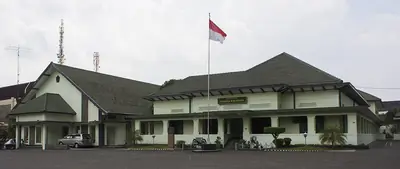
The Dharma Wiratama Museum focuses on the Indonesian Army’s role in that campaign. Its exhibits preserve artefacts illustrating the TNI AD’s contribution to the struggle for freedom.
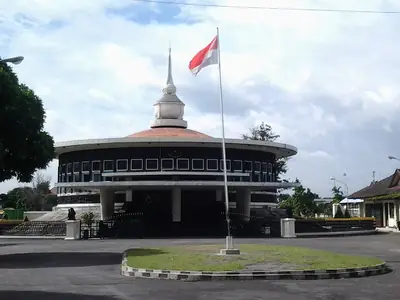
At the Sasana Wiratama Monument Museum of Prince Diponegoro, the focus is the legacy of Prince Diponegoro. The monument marks the place where Dutch forces besieged the prince during the Java War. The museum was developed in stages and officially opened on 9 August 1969 by then-General Suharto.
Yogyakarta’s art museums
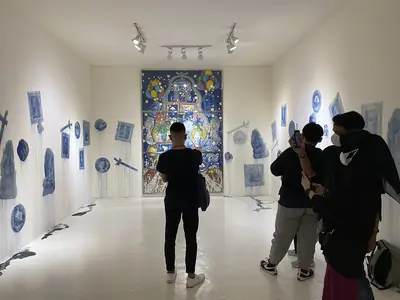
Jogja Gallery is an art gallery near the North Alun-alun. For contemporary art, the Jogja National Museum occupies the former campus of the Akademi Seni Rupa Indonesia, now the Institut Seni Indonesia Yogyakarta. The site covers 1.4 hectares and includes the Fine Art Museum Gallery, Pendopo Ajiyasa, the Seni Situs Patung exhibition room and the Situs Kriya space.
The museum also has the JNM Art Shop and a canteen. Its Gallery for Citizens gives emerging artists a place to hold exhibitions free of charge.
Smaller museums with unusual collections
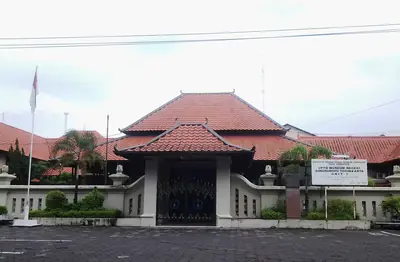
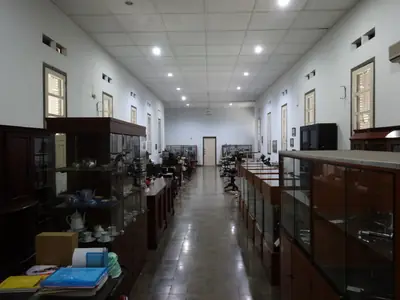
The Dr. Yap Eye Hospital Museum honours the founders of Yogyakarta’s original eye hospital, Dr. Yap Hong Tjoen and Dr. Yap Kie Tiong. Opened in 1998, it contains around 885 objects, including antique ophthalmic instruments, household items, photographs, paintings, books and electronic devices. Its collection also includes plates awarded to Dr. Yap Kie Tiong by the Kedaulatan Rakyat newspaper.
The Yogyakarta Maritime Museum presents Indonesia’s seafaring heritage inside a former private house donated by Rear Admiral Yosafat Didik Heru Purnomo. Its displays include ship models, old navigation tools and other maritime artefacts. The museum opened to the public on 25 April 2009.
For a different subject, the Sandi Museum explores codes and ciphers. It contains coding machines, encryption tools and other objects linked to secret communication. It operates as a Technical Implementation Unit of Indonesia’s National Cyber and Code Agency, BSSN, and is the country’s only cryptology museum.
Museum Wahanarata and Romo Mangun Museum
Beside the western side of the Kraton, Museum Wahanarata displays 23 royal carriages used by the sultans of the Ngayogyakarta Hadiningrat kingdom. Many are ornately gilded. The museum opened in 1985 and was formerly known as Museum Kareta Karaton.
The Romo Mangun Museum is a modest memorial built by local residents for Yusuf Bilyarta Mangun Wijaya, an Indonesian architect known for his work on the Code housing complex. He died on 10 February 1999, and the museum preserves the memory of his community-focused work.
Explore Yogyakarta with a self-guided audio tour
A Yogyakarta self-guided walking tour with Neywo lets you explore without joining a group. The app has three walking tours and one bus route:
- Malioboro to the Sultan’s Palace: 3.61 km, 111 minutes and 10 narrated stops.
- Water Castle and the Southern Gate: 4.7 km, 103 minutes and 6 narrated stops.
- Tugu Axis: Monument, Codes and Independence: 5.12 km, 108 minutes and 7 narrated stops.
- Transjogja 15: Palace Quarter to Malioboro: 4.6 km, 20 minutes and 6 narrated stops.
The stories play as you reach each place, at your own pace, with no group and no schedule. Narration is available in 11 languages. After Yogyakarta, you can continue exploring Indonesia with Neywo’s guides to cities such as Jakarta and Semarang.
Download Neywo and explore Yogyakarta
Download Neywo to discover Yogyakarta through a free audio guide covering 31 narrated places. Choose a walking route or the Transjogja bus route, start whenever you like, and listen to the story of each palace, museum and historic site as you arrive.
Places with an audio guide in Yogyakarta
8 places in Yogyakarta with a Neywo audio guide. Each one starts telling its story as you reach it.
Self-guided tours in Yogyakarta
4 tours in Yogyakarta, free in the Neywo app. Each stop tells its story as you reach it.
- Bus ride
Transjogja 15: Palace Quarter to Malioboro
A Transjogja rapid bus that runs from the Taman Sari area past the royal carriage museum and the Sonobudoyo Museum to the Malioboro shopping street. A cheap ride through the heart of old Yogyakarta.
Soko Tunggal Mosque · Museum Wahanarata · Sonobudoyo Museum · Saint Francis Xavier Church, Kidul Loji · Siti Djirzanah Mosque · Gedung Agung
Open this tour: Transjogja 15: Palace Quarter to Malioboro - Walk
Malioboro to the Sultan's Palace
Follow Yogyakarta's royal axis from the bustle of Malioboro, past a mosque with a Chinese-temple roof, the presidential palace, the Dutch fort and the Javanese museum, to the Kraton where the Sultan still lives. Then continue to the royal carriages and the Water Castle's pools and its single-pillar mosque. Allow time to step inside the museums.
Siti Djirzanah Mosque · Gedung Agung · Benteng Vredeburg · Saint Francis Xavier Church, Kidul Loji · Sonobudoyo Museum · Kauman Great Mosque …
Open this tour: Malioboro to the Sultan's Palace - Walk
Water Castle and the Southern Gate
South of the palace the sultans built a pleasure garden of bathing pools and underground passages. Visit the royal carriages, wander the lanes of Taman Sari with its single-pillar mosque, pass the old southern gate of the city, then head south to a community mosque and the museum of the independence struggle.
Museum Wahanarata · Taman Sari · Soko Tunggal Mosque · Plengkung Nirbaya · Jogokaryan Mosque · Struggle Museum of Yogyakarta
Open this tour: Water Castle and the Southern Gate - Walk
Tugu Axis: Monument, Codes and Independence
Start at the white Tugu obelisk, the northern end of Yogyakarta's sacred axis, then explore three small museums nearby: the country's only cryptology museum, an army museum of the independence war and a charming eye-hospital museum. Continue east to the princely house of Pakualaman, General Sudirman's museum and the 1934 church of St Joseph.
Tugu Yogyakarta · Sandi Museum · Dharma Wiratama Museum · Dr. Yap Eye Hospital Museum · Pakualaman · Sasmitaloka Panglima Besar Jenderal Sudirman Museum …
Open this tour: Tugu Axis: Monument, Codes and Independence
Walk Yogyakarta with Neywo
Neywo turns Yogyakarta into a self-guided audio tour. Stories arrive as you reach the place they belong to, and the route reshapes when you wander off it.

