Semarang, Indonesia: Self-Guided Walking Tour
Things to do in Semarang: museums, temples and historic landmarks
Semarang, the capital of Central Java, is a city shaped by railway history, religious traditions and layers of Javanese, Chinese, Dutch and Indonesian heritage. The best things to do in Semarang include exploring Kota Lama, visiting distinctive museums and discovering landmarks around Tugu Muda and the city’s mosques. Neywo has a free audio guide for Semarang with 16 narrated places.
What to see in Semarang
Lawang Sewu
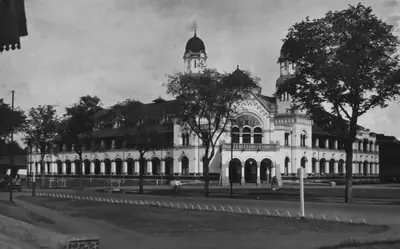
One of Semarang’s best-known landmarks, Lawang Sewu stands opposite Tugu Muda. The building was constructed between 1903 and 1907 as the headquarters of the Nederlandsch-Indische Spoorweg Maatschappij, or NIS, and is now a museum and railway-history gallery.
Its name comes from a Javanese phrase meaning “a thousand doors”. The building does not actually have exactly one thousand doors, but its many large doors and windows explain the nickname. The two-storey structure also has a bunker beneath it, built by the Dutch to help keep the interior cool. Today, Lawang Sewu is connected with Indonesia’s railway history and is operated as a tourist destination by KAI Wisata.
Sam Poo Kong
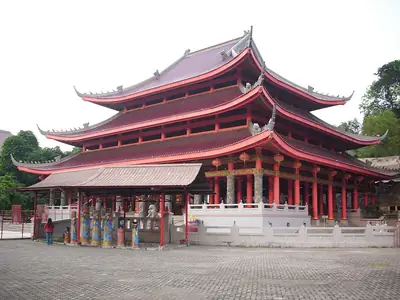
Also known as Gedung Batu Temple, Sam Poo Kong is a striking place of worship built around a large stone cave on a rocky hill in Simongan, southwest of Semarang. The name Gedung Batu means “Stone Building”, referring to the cave at the centre of the complex.
Inside the cave, an altar and statues of Sam Po Tay Djien mark the sacred heart of the site. Sam Poo Kong is closely associated with the Chinese admiral Zheng He, also known as Cheng Ho or Sam Poo. According to local belief, the cave was his former resting place and first landing site. The temple later became a place where people remembered and venerated him.
The complex also reflects a meeting of traditions. Zheng He came from Yunnan and belonged to the Hui people, most of whom were Muslim, while Buddhist traditions also influenced his life. This mixture of history, belief and natural rock makes Sam Poo Kong one of the most distinctive places to visit in Semarang.
Kota Lama and Museum Kota Lama
Kota Lama, Semarang’s Old Town, preserves the atmosphere of the city’s colonial past. The district reflects Semarang’s former importance as a trading port and contains historic buildings connected with the Dutch period.
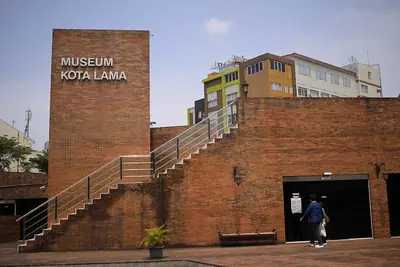
Museum Kota Lama, also called the Old City Museum, offers an introduction to Semarang’s history. It is located at Jalan Cenderawasih Number 1A, in Purwodinatan, Semarang Tengah. The museum provides useful context for exploring the surrounding streets and buildings.
Blenduk Church
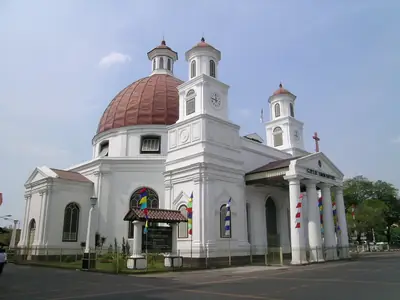
Blenduk Church, officially GPIB Immanuel, is one of the most recognizable landmarks in Kota Lama. Built in 1753 by Dutch residents of Semarang, it is regarded as the oldest church in Central Java and remains one of the province’s oldest Protestant churches.
The church has a Neo-Classical design and an unusual octagonal, or eight-sided, shape. It stands on Jalan Suari, a street once known by its Dutch name, Kerk Straat, meaning Church Street. Its distinctive form makes it an essential stop when exploring the Old Town.
Tay Kak Sie Temple
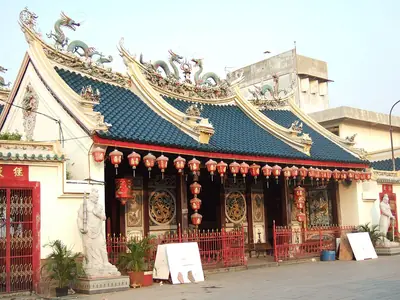
On Gang Lombok, Tay Kak Sie Temple introduces another layer of Semarang’s religious and cultural history. Also known as Klenteng Tay Kak Sie, it is a Taoist temple whose name means “Temple of Great Awareness”.
The temple was founded in 1746. Above the entrance, the name Tay Kak Sie appears as 大覺寺, or Da Jue Si. The board also records the era of Emperor Dao Guang of the Qing Dynasty, whose reign lasted from 1821 to 1850.
Holy Rosary Cathedral
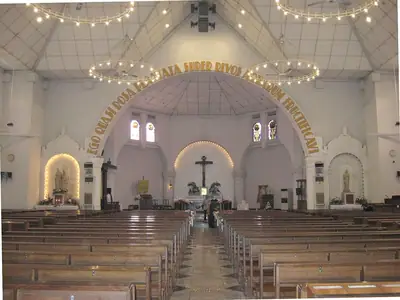
The Holy Rosary Cathedral, officially the Cathedral Church of Our Lady Queen of the Holy Rosary, stands near Tugu Muda in Semarang’s Randusari district. It is one of the important religious landmarks in this part of the city.
The cathedral stands on a stone foundation, with a large worship space supported by free-standing columns. Its roof and arches feature parapets, and the main front of the church faces west. The grounds include a Marian prayer garden, a pilgrimage garden, church offices and residences for priests.
Mandala Bhakti Museum
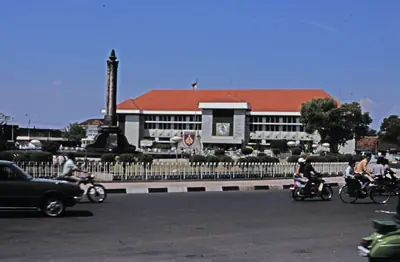
Also located around Tugu Muda, the Mandala Bhakti Museum focuses on the history of struggle. Its collections include military objects, documents, photographs and weapons connected with Indonesia’s past, including materials related to Kodam IV/Diponegoro.
The building itself dates from around 1906, when it was constructed as the Raad van Justitie, or High Court, for Semarang’s European population. It later became the headquarters of Kodam IV/Diponegoro and officially began serving as a museum in 1985. The two-storey building has a stone foundation, plastered brick walls, verandas on both floors and a tiled limasan roof. A 25 pounder field gun stands outside.
Great Mosque of Central Java
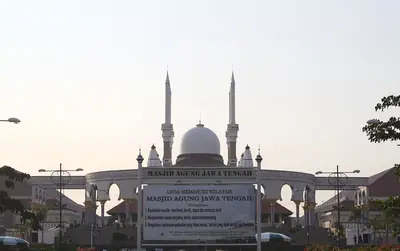
Known locally as Masjid Agung Jawa Tengah, the Great Mosque of Central Java is the provincial mosque and one of Semarang’s major modern landmarks. The complex occupies a ten-hectare site. Its main building covers about 7,669 square metres, while the surrounding courtyard covers another 7,500 square metres.
Construction began in 2001 and the complex was completed in 2006. It was officially inaugurated by President Susilo Bambang Yudhoyono on 14 November 2006. The scale of the buildings and open courtyard gives the mosque a powerful presence and reflects its role as a place serving the entire province.
Within the Asmaul Husna Tower at the mosque, the Museum Pusat Perkembangan Islam Jawa Tengah explores the development of Islam in Central Java. Its setting makes it a particularly distinctive museum visit.
Baiturrahman Grand Mosque Semarang
At Simpang Lima, the central area of Semarang, Baiturrahman Grand Mosque is both a place of worship and a gathering place for the Muslim community. The mosque was built between 1968 and 1974. Construction began on 10 August 1968, when 137 foundation piles were installed, and the completed mosque was inaugurated by President Soeharto on 15 December 1974.
The building’s distinctive limasan form is an important part of its appearance. The mosque stands on a site measuring 11,765 square metres, giving it a substantial presence within the Simpang Lima area.
More museums and historic places
Semarang’s museums offer further ways to understand Central Java and the city’s identity. The Ranggawarsita Museum is an ethnographic museum devoted to the culture of Central Java and stands at Number 1 Abdul Rahman Saleh Street, in Kalibanteng Kulon.
The Indonesian World Records Museum, also known as MURI, celebrates remarkable achievements by people from Indonesia. It was founded in Semarang on 27 January 1990 by Jaya Suprana as an independent community institution dedicated to collecting records and recognizing exceptional achievements.
The Jamu Jago Museum focuses on the Jamu Jago company, its herbal products and the wider subject of herbal medicine. Semarang Sekayu Mosque is widely recognized as the oldest mosque in the city and is another important religious landmark in Central Semarang.
Explore Semarang with a self-guided audio tour
A Semarang self-guided walking tour is a practical way to connect the city’s landmarks without joining a group. Neywo offers three walking tours in Semarang:
- Kota Lama: Dutch Semarang, Temples and Churches — 1.86 km, 47 minutes and 4 narrated stops.
- Tugu Muda: A Thousand Doors and a Soldiers’ Museum — 1.2 km, 37 minutes and 4 narrated stops.
- From Kota Lama to the Thousand Doors: Eight Landmarks of Semarang — 5.16 km, 114 minutes and 8 narrated stops.
The app tells the story of each place as you reach it, at your own pace, with no group and no schedule. Narration is available in 11 languages.
Download Neywo and discover Semarang
Download Neywo to explore Semarang with a free audio guide covering 16 narrated places and three walking routes. Choose a route through Kota Lama, follow the landmarks around Tugu Muda or connect eight historic sites on a longer walk. The stories play as you arrive, so you can explore independently and spend as much time as you like at each place.
Semarang is one destination in Indonesia worth taking slowly, especially if your journey also includes Yogyakarta or Jakarta.
Places with an audio guide in Semarang
8 places in Semarang with a Neywo audio guide. Each one starts telling its story as you reach it.
Self-guided tours in Semarang
3 tours in Semarang, free in the Neywo app. Each stop tells its story as you reach it.
- Walk
Kota Lama: Dutch Semarang, Temples and Churches
Semarang's Old Town in a short stroll: the octagonal Blenduk Church from 1753, the city's oldest, the first Catholic church of Semarang, the Old City Museum, and the Tay Kak Sie temple in the lanes of Chinatown. Go early, before the heat.
Tay Kak Sie Temple · Blenduk Church · Museum Kota Lama · St. Joseph's Church, Semarang
Open this tour: Kota Lama: Dutch Semarang, Temples and Churches - Walk
Tugu Muda: A Thousand Doors and a Soldiers' Museum
Around Tugu Muda, the monument at the city's busiest crossing: the Holy Rosary Cathedral, the Mandala Bhakti military museum, the railway headquarters nicknamed Lawang Sewu, the Thousand Doors, and finally the oldest mosque in Semarang.
Holy Rosary Cathedral · Mandala Bhakti Museum · Lawang Sewu · Semarang Sekayu Mosque
Open this tour: Tugu Muda: A Thousand Doors and a Soldiers' Museum - Walk
From Kota Lama to the Thousand Doors: Eight Landmarks of Semarang
Semarang's two best-known districts in one long stroll: the Dutch Old Town with the octagonal Blenduk Church, Museum Kota Lama, St. Joseph's and the Tay Kak Sie temple, then the old Sekayu mosque and the Tugu Muda quarter with Lawang Sewu, the Mandala Bhakti museum and the Holy Rosary Cathedral. The stretch from Chinatown to the mosque is about 2 km: start early, carry water, or take a becak for that leg.
Museum Kota Lama · St. Joseph's Church, Semarang · Blenduk Church · Tay Kak Sie Temple · Semarang Sekayu Mosque · Lawang Sewu …
Open this tour: From Kota Lama to the Thousand Doors: Eight Landmarks of Semarang
Walk Semarang with Neywo
Neywo turns Semarang into a self-guided audio tour. Stories arrive as you reach the place they belong to, and the route reshapes when you wander off it.

