Visiting Noto, Italy: Top Sights on Foot
Things to Do in Noto: A Guide to Sicily’s Baroque City
The best things to do in Noto include exploring its golden Baroque churches and palaces, walking along Corso Vittorio Emanuele, and discovering ancient sites around the city. Rebuilt after the earthquake of 1693, Noto is one of the most remarkable destinations in Sicily, with an unusually unified historic center shaped by late Baroque architecture. Neywo has a free audio guide for Noto with 35 narrated places, available in 11 languages.
What to See in Noto’s Historic Center
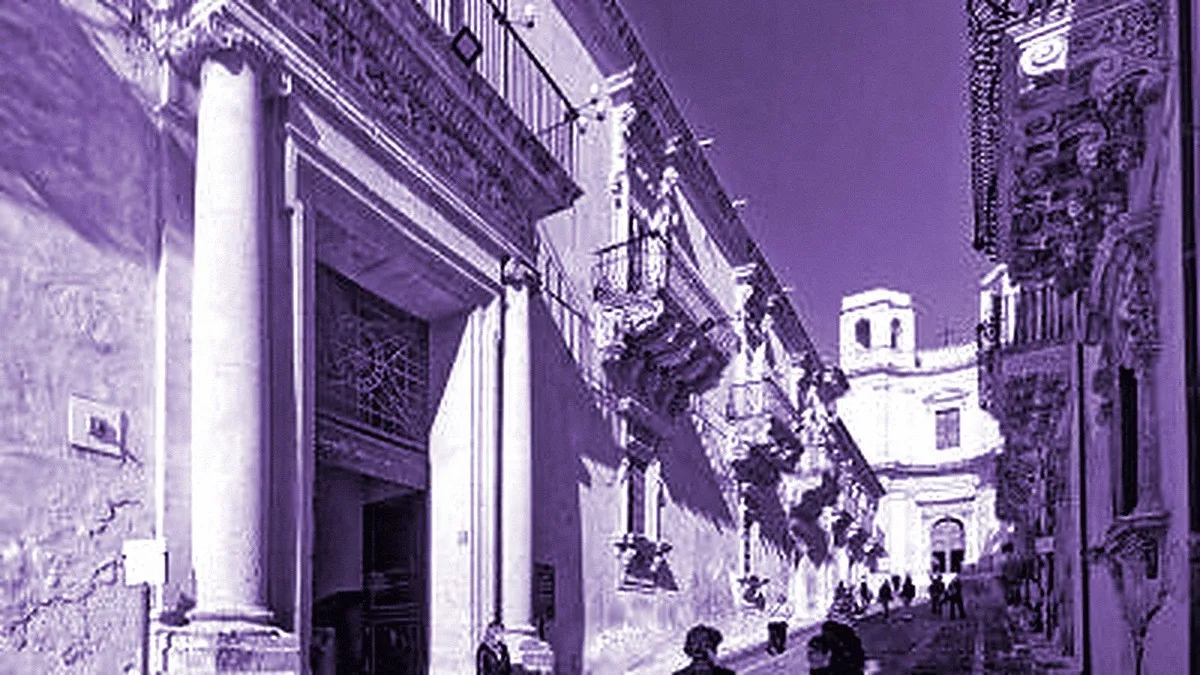
Noto’s main sights are concentrated around Corso Vittorio Emanuele and the surrounding streets. The warm color of the local calcarenite gives the city its golden appearance, while churches, noble residences, public buildings, and monumental staircases create a continuous architectural experience.
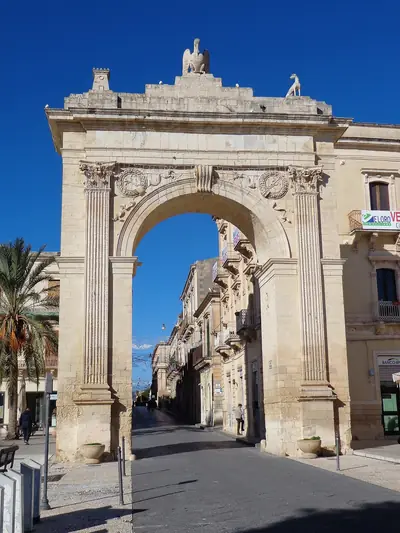
Porta Reale
Porta Reale, also known as Porta Ferdinandea or Porta Nazionale, marks one of the principal entrances to Noto’s historic center. Built during the city’s reconstruction in the eighteenth century, the Baroque gateway is decorated with floral motifs, sculpted cherubs, and the royal coat of arms of the Kingdom of Sicily. A Latin inscription commemorates King Ferdinand the Fourth of Bourbon.
Church of Santa Chiara and Basilica del Santissimo Salvatore
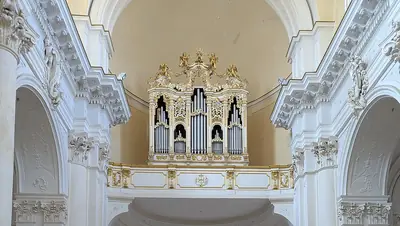
The Church of Santa Chiara, officially the Church of Santa Maria Assunta, was designed by Rosario Gagliardi in 1730 and completed in 1758. Its richly decorated Baroque interior is associated with the former Benedictine convent, which now houses the Museo Civico Archeologico di Noto.
The nearby Basilica del Santissimo Salvatore has a recently restored interior considered among the most impressive in Noto. The former Benedictine monastery beside it is now used as the seminary of the Diocese of Noto. The complex also includes access to the panoramic terrace of Santa Chiara.
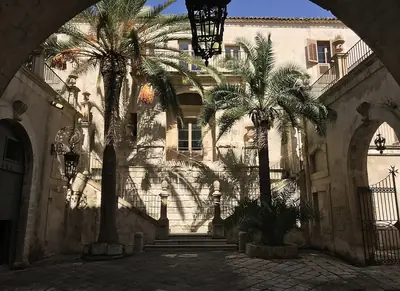
Palazzo Trigona di Cannicaro
The Mariannina Coffa staircase beside Palazzo Trigona di Cannicaro is one of Noto’s most photographed settings. Its artistic and floral displays change each year, with new designs and themes that add a creative element to the historic streetscape.
Palazzo Ducezio
Palazzo Ducezio is Noto’s town hall and the main building in Piazza del Municipio. Designed by Vincenzo Sinatra, the palace has an elegant curved façade with twenty arches on the lower level and thirteen rectangular windows above.
Inside, the oval Hall of Mirrors is decorated with stucco and mirrors. Its ceiling features The Foundation of Neas, a Neoclassical fresco painted in 1826 by Antonio Mazza and presented as an allegory of Ducezio, the Sicel leader associated with the city’s original settlement.
Noto Cathedral
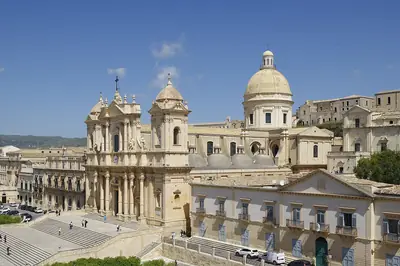
Noto Cathedral, or the Cathedral of San Nicolò, is the city’s principal Catholic place of worship and one of the clearest expressions of Sicilian Baroque. Its elevated position and broad staircase make it a defining feature of the city center.
Construction began in 1694, during the rebuilding of Noto after the 1693 earthquake, and the church opened for worship in 1703. The façade is carefully balanced, with a central portal framed by Corinthian columns, sculptural decoration, and a rose window. Inside, three naves contain stucco work, frescoes, and other richly ornamented details. The cathedral has been the seat of the Diocese of Noto since the diocese was established in 1844.
San Carlo al Corso
The Church of San Carlo al Corso, also called the Collegiata, was built as the church of the former Jesuit residence and dedicated to Saint Charles Borromeo. Its concave façade is arranged in three levels, with Doric, Ionic, and Corinthian orders. Free-standing columns give the warm limestone exterior a strong sense of movement, while a floral oculus completes the upper section.
The interior has three naves and a barrel vault, with eighteenth-century altarpieces and a wooden icon of Saint Aloysius Gonzaga. The main altar includes marble statues of Faith and Hope by Giuseppe Giuliano. The altar and the church’s bell came from the Jesuit church in ancient Noto, destroyed in the earthquake of 1693.
Palazzo Nicolaci di Villadorata
Palazzo Nicolaci di Villadorata is one of Noto’s most distinctive noble residences and is renowned as the largest palace in the city. Its balconies are decorated with elaborate wrought-iron balustrades and sculpted figures of mermaids, sphinxes, and winged horses.
The palace originally contained forty-eight rooms and three cisterns. The date 1737 appears above the entrance, although the building developed through several architectural phases. Its richly theatrical details express the ambition and social rise of the Nicolaci family.
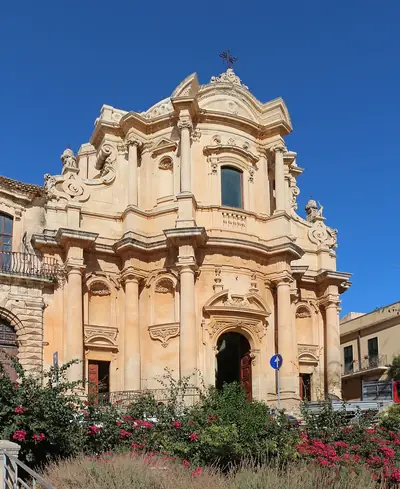
San Domenico
Facing Piazza XVI Maggio, the Church of San Domenico is considered one of the finest examples of Noto’s Baroque architecture. Rosario Gagliardi designed the church in the eighteenth century, giving the façade a central section that curves outward toward the street.
The interior is based on a Greek-cross plan, with three naves and five decorated domes. Its stucco work reflects Saint Dominic’s devotion to the Madonna of the Rosary. The main altar contains a statue of the Madonna of the Rosary by Vito d’Anna, while the church also holds a Crucifix, four marble stations depicting scenes from the Passion, and other eighteenth-century paintings.
Palazzo Di Lorenzo del Castelluccio
Built in 1782, Palazzo Di Lorenzo del Castelluccio offers a glimpse of Noto’s noble architecture at the end of the eighteenth century. The palace was rebuilt in Neoclassical style for the Di Lorenzo family, the marquises of Castelluccio, as part of the city’s transformation after the earthquake.
Church of Our Lady of Mount Carmel
The Carmine, or Church of Our Lady of Mount Carmel, is one of Noto’s important religious buildings and one of the city’s best-preserved examples of Baroque architecture.
Ancient Sites Around Noto
Noto’s history extends beyond the eighteenth-century city. The wider area includes archaeological remains connected with Greek settlement and one of Sicily’s earliest Bronze Age cultures.
Helorus, or Eloro
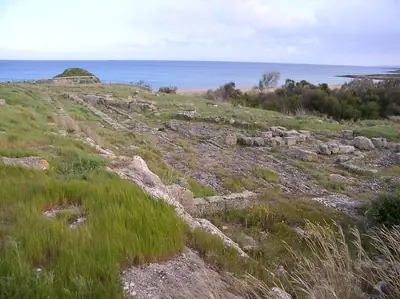
Helorus, also known as Eloro, is an ancient city whose remains form an archaeological site on a hill facing the Ionian Sea. It was a Siceliot polis—a Greek-founded city in Sicily—and was occupied from the Archaic period through Late Antiquity. Its long history provides a view of Sicily from the earliest phases of ancient settlement to the later ancient world.
Colonna Pizzuta
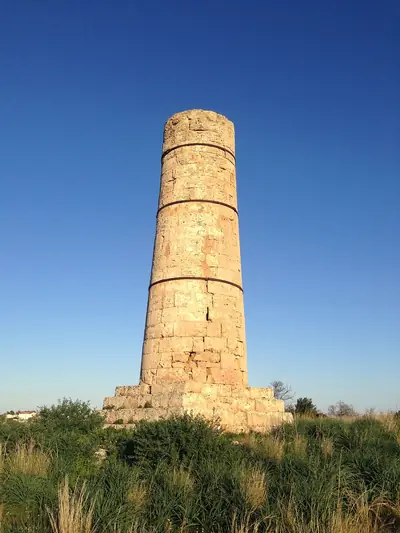
Near Eloro, the Colonna Pizzuta is a monument from the Greek period. The column dates from the third century BC and is thought to have marked an important funerary monument. It stands 10.50 metres above a four-stepped base and measures 3.90 metres in diameter. The burial chamber beneath the steps was investigated by archaeologist Paolo Orsi in 1899.
Castelluccio di Noto Excavations
The Castelluccio di Noto excavations are connected with one of Sicily’s earliest Bronze Age cultures. The site gave its name to the Castelluccio Culture, making it an important place for understanding the island’s prehistoric past.
Torre di Vendicari
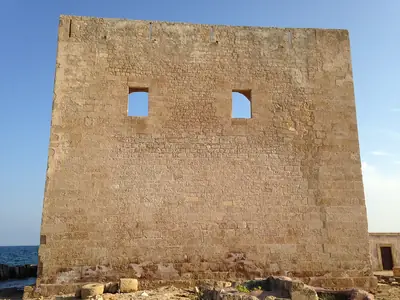
Torre di Vendicari is one of the historic structures found in the area around Noto. The tower adds another layer to the landscape beyond the Baroque center and its archaeological sites.
Noto and the Val di Noto
Noto belongs to the Val di Noto, the historic region covering the southeastern third of Sicily. The area is especially known for its group of late Baroque cities, rebuilt after the catastrophic earthquake of 1693.
The reconstruction, directed on behalf of the Sicilian king by the Duke of Camastra, created an opportunity to redesign the cities according to modern urban ideas of the time. Their unified appearance and shared architectural language are now associated with Sicilian Baroque.
For more destinations in the region, explore Ragusa and Ispica, or continue discovering Italy.
Explore Noto with Neywo
Neywo’s free Noto audio guide includes 35 narrated places and two self-guided walking tours:
- Sicily’s Stone Stage: Corso Vittorio Emanuele — 1.68 km, 87 minutes, 12 narrated stops.
- Noble Palaces and Quiet Baroque Churches — 2.03 km, 72 minutes, 8 narrated stops.
The app tells the story of each place as you reach it, at your own pace, with no group and no schedule. Download Neywo and explore Noto’s Baroque streets, churches, palaces, and ancient sites with the city’s history playing as you walk.
Places with an audio guide in Noto
8 places in Noto with a Neywo audio guide. Each one starts telling its story as you reach it.
Self-guided tours in Noto
2 tours in Noto, free in the Neywo app. Each stop tells its story as you reach it.
- Walk
Sicily's Stone Stage: Corso Vittorio Emanuele
After the earthquake of 1693 flattened the old town, Noto was rebuilt in golden limestone along one street. Stroll from the royal gate along the Corso to the cathedral, the town hall, a palace with mermaid balconies and the Baroque churches of Gagliardi, and end at the 19th-century theatre.
Porta Reale · Chiesa di San Francesco d’Assisi all’Immacolata · Spirito Santo · Santa Chiara · Palazzo Trigona di Cannicaro · Palazzo Ducezio …
Open this tour: Sicily's Stone Stage: Corso Vittorio Emanuele - Walk
Noble Palaces and Quiet Baroque Churches
Leave the busy Corso for the calmer streets above and below it: the great Church of the Holy Crucifix, the curved facade of Montevergine, the neoclassical Palazzo Di Lorenzo and a string of small Baroque churches that complete the rebuilt town.
Sant'Andrea apostolo · Santissimo Crocefisso · Sant'Agata · Sant'Elia · Santa Maria dell'Arco · Palazzo Di Lorenzo Castelluccio …
Open this tour: Noble Palaces and Quiet Baroque Churches
Walk Noto with Neywo
Neywo turns Noto into a self-guided audio tour. Stories arrive as you reach the place they belong to, and the route reshapes when you wander off it.

