What to See in Piazza Armerina, Italy: Free Audio Guide
Things to Do in Piazza Armerina, Sicily
The best things to do in Piazza Armerina combine a historic hilltop town with one of Sicily’s greatest Roman sites: Villa Romana del Casale. Explore the cathedral, churches, civic buildings and museums in the centre, then discover the extraordinary mosaics of the late antique residence a few kilometres away. Neywo offers a free audio guide for Piazza Armerina, with 14 narrated places in 11 languages.
What to See in Piazza Armerina
Piazza Armerina stands in Sicily’s province of Enna, about 697 metres above sea level, among gently rolling countryside and broad areas of farmland. Its historic sights bring together religious architecture, civic buildings, museums and landmarks connected with the town’s past.
Villa Romana del Casale
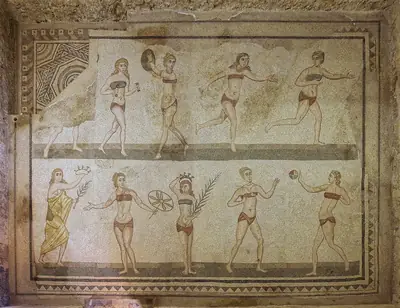
A few kilometres from town, Villa Romana del Casale is the area’s essential archaeological visit. The complex dates from the early fourth century AD and is better understood as a richly decorated late antique residence with the character of an imperial urban palace than simply as a villa.
Its UNESCO World Heritage status, awarded in 1997, reflects the importance of its decoration. Mosaics and opus sectile—patterns made from pieces of cut stone—cover about 3,500 square metres. The collection is celebrated for its size, variety and exceptional preservation. Frescoes once covered the interior walls, while even the exterior walls were painted. Landslides and floods eventually buried the remains, helping to protect them.
Piazza Armerina Cathedral
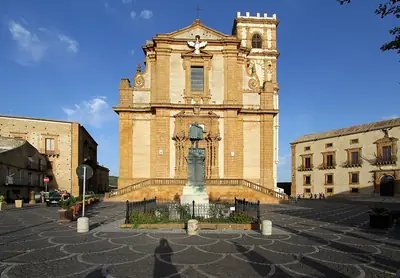
The Cattedrale di Maria Santissima delle Vittorie is the cathedral of the Diocese of Piazza Armerina and was raised to the rank of minor basilica in 1962. Dedicated to Mary of the Victories, it grew from the foundations of an earlier fifteenth-century church.
Architect Orazio Torriani began the present building in 1604, and construction continued until 1719. The dome was added in 1768. The cathedral became the seat of the newly created Diocese of Piazza in 1817.
Inside, the central dome dominates the space. A cross painted on both sides shows the Crucifixion of Christ on one face and the Resurrection on the other. The baptistery by Antonello Gagini is another distinctive feature to look for.
Aragonese Castle
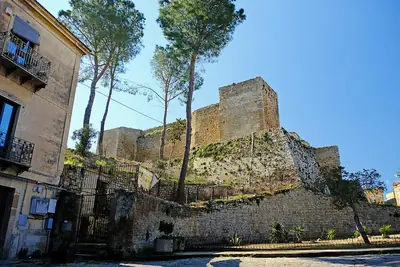
The Aragonese Castle, or Castello Aragonese, is one of Piazza Armerina’s named historic landmarks. It adds a defensive note to a town otherwise marked by churches, civic buildings and cultural institutions.
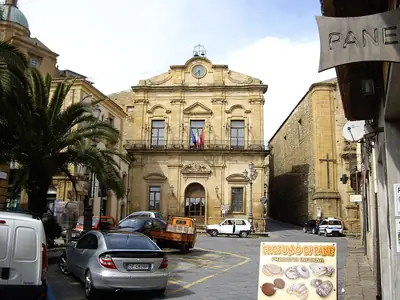
Palazzo di Città
Palazzo di Città was originally created as the seat of the Corte Capitanale. Today, its ground floor functions as a cultural centre. The first floor contains the council chamber and additional rooms, which are currently empty. Until a few years ago, those rooms hosted an exhibition of ceramic artefacts dating from the Roman period to the Middle Ages.
Museums of Piazza Armerina
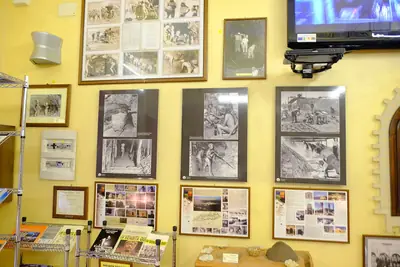
The Museo della civiltà mineraria, also known as the Mostra Permanente della Civiltà Mineraria, explores the story of mining and its place in local culture.
The Museo Diocesano di Piazza Armerina offers another perspective on the town’s heritage, alongside the religious buildings that shape the historic centre.
Churches and religious buildings
Piazza Armerina’s smaller religious landmarks make the town rewarding to explore on foot. The Church of San Rocco stands in Piazza Giuseppe Garibaldi, while Anime Sante del Purgatorio, San Giuseppe and San Pietro offer further stops among the town’s historic buildings.
The Commenda dei Cavalieri di Malta is another church to include in a walk. Nearby, San Giovanni adds another religious building to the route.
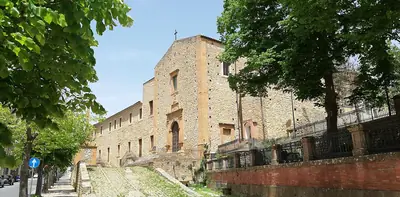
In the northwestern part of town, the Priorato di Sant’Andrea consists of the Church of Sant’Andrea and its primitive cenobium. Together, they belonged to the Grand Priory of the Equestrian Order of the Holy Sepulchre of Jerusalem, under the title of Sant’Andrea and Sant’Elia. The church is now entrusted to the Piazza Armerina Delegation of that order.
Teatro Garibaldi
The Garibaldi Theatre is a compact historic venue built close to the town’s fourteenth-century wall and opposite the Church of Saint Stephen. Its façade was redesigned in 1902 by Giovanni Pastorelli in a Renaissance style, with paired pilasters, two levels of windows and decorative stonework.
Four upper-floor medallions depict Giuseppe Verdi and Vincenzo Bellini at the centre, with Vittorio Alfieri and Carlo Goldoni on either side. The theatre’s origins are uncertain because municipal records from before Italian unification were destroyed, although it is thought to date from around 1800.
The present façade followed damage caused when the town walls collapsed in 1852. Inside, the horseshoe-shaped auditorium has three tiers of boxes and a gallery, with space for 320 spectators. The original wooden decorations on the railings and ceiling remain, even though the wooden structures of the boxes have been replaced with steel.
A Piazza Armerina Self-Guided Walking Tour
For travellers looking for a Piazza Armerina self-guided walking tour, Neywo’s route links many of the town’s central sights in a single walk. Hilltop Sicily: From the Aragonese Castle to the Garibaldi Theatre covers 2.9 km in 96 minutes and includes 11 narrated stops:
- Priorato di Sant’ Andrea
- Aragonese Castle
- Piazza Armerina Cathedral
- Palazzo di Città
- San Rocco church
- Anime Sante del Purgatorio
- Museo della civiltà mineraria
- San Giuseppe
- Commenda dei Cavalieri di Malta e
- Teatro Garibaldi
- San Pietro
The route gives the historic centre a clear sequence, moving between religious buildings, civic heritage, the mining museum, the castle and the theatre.
Piazza Armerina is part of Sicily, an island whose historic towns and archaeological sites offer very different ways to experience Italy. If you are continuing through southeastern Sicily, you can also compare it with destinations such as Ragusa, Noto or Scicli.
Explore Piazza Armerina with Neywo
Download Neywo for a free audio guide to Piazza Armerina with 14 narrated places. The app includes 1 walking tour: a 2.9 km route lasting 96 minutes, with 11 narrated stops. Each story plays as you reach the place, at your own pace, with no group and no schedule. You can listen while walking through the town and let the route introduce its churches, museums, castle, civic buildings and theatre as you arrive.
Places with an audio guide in Piazza Armerina
8 places in Piazza Armerina with a Neywo audio guide. Each one starts telling its story as you reach it.
Self-guided tours in Piazza Armerina
1 tour in Piazza Armerina, free in the Neywo app. Each stop tells its story as you reach it.
- Walk
Hilltop Sicily: From the Aragonese Castle to the Garibaldi Theatre
Piazza Armerina climbs a hill in the heart of Sicily, and this walk climbs with it. Start at the quiet Priory of Sant'Andrea on the northern edge, drop to the Aragonese Castle, visit the baroque cathedral crowned by its 1768 dome, pass the old civic palace and the small churches of the upper town, and finish at the horseshoe-shaped Garibaldi Theatre and the church of San Pietro.
Priorato di Sant' Andrea · Aragonese Castle · Piazza Armerina Cathedral · Palazzo di Città · San Rocco church · Anime Sante del Purgatorio …
Open this tour: Hilltop Sicily: From the Aragonese Castle to the Garibaldi Theatre
Walk Piazza Armerina with Neywo
Neywo turns Piazza Armerina into a self-guided audio tour. Stories arrive as you reach the place they belong to, and the route reshapes when you wander off it.

