Messina, Italy: Self-Guided Walking Tour
Things to Do in Messina, Sicily: What to See and Explore
Looking for things to do in Messina? This Sicilian port city combines Norman heritage, sixteenth-century fortifications, religious landmarks, museums, and views across the Strait of Messina. Its story is also one of reconstruction: the cathedral and much of the city were rebuilt after the devastating 1908 earthquake and the destruction caused by aerial bombardment during the Second World War. Neywo has a free audio guide for Messina with 89 narrated places.
What to See in Messina
Forte Gonzaga
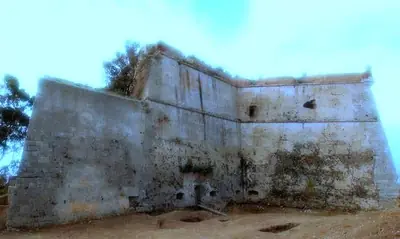
One of the most striking things to see in Messina is Forte Gonzaga, also known as Castel Gonzaga. Built in the mid-16th century, the bastioned fort occupies a hill overlooking both the Strait of Messina and the surrounding hinterland. It remained an active military site until 1973 and is now in good condition, despite the battles fought around its walls over the centuries.
Forte Castellaccio
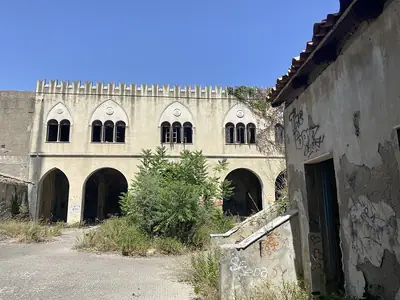
Forte Castellaccio forms part of Messina’s sixteenth-century defensive landscape. Built around the middle of the 1500s under the direction of Juan de Vega, Viceroy of Sicily, it belonged to a project ordered by Emperor Charles V of Habsburg. The design is attributed to military architect Antonio Ferramolino. After suffering damage in the 1908 earthquake, it was briefly reused in the 1940s as a colony for boys before being abandoned again. Local stories associate the site with ghosts of orphans and the apparition of a nun.
Messina Cathedral and the Astronomical Clock
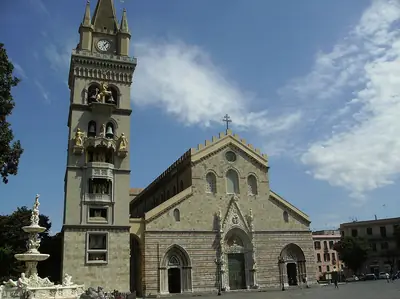
Messina Cathedral, or the Duomo di Messina, dominates the city’s historic centre. Its origins date back to the Norman period, and it was consecrated in 1197 by Archbishop Berardo in the presence of Holy Roman Emperor Henry VI and Constance I of Sicily. The cathedral received the title of minor basilica from Pope Pius XII in June 1947.
The building visible today is largely the result of twentieth-century reconstruction. The 1908 earthquake left only the original perimeter walls, the Gothic portal, and the apse; later, incendiary bombs in 1943 destroyed much of the restored roof. An original mosaic and a statue survived, preserving visible traces of the cathedral’s medieval past. Inside is the second-largest pipe organ in Italy.
The cathedral tower houses Messina’s astronomical clock. Installed in 1933 during the rebuilding of the campanile, it was commissioned by Archbishop Angelo Paino. Its mechanism was engineered by Frédéric Klinghammer, while the artistic design followed plans by Théodore Ungerer, drawing inspiration from Strasbourg’s astronomical clock. Its displays occupy several levels and sides of the tower.
Fountain of Orion
A few steps from the cathedral, Piazza Duomo is home to the Fountain of Orion. Dating from 1553, it was sculpted by Giovanni Angelo Montorsoli with assistance from Domenico Vanello. Its position beside the cathedral makes it a natural part of a walk through Messina’s historic centre.
Colonna dell’Immacolata
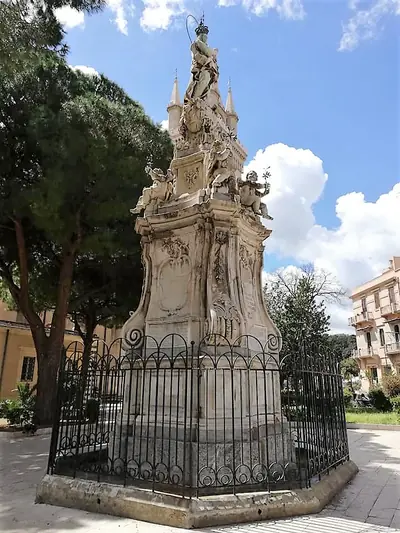
On the north side of the cathedral stands the Colonna dell’Immacolata. It is also known as the Statua dell’Immacolata, the Guglia dell’Immacolata, and the Obelisco dell’Immacolata. The monument takes the form of a column, statue, spire, or obelisk and adds a distinctive feature to the square around the cathedral.
Church of the Santissima Annunziata dei Catalani
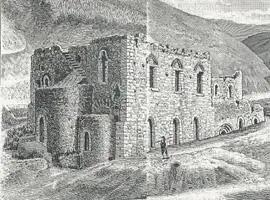
The Church of the Santissima Annunziata dei Catalani is one of Messina’s most notable survivors of the 1908 earthquake. Built in the 12th century under Norman rule, it stands on the remains of an ancient temple dedicated to Neptune and combines Arab, Byzantine, and Roman architectural elements.
Its apse is unusually well preserved. The church now lies about three metres below the reconstructed street level, a striking reminder of how the city changed after the earthquake. It was once called Annunziata di Castellammare because it stood near a medieval fortress guarding the port inlet and shipyard.
Next to the church, Palazzo Magaudda displays Messina’s eclectic-Liberty style. Its façade includes cement-formwork decorations and polychrome graffiti, as well as friezes and ornamental details associated with Coppedè.
Stele della Madonna della Lettera
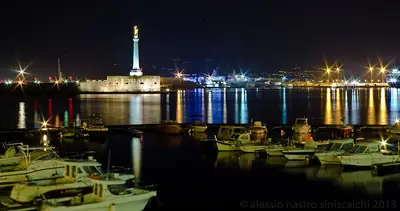
At the entrance to Messina’s port, the Stele della Madonna della Lettera marks the threshold of the harbour. This votive monument is dedicated to the Madonna della Lettera and stands on the Forte del Santissimo Salvatore, a sixteenth-century fort on the San Raineri pier. The fort has long watched over the approach to the harbour.
Statue of John of Austria
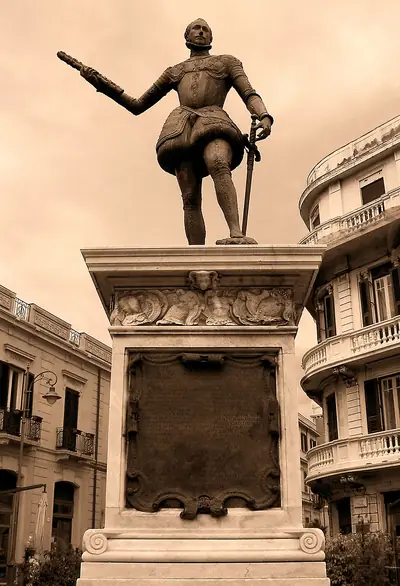
The bronze Statue of John of Austria stands in Piazza dei Catalani and commemorates the victor of the Battle of Lepanto. The Senate of Messina commissioned it in 1571, after the victory of October 7, and it was erected and dedicated in 1572.
Created by Andrea Calamech, a sculptor and architect from Carrara, the statue originally had a gilded surface. John of Austria holds a three-pronged baton representing his command of the alliance of Philip II, the Pope, and the Republic of Venice. The pedestal carries bronze plaques showing the fleet, the battle, and the victorious return to Messina.
Santa Maria della Valle and Santa Maria di Mili
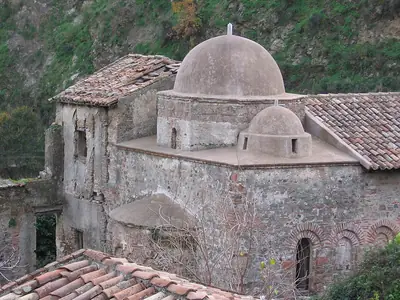
Outside the city, the church of Santa Maria della Valle is known affectionately as La Badiazza. Another important religious landmark is Santa Maria di Mili, a Norman church described as one of the oldest examples of Norman religious architecture in Sicily. The former Monastero di Santa Maria di Mili stands beside it as part of the same religious complex.
Forte Crispi
Forte Crispi is a coastal battery overlooking the Strait of Messina. Built at the end of the 19th century as part of the Umbertine fortifications, it was named after politician Francesco Crispi and replaced the older Batteria Menaja. Its construction strengthened this strategic point alongside earlier defensive works dating back to the period of Emperor Charles V.
Collezione pupi Ninì Cocivera
The Collezione pupi Ninì Cocivera introduces visitors to Sicily’s marionette tradition. Its puppets are hand-carved from wood and can reach 150 centimetres in height and weigh as much as 20 kilograms. They belong to the tradition of the Opera dei Pupi, recognised by UNESCO as intangible cultural heritage.
Performances traditionally draw on medieval epic and chivalric literature, including the Carolingian cycle and Arthurian legends. The repertoire also includes stories of Siculo-Norman rulers such as Roger I and Roger II, legends of brigands and saints, and adaptations of Romeo and Juliet and Macbeth. A short walk away, the Museum of Popular Culture and Music of the Peloritani explores traditions from the Messina hinterland.
Regional Museum of Messina
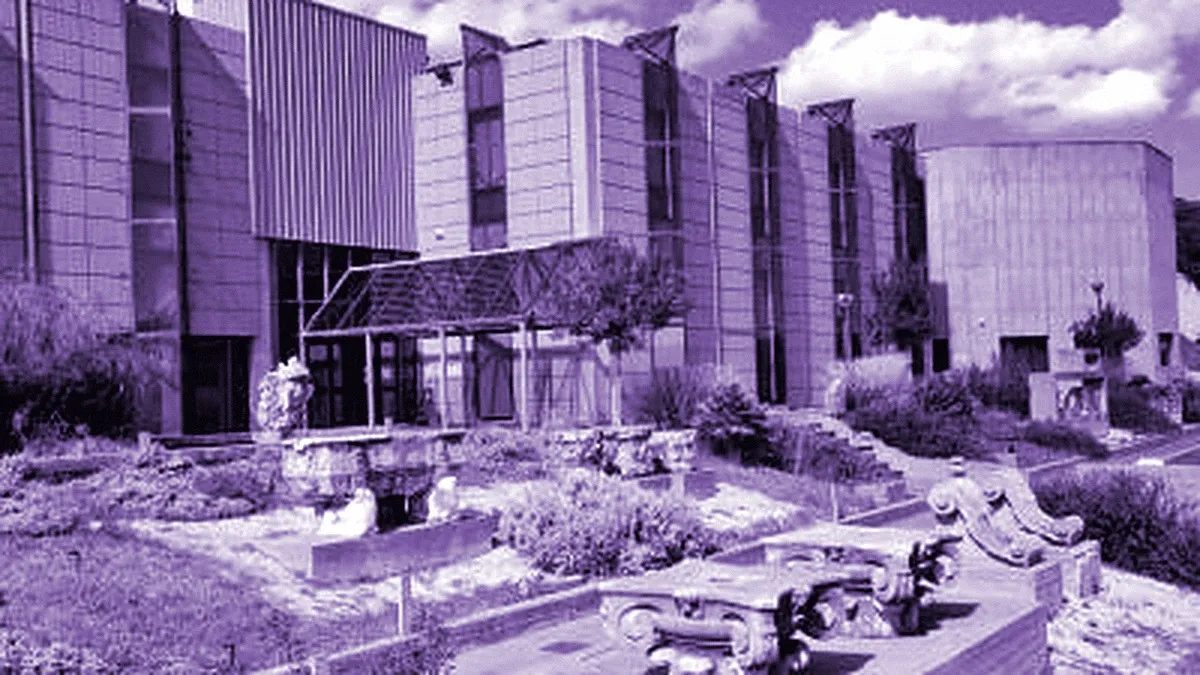
The Regional Museum of Messina, also known as MuMe, is an archaeology and art museum covering the development of art and culture in Messina from the 12th to the 18th centuries. Its indoor and outdoor spaces occupy about 17,000 square metres, making it the largest museum in southern Italy.
Until 2017, the museum was housed in the former Barbera-Mellinghoff silk mill, a late nineteenth-century building selected after the 1908 earthquake. Since 2017, it has been located in a nearby complex designed in the 1970s and inaugurated that year.
Fountain of Gennaro and Sant’Eustochia
The Fountain of Gennaro, also called the Fontana dell’Acquario, dates from the early 17th century. It originally stood at the intersection of Corso and Via del Collegio before being moved to its present piazza. After restoration, it returned to public view in 2015.
The Church of Sant’Eustochia Smeralda, usually known simply as Sant’Eustochia, is a modest church on Via XXIV Maggio. The street was once called Via dei Monasteri, reflecting the area’s long monastic history.
Explore Messina with a Self-Guided Audio Tour
Neywo offers a Messina self-guided walking tour experience through five walking tours and one bus route. Together, they cover the city at different speeds and through different themes:
- Reborn from 1908: Cathedral, Lepanto and the Harbour Gate — 1.71 km, 83 minutes, 10 narrated stops.
- Greek Killers and Hill Churches: Old Messina’s Hidden Axis — 2.49 km, 96 minutes, 12 narrated stops.
- Gothic Gems and the Lost Royal Waterfront — 2.07 km, 75 minutes, 9 narrated stops.
- Forts and Hill Chapels above the Strait — 2.14 km, 62 minutes, 5 narrated stops.
- Knights, Scholars and the Museum on the Northern Seafront — 3.96 km, 92 minutes, 7 narrated stops.
- Line 17: From Città Nuova through the Heart of Messina — a 9.4 km bus route lasting 40 minutes, with 9 narrated stops.
Download Neywo and explore Messina at your own pace. The app tells the story of each place as you reach it, with no group and no schedule, and its narration is available in 11 languages.
Messina is part of Sicily, one of Italy’s most varied regions. For more ideas elsewhere on the island, you can also explore Palermo, Cefalù, Lipari, or Noto.
Places with an audio guide in Messina
8 places in Messina with a Neywo audio guide. Each one starts telling its story as you reach it.
Self-guided tours in Messina
6 tours in Messina, free in the Neywo app. Each stop tells its story as you reach it.
- Bus ride
Line 17: From Città Nuova through the Heart of Messina
ATM Messina's line 17 runs along Viale Boccetta and the centre past the Teatro Vittorio Emanuele, the cathedral and a string of old churches and fountains, ending at the central station. A cheap, local way to cross the city and see its rebuilt core.
Our Lady of Pompeii Church · San Francesco all'Immacolata · Teatro Vittorio Emanuele II · Palazzo Zanca · Messina Cathedral · San Giuseppe …
Open this tour: Line 17: From Città Nuova through the Heart of Messina - Walk
Reborn from 1908: Cathedral, Lepanto and the Harbour Gate
In December 1908 an earthquake and tsunami flattened Messina, and what you see was rebuilt around the survivors. Start in the Liberty-style streets of Via Garibaldi, find a Norman church sunk three metres below the modern street, meet the bronze victor of Lepanto and the 18th-century palace that survived the quake, then stand beneath the cathedral's famous astronomical clock tower. End at the harbour mouth, where a stele greets every ship.
Palazzetto Coppedè · Church of the Santissima Annunziata dei Catalani · Palazzo Cerruti · Statue of John of Austria · Palazzo Calapaj - d'Alcontres · Fountain of Orion …
Open this tour: Reborn from 1908: Cathedral, Lepanto and the Harbour Gate - Walk
Greek Killers and Hill Churches: Old Messina's Hidden Axis
Follow the historic axis of Via Sant'Agostino through the quarter that kept some of its pre-earthquake character. See a monumental fountain in Piazza Basicò, a 17th-century palace of charity, the sanctuary on Caperrina hill, Sicily's largest theatre and the lone octagonal tower of Matagrifone, the castle whose name means 'Greek killers'. Finish at the great sanctuary of San Francesco all'Immacolata on Viale Boccetta.
Chiesa del Carmine · Fountain of Gennaro · San Salvatore · Santa Maria di Montalto · San Francesco dei Mercanti · Falconieri fountain …
Open this tour: Greek Killers and Hill Churches: Old Messina's Hidden Axis - Walk
Gothic Gems and the Lost Royal Waterfront
Walk the harbour side of old Messina, where small churches hide the finest Gothic architecture in the Mediterranean and a single palazzo remembers the grand sea-front Palazzata that vanished in 1908. Finish at the site of the Royal Palace and the pentagonal Spanish citadel guarding the port.
San Giuseppe · Teatro Peloro · Santa Caterina di Valverde · Sant'Elia · Santa Maria Alemanna · Banca Commerciale Italiana(Borzi and Buscema) …
Open this tour: Gothic Gems and the Lost Royal Waterfront - Walk
Forts and Hill Chapels above the Strait
Climb the western hills for the Spanish forts that once guarded Messina and the small sanctuaries around them. A quieter walk with sweeping views of the Strait of Messina, best in the cool of the morning.
Santa Rita · Santa Marta · Forte Gonzaga · Santa Maria della Consolazione · Forte Castellaccio (Messina)
Open this tour: Forts and Hill Chapels above the Strait - Walk
Knights, Scholars and the Museum on the Northern Seafront
Head north from the Knights of Malta church along the harbour road to the old university quarter and the Regional Museum, home of Messina's great Caravaggios. Churches, a Dominican sanctuary and the seafront in between.
Chiesa di San Giovanni Gerosolimitano di Malta · San Giuliano · Santa Maria di Porto Salvo · San Domenico · University of Messina · Gesù e Maria del Buonviaggio …
Open this tour: Knights, Scholars and the Museum on the Northern Seafront
Walk Messina with Neywo
Neywo turns Messina into a self-guided audio tour. Stories arrive as you reach the place they belong to, and the route reshapes when you wander off it.

