What to See in Palermo, Italy: Free Audio Guide
Things to Do in Palermo: What to See in Sicily’s Historic Capital
Palermo is Sicily’s capital, a city where Byzantine, Arab, Norman, Gothic, Baroque, and modernist influences stand side by side. The best things to do in Palermo include visiting royal chapels and cathedrals, comparing the domes of Piazza Bellini, exploring historic palaces, and following the city’s cultural story from the medieval centre to the waterfront. Neywo offers a free audio guide for Palermo with 207 narrated places.
As you explore the city, Palermo’s layers of history become especially clear. The capital is part of Sicily, but its monuments also reflect connections between the Mediterranean’s different cultures and ruling powers.
What to see in Palermo
Piazza Bellini: Martorana and San Cataldo
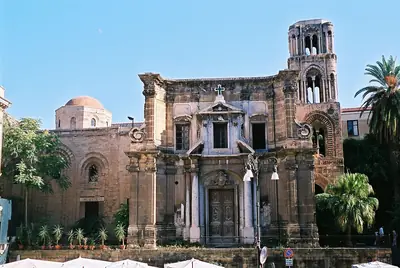
Piazza Bellini brings two of Palermo’s most distinctive Norman-era churches together. La Martorana, also known as the Church of Santa Maria dell’Ammiraglio, combines a Byzantine-Norman foundation with later artistic and architectural additions. Its Greek-cross plan and façade tower are characteristic features, while its interior preserves mosaics and an Arabic Christian inscription painted on wood.
The church also reflects the history of Arbëreshë communities in southern Italy and Sicily. Albanian exiles who arrived from the fifteenth century onward maintained traditions visible in the liturgy, language, icon painting, and parish customs. Two entrance columns preserve Arabic inscriptions in Kufic script, including a passage from the Quran and a basmala.
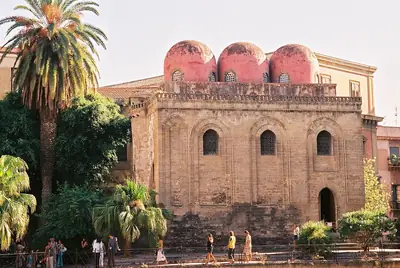
Beside it, Chiesa di San Cataldo is immediately recognisable by its compact cubic shape and three rounded domes. Built between 1154 and 1160, it is a notable example of Sicilian Arab-Norman architecture and has formed part of a UNESCO World Heritage Site since 2015. Blind arches, high windows, Kufic lettering, and visible stonework shape the exterior, while rounded arches and ancient columns organise the interior.
Palazzo dei Normanni and the Cappella Palatina
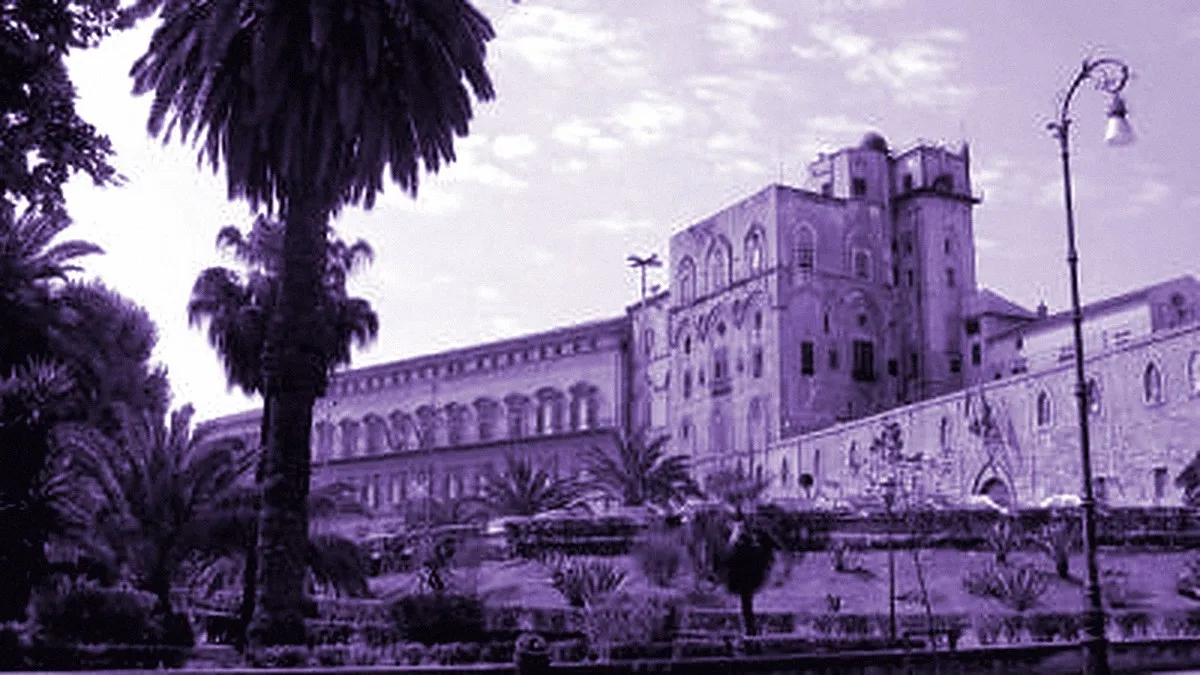
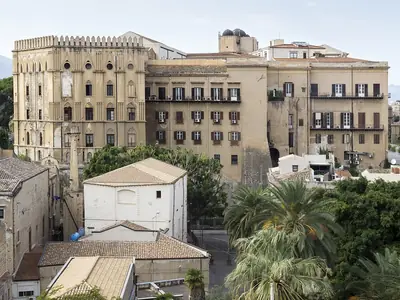
Palazzo dei Normanni, or the Royal Palace, has served as a centre of power across several eras. The site began as a Punic fortress, later became a Roman fort and a castle of the Arab emirs, and was transformed into the residence of the Norman kings in the twelfth century. It subsequently served rulers of the Kingdom of Sicily and became an imperial seat for Frederick II and Conrad IV. Today, it is the seat of the Sicilian Regional Assembly.
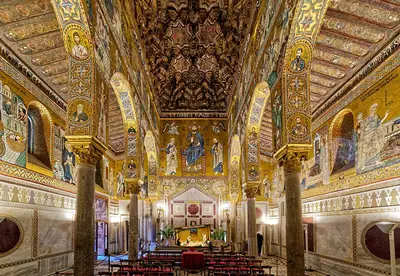
The palace is part of the UNESCO World Heritage site Arab-Norman Palermo and the cathedrals of Cefalù and Monreale. Inside, the first floor contains the Cappella Palatina, the royal chapel commissioned by Roger II of Sicily in 1132 and consecrated in 1140.
Dedicated to Saint Peter, the chapel brings Norman, Byzantine, and Arab traditions together. Its three apses and domed sanctuary recall a Byzantine basilica, while the rectangular plan and muqarnas ceiling reveal Fatimid influence. Golden-background mosaics dominate the interior, creating one of Palermo’s most memorable examples of Sicilian Arab-Norman art.
Palermo Cathedral
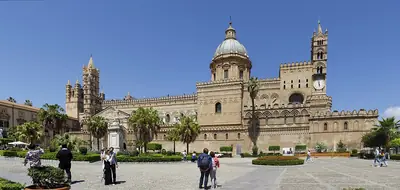
Palermo Cathedral is the city’s principal Catholic place of worship and the seat of the Archdiocese of Palermo. Dedicated to the Assumption of the Virgin Mary, it is best understood as an architectural record of the city rather than as a monument from one single period.
The Norman archbishop of Palermo, Gautier Ophamil, built the cathedral in the twelfth century on the site of an older basilica. That earlier Christian building had been converted into a mosque under Arab rule in the ninth century. The cathedral’s towers date from the fourteenth and fifteenth centuries, its Catalan Gothic portico from the fifteenth century, and its Baroque nave was enlarged at the end of the eighteenth century.
Piazza Verdi and Teatro Massimo
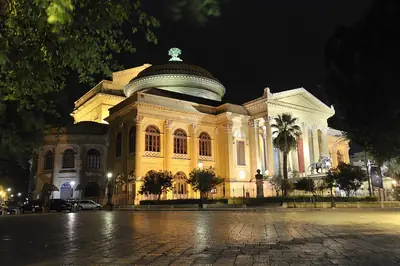
Piazza Verdi, also known as Piazza Massimo, takes its identity from the Teatro Massimo Vittorio Emanuele at its centre. The square was created between 1875 and 1897, when the construction of the opera house transformed the former San Giuliano district. The project involved demolishing the district, its convent and church, Porta Maqueda, and the remaining stretch of the city walls.
Teatro Massimo was built between 1875 and 1897 and opened on 16 May 1897 with a performance of Verdi’s Falstaff. Giovanni Battista Filippo Basile began the work, and his son Ernesto Basile completed it. The monumental entrance is reached by a broad staircase guarded by two lion sculptures, with a portico supported by six Corinthian columns above.
Villino Favaloro
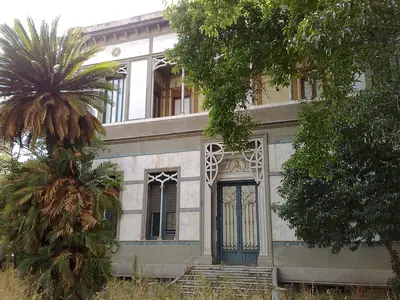
Villino Favaloro is widely considered Palermo’s first example of modernism. Built between 1889 and 1891 to a design by Giovan Battista Filippo Basile, it was completed by his son Ernesto between 1913 and 1914.
The building’s octagonal turret on Via Dante is one of its most distinctive features. Its winter garden uses iron and glass decorated with Liberty-style motifs, while Salvatore Gregorietti created the turret’s mosaic decoration. Today, the villa is also known as the Regional Museum of Photography, giving the building both an architectural and cultural role.
Palazzo Chiaramonte in Piazza Marina
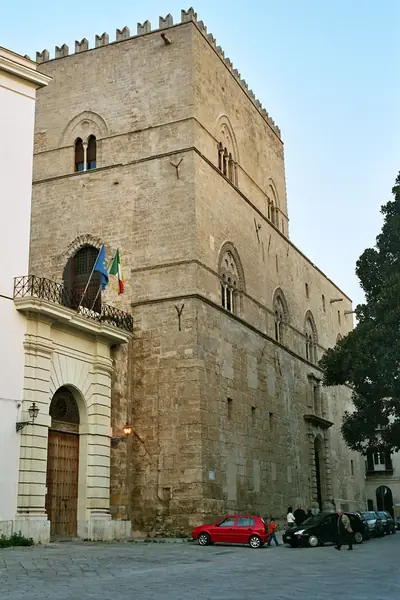
Palazzo Chiaramonte, also called the Steri, is an imposing fourteenth-century palace built for the powerful Chiaramonte family. Its architectural importance is reflected in the name “Chiaramonte style”, used for the Sicilian late Gothic style associated with the building.
The palace later became a royal residence under the Aragonese rulers and served as the Palermo seat of the Spanish Inquisition in Sicily from 1604 to 1782. Its name, Steri, comes from Hosterium, meaning a fortified palace.
Palazzo Abatellis and Mirto Palace
In the Kalsa quarter, Palazzo Abatellis combines a historic noble residence with one of Palermo’s major art destinations. Built at the end of the fifteenth century, the palace now houses the Galleria Regionale della Sicilia, which has been located there since 1954.
The gallery presents the development of figurative culture in Sicily from the twelfth to the seventeenth century. Among its celebrated works are Antonello da Messina’s Annunciata and The Triumph of Death. The building itself is part of the experience: its historic setting and the gallery’s arrangement bring architecture and art together.
Nearby, Mirto Palace is a house museum in the former residence of the Lanza-Filangeri family, the Princes of Mirto. It offers another way to encounter Palermo’s aristocratic interiors and domestic history.
Palazzo Butera and the waterfront
Palazzo Butera is a monumental aristocratic palace in the Kalsa quarter, facing the Mediterranean. Its seaside façade opens onto the broad terrace known as the Passeggiata delle Cattive, built above the base of the former city walls.
The palace looks across the Gulf of Palermo towards the Foro Italico. From the port, the contrasting colours of its façades make it easy to recognise. Together with nearby Porta Felice, it forms a dramatic architectural setting at the entrance to Palermo.
Admiral’s Bridge
The Admiral’s Bridge, or Ponte dell’Ammiraglio, is a medieval landmark associated with Norman Sicily. Its twelve arches once carried it over the Oreto River, and its stone structure remains visible from today’s Corso dei Mille.
The bridge was built during the Norman era by George of Antioch, who held the title ammiratus ammiratorum. It was inscribed in 2015 as part of the UNESCO World Heritage site Arab-Norman Palermo and the Cathedral Churches of Cefalù and Monreale.
More places to visit in Palermo
Several other landmarks add different perspectives on the city:
- Colonna dell’Immacolata: In Piazza San Domenico, a bronze statue of the Virgin of the Immaculate Conception stands above the square on a column erected in 1631.
- Sicilian Ethnographic Museum Giuseppe Pitrè: Founded in 1909 by Giuseppe Pitrè, the museum documents Sicilian culture, traditions, and folklore. Its library contains more than 30,000 volumes.
- Stadio Renzo Barbera: Palermo’s football stadium and home ground of Palermo FC stands within Favorita park. It opened on 24 January 1932 and hosted matches during the 1990 World Cup.
- Palazzo Butera: Its waterfront position and connection with the Passeggiata delle Cattive make it one of the Kalsa quarter’s most recognisable buildings.
Explore Palermo with a self-guided audio tour
A Palermo self-guided walking tour lets you move between the city’s monuments while hearing their stories as you arrive. Neywo has four walking tours, one bus route, and one bike route in Palermo, with narration available in 11 languages.
The routes include:
- The Norman Kings’ Palermo: a 1.19 km walk lasting 68 minutes, with 6 narrated stops.
- Domes, Mosaics and Opera: a 2.84 km walk lasting 107 minutes, with 6 stops.
- Kalsa by the Sea: a 2.05 km walk lasting 81 minutes, with 8 stops.
- Arab Summer Palaces and the Catacombs of the Capuchins: a 1.87 km walk lasting 52 minutes, with 5 stops.
- Free Centro Storico Shuttle: a 4.4 km bus route lasting 19 minutes, with 5 stops.
- La Favorita Royal Park: a 2.5 km bike route lasting 12 minutes, with 2 stops.
Download Neywo and explore Palermo with a free audio guide that tells the story of each place as you reach it, at your own pace, with no group and no schedule.
Places with an audio guide in Palermo
8 places in Palermo with a Neywo audio guide. Each one starts telling its story as you reach it.
Self-guided tours in Palermo
6 tours in Palermo, free in the Neywo app. Each stop tells its story as you reach it.
- Bike ride
La Favorita Royal Park: Gate of the Lions to the Chinese Palace
Cycle the traffic-free avenues of Parco della Favorita, the old royal hunting estate, from the Porta dei Leoni gate to the Palazzina Cinese and its Sicilian ethnographic museum. Cyclists and pedestrians share the park's historic-gardens circuit.
Porta dei Leoni · Sicilian Ethnographic Museum Giuseppe Pitrè
Open this tour: La Favorita Royal Park: Gate of the Lions to the Chinese Palace - Bus ride
Free Centro Storico Shuttle: the Norman Heart by Bus
AMAT's free Centro Storico shuttle loops through the old town from Porta Felice by the sea to Piazza Indipendenza under the Norman Palace. Ride it past San Cataldo, the Palatine Chapel, San Giovanni degli Eremiti and Teatro Massimo without paying a fare.
Chiesa di San Cataldo · San Giovanni degli Eremiti · Cappella Palatina · Palermo Cathedral · Teatro Massimo Vittorio Emanuele
Open this tour: Free Centro Storico Shuttle: the Norman Heart by Bus - Walk
The Norman Kings' Palermo: Palace, Chapel and Cathedral
Begin at the gate where Charles V's victory over Tunis is carved in four Moors, then step into Europe's oldest royal residence and its glittering golden chapel. Pass the Arab-style domes of San Giovanni degli Eremiti and a Gothic palace built out of rivalry, and end at the cathedral where emperors sleep.
Porta Nuova · Palazzo dei Normanni · Cappella Palatina · San Giovanni degli Eremiti · Palazzo Sclafani · Palermo Cathedral
Open this tour: The Norman Kings' Palermo: Palace, Chapel and Cathedral - Walk
Domes, Mosaics and Opera: Piazza Bellini to Teatro Massimo
Two Arab-Norman churches share one small square, one with red domes and one with Byzantine gold. Walk the Via Maqueda axis past a contemporary-art palace to Italy's largest opera house, then finish at the first modernist villa in Palermo.
Chiesa di San Cataldo · Martorana · Palazzo Riso · Teatro Massimo Vittorio Emanuele · Teatro Politeama · Villino Favaloro
Open this tour: Domes, Mosaics and Opera: Piazza Bellini to Teatro Massimo - Walk
Kalsa by the Sea: Palaces, Gates and Unfinished Churches
Wander the old Arab quarter by the harbour. From the seafront Porta Felice you pass palaces of princes and a church with no roof, then reach the Steri, the fortress-palace on Piazza Marina where the Inquisition once sat.
Santa Maria della Catena · Porta Felice · Palazzo Butera · Palazzo Abatellis · Santa Maria dello Spasimo · La Magione, Palermo …
Open this tour: Kalsa by the Sea: Palaces, Gates and Unfinished Churches - Walk
Arab Summer Palaces and the Catacombs of the Capuchins
Leave the centre for the Zisa district, where the Normans built pleasure palaces in Arab style. See the Zisa and La Cuba, a small chapel and a former factory turned art space, and the catacombs where thousands of mummified Palermitans are laid out.
Santissima Trinità alla Zisa · Zisa Palace · Cantieri Culturali alla Zisa · Catacombe dei Cappuccini · Cuba Palace
Open this tour: Arab Summer Palaces and the Catacombs of the Capuchins
Walk Palermo with Neywo
Neywo turns Palermo into a self-guided audio tour. Stories arrive as you reach the place they belong to, and the route reshapes when you wander off it.

