Visiting Ragusa, Italy: Top Sights on Foot
Things to do in Ragusa: Baroque churches, historic palaces and hillside streets
The best things to do in Ragusa include exploring the two historic districts of Ragusa Ibla and Ragusa Superiore, discovering Baroque churches and palaces, and visiting landmarks connected with the city’s history. Set between deep valleys, Ragusa combines dramatic hillside views with the architectural heritage of southeastern Sicily. Neywo offers a free audio guide for Ragusa with 36 narrated places.
What to see in Ragusa
Ragusa’s sights are spread across its two historic centers and the surrounding territory. The following places offer a way to explore the city’s religious buildings, palaces, squares and gardens in roughly the order encountered on its walks.
Ragusa Ibla and the Duomo of San Giorgio
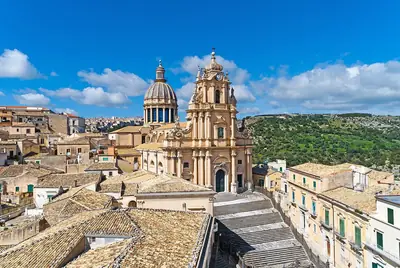
The Duomo of San Giorgio, also known as the Duomo di San Giorgio, is Ragusa’s cathedral and one of the city’s defining monuments. It stands among the most important landmarks of Ragusa Ibla, whose streets and buildings reflect the city’s distinctive Baroque identity.
Nearby, the Church of San Giuseppe in Piazza Pola is considered one of the jewels of Sicilian Baroque, together with the Duomo of San Giorgio. The church was built on the remains of San Tommaso, destroyed in the earthquake of 1693, and is attributed to Rosario Gagliardi.
Santa Maria dell’Itria
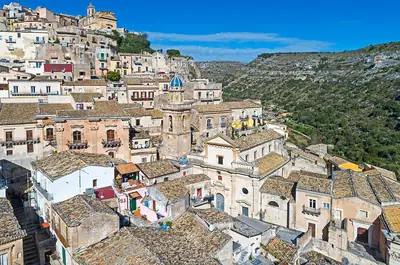
Santa Maria dell’Itria is one of Ragusa’s historic churches. Its distinctive place among the city’s religious buildings makes it a worthwhile stop while exploring the streets of the older district.
Chiesa delle Anime del Purgatorio
In Piazza della Repubblica, in Ragusa Ibla, stands the Chiesa delle Anime del Purgatorio, also known as the Chiesa del Purgatorio. The square is better known locally as Piazza degli Archi, or l’Archi, recalling the aqueduct arches that once stood here before the earthquake of 1693.
The church survived that disaster unharmed. Its late Baroque design has a basilica-style plan with three naves, making it a particularly interesting building to look for in the square.
Palazzo Battaglia
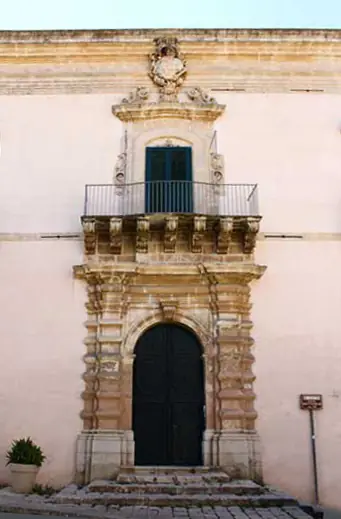
Palazzo Battaglia is a historic civic building and part of Ragusa’s UNESCO heritage. An earlier building was destroyed by the 1693 Val di Noto earthquake, and the present palace began to take shape in 1724 on the initiative of Baron Grandonio Battaglia of Torrevecchia.
Its reconstruction is part of the wider story of Ragusa’s post-earthquake architecture, when much of the city took on its Baroque character.
Santa Maria delle Scale
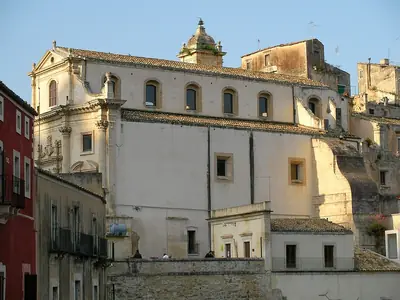
Santa Maria delle Scale stands between Ragusa Ibla and Ragusa Superiore, at the boundary between the city’s two historic centers. Its position makes it an important landmark for understanding Ragusa’s layout as well as a church worth visiting in its own right.
The building combines Gothic, Romanesque and Baroque elements. It also survived parts of the destruction caused by the 1693 earthquake, preserving a visible connection with the city’s earlier architectural history.
Ragusa Cathedral
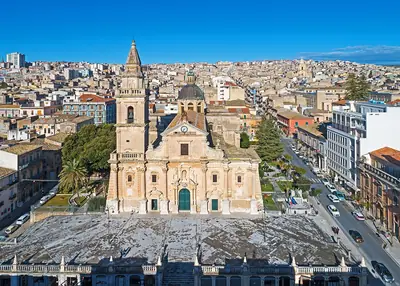
In Ragusa Superiore, the Cathedral of Saint John the Baptist, also known as Ragusa Cathedral, is one of the city’s principal places of worship. It gives the upper district a monumental focus and provides a contrast with the more atmospheric streets and squares of Ibla.
The upper city has a different rhythm from the district below, with broader streets and a more everyday urban atmosphere. Exploring both areas is one of the essential things to do in Ragusa.
Historic palaces in Ragusa Superiore
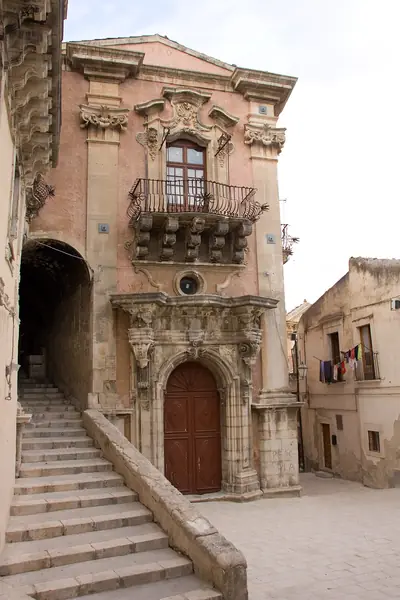
Several palaces add detail to a walk through Ragusa’s historic streets. Palazzo Bertini is a distinctive historic building, while Palazzo della Cancelleria, also known as Palazzo Nicastro, is another notable palace to look for in the city.
These buildings help show how Ragusa’s identity extends beyond its best-known churches. Its historic center is made up of civic architecture, religious landmarks, squares and steep connections between the upper and lower districts.
Giardini Iblei and San Vincenzo Ferreri
The Giardini Iblei offer a green setting and views towards the surrounding countryside. They provide a change of pace after Ragusa Ibla’s stone streets and Baroque buildings.
At the entrance to the gardens stands the former Church of San Vincenzo Ferreri, also known as the Church of Our Lady of the Most Holy Rosary. Located in Piazza G. B. Hodierna, it is no longer consecrated and has been used as a public auditorium since December 2010.
Donnafugata Castle
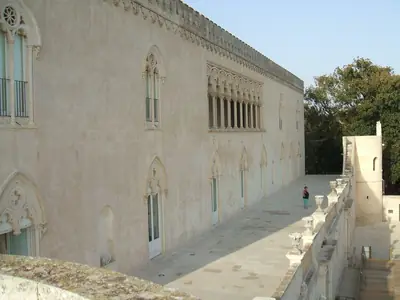
About fifteen kilometres from Ragusa, in the territory of the city, Donnafugata Castle is a grand Sicilian residence rather than a distant fortress. The building is a sumptuous noble residence dating from the late nineteenth century.
It covers more than 7,500 square metres and rises over three floors in a neo-Gothic style. Two side towers crown the building. The residence once stood above the estates of the wealthy Arezzo De Spuches family, and its scale and ornate appearance reflect the ambition of that country residence.
Torre Cabrera in Marina
In Marina, Torre Cabrera stands only a few metres from the sea and the old port, on the southern side of the central square. Also known as Torre di Mazzarelli, it was built as a coastal defence tower at the request of the Count of Cabrera.
Its position connects the town’s public square with the waterfront, making it one of the most distinctive landmarks in this part of Ragusa.
Ragusa’s Baroque heritage
The earthquake of 1693 transformed Ragusa. Much of the city was rebuilt in the Baroque style, while parts of the medieval layout and older architecture remained visible. The result is a city of contrasts: Ragusa Superiore above, Ragusa Ibla below, and historic churches and palaces distributed across steep streets and hillside viewpoints.
Ragusa forms part of the UNESCO-listed Val di Noto, recognized for its exceptional late-Baroque heritage. Nearby Scicli and Noto offer further ways to explore this architectural landscape in southeastern Sicily.
Explore Ragusa with a self-guided audio tour
Download Neywo to explore Ragusa with stories that play as you reach each place, at your own pace, with no group and no schedule. The app includes 2 walking tours and 1 bus route:
- Ragusa Ibla: Baroque Reborn After 1693 — a 2.22 km walk lasting 107 minutes, with 12 narrated stops.
- Upper Ragusa: Bridges, Museums and the Stairs Down to Ibla — a 2.41 km walk lasting 85 minutes, with 9 narrated stops.
- Linea 3: the Ibla shuttle loop — a 7.2 km bus route lasting 31 minutes, with 10 narrated stops.
The narration is available in 11 languages. Use the app to turn a visit to Ragusa’s churches, palaces, gardens and historic streets into a self-guided experience, moving through the city at a pace that suits you.
Places with an audio guide in Ragusa
8 places in Ragusa with a Neywo audio guide. Each one starts telling its story as you reach it.
Self-guided tours in Ragusa
3 tours in Ragusa, free in the Neywo app. Each stop tells its story as you reach it.
- Bus ride
Linea 3: the Ibla shuttle loop
Linea 3 is Ragusa's circular shuttle through Ibla. It passes Porta Walter, the Baroque Palazzo Battaglia, the Purgatorio church, San Rocco and Santa Maria delle Scale, then climbs to Palazzo Bertini and the Cathedral of San Giovanni Battista in the upper town.
Piazza Antonio Gramsci · Santa Maria dei Miracoli, Ragusa · Porta Walter · San Vincenzo Ferreri · Palazzo Battaglia, Ragusa · Chiesa delle Anime del Purgatorio …
Open this tour: Linea 3: the Ibla shuttle loop - Walk
Ragusa Ibla: Baroque Reborn After 1693
The 1693 earthquake flattened Ibla, and the town was rebuilt in a blaze of late Baroque. Start at the Palazzo della Cancelleria and the church of the Itria, pass the arches square of the Purgatorio, the castle site, the cathedral of San Giorgio and the Knights' Cafe, then follow Piazza Pola to San Francesco and end in the Iblei Gardens on the cliff above the Irminio valley.
Palazzo della Cancelleria · Santa Maria dell'Itria, Ragusa · Chiesa delle Anime del Purgatorio · Castle of Ragusa · Duomo of San Giorgio · Porta Walter …
Open this tour: Ragusa Ibla: Baroque Reborn After 1693 - Walk
Upper Ragusa: Bridges, Museums and the Stairs Down to Ibla
Begin in Piazza Gramsci and cross the oldest bridge in Ragusa, then visit the archaeological museum and the cathedral of San Giovanni Battista in the upper town. Walk on past Palazzo Bertini and down to Santa Maria delle Scale, where the two halves of the city meet, and end among the Baroque palaces of Ibla.
Piazza Antonio Gramsci · Ponte vecchio · Museo Archeologico Ibleo · Ragusa Cathedral · Museo Civico Italia in Africa · Palazzo Bertini …
Open this tour: Upper Ragusa: Bridges, Museums and the Stairs Down to Ibla
Walk Ragusa with Neywo
Neywo turns Ragusa into a self-guided audio tour. Stories arrive as you reach the place they belong to, and the route reshapes when you wander off it.

