What to See in Zaragoza, Spain: Free Audio Guide
Things to Do in Zaragoza: What to See in the Aragonese Capital
The best things to do in Zaragoza include exploring Roman ruins, discovering Islamic and Christian architecture, visiting museums, and following the Ebro through the city’s historic and modern quarters. Zaragoza is the capital of Aragón and a city shaped by more than two thousand years of changing cultures, from Caesaraugusta and Saraqusta to the present day. Neywo offers a free audio guide for Zaragoza with 194 narrated places.
What to See in Zaragoza
Basilica of Our Lady of the Pillar
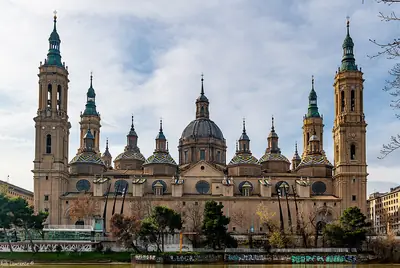
The Basilica of Our Lady of the Pillar is one of Zaragoza’s two metropolitan cathedrals, sharing that role with the nearby Cathedral of the Savior, or La Seo. Its devotion centres on a jasper column known as the Pillar, which tradition connects with an appearance of the Virgin Mary to the apostle Saint James in the year 40.
The present building is a major Baroque work begun in 1681 and developed over the following centuries. Its exterior follows Aragón’s brick-building tradition, while the interior has three equally high naves, barrel vaults, domes, and saucer vaults resting on substantial pillars.
Cathedral of the Savior, or La Seo
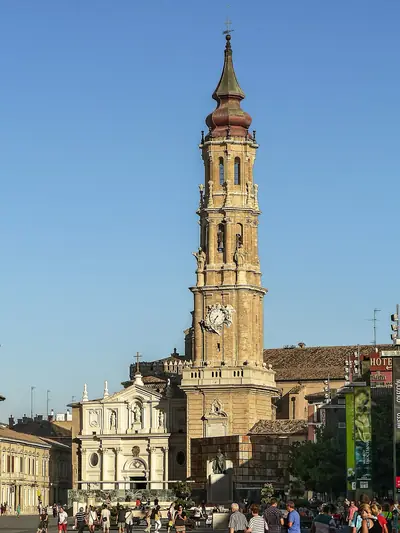
La Seo stands on a site that was first occupied by the Roman forum of Caesaraugusta and later by the main mosque of Saraqusta. The mosque’s minaret influenced the tower that rises above the cathedral today, making the building a particularly clear record of Zaragoza’s religious and urban transformations.
Construction began in the twelfth century in the Romanesque style, and the cathedral was repeatedly altered and enlarged. Its unusual interior has five naves and six bays, all covered by ribbed vaults of equal height. The result is a broad, almost square hall with a striking sense of space.
Aljafería Palace
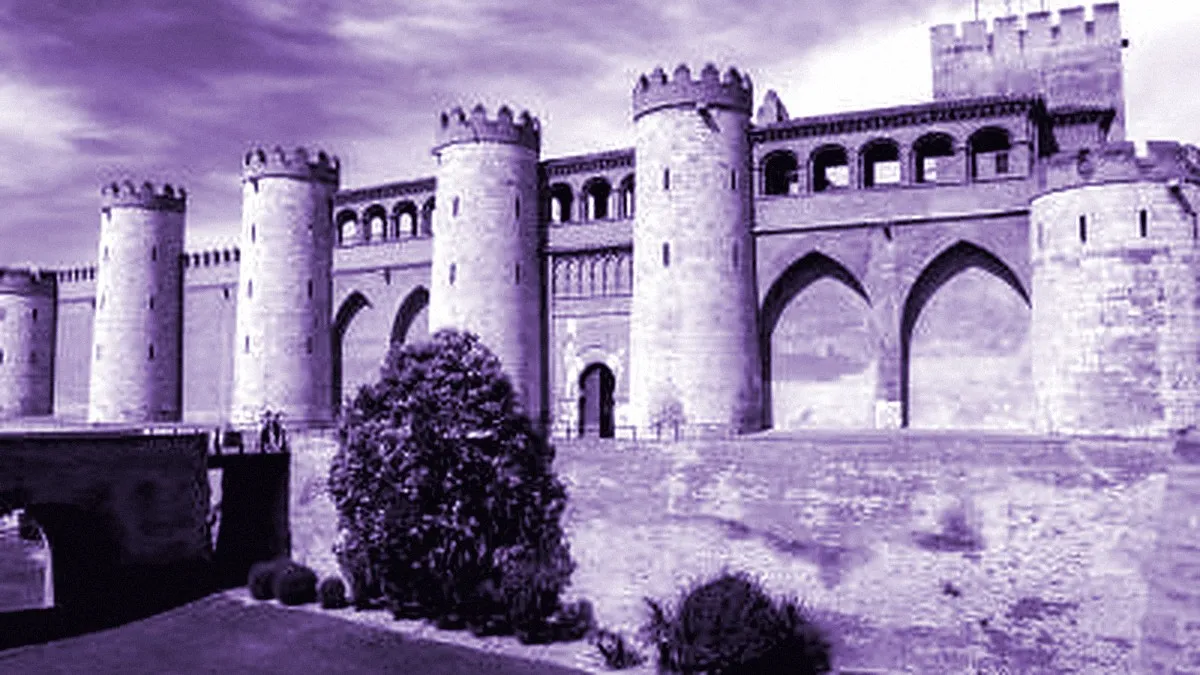
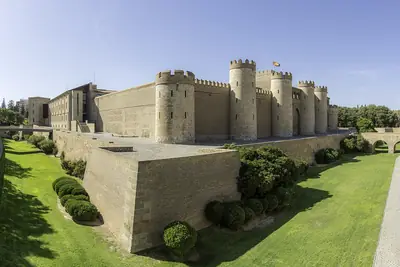
The Aljafería is Zaragoza’s great Islamic landmark and one of the most important surviving examples of Hispano-Muslim palace architecture from the taifa period. It was built in the second half of the eleventh century for Abu Jaffar al-Muqtadir of the Banu Hud dynasty, when the Taifa of Zaragoza was at its political and cultural height.
The palace began as a rectangular fortified enclosure reinforced by sixteen semicircular towers. Behind that defensive exterior, its interiors were designed for a more refined world of courtyards, decoration, and courtly life. Mixtilinear arches, S-shaped springers, open arabesque designs, and vegetal stucco work reveal the artistic importance of the complex. Later Christian, Renaissance, and modern additions form part of its layered history; today, it houses Aragón’s regional parliament.
Roman Theatre of Zaragoza
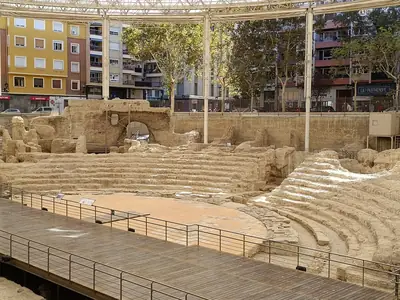
The Roman Theatre of Caesaraugusta is one of the clearest reminders of Zaragoza’s Roman past. Built during the first half of the first century, under the reigns of Tiberius and Claudius, it followed the model of Rome’s Theatre of Marcellus.
The theatre could accommodate around six thousand spectators, a considerable capacity for a city whose population was given as about eighteen thousand. It remained active until the third century, when its materials were reused in walls and other structures. Archaeological excavations brought the remains back to light in the 1970s; they are now preserved as part of the Caesaraugusta Theatre Museum.
Saragossa Museum
The Saragossa Museum, or Museo de Zaragoza, is the oldest museum in the city and one of the broadest introductions to Aragón’s past. Its collections range from prehistory to the twentieth century and include archaeology, fine arts, ethnology, ceramics, and Oriental art.
The main building houses archaeology and fine arts. Other sections include the Casa Pirenaica, dedicated to ethnology, and the Casa de Albarracín, devoted to ceramics. Both stand in Parque José Antonio Labordeta and reproduce traditional architectural models from the regions they represent. The museum also has a section in Velilla de Ebro presenting finds from the archaeological site of Colonia Celsa.
Goya Museum and Casa Aguilar
The Goya Museum—also known as the Ibercaja Collection and Camón Aznar Museum—is one of Zaragoza’s principal fine-arts museums. Its collection contains more than 1,000 works, with around 500 on display, including paintings and engravings by Francisco Goya alongside works from a broader fine-arts collection.
The museum opened in 1979 as the Camón Aznar Museum and took its present name in 2015. The visit also connects with Casa Aguilar, a palace that forms part of the architectural character around the museum.
Alma Mater Museum
The Alma Mater Museum occupies the oldest part of Zaragoza’s Archbishop’s Palace. It brings together artworks and objects belonging to the Diocese of Zaragoza, including altarpiece panels, paintings, and sculptures dating from the fifteenth to the eighteenth centuries.
The collection includes representations of the Virgin of the Pillar and of early Christian martyrs associated with Zaragoza, including Engratia of Zaragoza and Vincent of Zaragoza. The museum opened in 2011 as the Diocesan Museum of Zaragoza and adopted the name Alma Mater Museum in 2016.
Basilica of Saint Engratia
The Basilica of Saint Engratia, or Santa Engracia, stands on a site associated with an early Christian chapel dedicated to Saint Engratia and other Zaragoza martyrs. The church remained active during the Visigothic period and later became the centre of a Mozarab community during Islamic rule.
The former Plateresque monastery was eventually demolished after the Sieges of Zaragoza, but its Renaissance entrance survives. The church’s crypt also preserves two Early Christian sarcophagi, offering some of the oldest surviving evidence connected with the site.
Casa de los Morlanes
Casa de los Morlanes is a sixteenth-century building on Plaza de San Carlos. Although its original interior has been completely renewed, the façade remains an important example of Zaragoza’s historic domestic architecture.
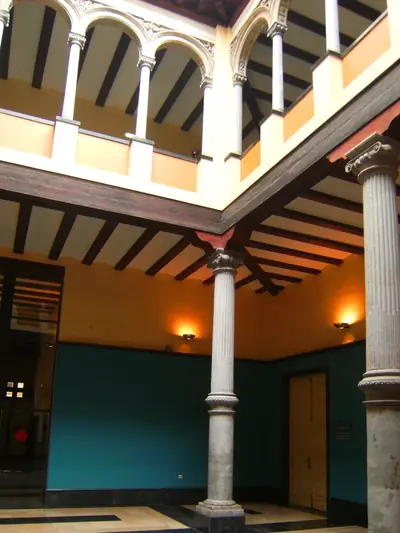
Its plaster decoration was completed in 1555. The three-level façade combines a stone base, brickwork, framed windows, and a gallery of doubled semicircular arches. The richest decoration surrounds the windows of the main floor, where vegetal patterns, grotesques, garlands, and small angels appear in the plasterwork.
Casa de Miguel Donlope
Beside La Seo on Calle Dormer, Casa de Miguel Donlope is one of Aragón’s best-preserved Renaissance palaces. Miguel Donlope ordered its construction during the third and fourth decades of the sixteenth century; the building was completed in 1542, although work on its decoration continued afterwards.
The palace is now home to the Real Maestranza de Caballería de Zaragoza. Its Renaissance architecture and the story of its owner make it one of the most interesting historic residences in the cathedral quarter.
Monumento al Justicia and Plaza de Aragón
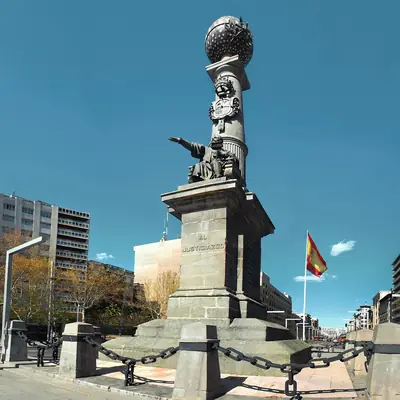
The Monumento al Justicia, also known as the Monumento al Justiciazgo, stands in Plaza de Aragón. Founded in 1892 and installed in 1904, it is one of the defining landmarks of the square.
Plaza de Aragón lies at one end of Paseo de la Independencia. The boulevard separates it from Plaza de España, while the square is also home to the Capitanía General building, described as an example of late Neoclassicism.
Palacio de Montemuzo
Palacio de Montemuzo is a Renaissance palace that now houses Zaragoza’s Municipal Archive. Built at the end of the sixteenth century, it is connected at ground-floor level with Casa Artiach, a residential building from the beginning of the twentieth century designed with eclectic and Modernist decorative elements.
Expo 2008 and Anfiteatro Expo
The Expo 2008 site brings a modern architectural dimension to Zaragoza. Beside the Ebro and at the foot of Zaha Hadid’s Bridge Pavilion, Anfiteatro Expo was designed as a large performance venue protected from changing weather.
The covered amphitheatre has a 600-square-metre stage and seating for up to 7,000 people. Its structure was designed by Félix Escrig Pallarés.
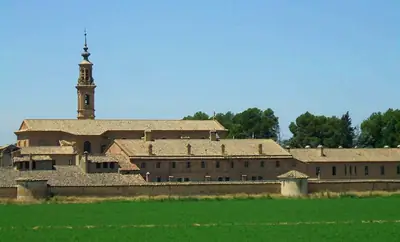
Charterhouse of Aula Dei
A little north of Zaragoza, the Charterhouse of Aula Dei, or Cartuja de Aula Dei, offers a quieter historic setting. The former Carthusian monastery was built in 1563 and declared a National Monument in 1983. It is now protected as a Site of Cultural Interest and has housed a Community of Chemin Neuf since around 2011.
Explore Zaragoza with a Self-Guided Audio Tour
Neywo makes it easy to explore Zaragoza independently. Its six walking tours range from 1.09 to 3.09 km and from 39 to 104 minutes, with a total of 46 narrated stops across the walks. They cover the Pilar and La Seo cathedral quarter, Roman Zaragoza, the palaces and plazas of the Coso, the Aljafería and the Heroines of the Sieges, San Pablo and the market, and Expo 2008.
There is also one 3.6 km bus route lasting 15 minutes with eight narrated stops, and one 9.1 km bike route lasting 46 minutes with five stops. The app tells the story of each place as you reach it, at your own pace, with no group and no schedule. Download Neywo and explore Zaragoza with a free audio guide whenever you choose. To place Zaragoza in a wider journey through Spain, you can also discover other cities such as Madrid, Mérida, or Logroño.
Places with an audio guide in Zaragoza
8 places in Zaragoza with a Neywo audio guide. Each one starts telling its story as you reach it.
Self-guided tours in Zaragoza
8 tours in Zaragoza, free in the Neywo app. Each stop tells its story as you reach it.
- Bike ride
Aljafería by Bike: West Side Cycle Lane
A ride on Zaragoza's segregated cycle lanes from the Portillo district to the Aljafería palace and on to the Delicias and Legion memorial area. Short and flat, with the Moorish palace as the highlight.
Church of las Fecetas · Teatro de la Estación · Aljafería · Church of St. Pedro de Arbués · Legion memorial
Open this tour: Aljafería by Bike: West Side Cycle Lane - Bus ride
Bus 22: Across Zaragoza's Heart
A regular daytime city line that runs from Las Fuentes through the old Magdalena district, past San Miguel, Santa Engracia and Plaza Paraíso, then along Paseo María Agustín to CaixaForum. Ride it to see the city's churches, the Puerta del Carmen with its siege scars and the modern art of the Pablo Serrano museum without a walk.
Church of San Nicolás de Bari · Centro de Historia (Zaragoza) · Iglesia parroquial de San Miguel de los Navarros · Cripta de Santa Engracia · Plaza de Basilio Paraíso · Puerta del Carmen …
Open this tour: Bus 22: Across Zaragoza's Heart - Walk
Pilar, Seo and the Renaissance Exchange
Zaragoza's two cathedrals stand a few hundred metres apart on the Ebro bank. Start in the Plaza del Pilar at the jasper Pillar of the Basilica, pass the Goya collection, the little bronze horse and the brick Renaissance Lonja, then reach La Seo, whose tower still carries the shape of a mosque minaret, and the Dean's Arch. The walk ends with two brick Renaissance houses and the 1799 Teatro Principal on the Coso.
Plaza de Nuestra Señora del Pilar · Basilica of Our Lady of the Pillar · Goya Museum - Ibercaja Collection - Camón Aznar Museum · Caballito de La Lonja · Lonja de Zaragoza · Alma Mater Museum …
Open this tour: Pilar, Seo and the Renaissance Exchange - Walk
Caesaraugusta: Roman Zaragoza Underfoot
Augustus founded Caesaraugusta here around 14 BC, and its forum, baths, theatre and river port lie beneath the old town. Walk from the surviving Roman walls and the statue of the emperor down to museums built over the excavations, and see how a provincial Roman city lived, bathed, traded and went to the theatre.
Augustus memorial · Church of San Juan de los Panetes (Zaragoza) · Museum of the Public Baths of Caesaraugusta · Roman Theatre of Zaragoza · Museo del Foro de Caesaraugusta · Museum of the River Port of Caesaraugusta
Open this tour: Caesaraugusta: Roman Zaragoza Underfoot - Walk
Palaces and Plazas of the Coso
The old Roman wall line became El Coso, the avenue where Aragonese nobles built their houses. Pass Renaissance palaces and courtyards, a medieval Mudejar tower in the quiet Plaza de San Felipe and Pablo Gargallo's sculpture museum, then Plaza de España, the 1799 Teatro Principal and the Renaissance Montemuzo palace.
Palacio de los Luna · Iglesia de Santo Tomás de Villanueva · Palacio de Fuenclara · Torreón Fortea · Pablo Gargallo Museum · Palacio de los condes de Sástago …
Open this tour: Palaces and Plazas of the Coso - Walk
Aljafería and the Heroines of the Sieges
From the Moorish Palace of Joy to the monuments of Napoleon's sieges. Begin at the Aljafería, the finest taifa palace in Spain, then follow the trail of Agustina de Aragón, General Palafox and the defenders of 1808-09 to Santa Engracia and the Plaza de los Sitios.
Aljafería · Agustina de Aragón memorial · Monumento a Palafox · Pablo Serrano Museum · Puerta del Carmen · Plaza de Basilio Paraíso …
Open this tour: Aljafería and the Heroines of the Sieges - Walk
San Pablo and the Mercado: Zaragoza's Working Quarter
Away from the cathedrals, the San Pablo district, known as El Gancho, keeps the city's third cathedral, a Baroque palace front and the iron-and-glass central market. Walk from a convent that is now the fire museum to the old fish market that became a theatre.
Museo del Fuego y de los Bomberos · Iglesia de San Pablo · Palacio de los Duques de Villahermosa · Teatro del Mercado · Mercado de Lanuza · Fuente de la Samaritana
Open this tour: San Pablo and the Mercado: Zaragoza's Working Quarter - Walk
Expo 2008: Zaha Hadid's Bridge on the Ebro
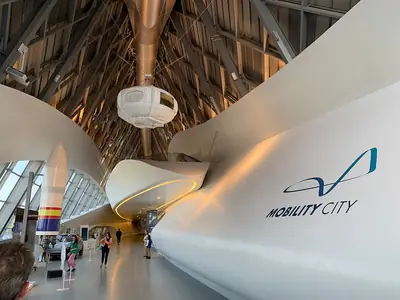
The 2008 Water Expo left Zaragoza a riverside showground. Cross to Zaha Hadid's gladiolus-shaped Bridge Pavilion, then see the covered amphitheatre at its foot, the Mobility City museum and the Arbolé theatre.
Bridge Pavilion · Anfiteatro Expo · Mobility City · Nuevo Teatro Arbolé
Open this tour: Expo 2008: Zaha Hadid's Bridge on the Ebro
Walk Zaragoza with Neywo
Neywo turns Zaragoza into a self-guided audio tour. Stories arrive as you reach the place they belong to, and the route reshapes when you wander off it.

