Almería, Spain: Self-Guided Walking Tour
Things to do in Almería: what to see in the city
The best things to do in Almería include exploring the Alcazaba, discovering archaeological remains beneath the modern city, and visiting museums devoted to local art, photography, cinema and music. Almería’s history stretches from Roman trade and Islamic rule to its modern film and football culture. Neywo offers a free audio guide for Almería with 61 narrated places, available in 11 languages.
Part of Andalusia in southern Spain, Almería is a city where the past is visible in its fortifications, museums and streets. Its sights range from a nearly thousand-year-old hilltop fortress to a market, a contemporary art museum and a coastal watchtower.
What to see in Almería
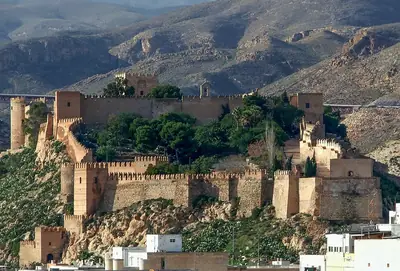
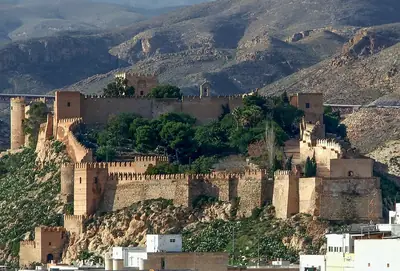
Alcazaba de Almería
The Alcazaba is Almería’s defining monument: a vast fortress standing on Cerro de San Cristóbal above the city. It is one of the most important monumental and archaeological complexes in Andalusia, preserving nearly a thousand years of architectural history from Arab rule in Al-Andalus as well as later Christian additions.
The fortification has walls more than three metres thick and about five metres high, with a perimeter of roughly 1,430 metres. The site is connected with the Hoya ravine and Cerro de San Cristóbal, forming a larger defensive and cultural landscape. The castle and towers added in the 15th and 16th centuries show how the complex continued to evolve after the Muslim period.
Puerta de Almería archaeological site
Below the modern city, the Puerta de Almería archaeological site brings together remains from two very different periods. It contains the only preserved Roman remains in Almería: a fish-salting factory where fish was processed and packed for trade across the Mediterranean.
Stone vats and channels reveal how fish was cleaned, salted and cured, while amphorae once carried garum, the fermented fish sauce prized in the Roman world. The site also preserves part of a gate in the southern wall of the medieval Islamic city, including its threshold, hinge sockets and worn stones.
Museo de Almería
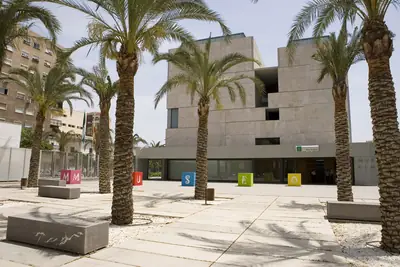
The Museum of Almería is the province’s leading archaeological museum and holds its largest and most representative collection of archaeological objects. Its displays cover the region from prehistoric times through antiquity.
The institution began as the Provincial Archaeological Museum of Almería in 1933 and became a public institution the following year. The current building, opened in 2006, is a distinctive modern design that received several architectural and museum awards.
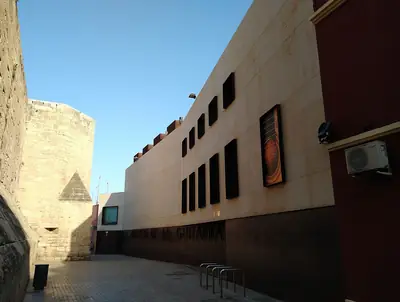
Antonio de Torres Spanish Guitar Museum
The Antonio de Torres Spanish Guitar Museum explores the instrument’s place in Spanish musical history through the work of its most influential maker. The museum holds three guitars built by Antonio de Torres himself.
Its most remarkable object arrived in 2020: the oldest known Spanish guitar, dating from 1684. The instrument had once belonged to Torres, who acquired and studied it before developing his own contribution to guitar making.
The building also has a former life. It opened in 2009 as the Museo de la Ciudad, presenting Almería’s history from prehistory and Muslim rule to the Christian reconquest and the modern era. When that museum closed in 2013, its collections moved to the Heritage Interpretation Center in the old Casa del Policía on Plaza Vieja.
Centro Andaluz de la Fotografía
The Andalusian Center of Photography occupies a 19th-century building that originally housed the Liceo Artístico y Literario, a cultural society devoted to art, literature and debate. The centre was created in 1992 and approaches photography through exhibitions, workshops, research, publications and the preservation of Andalusia’s photographic heritage.
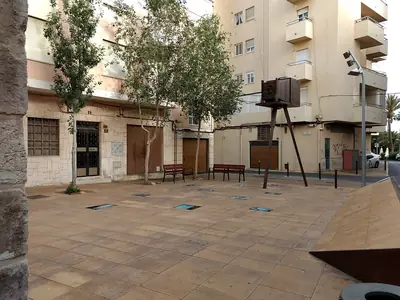
It also produces its own projects and works with photography collectives. The small plaza outside contains a monument to Manuel Falces, adding another point of interest before entering the exhibitions and archive spaces.
Casa del Cine
Casa del Cine celebrates Almería’s role in international filmmaking. The city and its surrounding province have served as settings for stories representing the American West, the Middle East and even distant planets.
The cultural centre explains how the landscapes of this corner of southeastern Spain became versatile filming locations. It is a natural stop for anyone interested in the relationship between Almería and cinema.
Casa Doña Pakyta
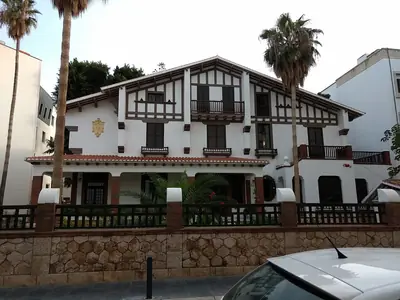
Casa Doña Pakyta is one of the two sites belonging to the Museo de Arte de Almería. The building was commissioned in 1928 by Antonio González Egea and designed by architect Guillermo Langle. It was originally a family home known as Casa Montoya or Casa Vasca, reflecting its distinctive Basque-influenced style.
Francisca Díaz Torres, known as Doña Pakyta, later gave the property to the city. It opened as a public museum in May 2015. Its collection focuses on art from Almería and the surrounding province, particularly paintings and sculptures created between roughly 1880 and 1970. High ceilings, original woodwork and domestic rooms give the museum an intimate setting.
Espacio 2
Espacio 2 is the second site of the Museo de Arte de Almería and focuses on contemporary art. Together with Casa Doña Pakyta, it presents the city’s municipal collection across different periods, with Espacio 2 taking up the story from 1980 onward.
Museo del Realismo Español Contemporáneo
The Museum of Contemporary Spanish Realism, known as MUREC, opened on March 15, 2024. It occupies the former Hospital of Santa María Magdalena in Almería and is dedicated to contemporary Spanish realist art.
Almería Central Market
Near Puerta de Purchena, Almería Central Market is the city’s historic Mercado Central. It was Almería’s first supply market and for many years its largest, serving as the principal source of goods for local residents.
The market offers a look at the practical, everyday side of the city, complementing the monuments and museums of the historic centre.
Almería Walk of Fame
On Poeta Villaespesa Street, beside the Teatro Cervantes, the Almería Walk of Fame pays tribute to actors and filmmakers who have worked in the province. It is a simple promenade that reflects Almería’s long connection with the cinema industry.
Portada del Ingenio
Also known as the Puerta del Ingenio, the Portada del Ingenio is a historic monumental gateway and one of Almería’s enduring reminders of its layered past.
Torre de San Miguel
On the Cabo de Gata coast, Torre de San Miguel is an 18th-century military watchtower built to spot threats approaching from the sea and raise the alarm. It formed part of the coastal defensive chain protecting Andalusia.
The tower was declared a monument and recognised as a Bien de Interés Cultural in 1985. Its current state of abandonment and weathered stonework are part of its story, showing the effects of time while preserving the memory of the coast’s strategic role.
Estadio de los Juegos Mediterráneos
The Estadio de los Juegos Mediterráneos is the home of UD Almería. It opened in 2004 and hosted the fifteenth Mediterranean Games in 2005, when athletes from across the region came to Almería.
The stadium has also been known as the Power Horse Stadium and the UD Almería Stadium. Its changing names and seating arrangements reflect its history as a modern venue shaped by both international sport and the city’s football culture.
Explore Almería with Neywo
Neywo’s free Almería audio guide includes 61 narrated places. You can choose from three walking tours, one bus route and one bike route:
- Fortress, Cathedral and Guitar: Almería’s Old Quarter — 1.79 km, 89 minutes and 12 narrated stops.
- From Plaza Vieja to the Cable Inglés: Almería’s Belle Époque and Cinema — 2.41 km, 94 minutes and 12 narrated stops.
- Eastern Almería: Royal Cisterns, Holy Week and the Archaeology Museum — 1.87 km, 62 minutes and 7 narrated stops.
- Bus L1: The Historic Centre Line to the Alcazaba Hill — 5.1 km, 22 minutes and 10 narrated stops.
- Eastern Almería by Bike: Diezmo Castle to the Arts Museum — 2 km, 10 minutes and 3 narrated stops.
Download Neywo and explore Almería at your own pace. The app tells the story of each place as you reach it, with no group and no schedule.
Places with an audio guide in Almería
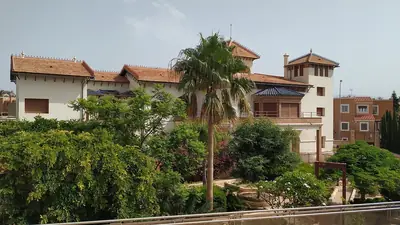
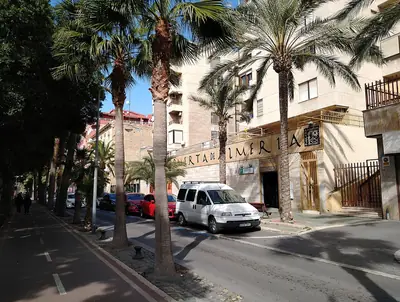
8 places in Almería with a Neywo audio guide. Each one starts telling its story as you reach it.
Self-guided tours in Almería
5 tours in Almería, free in the Neywo app. Each stop tells its story as you reach it.
- Bike ride
Eastern Almería by Bike: Diezmo Castle to the Arts Museum
A short ride along Almería's eastern cycle lanes from the site of the Castle of Diezmo, past the archaeology museum, to Espacio 2, the municipal museum of contemporary Almería art.
Castle of Diezmo · Museo de Almería · Espacio 2
Open this tour: Eastern Almería by Bike: Diezmo Castle to the Arts Museum - Bus ride
Bus L1: The Historic Centre Line to the Alcazaba Hill
Almería's L1 bus was created to serve the narrow streets of the old town. It links the Central Market and the museum district with the Roman remains at the Puerta de Almería and the foot of the Alcazaba hill, a cheap and easy way to see the historic centre.
Colegio de la Compañía de María · Almería Central Market · Juan Cassinello square · Almería Walk of Fame · Doña Pakyta Art Museum · Centro Andaluz de la Fotografía …
Open this tour: Bus L1: The Historic Centre Line to the Alcazaba Hill - Walk
Fortress, Cathedral and Guitar: Almería's Old Quarter
Climb to the Alcazaba, the great Moorish fortress above the port, then drop through the Almedina quarter to the Roman fish-salting vats beneath the street and the only civil building of the 16th century left in the city. Visit the poet's house, a palace-archive and the only fortress-cathedral of its kind in Spain, then the museum of Antonio de Torres, the Almería-born father of the modern classical guitar.
Alcazaba y Murallas del Cerro de San Cristóbal · San Anton hermitage · Iglesia de San Juan Evangelista · Puerta de Almería archaeological site · Hospital de Santa María Magdalena · Casa del Poeta …
Open this tour: Fortress, Cathedral and Guitar: Almería's Old Quarter - Walk
From Plaza Vieja to the Cable Inglés: Almería's Belle Époque and Cinema
Wander from the arcaded Plaza Vieja and the busy Central Market to Almería's elegant theatre, its cinema Walk of Fame and the mansions of the early twentieth century. Pass a Jesuit church and a Romanian Greek-Catholic one, a forest of 142 pillars in memory of Mauthausen deportees, and end at the Cable Inglés, an iron-ore loading pier reaching into the sea.
Plaza de la Constitución de Almería · Archivo Histórico Provincial de Almería building · Almería Central Market · Iglesia de San Pedro El Viejo · Antiguo Convento de Santo Domingo · Edificio del Círculo Mercantil e Industrial y Teatro Cervantes …
Open this tour: From Plaza Vieja to the Cable Inglés: Almería's Belle Époque and Cinema - Walk
Eastern Almería: Royal Cisterns, Holy Week and the Archaeology Museum
Leave the centre for the quieter east. Start at the 11th-century cisterns built by the taifa king Jairán, pass a Holy Week church, the provincial council and an old theatre, then reach the province's premier archaeology museum and the municipal museum of Almerian art.
Aljibes árabes de Jairán · Iglesia de San Sebastián · Edificio de la Diputación Provincial · Teatro Cine Apolo · Colegio de la Compañía de María · Museo de Almería …
Open this tour: Eastern Almería: Royal Cisterns, Holy Week and the Archaeology Museum
Walk Almería with Neywo
Neywo turns Almería into a self-guided audio tour. Stories arrive as you reach the place they belong to, and the route reshapes when you wander off it.

