Things to Do in Pamplona, Spain: Walking Guide
Things to do in Pamplona
Pamplona, the historic capital of Navarre, layers Roman foundations, medieval fortifications and a lively northern Spanish identity, most famously celebrated during the San Fermín festival and its running of the bulls. The city offers a compact old town filled with Renaissance palaces, a complete cathedral complex, museums that trace Navarre’s deep past, and green spaces that contrast with its bustling streets. Neywo provides a free audio guide for Pamplona with 77 narrated places, letting you hear the story of each site as you walk at your own pace.
Explore Pamplona’s highlights
Palacio Condestable de Pamplona
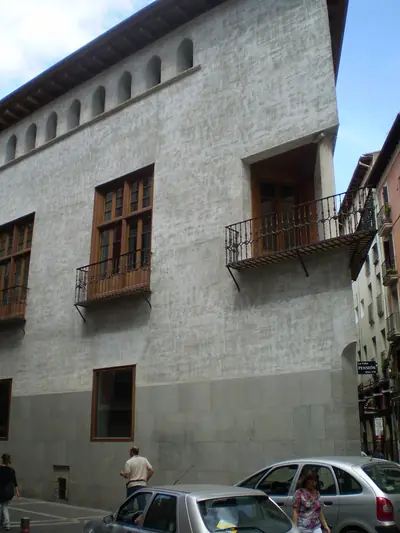
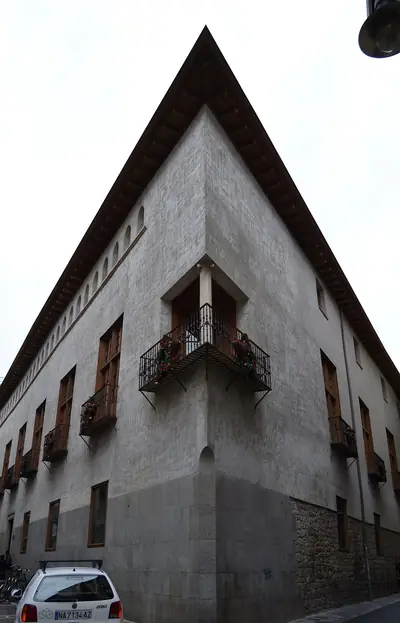
This Renaissance palace stands where Calle Mayor meets Calle Jarauta. Its rectangular central courtyard is surrounded by stone columns with eight sides, a detail visible in the restored building. Declared a Cultural Heritage monument in 1997, the palace now houses the Civivox Condestable cultural centre, a public library and the Pablo Sarasate Museum, revealing original wooden ceiling structures from the sixteenth century.
Pamplona Cathedral
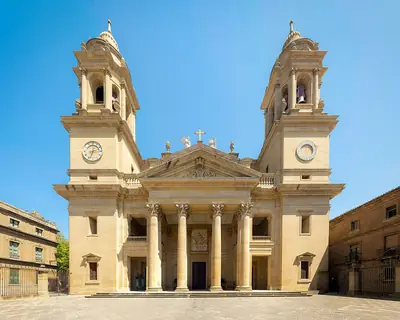
Known as the Cathedral of Santa Maria of the Assumption, the site forms a remarkably complete complex that includes the church, cloister, sacristies, a storeroom, refectory, chapter house and dormitory. Gothic architecture dominates the church and cloister, built between the fourteenth and sixteenth centuries, while the western façade was added in the late eighteenth century in a Neoclassical style. The cloister is regarded as a marvel of European Gothic art and one of the finest surviving examples in the region. The cathedral’s Gothic structure also served as an important stop on the medieval pilgrimage route to Santiago de Compostela.
Museum of Navarre
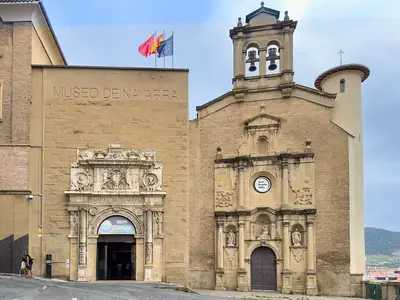
Housed in the former Hospital of Nuestra Señora de la Misericordia, a building dating from the first half of the sixteenth century, the museum displays an original Plateresque façade and an adjoining Renaissance chapel—both unique examples of this style in Pamplona. Its permanent collection follows a chronological path from Paleolithic and Iron Age objects through Roman, pre‑Romanesque, Romanesque, Muslim, Gothic and Renaissance art. Highlights include the Abauntz map, the Lerga funerary stone, a mosaic from the Roman town of Ramalote in Tudela, Romanesque capitals and a Spanish‑Muslim ivory chest. Recently, the Irulegi Hand and the Man of Loizu have been on display in the redesigned prehistory galleries since December 17, 2024, and the museum currently holds the Togatus of Pompaelo.
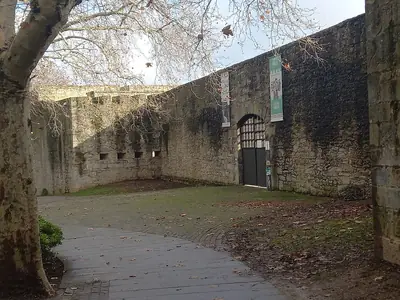
Walls of Pamplona Interpretation Center
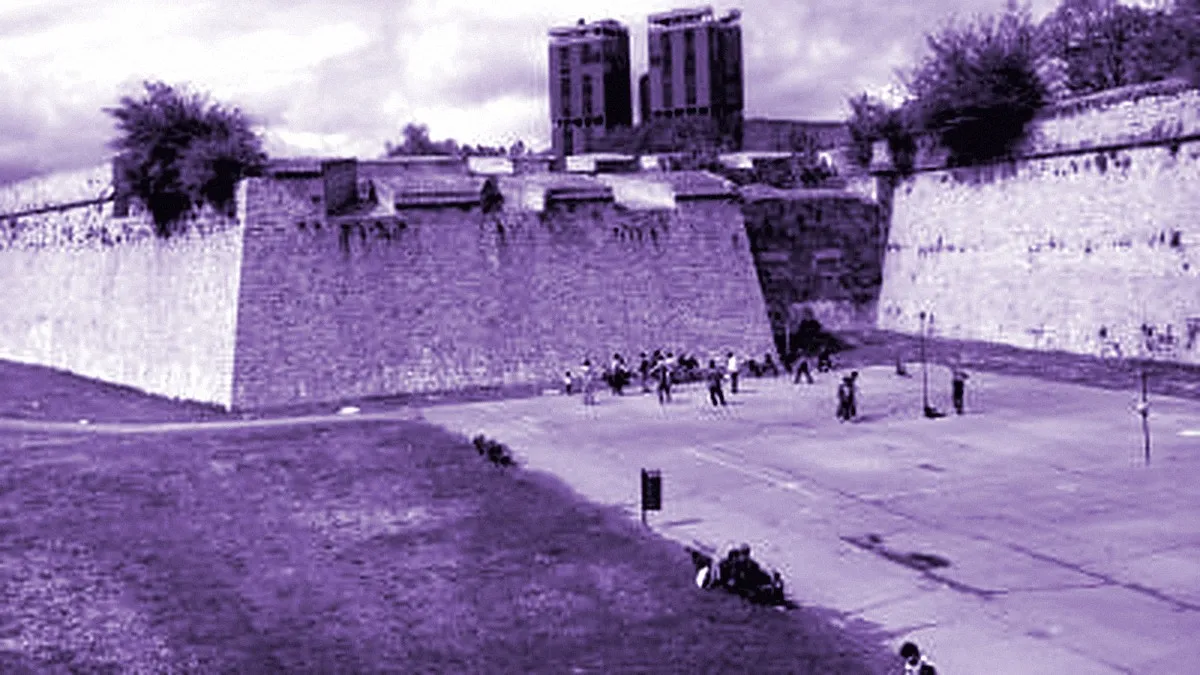
Located in the San Bartolome Bastion within the city’s historic fortifications, beside Medialuna Park, the bullring and the descent of Labrit, this museum presents the story of Pamplona’s walls. Exhibits explain the construction, function and evolution of the defenses that have surrounded the settlement for centuries.
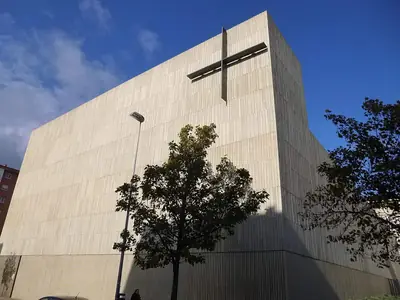
Church of San Jorge
The parish church of the San Jorge neighborhood was established on April 26, 1968 by Archbishop Enrique Delgado Gómez. For about forty years it operated in the ground floor of a residential block before a new building, designed by Fernando Tabuenca and Jesús Leache after an architecture competition launched in 2000 by Archbishop Fernando Sebastián Aguilar, was inaugurated in 2008. The complex centres on a broad atrium: the church occupies one side of a rectangular block set perpendicular to San Jorge Avenue, while the parish centre—containing offices, catechism rooms and priest accommodation—lies on the other. A continuous concrete wall encloses the site, with a bell and an iron cross placed above the two entrances.
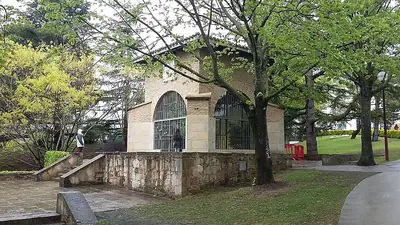
Ermita de Santa María Madre del Amor Hermoso
This small hermitage offers a quiet spot for reflection. Visitors are invited to experience the place at their own pace, taking in its modest architecture and surrounding setting.
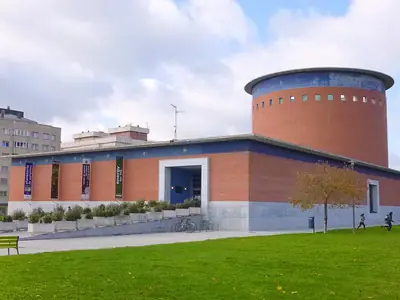
Planetario de Pamplona
Opened on November 26, 1993 with an inauguration attended by Infanta Cristina and Navarrese authorities, the planetarium sits in Yamaguchi Park. Its red‑brick building combines a cylindrical structure and a parallelepiped shaped according to the golden proportions. The main spectacle takes place in Tornamira Hall beneath a dome twenty metres in diameter, described as the largest of its kind in Spain. A star projector, seventy additional projectors and other audiovisual systems create journeys through space, showing more than nine thousand stars overhead. Programmes explore the birth and death of stars and invite visitors to imagine the cosmos.
Museo Pablo Sarasate
This museum is dedicated to the violinist Pablo Sarasate, who was born in Pamplona. It presents an exhibition that traces his life, performances and legacy, highlighting his contribution to classical music.
University Museum of Navarra
Located on the University of Navarra campus, the museum occupies a building designed by Rafael Moneo that extends over more than 11 000 square metres across three floors, with 3 000 square metres devoted to exhibition space. Inside are twelve galleries, workshops, classrooms, a restaurant and a terrace. Opened on January 22, 2015 by King Felipe VI and Queen Letizia Ortiz, the museum’s main purpose is educational, supporting the learning experience of university students while welcoming the wider community through temporary exhibitions, presentations from the permanent collection, public activities and artistic events.
Monumento a los Fueros de Navarra
The monument commemorates the Gamazada, a popular reaction in 1893‑1894 against a proposal by Germán Gamazo to abolish Navarre’s special fiscal regime. Demonstrations, formal protests and a collection of more than 120 000 signatures were presented to the regent Maria Christina when Navarre had around 300 000 inhabitants. A brief armed revolt near Puente la Reina in June 1893, carried out under the cry “Long live the fueros,” was quickly stopped, and Navarrese institutions publicly rejected violent methods.
El Sadar Stadium
Home to Club Atlético Osasuna, El Sadar is noted for having one of the best atmospheres in Spanish football. Built in the 1960s and officially opened on September 2, the pitch measures 105 metres by 67.5 metres and the stadium holds more than 23 000 spectators. The name honours the nearby Sadar River; the venue was once called Reyno de Navarra under a sponsorship deal. Over the years it has received a new upper preferential stand, updated press areas, upgraded video scoreboards, improved pitch views and the removal of the former barrier separating the lower stands from the playing area. It lies in the southern part of the Arrosadia neighbourhood, beside the Navarra Arena pavilion.
Plaza de Toros de Pamplona
The bullring, projected in 1920 and completed in 1922, can accommodate about 19 720 spectators, making it one of the largest bullrings in the world. Besides bullfighting, it hosts concerts and other performances. During the final months of the Spanish Civil War in 1939, the arena was repurposed as a Francoist concentration camp that held thousands of Republican prisoners, adding a sombre chapter to its history.
Castle Square (Plaza del Castillo)
Covering almost 14 000 square metres, this central space has long been described as the living room of Pamplona. It took shape in the middle of the sixteenth century and served as a market, agricultural area, setting for celebrations and fairs, and the main venue for bullfights from 1385 to 1844. Today the square fills with cafés and social gatherings. Its name recalls the castle that once stood on the eastern part, built by Luis Hutín in 1310 as a military parade ground. During the Middle Ages the square acted as a neutral zone during conflicts between three towns, giving it both military and civic importance. At its centre stands the Kiosko de la Plaza del Castillo, a distinctive feature that marks the square’s evolution from a martial ground to a relaxed meeting place.
San Fermín
The San Fermín festivities honour Saint Fermín and run from July 6 through July 14. The celebration begins at noon on July 6 with the chupinazo, a ceremonial rocket launched from the balcony of City Hall. It ends with the traditional farewell song “Pobre de mí.” The best‑known tradition is the encierro, or running of the bulls: each morning from July 7 to 14 at eight o’clock, participants run an 849‑metre route ahead of six bulls and six steers, finishing at the bullring. The run usually lasts between two and four minutes. San Fermín has been celebrated in July for more than four hundred years; in 1591 the date was moved from October 10 to July 7 following an order from Bernardo Sandoval, Bishop of Pamplona, linking the festival to the day commemorating Navarre’s union with the Crown of Castile.
Royal and General Archive of Navarre
Situated in the historic Palace of the Kings of Navarre, the archive began as a twelfth‑century royal residence before passing through several roles—episcopal residence, viceroyal headquarters, Captaincy General headquarters and Military Government until 1971. The palace retains a Gothic hall with vaulted ceilings and a porticoed courtyard garden. Inside, a specialised library holds about 3 000 ancient volumes and numerous other documents that trace Navarre’s documentary heritage.
Discover Pamplona with Neywo
Neywo’s free audio guide for Pamplona includes five walking tours and one bus route. The walks are:
- “Run with the Bulls: The Encierro Route and Old Town Squares” – 2.19 km, 84 minutes, 11 stops
- “Pilgrims, Kings and the Cathedral of Navarrería” – 2.82 km, 109 minutes, 12 stops
- “Walls, Bastions and Gardens: Pamplona’s Fortifications” – 2.02 km, 78 minutes, 10 stops
- “Yamaguchi Park and the University of Navarra” – 1.87 km, 51 minutes, 5 stops
- “The Ensanches: Squares, Churches and the Belle Epoque Edge of Pamplona” – 1.83 km, 70 minutes, 9 stops
The bus route is:
- “Line R1: Plaza de los Fueros to the Magdalena Bridge” – 8.4 km, 36 minutes, 6 stops
Each story plays automatically as you reach the site, allowing you to explore at your own pace with no group and no schedule. Narration is available in 11 languages, so you can choose the language that suits you best. Download Neywo today and let the city’s history, culture and festivities come alive wherever you walk.
For further travel ideas in northern Spain, you might also consider visiting nearby destinations such as Zaragoza, Madrid or Logroño, and explore the broader region of Spain.
Places with an audio guide in Pamplona
8 places in Pamplona with a Neywo audio guide. Each one starts telling its story as you reach it.
Self-guided tours in Pamplona
6 tours in Pamplona, free in the Neywo app. Each stop tells its story as you reach it.
- Bus ride
Line R1: Plaza de los Fueros to the Magdalena Bridge
Ride the city's R1 bus from the Sadar side through the centre and across to the Rochapea. It passes the Plaza de los Fueros, the Korean statue, the Media Luna park and the medieval Magdalena bridge on the Camino de Santiago.
Plaza de los Fueros · The Korean · Parque de La Media Luna · Puente medieval de la Magdalena · Building of old Archivo General de Navarra · Church of San Antonio, Pamplona
Open this tour: Line R1: Plaza de los Fueros to the Magdalena Bridge - Walk
Run with the Bulls: The Encierro Route and Old Town Squares
Follow the streets where Pamplona's bulls race every July, from the fortress-church of San Cernín and the balcony of City Hall to Estafeta Street, the bronze runners and the bullring. Hemingway's fiesta, in walkable form, with pintxos stops along the way.
Church of San Fermín de Aldapa · Church of San Cernín, Pamplona · City Hall Square, Pamplona-Iruña · Kingdom of Navarre · Palacio de Navarra · Estafeta Street …
Open this tour: Run with the Bulls: The Encierro Route and Old Town Squares - Walk
Pilgrims, Kings and the Cathedral of Navarrería
Enter Pamplona the way Camino pilgrims do, over the medieval Magdalena Bridge and through the France Gate, then wander the oldest quarter. The Gothic cathedral with its finest cloister, a royal palace turned archive and Renaissance mansions fill the route.
Puente medieval de la Magdalena · Portal de Francia · Palace of the Kings of Navarre · Palacio Marqués de Rozalejo · Pamplona Cathedral · Arzobispado de Pamplona …
Open this tour: Pilgrims, Kings and the Cathedral of Navarrería - Walk
Walls, Bastions and Gardens: Pamplona's Fortifications
Walk the green edge of the old city: the promenade with its mysterious royal statues, a Romanesque church-fortress, the Baluarte, the star-shaped Renaissance Citadel and the gate and gardens of La Taconera, the oldest park in the city.
Monumento a los Fueros de Navarra · Paseo de Sarasate · Iglesia de San Nicolás · Palacio de Congresos y Auditorio de Navarra (Baluarte) · Citadel of Pamplona · Portal de San Nicolás …
Open this tour: Walls, Bastions and Gardens: Pamplona's Fortifications - Walk
Yamaguchi Park and the University of Navarra
A quieter southern walk: a Japanese-designed park, the city planetarium, a hermitage and the contemporary art museum on the university campus.
Planetario de Pamplona · Parque Yamaguchi · Ermita de Santa María Madre del Amor Hermoso · University Museum of Navarra · University of Navarre
Open this tour: Yamaguchi Park and the University of Navarra - Walk
The Ensanches: Squares, Churches and the Belle Epoque Edge of Pamplona
Step out of the walls into the 19th-century extensions. Pass the old archive and the Goicoechea palace, the churches of San Miguel, San Antonio and San Francisco Javier, the quirky statue of The Korean, Plaza de la Libertad and the Monument to the Fallen, and finish at the Cristo Rey church.
Building of old Archivo General de Navarra · Casa Goicoechea · Church of San Miguel, Pamplona · Church of San Antonio, Pamplona · Church of San Francisco Javier, Pamplona · The Korean …
Open this tour: The Ensanches: Squares, Churches and the Belle Epoque Edge of Pamplona
Walk Pamplona with Neywo
Neywo turns Pamplona into a self-guided audio tour. Stories arrive as you reach the place they belong to, and the route reshapes when you wander off it.

