What to See in Cádiz, Spain: Free Audio Guide
Things to Do in Cádiz: What to See in Spain’s Atlantic City
Cádiz is an ancient Atlantic port city on a narrow peninsula in Andalusia, with a historic center shaped by the sea, trade and centuries of changing rule. The best things to do in Cádiz include exploring its cathedral, fortifications, palaces, museums and old neighborhoods, all within a compact cityscape that is easy to discover on foot. Neywo has a free audio guide for Cádiz with 47 narrated places.
What to See in Cádiz Old Town
The historic center brings together religious buildings, merchant palaces, archaeological remains and public squares. These are some of the most important places to include in a visit.
Cádiz Cathedral
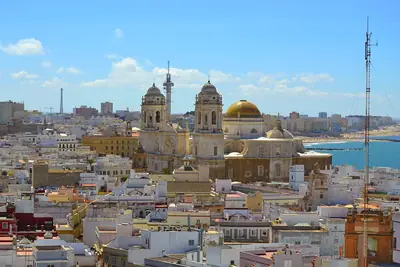
Cádiz Cathedral stands in the historic center, close to the sea and visible from many parts of the city. Construction began in 1722, and the building was generally considered finished on 28 November 1838, although some elements, including the choir, presbytery and towers, were still pending.
Its changing appearance reflects the long construction process. Originally conceived as a Baroque building, it also incorporates Rococo details and was ultimately completed in the Neoclassical style. Economic crises, the French invasions and Spain’s later loss of power over America all affected the project.
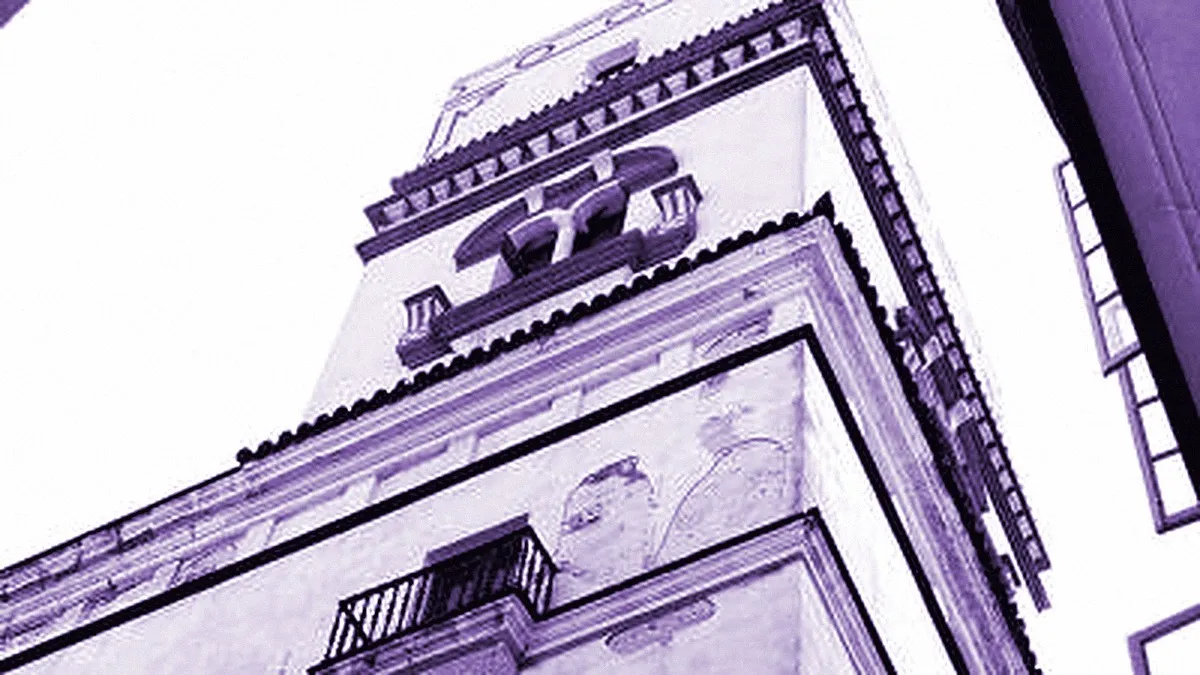
Inside, chapels contain paintings and relics from the former cathedral and monasteries across Spain. The Levante Tower, one of the cathedral’s towers, is open to visitors and offers panoramic views across Cádiz.
Casa del Almirante
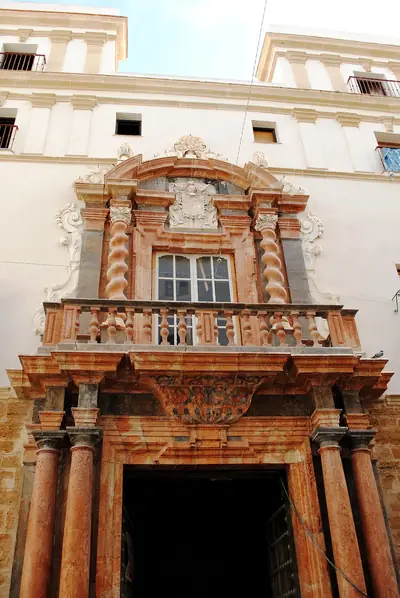
The Casa del Almirante is a late-17th-century Baroque house-palace commissioned by the family of Admiral Diego de Barrios, associated with the Flota de Indias. Its red-and-white marble façade is particularly striking, with paired Tuscan columns, a balcony framed by Solomonic columns, a curved pediment and the family coat of arms.
The marble portal is associated with Genoa’s Andreoli workshop and was assembled by the master García Narváez. Two lookout towers crowned with pilasters complete the façade. Inside, a columned courtyard and a staircase beneath an elliptical dome continue the building’s elegant character.
Arco de los Blancos and Cádiz’s Roman layers
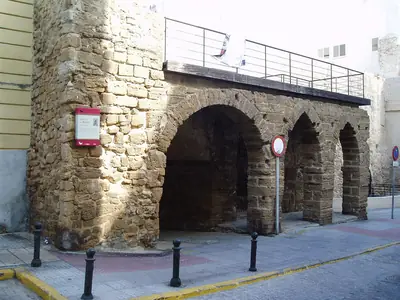
In the Pópulo neighborhood, the Arco de los Blancos preserves a broad stone vault that formed part of an ancient Roman city gate. It was originally known as Puerta de Tierra and served as the city’s main land entrance during the Middle Ages.
The gateway later took its current name from the Blanco family, who built a chapel above it in the 17th century. Beneath the former royal butcher shops nearby, archaeologists discovered annexes of Cádiz’s Roman Theatre, showing how several periods of the city’s history overlap in the same area.
Museum of Cádiz
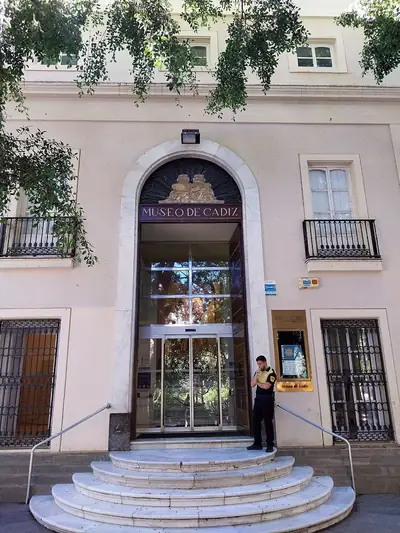
The Museum of Cádiz brings together archaeology, fine art and puppets across three floors. Its present home was established in 1935, while the institution itself was officially created in 1970 through the merger of the Provincial Museum of Fine Arts and the Provincial Museum of Archaeology.
The archaeological collection began developing after a Phoenician sarcophagus was found in the city’s shipyard. The art collection includes works taken from a monastery in 1835, including paintings by Zurbarán from the Charterhouse of Jerez de la Frontera, as well as works by Murillo and Rubens. Archaeology occupies the ground floor, fine art the first floor and puppets the second.
Oratorio de San Felipe Neri and the Constitution of 1812
The Oratorio de San Felipe Neri is a Baroque church built between 1685 and 1719. It is closely connected with one of Spain’s decisive political moments: meetings of the Cortes Generales took place here from 1811, and the Constitution of 1812 was debated, approved and proclaimed in the church during the Napoleonic invasion of Spain.
The building has an unusual elliptical plan, designed by Blas Díaz. After damage from the 1755 Lisbon earthquake, Pedro Afanador carried out repairs in 1764, including the reconstruction of the distinctive double-section dome with eight windows.
Oratorio de la Santa Cueva
The Oratorio de la Santa Cueva is arranged as two oratories, one above the other, and is one of the important examples of Neoclassical religious architecture in Andalusia. The upper chapel is bright and richly decorated, while the lower chapel is more austere and designed for quiet reflection.
The upper oratory contains three paintings by Goya: The Last Supper, The Multiplication of the Loaves and Fishes and The Parable of the Wedding of the King’s Son. The lower chapel centers on a life-size Calvary in polychrome wood made by Vaccaro and Gandulfo. The oratory was consecrated in 1796 by Bishop Antonio Martínez de la Plaza.
Palacio de Mora
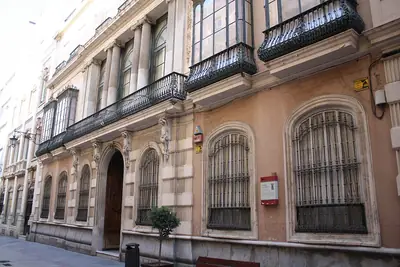
The Palacio de Mora, also known as the Casa Palacio de los Mora, dates from the mid-19th century and was designed by Juan de la Vega y Correa. Completed in 1862, it is an example of Isabelline architecture. Its inauguration included a gala presided over by Queen Isabella II.
The façade is divided into three sections, with a central doorway topped by a marble balcony supported by sculpted figures. Along Calle Ancha, decorative iron terraces, curved balconies and enclosed wooden-and-glass galleries known as cierros give the palace a distinctive Cádiz appearance. The interior is organized around a main courtyard, with additional patios and a garden.
Antiguo Hospital de Nuestra Señora del Carmen
The Antiguo Hospital de Nuestra Señora del Carmen, traditionally known as the Women’s Hospital, is a mid-18th-century Baroque civil building designed by Pedro Luis Gutiérrez de San Martín. It was inaugurated on 16 October 1749.
The hospital is organized around two courtyards connected by an intermediate staircase. Its imperial-style double staircase, covered by an encamonada vault, is considered one of the notable examples of Spanish Baroque design. The building adapts Baroque models from inland Andalusia to Cádiz’s limited space, using Italian marble and American wood.
Cádiz’s Sea Walls, Beaches and Fortifications
The Atlantic is central to Cádiz’s identity. The city’s defensive structures stand beside beaches, promenades and cultural spaces, creating some of its most memorable views.
Castillo de Santa Catalina
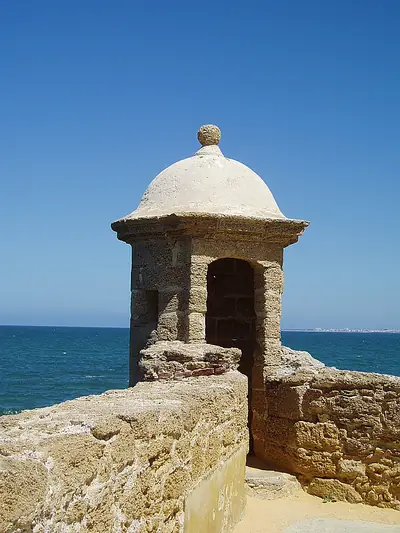
The Castillo de Santa Catalina extends into the sea beside La Caleta. Its pentagonal plan has an Italian influence, with projecting points that give the fortress a star-like outline. Construction began in 1598 according to plans by the engineer Cristóbal de Rojas, and the castle was completed by Ignacio de Sala in 1621.
The fortress helped shape a model later used for colonial forts in Cuba, Mexico and Puerto Rico. Today, its spaces are used for cultural events, including exhibitions, concerts and activities connected with the Alcances Documentary Film Festival.
Castle of San Sebastián
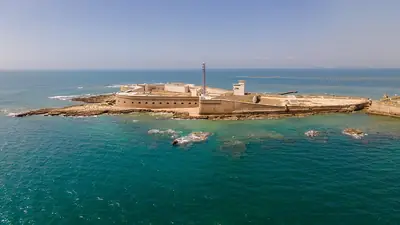
The Castle of San Sebastián occupies a rocky islet at the end of a stone causeway beyond La Caleta beach. A legend associates the site with the Temple of Kronos, while its documented history includes a chapel built by a Venetian crew in 1457 after surviving the plague.
A larger defensive castle was constructed in 1706 to protect Cádiz’s northern flank. The irregular fortress incorporates a watchtower dating from Muslim rule. In 1860, a levee connected the island with the mainland, making access easier for soldiers and visitors.
Balneario de Nuestra Señora de la Palma y del Real
The Balneario de Nuestra Señora de la Palma y del Real stands above the sands of La Caleta. Inaugurated in 1926, it replaced earlier wooden bathhouses used by summer visitors and is cataloged as an Asset of Cultural Interest.
Its central structure was originally designed to accommodate up to 300 guests. Two curved galleries extend on either side toward the sea, while a colorful ceramic panel depicting the Virgin of La Palma provides one of the building’s few ornamental details.
Baluarte de la Candelaria
The Baluarte de la Candelaria has watched over Cádiz Bay since 1672. Its triangular plan has an open southern side facing the city, while the angled northern façades point toward the sea. The seaward wall functioned both as a seawall and as a platform for artillery.
Over time, the bastion served as barracks, an engineer’s residence and headquarters for the military pigeon service. Today, its vaulted halls host exhibitions, while the palm-lined courtyard is used for concerts, plays and carnival celebrations.
Baluarte de los Mártires and Baluarte de los Capuchinos
The Baluarte de los Mártires and Baluarte de los Capuchinos are two further historic fortifications along Cádiz’s seafront. Both are recognized cultural properties and form part of the defensive landscape that connects the city’s walls with La Caleta and the Atlantic castles.
Explore Cádiz with Neywo
A Cádiz self-guided walking tour lets you follow the city’s history without joining a group or following a fixed timetable. Neywo offers six walking tours, one bus route and one bike route in Cádiz:
- Six walking tours: routes of 0.7 to 4.47 km, lasting 43 to 204 minutes, with between 4 and 15 narrated stops.
- One bus route: 3.5 km, 15 minutes and 8 stops.
- One bike route: 7.1 km, 36 minutes and 9 stops.
The walks cover Cádiz Cathedral and the old town squares, Plaza de Mina and the Santa Cueva, the sea walls from the Four Towers to San Sebastián, Alameda de Apodaca and the Falla Theatre, Santa Maria and Puerta de Tierra, and a longer route from the old town to the Atlantic castles.
With Neywo, each story plays as you reach the place it describes. Explore at your own pace, with no group and no schedule. The narration is available in 11 languages, making the app a practical way to discover Cádiz’s architecture, archaeology and fortifications while walking through the city. If you are exploring more of the region, continue with our guide to Andalusia or the wider Spain destination guide.
Places with an audio guide in Cádiz
8 places in Cádiz with a Neywo audio guide. Each one starts telling its story as you reach it.
Self-guided tours in Cádiz
8 tours in Cádiz, free in the Neywo app. Each stop tells its story as you reach it.
- Bike ride
Along the Cádiz seafront by bike
Follow the cycle lanes on Cádiz's seafront from the Candelaria bastion past the Genovés park, the old sea baths and the sea bastions, with the cathedral dome close by. Pass the Arco de los Blancos and the lithographic workshop before ending at the Customs Palace. Flat, short and always within sight of the ocean.
Baluarte de la Candelaria · Parque Genovés · Balneario de Nuestra Señora de la Palma y del Real · Baluarte de los Mártires · Baluarte de los Capuchinos · Cádiz Cathedral …
Open this tour: Along the Cádiz seafront by bike - Bus ride
Line 2: Cádiz's walls and bastions by city bus
Ride the everyday Cádiz bus along the edge of the old town. It passes the Puerta de Tierra gateway, the Pópulo arch, the cathedral and the sea bastions of Capuchinos, Mártires and Candelaria. Sit on the sea side and you see the Atlantic for most of the ride.
Puerta de Tierra · Arco de los Blancos · Cádiz Cathedral · Baluarte de los Capuchinos · Baluarte de los Mártires · Balneario de Nuestra Señora de la Palma y del Real …
Open this tour: Line 2: Cádiz's walls and bastions by city bus - Walk
Cadiz cathedral and the old town squares
The yellow-domed cathedral that took 116 years and bankrupted its parish, a Roman theatre found under the houses in 1980, and the merchant mansions and watchtowers of a city that got rich on the American trade.
Palace of the Marquises of Recano · Correos y Telégrafos · Plaza de las Flores · Plaza Candelaria · Santiago Apóstol church, Cádiz · Cádiz Cathedral …
Open this tour: Cadiz cathedral and the old town squares - Walk
Plaza de Mina, the Santa Cueva and Torre Tavira
The nineteenth-century bourgeois quarter: the provincial museum's Phoenician sarcophagi, a Goya-decorated oratory, the chapel where Spain's 1812 constitution was drafted, and the watchtower with the camera obscura over the rooftops.
Plaza de Mina · Museum of Cádiz · Convento San Francisco · Casas de las Cuatro Torres · Plaza de España, Cádiz · Palacio de la Aduana (Cádiz) …
Open this tour: Plaza de Mina, the Santa Cueva and Torre Tavira - Walk
The sea walls: from the Four Towers to San Sebastian
Cadiz as a fortress on a spit of sand. Bastions, a customs palace, a Moorish-revival bath house on the beach, and two castles — one guarding the bay, one out along a causeway with the Atlantic on both sides.
Baluarte de los Capuchinos · Baluarte de los Mártires · Balneario de Nuestra Señora de la Palma y del Real · Castillo de Santa Catalina · Castle of San Sebastián
Open this tour: The sea walls: from the Four Towers to San Sebastian - Walk
Alameda de Apodaca and the Falla theatre
A short seafront stroll for the end of a day — the bastion, the palm-lined promenade above the water, the tiled square of San Antonio and the red-brick Moorish-revival theatre named after the composer buried in the cathedral.
Baluarte de la Candelaria · Alameda de Apodaca · Plaza de San Antonio · Teatro Falla
Open this tour: Alameda de Apodaca and the Falla theatre - Walk
Santa Maria and the Puerta de Tierra
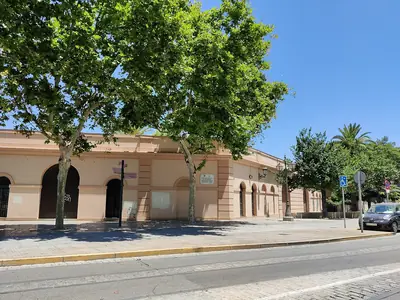
The workaday side of the peninsula, behind the land gate that was the city's only way in and out. A closed railway station, a Dominican convent, a puppet museum and a lithography workshop still using its original presses.
Plaza de Santo Domingo · Convento de Nuestra Señora del Rosario y Santo Domingo · Antigua Estación de Tren de Cádiz · Puerta de Tierra · Museo del Títere
Open this tour: Santa Maria and the Puerta de Tierra - Walk
The Ultimate Cadiz: old town to the Atlantic castles
Across the whole peninsula, from the mansions of the American trade through the cathedral quarter and out along the bastions to the two sea castles. Four and a half kilometres with water on both sides most of the way.
Archivo Histórico Provincial de Cádiz · Casa del Almirante · Arco de los Blancos · Roman Theatre of Cádiz · Casa de la Contaduría · Cádiz Cathedral …
Open this tour: The Ultimate Cadiz: old town to the Atlantic castles
Walk Cádiz with Neywo
Neywo turns Cádiz into a self-guided audio tour. Stories arrive as you reach the place they belong to, and the route reshapes when you wander off it.

