What to See in Mérida, Spain: Free Audio Guide
Things to Do in Mérida, Spain: Roman Heritage and Historic Landmarks
The best things to do in Mérida include exploring one of Spain’s richest Roman archaeological landscapes, alongside medieval churches, Islamic fortifications, and museums. Founded as Augusta Emerita in 25 BC, the city became the capital of the Roman province of Lusitania, and its ancient monuments remain closely connected to everyday urban life. Mérida is in Spain, and Neywo has a free audio guide for the city with 21 narrated places.
What to See in Mérida
Mérida’s historic center and archaeological sites reveal the city in layers. Roman forums, bridges, houses, temples, and entertainment venues appear alongside Christian buildings and a ninth-century Muslim fortress.
Archaeological Ensemble of Mérida
The Archaeological Ensemble brings together the remains of Augusta Emerita, the Roman colony founded by order of Emperor Augustus to settle veterans of two legions. Mérida later became the capital of Lusitania and an important economic, legal, military, and cultural center.
Among the most significant remains are the theatre, amphitheatre, and aqueducts. Together, they show the scale and variety of Roman public life and engineering. Mérida preserves more important ancient Roman monuments than any other city in Spain.
Roman Theatre and Amphitheatre
The Roman theatre and amphitheatre are among the essential places to visit in Mérida. The theatre hosted performances, while the amphitheatre was designed for large public spectacles. Their surviving structures offer a direct sense of how entertainment formed part of life in Augusta Emerita.
They are also included in Neywo’s walking route from the Roman Theatre to the Alcazaba, making them natural starting points for a Mérida self-guided walking tour.
National Museum of Roman Art
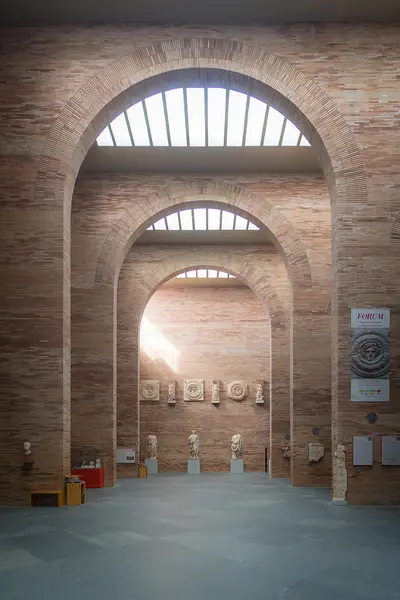
The Museo Nacional de Arte Romano is devoted to archaeological discoveries from Augusta Emerita. Its collection includes mosaics, sculptures, and everyday objects that help explain how people lived in the ancient city.
The building is equally notable. Designed by the Spanish architect Rafael Moneo and inaugurated in 1986, it uses brick and soaring arches to echo Roman architecture while creating a distinctly modern museum. The building was declared a historical and artistic monument in 1962.
Roman Forum
The Roman Forum was the main public area of Augusta Emerita. It is one of the clearest places to understand the civic structure of the ancient city, which also had a second, later Provincial Forum built in 50 AD.
The name Emerita Augusta referred to the city’s veteran settlers: in Latin, emeritus described someone who had completed military service with honor. The surviving ruins make the forum an important stop for anyone interested in what to see in Mérida beyond the most famous monuments.
Temple of Diana
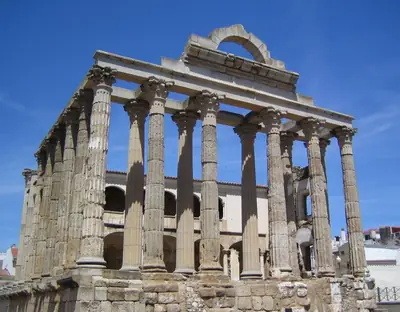
Despite its traditional name, the Temple of Diana was not dedicated to Diana. It belonged to the imperial cult and honored the Roman emperors. Built in the first century AD in the municipal forum, it occupied a prominent position in the city.
It is the only Roman religious building in Mérida to have survived in an acceptably preserved state, making its columns and structure one of the city’s most recognizable sights.
Arch of Trajan
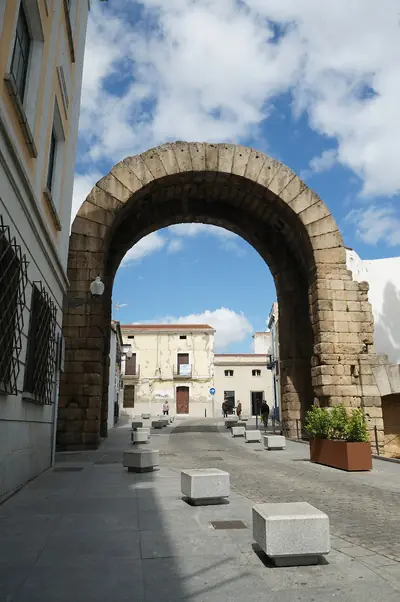
The Arch of Trajan was a monumental Roman gateway and part of the infrastructure that made Augusta Emerita an important city. Its familiar name is misleading: there is no evidence connecting the arch to Emperor Trajan.
It was once thought to be a triumphal arch, but that interpretation was never proven. The monument has been protected as a national monument since 1912 and forms part of Mérida’s UNESCO-listed archaeological ensemble.
House of the Mitreo and Amphitheatre House
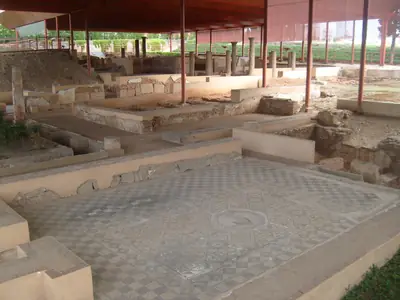
The House of the Mitreo is one of Mérida’s most impressive Roman residences. It stood just outside the fortified walls of the ancient city and takes its name from its proximity to a Mithraic sanctuary on the Cerro de San Albín. The house became a Cultural Heritage Site in 1990 and part of the Archaeological Ensemble in 1993.
The Amphitheatre House, or Casa del Anfiteatro, offers another glimpse into domestic life in Augusta Emerita. Together, these archaeological residences shift the focus from public monuments to the homes and everyday surroundings of the city’s inhabitants.
Roman Circus Maximus
The Roman Circus was a vast chariot-racing arena built outside the city walls at the beginning of the first century AD. It stretched about 400 metres and could hold up to 30,000 spectators, making it one of the most important circuses in the Roman Empire after the Circus Maximus in Rome.
Although only the foundations remain, the oval outline is still visible. That surviving shape gives visitors a strong impression of the building’s original scale.
San Lázaro Roman Aqueduct and Albarregas Roman Bridge
The San Lázaro Roman aqueduct was one of three water conduits supplying Mérida. It carried water into the city and crossed the depression of the Albarregas River. The structure extends for almost 1,000 metres and reflects the planning required to support a major Roman settlement.
Nearby, the Albarregas Roman bridge crosses the river of the same name, a tributary of the Guadiana. Built in granite at the end of the first century BC, it has stood for more than two thousand years and remains part of the UNESCO-listed archaeological ensemble.
Alcazaba of Mérida
The Alcazaba is a ninth-century Muslim fortification built in 835 by order of Abd ar-Rahman II, Emir of Córdoba. It was constructed to control Mérida after the city had rebelled.
The fortress has square walls measuring 130 metres on each side, rising 10 metres high and nearly 3 metres thick. Twenty-five square-based towers reinforced the walls, while stones from earlier Roman and Roman-Visigothic structures were reused in the construction. Inside, an aljibe collected and filtered river water for the garrison.
The Alcazaba stands beside the Roman bridge over the Guadiana and demonstrates how Mérida’s history continued long after the Roman period.
Co-cathedral of Saint Mary Major and Cathedral of Saint Mary of Jerusalem
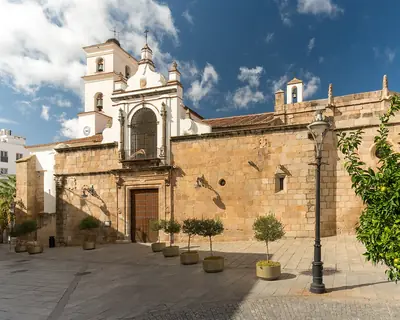
The Co-cathedral of Saint Mary Major stands in Mérida’s historic heart. It is considered the heir of the ancient cathedral of Augusta Emerita, and its oldest surviving sections date from the thirteenth century, after the city was reconquered by Alfonso IX of León. Together with the Cathedral of Badajoz, it serves as the seat of the Archdiocese of Mérida-Badajoz.
The Cathedral of Saint Mary of Jerusalem is the city’s principal place of worship. It occupies the site of an earlier Visigothic church that served as the metropolitan church of Augusta Emerita. Although no visible remains of that cathedral survive above ground, excavations in the nearby Plaza de España uncovered architectural elements from the earlier structure.
Basilica of Saint Eulalia
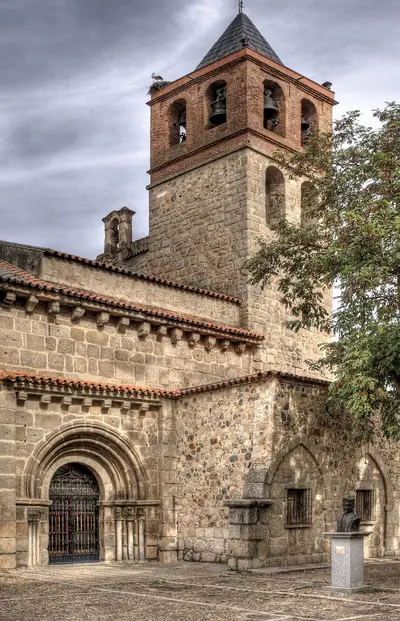
The Basilica of Saint Eulalia is central to the history of early Christianity on the Iberian Peninsula. Researchers consider it the first Christian temple built in Hispania after the Peace of Emperor Constantine. Originally erected as a martyrial basilica in memory of Saint Eulalia, it became an important pilgrimage destination for visitors from Western Europe and North Africa.
The present basilica was rebuilt in the thirteenth century by the Order of Santiago over the remains of the earlier building. Its history adds an important Christian layer to Mérida’s Roman heritage.
Church of Santa Clara
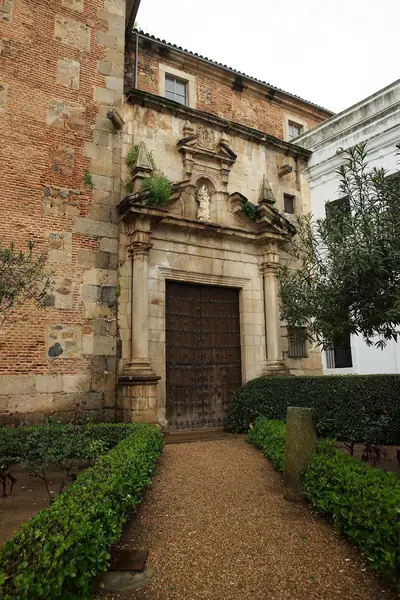
The Church of Santa Clara lies between the Co-cathedral of Saint Mary Major, Mérida City Hall, and the Assembly of Extremadura. It once belonged to the old Convent of Santa Clara.
Today, the church houses the Museum of Visigothic Art of Mérida, while the former convent buildings serve as the Santa Clara Exhibition Hall. It is a useful stop for understanding the city’s post-Roman history.
Explore Mérida with a Free Audio Guide
For a Mérida audio guide that fits around your own plans, download Neywo and choose between two walking tours. The app tells the story of each place as you reach it, at your own pace, with no group and no schedule. Narration is available in 11 languages.
- Emerita Augusta: Theatre to Alcazaba: a 2.31 km walk lasting 107 minutes, with 11 narrated stops.
- Mosaics, Aqueducts and a Martyr’s Basilica: a 4.57 km walk lasting 117 minutes, with 8 narrated stops.
The routes cover Roman theatres and houses, the National Museum of Roman Art, the Roman Forum, Temple of Diana, Circus, aqueducts, basilica, bridges, churches, and the Alcazaba. Together, they make it easier to experience Mérida as a city where Roman, Christian, Visigothic, and Islamic history remain woven into the streets.
Places with an audio guide in Mérida
8 places in Mérida with a Neywo audio guide. Each one starts telling its story as you reach it.
Self-guided tours in Mérida
2 tours in Mérida, free in the Neywo app. Each stop tells its story as you reach it.
- Walk
Emerita Augusta: Theatre to Alcazaba
The classic Roman Mérida in one loop. Sit in the theatre that still stages classical drama each summer, step into the gladiators' amphitheatre and the brick arches of Moneo's Roman art museum, then cross the forum and the Temple of Diana to the cathedral quarter, the Visigothic museum and the ninth-century Alcazaba by the Roman bridge. Finish at the Arch of Trajan, a convent turned parador and the church of Nuestra Señora del Carmen.
Roman Theatre of Emerita Augusta · Roman amphitheatre of Mérida · Building of Museo Nacional de Arte Romano · Roman Forum · Temple of Diana · Church of Santa Clara, Mérida …
Open this tour: Emerita Augusta: Theatre to Alcazaba - Walk
Mosaics, Aqueducts and a Martyr's Basilica
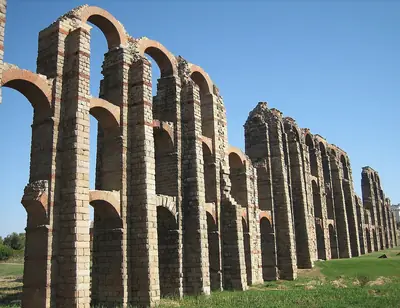
The quieter Roman and early Christian Mérida. Start at the House of the Mitreo and the circus ground of the Roman chariot races, pass the San Lázaro aqueduct and the basilica of Saint Eulalia, the first Christian temple built in Hispania after Constantine, and end below the towering 38 arches of the Aqueduct of the Miracles.
House of the Mitreo · Amphitheatre House, Mérida · Roman Circus Maximus of Mérida · San Lázaro Roman aqueduct · Basilica of Saint Eulalia of Mérida · Iglesia de Nuestra Señora del Carmen …
Open this tour: Mosaics, Aqueducts and a Martyr's Basilica
Walk Mérida with Neywo
Neywo turns Mérida into a self-guided audio tour. Stories arrive as you reach the place they belong to, and the route reshapes when you wander off it.

