Things to Do in Córdoba, Spain: Walking Guide
Things to Do in Córdoba: A Guide to the City’s Historic Places
The best things to do in Córdoba are concentrated around a remarkable historic centre shaped by Roman, Islamic, Jewish and Christian history. From the Mosque-Cathedral and the Roman Bridge to the courtyards of Viana Palace and the lanes of the Jewish Quarter, Córdoba offers an extraordinary amount to discover on foot. Neywo has a free audio guide for Córdoba with 49 narrated places.
Part of Andalusia in southern Spain, Córdoba is especially rewarding when explored slowly. Its monuments are close together, but each one opens a different chapter in the city’s past.
What to see in Córdoba
Mosque-Cathedral of Córdoba
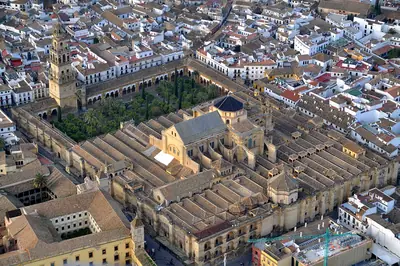
The Mosque-Cathedral is Córdoba’s defining monument, also known as La Mezquita or the Cathedral of Our Lady of the Assumption. The site was associated with the Basilica of San Vicente before the Muslim conquest, and excavations point to a 5th-century episcopal complex.
Abderramán I founded the great mosque in 786, after establishing the Emirate of Córdoba. Later rulers expanded it: Abderramán III added a new minaret in 958, while his son, al-Hakam II, commissioned the mihrab and macsura, completed in 971. At its greatest extent, the complex covered 23,400 square metres. Its present form reflects the building’s successive Christian and Islamic histories.
Puente romano and Torre de la Calahorra
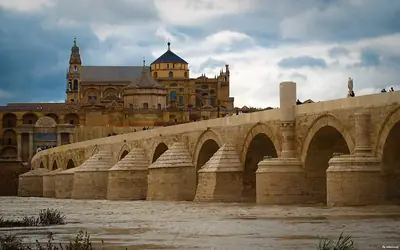
The Puente romano, or Puente Viejo, spans the Guadalquivir between the Campo de la Verdad and the Cathedral neighbourhood. For twenty centuries, it was Córdoba’s only bridge, until the San Rafael Bridge was built in the mid-20th century. Although the bridge has been rebuilt several times, much of its current structure is connected with Arab reconstructions in the 8th century.
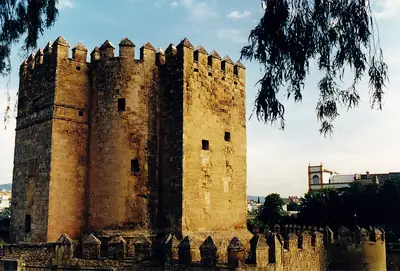
At its southern end, the Torre de la Calahorra protected this important crossing. The fortified gate is of Islamic origin and is now home to the Museo Vivo de Al-Ándalus. Its eight rooms present an audio-visual interpretation of Córdoba’s “golden age”, when scholars, artists and thinkers from Islam, Christianity and Judaism exchanged ideas. The tower’s terrace also offers wide views of the Mosque-Cathedral and the Old City.
Jardines del Alcázar
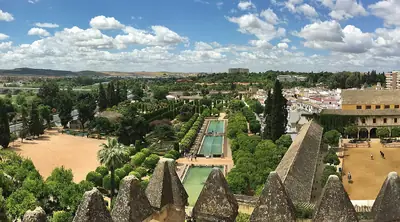
The Jardines del Alcázar combine water, gardens and history beside the Guadalquivir. Their origins go back to the 10th century, when Abd ar-Rahman III created an aqueduct, a working waterwheel and an irrigation system supplied by the river.
The gardens cover 55,000 square metres and include palm, cypress, orange and lemon trees, along with fountains and reflective ponds. Their layout is arranged across three levels, including an upper section beside the Tower of Lions and a middle section reached by a sweeping staircase. After falling into decline, the gardens were significantly renovated in the 20th century.
Alcázar de los Reyes Cristianos
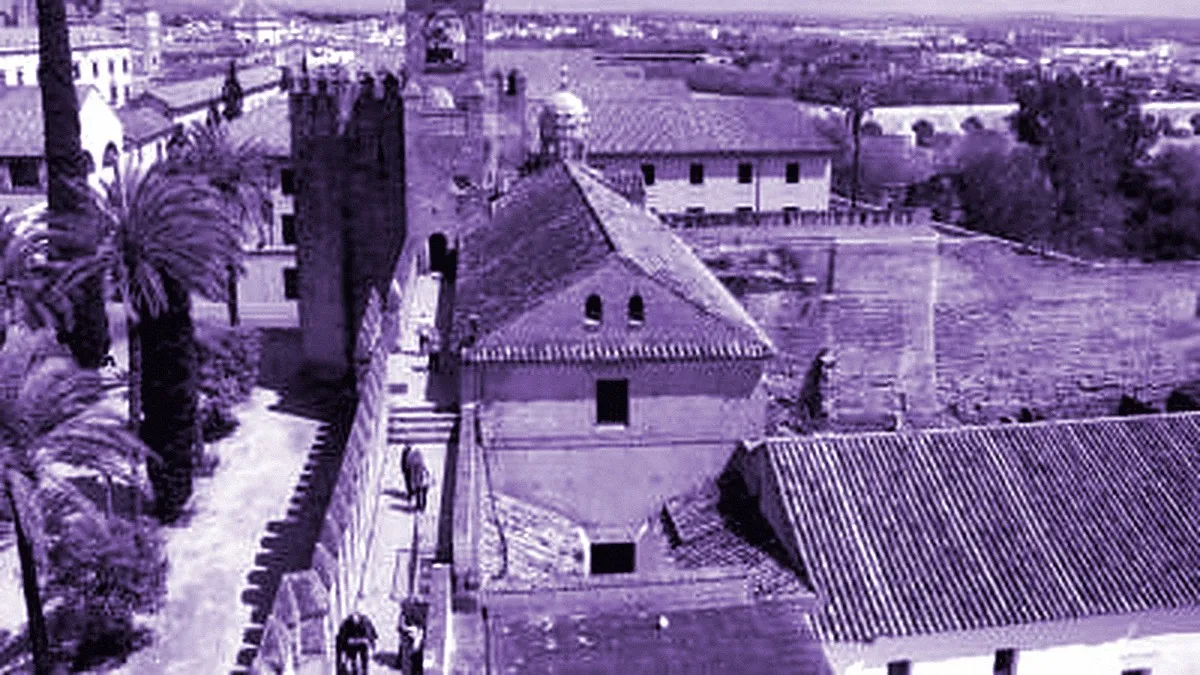
The Alcázar de los Reyes Cristianos, or Castle of the Christian Monarchs, stands near the river and has been reused by several civilizations. A Visigothic fortress occupied the area before Abd ar-Rahmán I developed it into a fortified palace with baths, gardens and a library. The Almohads later continued to strengthen the site.
After Christian forces claimed Córdoba in 1236, Alfonso XI rebuilt the castle in the Mudejar style. The reforms were completed in 1328. Parts of the earlier Almohad fortress, including the access area, patio de crucero and baths, were reused in the Christian palace.
Palacio Episcopal
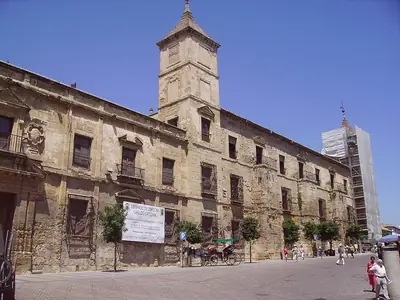
Opposite the west front of the Mosque-Cathedral, the Palacio Episcopal is an imposing Renaissance-style building in Córdoba’s historic centre. Its structure covers about 14,000 square metres, making it one of the largest buildings in the centre.
The courtyard contains the Fuente del Elefante, a sculpture associated with Umayyad Caliphal art. More recent work has connected the palace with the Mosque-Cathedral’s visitor reception centre. Restoration of the patio de Carruajes revealed remains of an Andalusi-period latrine, and later musealisation work was inaugurated in January 2026.
Córdoba Synagogue and the Jewish Quarter
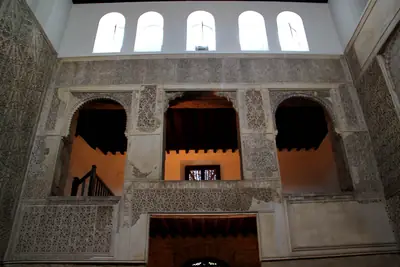
The Córdoba Synagogue is a small medieval building in the Jewish Quarter, completed in 1315 in the Mudéjar style. Its stucco decoration, Hebrew inscriptions and geometric patterns are particularly distinctive. Inside, the prayer hall retains a carved wooden ceiling and a well-preserved ark for Torah scrolls.
It served as a synagogue until 1492, then had several non-religious uses before reopening as a Jewish museum in 1985. The building is considered one of the few preserved synagogues of its period in Spain.
Nearby, Casa de Sefarad is a museum and cultural centre dedicated to Sephardic Jewish history, culture and tradition. It occupies a 14th-century Jewish house opposite the synagogue. The surrounding area also includes the Monumento a Maimónides, a bronze statue of the philosopher and scholar, and the Patio del Zoco, an artisan market whose name comes from the Arabic word suq, meaning market.
Palacio de los Marqueses de Viana
The Palacio de los Marqueses de Viana is a palace-museum in the Santa Marina neighbourhood. Originally built in the 15th century, it was expanded and transformed over time by the families who lived there. Its name comes from the marquises of Viana, the last owners.
The palace is organised around twelve patios and a garden. Each courtyard has its own character: the Receipt Patio has sixteen Tuscan columns, the Patio of the Oranges contains orange trees, and the Patio of Bars is known for its monumental ironwork. The palace opened to the public after its acquisition by the Provincial Savings of Córdoba and was declared a cultural landmark in 1981.
Convento de Santa Ana y San José
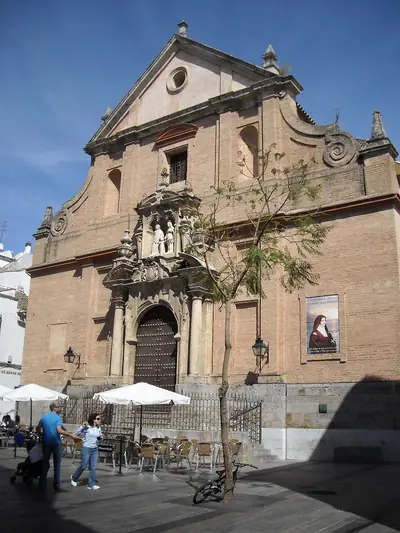
The Convento de Santa Ana y San José is a Baroque religious complex dedicated to Saint Anne, the Virgin and the Child, with devotion to Saint Joseph. Its Latin-cross church has a façade featuring these figures in a niche.
The complex is also noted for its cloister, Renaissance staircase and loggia leading towards the rear garden. It provides a quieter architectural counterpoint to Córdoba’s largest monuments.
Iglesia de San Pedro Apóstol
Also known as the Basílica de San Pedro, this church was built in Gothic style after Fernando III el Santo’s conquest of Córdoba. Renaissance and Baroque interventions later changed its appearance. The exterior combines Gothic and Baroque elements, including an elaborate façade, an arched portal and a large rose window.
Inside, the Baroque main altarpiece dates from the 18th century. The church is closely associated with the Martyrs of Córdoba, whose memory is preserved in the chapel of the Martyrs. In 2006, Pope Benedict XVI granted the church the title of minor basilica.
Museo Julio Romero de Torres
The Museo Julio Romero de Torres is dedicated to the Cordoban painter Julio Romero de Torres and contains the largest collection of his works. It occupies the former Hospital de la Caridad, which also houses the Museum of Fine Arts of Córdoba.
The museum was created in 1931, one year after the painter’s death, and was declared a cultural landmark in the category of monument in 1962.
Bullfighting Museum of Córdoba
The Bullfighting Museum of Córdoba, or Museo Taurino de Córdoba, explores the history of bullfighting in the city. It is housed in the 16th-century Renaissance House of the Bulls, in the Jewish Quarter.
Its displays include costumes, capes, photographs, posters and personal objects. They trace the development of bullfighting from a noble pastime into a professional spectacle rooted in Andalusian culture, while also addressing its technique, symbolism and controversy. A peaceful inner courtyard offers a break from the museum galleries.
Madinat Al-Zahra
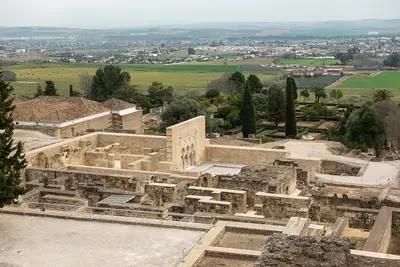
About eight kilometres beyond Córdoba, at the foot of Sierra Morena, the ruins of Madinat al-Zahra reveal the remains of a 10th-century fortified palace-city. Abd ar-Rahman III, the first caliph of Al-Andalus, began construction between 936 and 940, and work continued under his son, Al-Hakam II.
The city served as the capital and administrative centre of government. Its complex included reception halls, a congregational mosque, offices, aristocratic residences, gardens, baths, working areas and military spaces. Aqueducts supplied its water. After Al-Hakam II’s death, Madinat al-Zahra lost its role as the centre of government.
Explore Córdoba with Neywo
A Córdoba self-guided walking tour lets you explore the city without joining a group or following a fixed schedule. Neywo offers four walking tours, one bus route and one bike route in Córdoba:
- The Mezquita, the Roman bridge and the Alcazar: 2.04 km, 106 minutes and 12 narrated stops.
- The Juderia: synagogue, patios and the caliphal baths: 1.74 km, 86 minutes and 12 narrated stops.
- Córdoba beyond the Mezquita: Corredera to San Pablo: 2.32 km, 81 minutes and 10 narrated stops.
- The Ultimate Cordoba: bridge, Mezquita, synagogue, Viana: 3.49 km, 118 minutes and 8 narrated stops.
- C2 minibus: through the heart of old Córdoba: 5.2 km, 22 minutes and 9 narrated stops.
- Córdoba cycle lane ride: from Plaza del Potro to the Roman mausoleum: 3.2 km, 16 minutes and 7 narrated stops.
Download Neywo and explore at your own pace. The app tells the story of each place as you reach it, with no group and no schedule. Narration is available in 11 languages, making it a practical [free walking tour Córdoba] experience for discovering the city independently.
Places with an audio guide in Córdoba
8 places in Córdoba with a Neywo audio guide. Each one starts telling its story as you reach it.
Self-guided tours in Córdoba
6 tours in Córdoba, free in the Neywo app. Each stop tells its story as you reach it.
- Bike ride
Córdoba cycle lane ride: from Plaza del Potro to the Roman mausoleum
Cycle west along the old town's bike lane, from the convent of Santa Cruz and the Plaza del Potro, the inn where Cervantes stayed, past the Gate of the Bridge and the Alcázar of the Christian Monarchs. Pass the patios of San Basilio and the medieval Almodóvar gate and finish at the Roman mausoleum by the Victoria gardens.
Convento de Santa Cruz · Posada del Potro de Cordoba · Puerta del Puente · Alcázar de los Reyes Cristianos · San Basilio, Córdoba · Puerta de Almodóvar …
Open this tour: Córdoba cycle lane ride: from Plaza del Potro to the Roman mausoleum - Bus ride
C2 minibus: through the heart of old Córdoba
A small city minibus that climbs from Las Tendillas through the Axerquía, the medieval quarter east of the Mezquita. Ride it past the Roman temple, the Corredera square, the fernandine churches of San Pedro, La Magdalena and San Lorenzo and the Viana palace, then on to the Palacio de la Merced and the old Cuesta del Bailío. A cheap way into the real neighbourhoods.
Plaza de las Tendillas, Córdoba, Spain · Templo romano calle Claudio Marcelo · Plaza de la Corredera · Iglesia de San Pedro Apóstol · Iglesia de la Magdalena · Iglesia de San Lorenzo Mártir …
Open this tour: C2 minibus: through the heart of old Córdoba - Walk
The Mezquita, the Roman bridge and the Alcazar
Cordoba's core, walked from the far bank so the Mezquita arrives the way it should. A forest of 850 columns inside a mosque with a cathedral dropped into the middle of it, the Christian kings' fortress and its water gardens next door.
Torre de la Calahorra · Triunfo de San Rafael de la Puerta del Puente · Puente romano · Puerta del Puente · Molino de la Albolafia · San Basilio, Córdoba …
Open this tour: The Mezquita, the Roman bridge and the Alcazar - Walk
The Juderia: synagogue, patios and the caliphal baths
The whitewashed lanes west of the Mezquita — one of only three medieval synagogues left in Spain, the caliph's bath house, and the Calleja de las Flores, which is as narrow and as photographed as it sounds.
Roman theatre of Cordoba · Convento de Santa Ana y San José · Calleja de las Flores · Caliphal baths of Cordoba · San Pedro de Alcántara Church · Capilla de San Bartolomé …
Open this tour: The Juderia: synagogue, patios and the caliphal baths - Walk
Córdoba beyond the Mezquita: Corredera to San Pablo
The half of the old town the day trippers miss — the Roman temple columns rising out of a modern street, the arcaded Corredera square, the Julio Romero de Torres museum, and the Potro inn Cervantes put in Don Quixote.
Posada del Potro de Cordoba · Museo Julio Romero de Torres · Convento de Santa Cruz · Iglesia de San Pedro Apóstol · Plaza de la Corredera · Iglesia de San Pablo …
Open this tour: Córdoba beyond the Mezquita: Corredera to San Pablo - Walk
The Ultimate Cordoba: bridge, Mezquita, synagogue, Viana
Everything essential in three and a half kilometres — the Roman bridge, the Mezquita-Cathedral, the Juderia synagogue and the courtyard palace at the far end of the old town. Madinat al-Zahra is the great omission and needs a bus.
Torre de la Calahorra · Puente romano · Mosque-Cathedral of Cordoba · Palacio Episcopal · Jardines del Alcázar · Córdoba Synagogue …
Open this tour: The Ultimate Cordoba: bridge, Mezquita, synagogue, Viana
Walk Córdoba with Neywo
Neywo turns Córdoba into a self-guided audio tour. Stories arrive as you reach the place they belong to, and the route reshapes when you wander off it.

