Visiting Lleida, Spain: Top Sights on Foot
Things to Do in Lleida: Historic Churches, Castles and Contemporary Art
Looking for things to do in Lleida? This city in Catalonia, in western Spain, combines medieval churches, hilltop fortifications, civic buildings and museums in a compact historic setting. The highlight is La Seu Vella, Lleida’s Old Cathedral, but the city’s lower streets reveal equally interesting Romanesque, Gothic, Baroque and contemporary landmarks. Neywo has a free audio guide for Lleida with 59 narrated places, available in 11 languages.
What to see in Lleida
La Seu Vella and Castell de la Suda
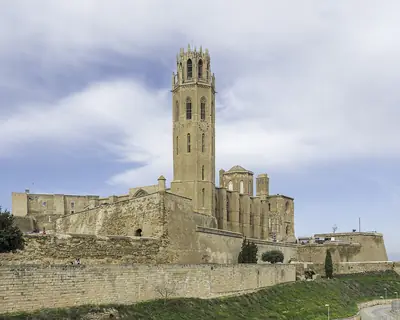
The best place to begin exploring Lleida is the hill occupied by La Seu Vella and Castell de la Suda. Together with the surrounding fortifications, they form the city’s most emblematic monumental complex.
La Seu Vella was commissioned from Pere de Coma in 1193. Its foundation stone was laid on 22 July 1203, and the cathedral was consecrated in 1278. Construction of the dome and roofs continued until 1286, while the bell tower and Apostles’ Door were added in the fifteenth century. The building combines Romanesque foundations with a monumental Gothic character, pointed ribbed vaults and later Renaissance additions.
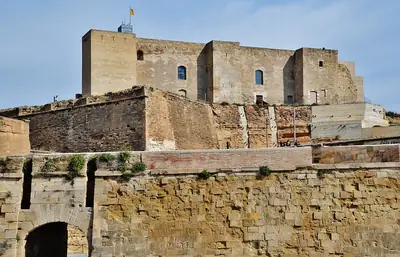
The hill also contains the remains of Castell de la Suda, or Castell del Rei. The fortress-palace began as a ninth-century Andalusian kasbah and is documented from 882, when Lleida was known as Medina Larida. It later became a royal residence and the setting for important political events, including the marriage of Ramón Berenguer IV and Petronila of Aragon in 1150. The position offers views across the Segre River and the surrounding agricultural plain.
Castell de Gardeny
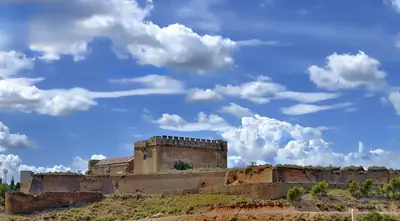
Gardeny Castle stands on Gardeny Hill and recalls the presence of the Knights Templar in Catalonia. The complex was once one of the order’s principal commanderies.
At its centre are two twelfth-century Templar buildings: a residential tower and the conventual chapel of Santa Maria de Gardeny. A later fortified enclosure surrounds them, with bastions dating from the seventeenth and eighteenth centuries. Wars destroyed several of the original buildings, while archaeological studies in 2005 showed that the surviving structures were first built separately and later connected.
Church of Sant Llorenç
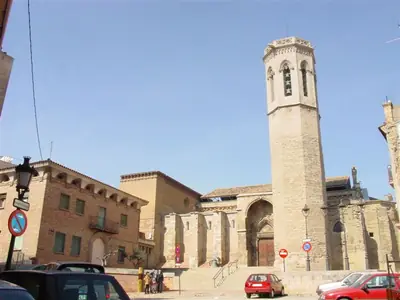
The Church of Sant Llorenç, or Església de Sant Llorenç, brings together two major architectural phases. Construction began in the late twelfth century in the Romanesque style, while Gothic additions followed later.
Its three naves are equal in height, with three apses. The central nave is the oldest and remains Romanesque; the side naves, lateral chapels and octagonal bell tower belong to the Gothic phase, particularly associated with the fifteenth century. The church also preserves four important Gothic altarpieces. It served as Lleida’s cathedral on two occasions, including periods when La Seu Vella was being used for military purposes or the new cathedral was not yet finished.
Seu Nova
Opposite the former Hospital de Santa Maria, the Seu Nova is Lleida’s current cathedral and the seat of the Diocese of Lleida. It was built between 1761 and 1781 to replace La Seu Vella, which had been requisitioned and converted into a fortress and military garrison after the War of the Spanish Succession.
The cathedral is an elegant example of Baroque architecture influenced by academic French classicism. Its restrained interior still preserves wall paintings, stained glass and liturgical ornaments, as well as the Mare de Déu del Blau, a devotional image made by Jordi Safont in 1447.
Hospital de Santa Maria de Lleida
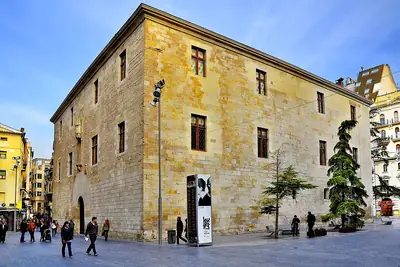
The former Hospital de Santa Maria stands opposite the Seu Nova and is one of the city’s notable examples of Catalan Gothic civil architecture. Built in the fifteenth and sixteenth centuries, it reflects the civic Gothic style associated with Catalan institutions and the social welfare systems of the Middle Ages.
The building is now home to the Institute of Ilerdense Studies. Its position facing the cathedral makes the two buildings an especially useful pairing for understanding Lleida’s religious and civic heritage.
Lleida Museum in Casa Misericòrdia
The Lleida Museum, officially the Diocesan and Comarcal Lleida Museum, occupies Casa de la Misericòrdia, the former convent of Sant Josep. The building is a protected local cultural property, while the museum and its collection were declared of National Interest in autumn 2020.
The collection covers a wide span of art and history, from Roman and Islamic pieces to Romanesque, Gothic, Renaissance and Baroque works. Its present building on Rambla d’Aragó opened in 2007, providing a way to follow changing artistic traditions within a single museum.
Centre d’Art la Panera and Church of Sant Martí
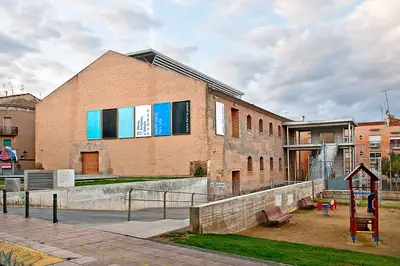
Beside the Church of Sant Martí in Lleida’s old town, Centre d’Art la Panera occupies a twelfth-century building with a contemporary purpose. Since 1997, the centre has focused on contemporary art, particularly by artists from Catalonia and Spain.
Its exhibitions, permanent collection, educational activities and research work share space with a historic setting. La Panera is also responsible for the Leandre Cristòfol Biennial of Spanish contemporary art.
The nearby Church of Sant Martí offers a strong architectural contrast. This Romanesque Catholic church has a single nave covered by a smooth pointed vault, three reinforcing arches and a doubled apse. Its simple exterior gives way to a carefully structured interior. The church and the Chapel of Sant Jaume were declared Cultural Assets of National Interest in 2016.
Capella de Sant Jaume
At the meeting point of Major Street and Cavallers Street, the Capella de Sant Jaume is also known as the Peu del Romeu Chapel. Originally built while Lleida was under Arab rule, it was later dedicated to Saint James and became a stopping point on the Catalan route of the Way of Saint James.
A statue of Saint James and the yellow shell associated with pilgrimage make the chapel’s connection with the route visible. It is a small landmark, but an important part of Lleida’s religious and pilgrimage history.
Mercat del Pla
In the historic centre, Mercat del Pla is a Noucentista building recognised as a Local Cultural Heritage Site. Its architectural character adds another period to a route that already includes Romanesque, Gothic, Baroque and contemporary buildings.
Palacio de la Diputación de Lérida
At Rambla de Ferran and Carrer del Carme, the Palacio de la Diputación de Lérida has been the central seat of the provincial government since 1898. The building was originally constructed between 1789 and 1795 as a hospice, above the former Hospital of the Holy Spirit, which had been destroyed during the War of the Spanish Succession.
Today, the building remains the working headquarters of the Diputación and hosts its administrative and political functions, including plenary sessions and the presidency.
CaixaForum Lleida
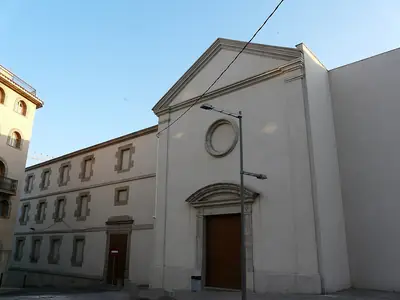
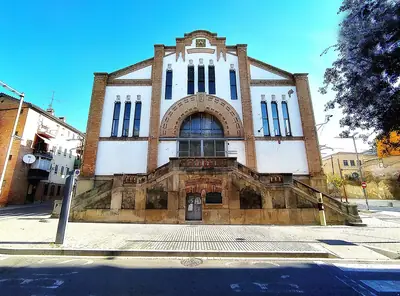
CaixaForum Lleida occupies the former Cine Vinyes, a building that continued its cultural role after becoming the Fundación “La Caixa” Cultural Centre in 1989. It adopted the CaixaForum name in 2008.
The centre includes an exhibition hall, a 226-seat auditorium and two multipurpose rooms with space for 50 people each. These facilities support exhibitions and other cultural activities in the city.
Smaller historic landmarks
Lleida’s streets also include several protected religious and civic landmarks. The Capella de la Sang is a recognised monument of the city, while Sant Pere de Lleida is protected as a local cultural heritage site. Near Carrer Cavallers, Font del Roser is a distinctive neoclassical fountain and a protected local cultural landmark.
Explore Lleida with a self-guided audio tour
Neywo makes it easy to turn these sights into a Lleida self-guided walking tour. The app tells the story of each place as you reach it, at your own pace, with no group and no schedule.
Lleida has four Neywo routes:
- Two walking tours: one is 1.72 km and takes 114 minutes, with 11 narrated stops; the other is 2.7 km and takes 104 minutes, with 10 stops.
- One bus route: 6.8 km, 29 minutes and 6 narrated stops.
- One bike route: 3.7 km, 18 minutes and 6 narrated stops.
The walks cover landmarks including the Lleida Museum, Church of Sant Llorenç, Seu Nova, Hospital de Santa Maria, Capella de Sant Jaume, La Seu Vella, Castell de la Suda, Centre d’Art la Panera, Mercat del Pla, CaixaForum Lleida and the Palacio de la Diputación de Lérida.
Download Neywo and explore Lleida at your own pace
Download Neywo to explore Lleida with a free audio guide covering 59 narrated places. Choose between 2 walking tours, 1 bus route and 1 bike route, with routes ranging from 1.72 to 6.8 km and from 18 to 114 minutes. Each story plays as you reach the place, at your own pace, with no group and no schedule.
Places with an audio guide in Lleida
8 places in Lleida with a Neywo audio guide. Each one starts telling its story as you reach it.
Self-guided tours in Lleida
4 tours in Lleida, free in the Neywo app. Each stop tells its story as you reach it.
- Bike ride
Lleida Old Town on Two Wheels
Cycle the lanes that run through Lleida's centre, from the Noucentista sanctuary of Santa Teresina to the Romanesque and Gothic churches of the old town, the Gothic hospital facing the New Cathedral and the car museum.
Parròquia-Santuari de Santa Teresina, Lleida · Church of Sant Llorenç · Hospital de Santa Maria de Lleida · Sant Pere de Lleida · Plaça de Sant Joan · Museu de l'Automoció RodaRoda
Open this tour: Lleida Old Town on Two Wheels - Bus ride
Lleida's Ramblas and Squares by Bus 8
Line 8 of Autobusos de Lleida links the bus station with the city centre along Avinguda de Blondel and the Rambla de Ferran. Ride it past the Diputació palace, the big squares of Plaça de la Pau and Plaça Ricard Vinyes, and the former maternity house that is now the public library. It runs on weekdays.
CaixaForum Lleida · Sant Pere de Lleida · Plaça de la Pau · Palacio de la Diputación de Lérida · Plaça Ricard Vinyes · Public Library of Lleida
Open this tour: Lleida's Ramblas and Squares by Bus 8 - Walk
Two Cathedrals and a Castle of Kings
Start in the old town among Romanesque and Gothic churches, then climb to the hill where Lleida was won and lost for a thousand years. You pass the Baroque New Cathedral, a pilgrims' chapel marked by a yellow shell, and the bronze Iberian chieftains at the old city gate. The walk ends at La Seu Vella and the Suda, the old cathedral and royal fortress that watch over the whole plain.
Lleida Museum · Church of Sant Llorenç · Seu Nova · Hospital de Santa Maria de Lleida · Oratori de Nostra Senyora dels Dolors · Capella de Sant Jaume (Lleida) …
Open this tour: Two Cathedrals and a Castle of Kings - Walk
Lleida Beyond the Hill: Art, Markets and Elysian Fields
A gentler walk through the modern and civic city: a twelfth-century granary turned contemporary art centre, a Noucentista market hall, a Dominican convent and the provincial palace. Museums of modern art and a tree-shaped civic sculpture lead you east to the French and English gardens of the Camps Elisis.
Centre d'Art la Panera · Mercat del Pla · Convent del Roser · CaixaForum Lleida · Sant Pere de Lleida · Font del Governador …
Open this tour: Lleida Beyond the Hill: Art, Markets and Elysian Fields
Walk Lleida with Neywo
Neywo turns Lleida into a self-guided audio tour. Stories arrive as you reach the place they belong to, and the route reshapes when you wander off it.

