Things to Do in Reus, Spain: Walking Guide
Things to Do in Reus: What to See in the Catalan City
The best things to do in Reus include exploring its Modernist buildings, historic squares, museums, theatres and industrial heritage. The city’s compact centre brings together architecture by Lluís Domènech i Montaner and Pere Caselles, the legacy of Antoni Gaudí, and places that reveal Reus’s artistic and social history. Neywo offers a free audio guide to Reus with 38 narrated places.
Reus is the capital of the municipality of the same name in Tarragona province, in Catalonia. Its streets are particularly rewarding for visitors interested in architecture and cultural heritage, but the city also has museums, wartime memory sites and distinctive landmarks beyond the centre.
What to see in Reus
The following places bring together many of the most important sights included in a visit to Reus.
Plaça del Mercadal and the Gaudí Centre
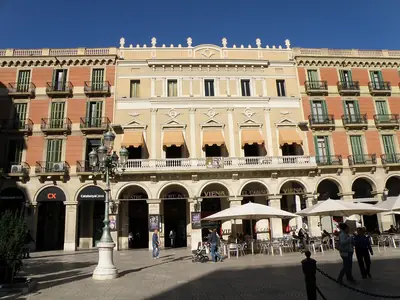
Plaça del Mercadal is home to the Gaudí Centre, opened in May 2007 in a rehabilitated building at the corner of Carrer del Vidre. Its exhibition space covers 1,200 square metres over three floors and explores Antoni Gaudí’s life and creative language through real objects, models, reproductions and audiovisual experiences.
The second floor focuses on Gaudí as an innovator, with interactive models showing his approach to shapes, space, light, air and water. The third floor uses a multiscreen presentation and tactile models to introduce the elements behind his artistic language.
Casa Navàs
At the corner of Plaça del Mercadal and Carrer de Jesús stands Casa Navàs, one of Reus’s most important Modernist buildings. It was designed by the Barcelona architect Lluís Domènech i Montaner and is a central stop for understanding the city’s architectural heritage.
Casa Iglésies Òdena
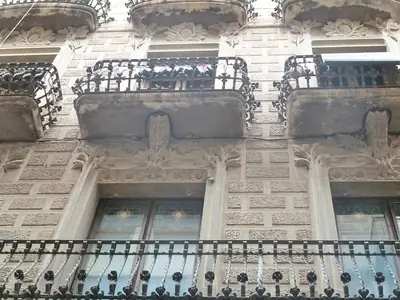
Also known as Casa Iglesias, Casa Iglésies Òdena is a protected monument in Reus, in the Baix Camp area of Tarragona Province. It forms part of the city’s collection of buildings that illustrate its Modernist and historic character.
Palau Miró and Plaça de Prim
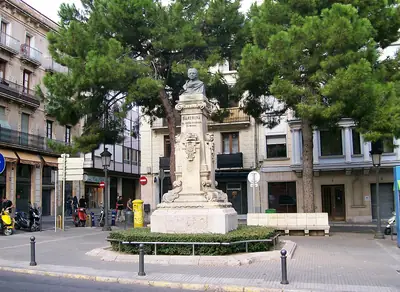
Plaça de Prim is one of Reus’s central public squares, where several streets and boulevards meet. At its centre stands an equestrian statue dedicated to General Joan Prim i Prats.
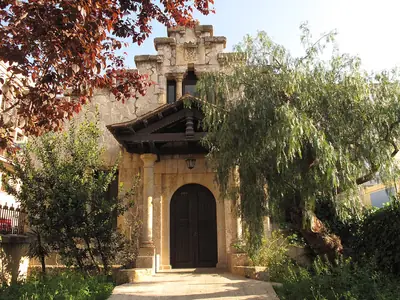
The square also preserves a fragment of Palau Miró, or Cal Miró. The former manor house was demolished in 1973, but its stone portal survives, reused as the entrance to a nursery in the former preventive prison of Reus. The palace once contained murals attributed to Joseph Flaugier and nineteenth-century decorative details, including ceiling panels said to recall a room where Isabel II had slept.
Palau Bofarull
On Llovera Street, near Plaça de Prim, Palau Bofarull is an urban palace associated with the ennobled Bofarull family. It is also known as L’Olimpo or Els Ploms, names connected with organisations that once had their headquarters there. The building is now home to the Reus Conservatory of Music and is protected as a locally recognised cultural asset.
Casa Querol and Casa Tomàs Jordi
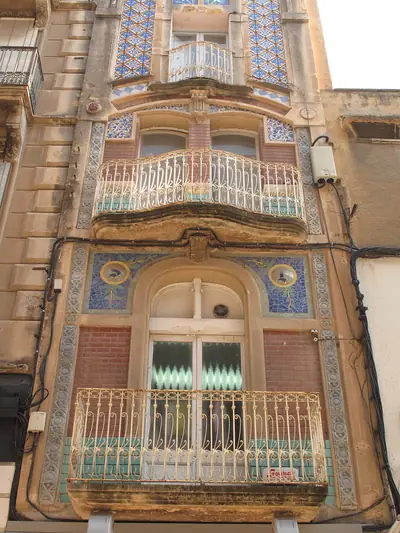
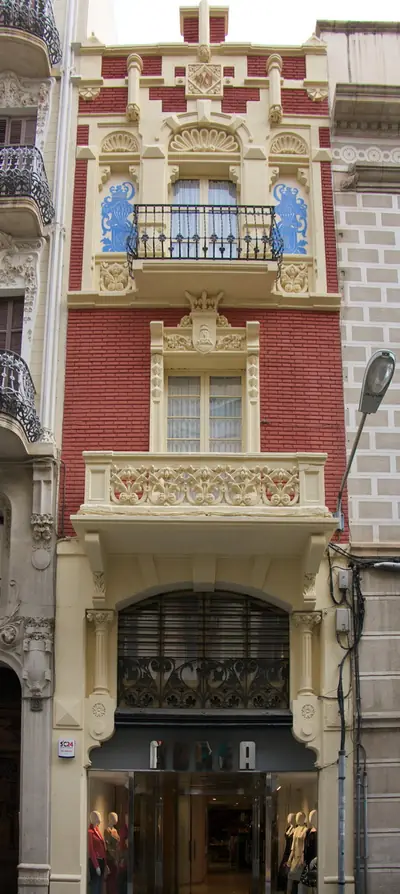
At number 17 on Llovera Street, Casa Querol, also called cal Querol, is a Modernist building designed by Pere Caselles. A little further along, at numbers 19 to 21, Casa Tomàs Jordi, or cal Tomàs Jordi, provides another example of Caselles’s work. Both buildings are protected as locally recognised cultural assets.
Teatre Fortuny and Plaça de Prim
The Teatre Fortuny was built in 1882, when Reus was the second city of Catalonia. It was intended to provide a theatre comparable to those in other major cities. The complex includes the theatre and the headquarters of El Círcol at number 4, Plaça de Prim; together, they are recognised as a cultural asset of national interest.
The theatre later entered a quieter period and was used as a cinema under the name Cine Fortuny. A consortium formed by the Government of Catalonia, the Tarragona Provincial Council and Reus City Council later made its rehabilitation possible. The building is named after Marià Fortuny i Marsal, the Catalan painter born in Reus.
Monument a Bartrina and the former Teatre Principal
The Monument a Bartrina is a heritage monument included in the Inventory of Architectural Heritage of Catalonia. Nearby is the former site of the Teatre Principal, popularly known as the Teatre de les Comèdies. Although the theatre has disappeared, its history remains connected with the area between Raval de Santa Anna and Carrer de Vallroquetes, beside Plaça de Catalunya.
Museu d’Art i Història de Reus
The Museu d’Art i Història de Reus is both a museum and a protected historic building. It is recognised as a cultural property of national interest, and the building was declared a historic and artistic monument in 1962. Its protected status forms part of the site’s importance within Reus’s heritage.
Museu Comarcal Salvador Vilaseca
The Museu Comarcal Salvador Vilaseca is one of Catalonia’s longest-established museum institutions. Its collections examine Reus and the surrounding area through history, art, society, politics and economic life, as well as the history of the Spanish Civil War.
The museum began as the Museu Municipal Prim-Rull, which opened at Casa Rull on 14 April 1934. Its holdings later expanded significantly with the donation of the archaeological collection of Salvador Vilaseca, who lived from 1896 to 1975. Together, the collections trace the economic, historical, cultural, artistic, social and political evolution of the city and its region.
CT Art Gallery and Plaça de la Farinera
CT Art Gallery is a starting point for exploring this historic part of Reus. A short distance away, Plaça de la Farinera—known locally as la Farinera—lies in the Santa Anna neighbourhood within the old ring of surrounding streets.
The square takes its name from the flour trade that once took place there. In 1756, the municipal government bought two houses to create a controlled place for selling flour. After residents objected to the loss of shared open space, the council bought another house and transformed the area into a square. Santa Anna Street runs along its western side, while Vallroquetes, Aleus and Vaqueria streets converge nearby.
Refugi antiaeri de la Patacada
The Patacada air-raid shelter is one of the most extensive wartime shelters recovered in Reus. It was one of 110 shelters excavated in the city during the Spanish Civil War to protect people from aerial attacks.
Its entrance is within the Patacada complex, alongside the municipal civic centre, the Casal de les Dones and the former washing facilities. The entrance hall now serves as both a reception area and an interpretation space, offering a direct way to understand this period of the city’s history.
Dispensari antituberculós de Reus
At number 34 on Carrer de Sant Joan, the former Antituberculosis Dispensary of Reus is a notable example of Noucentista architecture. Designed by Joan Rubió i Bellver, it was created as part of an effort to eradicate tuberculosis in the Camp area.
The building is protected as a Local Cultural Interest Site and is recorded in the Inventory of the Architectural Heritage of Catalonia.
Bòbila del Sugranyes
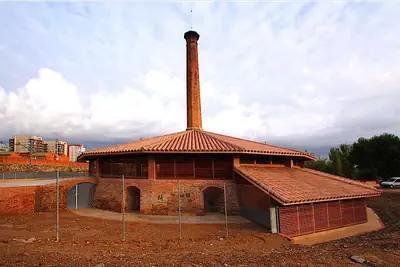
The Bòbila del Sugranyes, also known locally as the Forn del Sugranyes or Forn del Manxa, is a protected example of Reus’s industrial heritage. This former brickworks is centred on a circular kiln about 23 metres across, with a chimney rising 19 metres above it.
The lower part of the chimney is square, while the upper section is octagonal. Radial openings around the partly buried kiln fed the furnace, and a circulation gallery surrounded it. The brickworks produced bricks, roof tiles, floor tiles and other ceramic building materials. Its combination of adobe, brick, a radial structure and a striking chimney makes it a particularly distinctive site.
Torre del Cambrer and the churches of Reus
The Torre del Cambrer, also known as the Castell del Cambrer or Castell del Camarer, is a protected historic monument. It provides another link with the city’s architectural past.
The Església de la Puríssima Sang, also called the Església de la Sang, gives its name to the surrounding square and is one of Reus’s religious landmarks. Further away, Sant Bernat Calvó is a parish church in Barri Fortuny and a recognised part of Catalonia’s architectural heritage.
Explore Reus with a self-guided audio tour
Neywo’s free Reus audio guide includes three walking tours, one bus route and one bike route. Together, they cover 38 narrated places, with stories that play as you reach each location. The narration is available in 11 languages, and you can explore at your own pace, with no group and no schedule.
The routes include:
- Three walking tours: 0.96 km and 74 minutes with 12 stops; 0.91 km and 58 minutes with 9 stops; and 1.56 km and 62 minutes with 8 stops.
- One bus route: 5.1 km and 22 minutes with 5 stops, crossing Reus from the Santuari de la Mare de Déu de Misericòrdia to the Museu d’Art i Història de Reus.
- One bike route: 1.5 km and 8 minutes with 2 stops, following the route from Plaça de la Pastoreta to the Santuari de la Mare de Déu de Misericòrdia.
Download Neywo and explore Reus while the app tells the story of each place as you reach it—at your own pace, without joining a group or following a schedule. Reus is also a useful base for discovering other destinations in Spain, including nearby Tarragona and Salou.
Places with an audio guide in Reus
8 places in Reus with a Neywo audio guide. Each one starts telling its story as you reach it.
Self-guided tours in Reus
5 tours in Reus, free in the Neywo app. Each stop tells its story as you reach it.
- Bike ride
Passeig de Misericòrdia: a short ride to the sanctuary
A gentle ride on the cycle lane along the tree-lined Passeig de Misericòrdia, from the shepherdess of Plaça de la Pastoreta to the Renaissance sanctuary of the Mare de Déu de Misericòrdia at the edge of town.
Plaça de la Pastoreta · Santuari de la Mare de Déu de Misericòrdia
Open this tour: Passeig de Misericòrdia: a short ride to the sanctuary - Bus ride
Line L20 across Reus: from the Misericòrdia sanctuary to the museum
Ride the L20 city bus from the Renaissance sanctuary at the end of Passeig de Misericòrdia, past the shepherdess statue on Plaça de la Pastoreta and the geese fountain on Plaça de les Oques, to the Museum of Art and History and the Església de la Puríssima Sang. It is an easy, cheap way to see Reus beyond the old centre.
Santuari de la Mare de Déu de Misericòrdia · Plaça de la Pastoreta · Plaça de les Oques · Museo de Arte e Historia de Reus · Església de la Puríssima Sang
Open this tour: Line L20 across Reus: from the Misericòrdia sanctuary to the museum - Walk
Gaudí's hometown: Modernisme around Plaça de Prim
Reus is where Antoni Gaudí grew up, and it holds a rich crop of Modernista houses. Start at the flour square of La Farinera, cross to the Gaudí Centre on Plaça del Mercadal, then follow the streets around Plaça de Prim to see the work of Pere Caselles, a lost palace whose portal survives, and the pharmacy house that gave a street its nickname.
Casa Marco · CT Art Gallery · Casa Pinyol · Plaça del Mercadal · Gaudí Centre · Monument a Prim …
Open this tour: Gaudí's hometown: Modernisme around Plaça de Prim - Walk
Old Reus: walls, a castle and a patron saint
Walk the medieval heart of Reus, from the Baroque Franciscan church to the old fortified Baluard, then the priory of Sant Pere, the arcades of Plaça del Castell and the museum that tells the city's story. Along the way a theatre born of a popular subscription shows how Reus paid for its own culture.
Sant Francesc de Reus · Plaça del Baluard · Teatro Bartrina · Església Prioral de Sant Pere de Reus · Torre del Cambrer · Plaça del Castell …
Open this tour: Old Reus: walls, a castle and a patron saint - Walk
West Reus: Domènech i Montaner, the Goose Boy and the Circ
A quieter loop through the western streets of Reus. Start at the Museum of Art and History, pass the churches and old theatres of Carrer de Sant Joan, find the two Domènech i Montaner houses side by side, meet the bronze Goose Boy on his round square and finish at the pharmacy house of Casa Punyed.
Museo de Arte e Historia de Reus · Casa Ramon Vendrell · Sant Joan de Reus · Teatre Circ · Plaça de les Oques · Casa Gasull …
Open this tour: West Reus: Domènech i Montaner, the Goose Boy and the Circ
Walk Reus with Neywo
Neywo turns Reus into a self-guided audio tour. Stories arrive as you reach the place they belong to, and the route reshapes when you wander off it.

