Things to Do in Antalya, Turkey: Walking Guide
Things to do in Antalya, Turkey: what to see in the city
The best things to do in Antalya include exploring Kaleiçi, walking through ancient ruins, visiting archaeological museums and mosques, and seeing waterfalls meet the Mediterranean. The city combines Roman, Byzantine, Seljuk and Ottoman heritage with dramatic coastal scenery. Neywo offers a free audio guide for Antalya with 18 narrated places.
What to see in Antalya
Kaleiçi and Hadrian’s Gate
Kaleiçi is Antalya’s historic heart, where several of the city’s most important landmarks are close together. Hadrian’s Gate, also known as Üçkapılar, was built in honour of the Roman emperor Hadrian, who visited Antalya in 130 CE. Its three marble arches are set into the old city walls, and the lower section was restored in 1959.
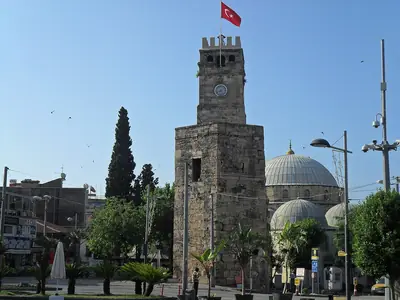
The nearby Antalya Clock Tower, or Saat Kulesi, dates from 1901. Built to mark the 25th year of Abdulhamit II’s reign, it has a distinctive square form, rough-stone walls and clock faces on each side. Its foundation incorporates an older section of the city walls.
Yivli Minaret Mosque
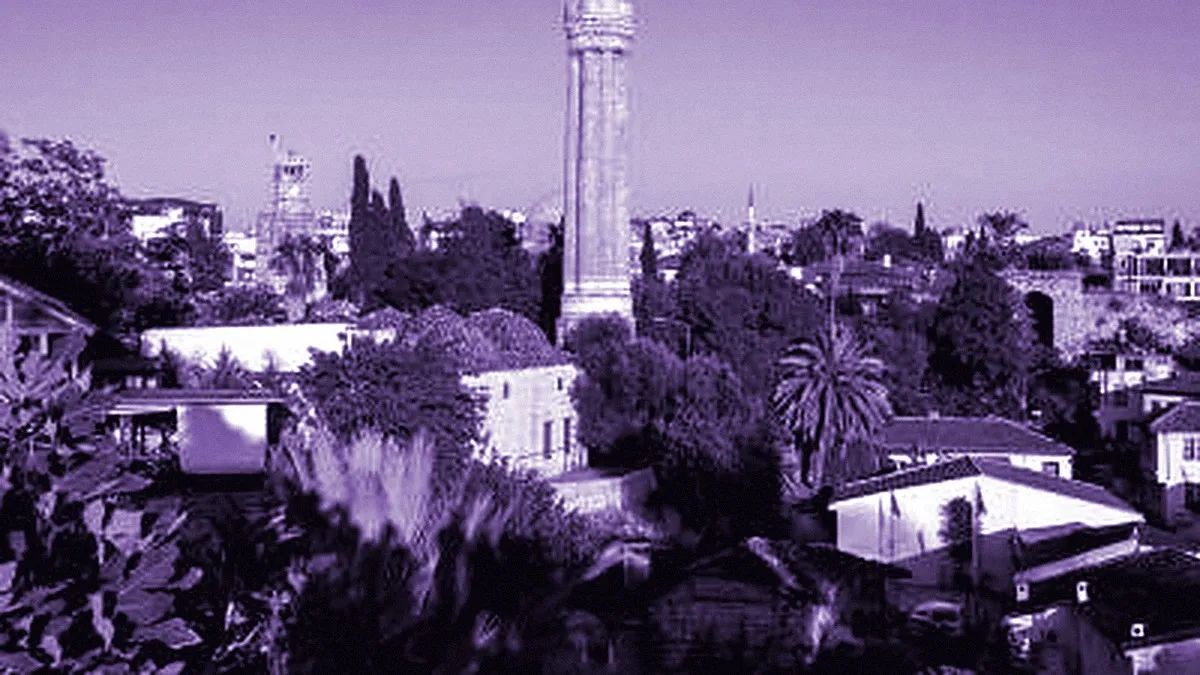
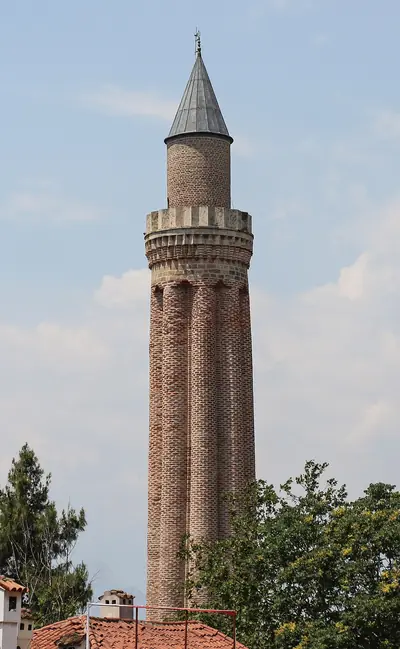
The Yivli Minaret Mosque is one of Antalya’s best-known landmarks. Its separate fluted-brick minaret is built on a four-sided base and has eight fluted sections, with 90 steps leading upwards. Traces of dark-blue tilework add to its distinctive appearance.
The minaret was constructed between 1219 and 1236. The mosque was first built in 1230 and fully reconstructed in 1373. The later building has six domes and is regarded as one of Antalya’s oldest examples of multi-dome construction.
Kesik Minare
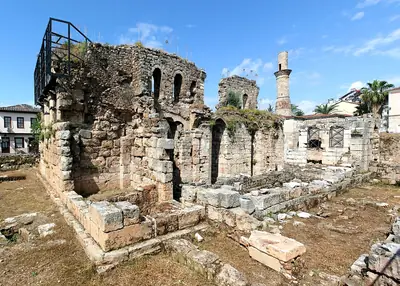
Kesik Minare, also called Korkut Cami or Cumanın Cami, stands on Kaleiçi Hesapçi Street. Its history reflects the many religious and political changes Antalya has experienced. The building began as a Roman temple in the 2nd century AD, became a Byzantine church in the 7th century, and was converted into a mosque after a minaret was added in the early 13th century under the Sultanate of Rum.
It later became a church again before returning to use as a mosque. A fire destroyed the main building in 1896, leaving the surviving minaret that gives the site its name. Restoration work began in 2018.
Hıdırlık Tower and Karaalioğlu Park
At the edge of Kaleiçi, Karaalioğlu Park provides views and space to pause near the old town. Its most prominent landmark is Hıdırlık Tower, a cylindrical Roman tower dating to the 2nd century. The structure is about 14 metres high, with a square lower section and a cylindrical upper section.
The tower has served different purposes over time, including fortification, a lighthouse and a lookout for ships entering the bay. Karaalioğlu Park also contains sculptures including the Worker and Son, a monument to poet Nâzım Hikmet, the Frog and Hand sculptures, and a statue of Don Quixote.
İskele Mosque
Near the water on Mermerli Street, İskele Mosque occupies a vintage-looking breakwater beside the Old Port. Built in the late nineteenth century, it is made entirely of stone. Its unusual design centres on a spring rising from the ground, with the mosque supported by four pillars above the natural water source.
Murat Paşa Mosque
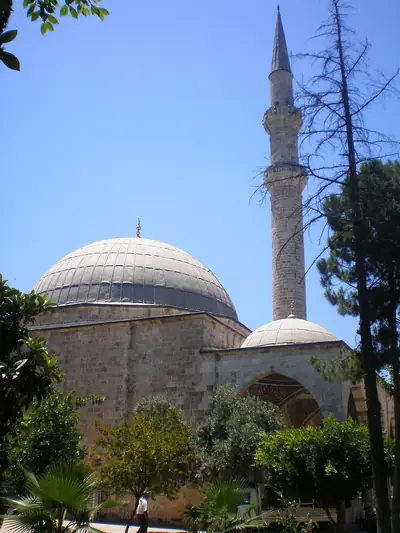
Murat Paşa Mosque is an Ottoman landmark in the Muratpaşa borough. It dates to 1570 and was long associated with Grand Vizier Kuyucu Murad Pasha, although newer information suggests it was commissioned by Karaman Beyi Murat Paşa.
The building combines Ottoman design with traces of Seljuk calligraphy. Reused architectural elements, known as spolia, appear behind the narthex, including Corinthian capitals. Inside, an inscription frieze runs along the upper walls, while light-coloured floral motifs stand out against a dark background around the dome.
Tekeli Mehmet Paşa Mosque
In the Kalekapısı district, Tekeli Mehmet Paşa Mosque is a notable Ottoman building constructed during the 17th century. It takes its name from Lala Mehmed Paşa.
The main dome rises on a lofty rim and is supported by three semi-domes and three smaller domes. Tiled panels decorate the pointed-arch lunettes on the northern façade and inside the mosque. These panels contain Quranic verses written in taliq script.
Antalya Museum
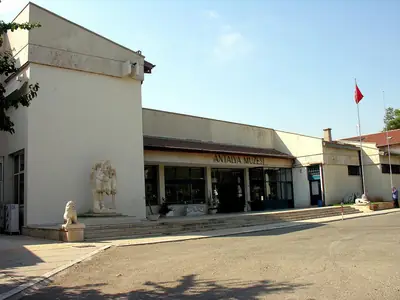
The Antalya Museum, also known as the Antalya Archaeological Museum, preserves archaeological discoveries from Antalya and the surrounding region. Its collection is arranged across 13 exhibition halls and an open-air gallery covering about 7,000 square metres.
Around 5,000 works are on display, while a further 25,000 to 30,000 artefacts remain in storage. The museum was founded in 1922 to protect ancient objects found around Antalya from occupying forces. It later moved from Alâeddin Mosque to Yivli Minare Mosque, before relocating to its present building in 1972. After extensive modifications, it reopened in April 1985 and received the European Council Special Prize in 1988.
Düden Waterfalls
Düden Waterfalls are formed by the Düden River as it travels towards the Mediterranean. The attraction has two distinct sections.
The Upper Düden Waterfalls are about 15 kilometres outside the city, in a deep river-carved gorge. Visitors can view the falls from above, explore the gorge on foot and look for the cave hidden behind the cascading water.
The Lower Düden Waterfalls are in the Lara area, east of the Old Town. Here, the water plunges over rugged cliffs directly into the Mediterranean Sea.
Perge
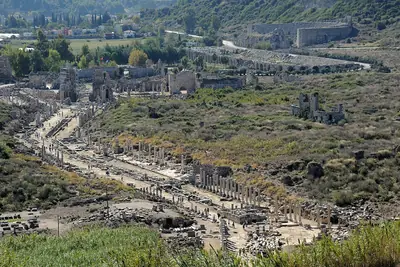
The ancient city of Perge, also called Perga, lies a short distance from Antalya. Its acropolis is thought to have been founded during the Bronze Age, and the city was considered one of the richest and most beautiful in the ancient world during the Hellenistic period.
Perge is especially notable for the long water channel running through the centre of its main street. The channel included cascading pools, an impressive feature in a region where summer temperatures can exceed 30 degrees Celsius. During the Hittite period, the city was known as Parha; references may also use Pergi or Perge.
Aspendos
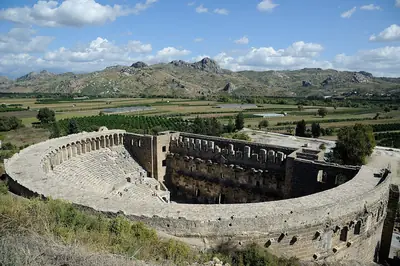
Aspendos was an ancient Greco-Roman city positioned on the Eurymedon River. It shared a border with Side and is described as one of Pamphylia’s richest cities. The site is closely associated with Belkıs, the village in Serik district where its ancient theatre is located.
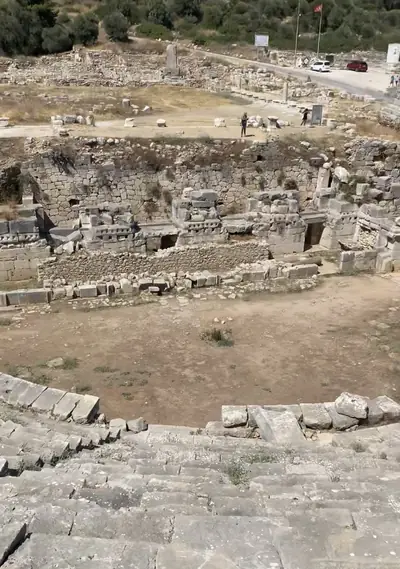
Xanthos Theater
Xanthos Theater is another archaeological stop in the wider Antalya region. Named for Xanthos, the theatre offers a place to imagine how performances once brought people together in this ancient setting.
Antalya Aquarium
For a different kind of visit, Antalya Aquarium combines themed displays with entertainment and education. It contains 40 thematic aquariums and a 131-metre-long, 3-metre-wide tunnel aquarium described as the world’s largest.
The complex also includes Snow World and the Ice Museum, a Tropical Reptile House known as WildPark, and the Oceanride XD Cinema. It stands in the heart of Antalya, 70 metres from Konyaaltı Beach.
Explore Antalya with a free audio guide
Neywo’s Antalya audio guide includes two self-guided walking tours through Kaleiçi and the city centre. The shorter walk covers 1.07 kilometres in 43 minutes and has six narrated stops: İskele Mosque, the Yivli Minaret Mosque, the Old Bazaar, Antalya Clock Tower, Tekeli Mehmet Paşa Mosque and Hadrian’s Gate.
The longer walk covers 4 kilometres in 114 minutes and includes 12 narrated stops, from Karaalioğlu Park and Hıdırlık Tower to Kesik Minare, Hadrian’s Gate, the Old Bazaar, Murat Paşa Mosque and the other central landmarks. Stories are available in 11 languages.
With Neywo, each story plays as you reach the place, at your own pace. There is no group and no schedule: download the app and explore Antalya independently. If you are continuing through Turkey, you can also discover Neywo guides for Fethiye, Bodrum and İstanbul.
Places with an audio guide in Antalya
8 places in Antalya with a Neywo audio guide. Each one starts telling its story as you reach it.
Self-guided tours in Antalya
1 tour in Antalya, free in the Neywo app. Each stop tells its story as you reach it.
- Walk
Kaleici: the old bazaar and Hadrian's Gate
A kilometre through Antalya's walled old town — three Ottoman mosques, the clock tower on the line of the old walls, the bazaar, and the triple marble arch built for Hadrian's visit in 130 AD.
Karaalioğlu Park · Hidirlik Tower · Kesik Minare · Hadrian's Gate · Tekeli Mehmet Paşa Mosque · Antalya Clock Tower …
Open this tour: Kaleici: the old bazaar and Hadrian's Gate
Walk Antalya with Neywo
Neywo turns Antalya into a self-guided audio tour. Stories arrive as you reach the place they belong to, and the route reshapes when you wander off it.

