Bodrum, Turkey: Self-Guided Walking Tour
Things to Do in Bodrum: What to See on a Self-Guided Walk
Looking for things to do in Bodrum? This Aegean town combines the remains of ancient Halicarnassus with medieval fortifications, historic religious buildings, museums, and a lively port. Its compact mix of archaeological sites and later layers makes Bodrum a rewarding destination for exploring on foot. Neywo has a free audio guide for Bodrum with 13 narrated places, available in 11 languages.
What to See in Bodrum
Bodrum Castle
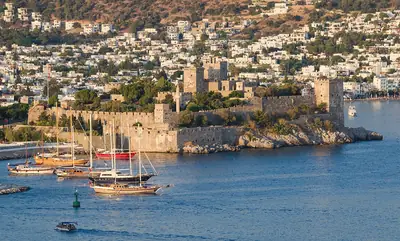
Bodrum Castle stands beside the port and is one of the town’s defining landmarks. The Knights of St John began building it around 1402, adding a chapel around 1407 and completing the first walls by 1437. Its four towers—the English, French, German, and Italian towers—are named after the nations whose knights built them.
The castle was reconstructed in the late 15th century before being taken over by the Ottoman Empire in 1523. The chapel was converted into a mosque and a minaret was added. The Ottomans held the fortress for nearly four centuries. In 2016, Bodrum Castle was placed on Turkey’s UNESCO Tentative List of World Heritage Sites.
Bodrum Museum of Underwater Archaeology
The Bodrum Museum of Underwater Archaeology is another important stop in the castle area. The source material identifies the museum as one of Bodrum’s principal cultural attractions, while the castle provides its historic setting beside the port.
Halicarnassus
Modern Bodrum stands over the ancient Greek city of Halicarnassus, once the capital of Caria. Its protected harbor made it an important stop on ancient Mediterranean maritime routes. Unlike many Greek city-states, Halicarnassus retained a monarchical government and remained loyal to the Persian Empire while nearby Ionian cities rebelled.
Under Mausolus, the city was strengthened with walls and public buildings. It also had a secret dockyard and a canal connecting the harbor with the inner city. After Mausolus’s death, Halicarnassus remained under Persian rule until Alexander the Great captured it during the siege of 333 BC.
Mausoleum at Halicarnassus
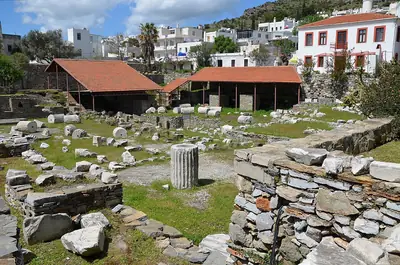
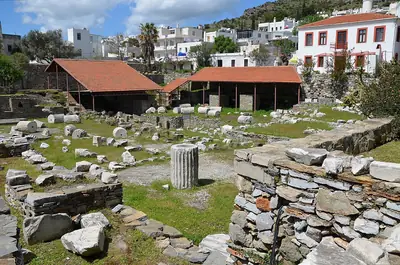
The Mausoleum at Halicarnassus was built for Mausolus, a satrap of the Achaemenid Persian Empire, and his sister-wife Artemisia II. Construction began around 353 BC and was completed by 351 BC. Its fame gave the word “mausoleum” to above-ground tombs.
The monument rose to about 45 metres and combined Greek columns with a pyramid-shaped roof influenced by Lycian and Egyptian forms. Four master Greek sculptors created reliefs for its sides, and the interior contained around 400 free-standing statues. A series of earthquakes between the 12th and 15th centuries eventually toppled the structure.
Ancient Theatre of Halicarnassus
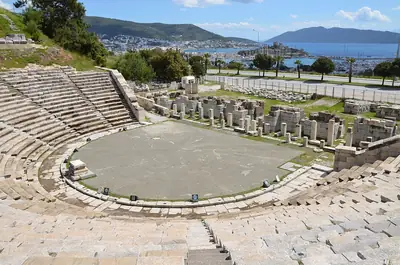
North of Bodrum’s city centre, the Ancient Theatre of Halicarnassus is a 4th-century BC Greco-Roman theatre originally built during the reign of Mausolus. It is one of Anatolia’s oldest theatres and could hold about 13,000 spectators.
The theatre has 55 rows of seats divided into twelve sections by eleven stairways. Roman alterations changed parts of the building, while Turkish volunteers restored it in the 1970s. The site also includes an altar dedicated to Dionysus, where sacrifices were made before performances. Small holes between some seats may once have supported shades.
Zeki Müren Museum
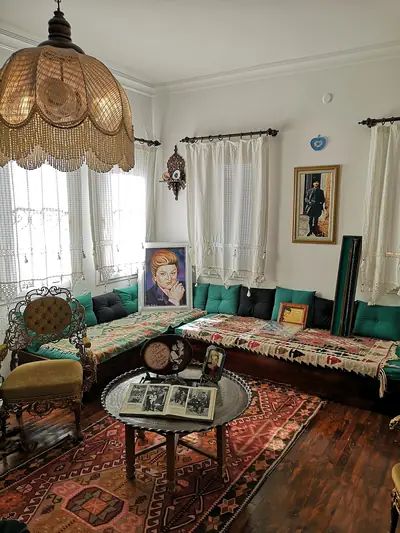
The Zeki Müren Museum occupies the former home of one of Turkey’s best-known classical music stars. It displays his stage costumes, paintings, fan letters, awards, and personal household objects.
The house was reorganised by Turkey’s Ministry of Culture and Tourism and opened to the public on July 8, 2000. In the garden, visitors can see Müren’s Buick Regal and a bronze statue by sculptor Tankut Öktem. The letters and awards reflect the strong connection between the singer and his audience.
Saint Nicholas Church
The remains of Saint Nicholas Church, also known as Aya Nikola Kilisesi, lie in Hilmi Uran Square on Cumhuriyet Street. The church was dedicated to Saint Nicholas and is believed to have been built either in 1780 or 1873.
Following the population exchange between Turkey and Greece, the building was used as a sponge warehouse, a cinema, and a public education centre. A controlled demolition took place in 1969 after a report described structural decay. The remaining site offers a reminder of Bodrum’s Greek Orthodox heritage.
Bodrum Kale Mosque
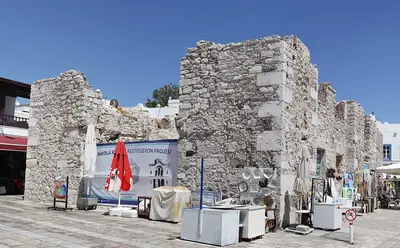
Bodrum Kale Mosque has served as a mosque, a church, and a monastery. Its importance lies in this succession of uses: the building preserves a layered history shaped by different religious and political periods.
Kızılhisarlı Mustafa Pasha Mosque
Kızılhisarlı Mustafa Pasha Mosque is a mosque in Bodrum, in Muğla province. It forms part of the town’s collection of historic religious buildings and can be included alongside the castle and central archaeological sites.
Tepecik Mosque
Tepecik Mosque, also known as Tepecik Cami, is another mosque in Bodrum. Its presence adds a later architectural layer to a town best known for the ancient city and the medieval castle.
Ancient Sites Beyond the Centre
Pedasa
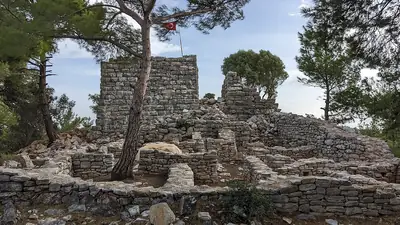
Pedasa was an ancient Carian city in the wider Bodrum region. By around 400 BCE, it had become a self-governing polis and joined the Delian League, the alliance led by Athens. Alexander the Great ended its independence, incorporating Pedasa into the territory of Halicarnassus along with five neighbouring towns.
Ancient sources use several forms of the name, including Pedasa, Pedasus, Pedasos, and Pedasum.
Strobilos
Strobilos, also known as Aspat or Çıfıt Kalesi, is an ancient Byzantine fortress on the southwestern Anatolian coast opposite Kos. First mentioned in 724, it is one of the few known Anatolian settlements dating from the early Middle Ages.
The site served at different times as a place of exile, a fortress, and a naval base for the Cibyrrhaeot Theme. An 11th-century monastery once stood there. Strobilos faced Arab attacks in 924 and 1035, was sacked by the Seljuk Turks around 1080, and later returned to Byzantine control before falling to the Turkish emirate of Menteshe in 1269.
Adliye Mosque
Adliye Mosque, also known as Adliye Camii, is located in Bodrum, in Muğla province in southwestern Turkey. It is one of the town’s local mosques and another point of interest for visitors exploring Bodrum’s religious architecture.
Explore Bodrum with a Free Audio Guide
A Bodrum self-guided walking tour is a simple way to connect the town’s monuments without joining a group. Neywo’s walking tour, “Bodrum from Castle to Wonder: Knights, Sultans and a Mausoleum,” covers 3.92 km in around 115 minutes and includes 9 narrated stops.
The route includes the Zeki Müren Museum, Saint Nicholas Church, Kızılhisarlı Mustafa Pasha Mosque, Bodrum Castle, Bodrum Kale Mosque, Tepecik Mosque, the Mausoleum at Halicarnassus, the Ancient Theatre of Halicarnassus, and Halicarnassus. The app tells the story of each place as you reach it, at your own pace, with no group and no schedule. Download Neywo and explore Bodrum with a free audio guide that turns a walk through the town into a connected journey through its history. Bodrum is part of Turkey, and you can continue discovering the country with nearby destinations such as Fethiye, Antalya, or İstanbul.
Places with an audio guide in Bodrum
8 places in Bodrum with a Neywo audio guide. Each one starts telling its story as you reach it.
Self-guided tours in Bodrum
1 tour in Bodrum, free in the Neywo app. Each stop tells its story as you reach it.
- Walk
Bodrum from Castle to Wonder: Knights, Sultans and a Mausoleum
Walk from the bay of Bodrum, where a Turkish pop star's house and a vanished Greek church sit by the shore, up to the Knights' castle, then inland to the site of the Mausoleum, one of the Seven Wonders, and the ancient theatre carved into the hill.
Zeki Müren Museum · Saint Nicholas Church, Bodrum · Kızılhisarlı Mustafa Pasha Mosque · Bodrum Castle · Bodrum Kale Mosque · Tepecik Mosque …
Open this tour: Bodrum from Castle to Wonder: Knights, Sultans and a Mausoleum
Walk Bodrum with Neywo
Neywo turns Bodrum into a self-guided audio tour. Stories arrive as you reach the place they belong to, and the route reshapes when you wander off it.

