Things to Do in Mardin, Turkey: Walking Guide
Things to do in Mardin: discover a stone city above the Mesopotamian Plain
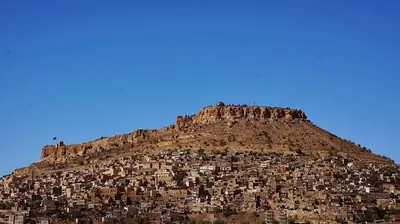
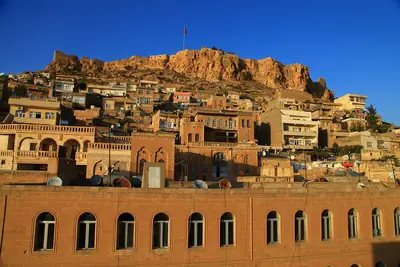
Mardin is a historic city built along a rocky hill above the Mesopotamian Plain, known for its honey-colored limestone architecture, religious monuments, and layered cultural heritage. The old city is worth exploring on foot, where mosques, churches, monasteries, courtyards, and narrow streets reveal the character of southeastern Turkey. Neywo has a free audio guide for Mardin with 21 narrated places, available in 11 languages.
What to see in Mardin
Mardin Castle
Mardin Castle, or Mardin Kalesi, rises on the high ridge above the city. Known locally as the Eagle’s Nest, it stands about 1,000 metres above the Mesopotamian Plain and has long defined Mardin’s skyline.
Its elevated position made it a powerful defensive site with extensive views across the plain. The castle is associated with a long succession of historical periods, including the Hamdanid, Artuqid, Seljuk, Safavid, and Ottoman eras. It was constructed during the Hamdanid period in the tenth century and later became part of the Artuqid realm from the eleventh to the thirteenth century.
Today, the site also contains a radar station and has served as a military base under a NATO agreement.
Great Mosque of Mardin
The Great Mosque of Mardin, known locally as Mardin Ulu Camii, is one of the city’s important examples of Artuqid-period architecture. Built from cut stone, it has a broad transverse layout and a dome above the area in front of the mihrab.
The exterior of the dome is divided into ribbed segments, an unusual treatment that became a lasting feature of Mardin’s architectural tradition. A rectangular courtyard lies to the north. The mosque originally had two minarets; the surviving minaret stands on a square base and was built in 1888 or 1889.
Inscriptions at the mosque preserve two accounts of its origins. One, dated 1176, attributes its construction to Diyarbekir ruler Kutbettin Ilgazi the Second. Another, in the courtyard, gives the date as 1186 and names Artuqid ruler Hüsameddin Yavlak Arslan.
Kırklar Church
Kırklar Church, formerly known as Mor Behnam, has stood in Mardin since 569 and remains the city’s metropolitan church. It is also known as the Church of the Forty Martyrs.
The church received its present name after the remains of forty Christian martyrs from Sebastia, also known as Sivas, were brought there in 1170. Inside, finely worked stone altars feature three entrance doors, while wooden altar doors are around four hundred years old. The church also preserves printed curtains made using a natural-dye tradition described as fifteen hundred years old.
Its spacious courtyard includes a bell tower house and a divan decorated with stone carving that resembles lacework.
Latifiye Mosque
Latifiye Mosque is also known as Abdüllatif Camii or Latifiye Camii. Located in Artuklu, it is one of the historic places of worship encountered while walking through Mardin’s old city.
Its setting among the city’s stone buildings helps show how religious monuments form an integral part of Mardin’s historic streetscape.
Mardin Museum
Mardin Museum, or Mardin Müzesi, stands in the Artuklu District. This archaeology and ethnography museum brings together objects that reflect the history and culture of the surrounding region.
The archaeological collection covers a long period, with objects from the Bronze Age, the Assyrian and Urartian eras, the Hellenistic period, the Roman and Byzantine empires, and the Seljuk, Artuqid, and Ottoman periods. Displays include tablets, cylinder and stamp seals, ritual vessels, figurines, jewelry, ceramics, oil lamps, tear bottles, and gold, silver, and copper coins.
Zinciriye Medresesi
Zinciriye Medresesi is one of the historic sites to include when exploring Mardin. Its name is part of the city’s architectural and cultural vocabulary, alongside the mosques, churches, and other monuments that shape the old town.
Mardin’s historic centre is best experienced as a connected landscape rather than as a list of isolated sights. The city’s stone façades, hilltop setting, and religious buildings all contribute to its distinctive character.
The old city and its religious heritage
Mardin’s old city rises along the rocky hill, with distinctive Artuqid architecture and views toward the surrounding landscape and the nearby Tigris River. Mosques, tombs, churches, monasteries, and other religious buildings reflect the different faiths that have shaped the city.
Mardin also lies along the historic Silk Road route. Five inns and a caravanserai remain associated with the city, offering a glimpse of the buildings and networks that once supported travel through the region.
Among the smaller landmarks in Artuklu are Dinari Pamuk Mosque, Melik Mahmut Mosque, Molla Halil Mosque, Hamidiye Camii, Hamza-i Kebir Camii, and Aran Village Mosque. They form part of the local architectural character and help make a walk through Mardin’s historic districts an experience of continuous discovery.
Mor Hananyo Monastery
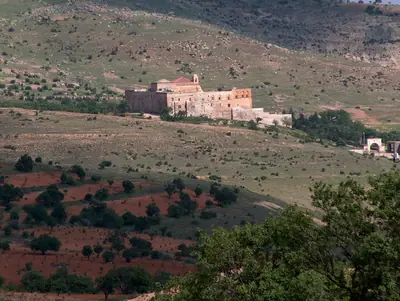
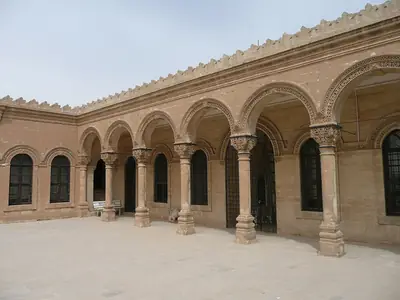
A few kilometres east of Mardin, Mor Hananyo Monastery is also known as Deyrulzafaran, or the Saffron Monastery. Surrounded by vineyards and trees, it remains one of the best-known centres of the Syriac Orthodox Church and continues as a living religious, cultural, and educational community.
The monastery is notable for its warm yellow-tinted walls and carefully carved stonework. Its complex includes the Domed Church, the Church of the Virgin Mary, the Church of the Patriarchal Throne, a mausoleum, and a garden structure known as Paradise. Although the buildings were added over different periods, the monastery was designed as a connected whole.
The site is traditionally said to have begun as a temple dedicated to the Assyrian sun god Šamaš. It was later used as a Roman fortress, before Saint Shleymun is said to have brought the remains of saints there and transformed the fortress into a monastery. The surviving mosaics are associated with the site’s earlier history.
The monastery took its present name after Mor Hananyo, also known as Saint Ananias. In 793, Saint Hananyo, metropolitan of Kefertuth, restored the monastery, which was then named in his honour.
Explore Mardin with a self-guided walking tour
A Mardin self-guided walking tour is a practical way to experience the city’s historic centre without following a group. Neywo’s walking tour, “Mardin: A Stone City Above the Mesopotamian Plain,” covers 2.85 km in about 101 minutes and includes 12 narrated stops.
The route visits Şeyh Çabuk Mosque, Kırklar Church, Latifiye Mosque, Mardin Museum, Mardin, Dinari Pamuk Mosque, Mardin Castle, Great Mosque of Mardin, Reyhaniye Mosque, Şehidiye Mosque, Sakıp Sabancı Mardin City Museum, and Melik Mahmut Mosque.
Download Neywo and explore Mardin at your own pace. The app tells the story of each place as you reach it, with no group and no schedule. In Mardin, Neywo offers one walking tour, 2.85 km and 101 minutes of narration, with 12 stops; the city audio guide includes 21 narrated places and narration in 11 languages. Mardin is part of Turkey, whose historic cities and landscapes offer many other places to explore.
Places with an audio guide in Mardin
8 places in Mardin with a Neywo audio guide. Each one starts telling its story as you reach it.

Self-guided tours in Mardin
1 tour in Mardin, free in the Neywo app. Each stop tells its story as you reach it.
- Walk
Mardin: A Stone City Above the Mesopotamian Plain
Follow the old town's main street along its rocky terrace, from the Syriac Church of the Forty Martyrs to the Artuqid Great Mosque and the museums further east. The golden limestone houses, domes and minarets step down the hillside, with the Eagle's Nest castle watching from the ridge. Allow time for the views over the plain.
Şeyh Çabuk Mosque · Kırklar Church · Latifiye Mosque · Mardin Museum · Mardin · Dinari Pamuk Mosque …
Open this tour: Mardin: A Stone City Above the Mesopotamian Plain
Walk Mardin with Neywo
Neywo turns Mardin into a self-guided audio tour. Stories arrive as you reach the place they belong to, and the route reshapes when you wander off it.

