What to See in St Augustine, United States: Free Audio Guide
Things to do in St Augustine: what to see in Florida’s historic city
The best things to do in St Augustine combine Spanish colonial history, striking architecture, museums and a walkable historic center. From the coquina walls of Castillo de San Marcos to the domes, churches and lively streets around the old city, St Augustine is a place to explore on foot. Neywo has a free audio guide for St Augustine with 41 narrated places.
What to see in St Augustine
Castillo de San Marcos
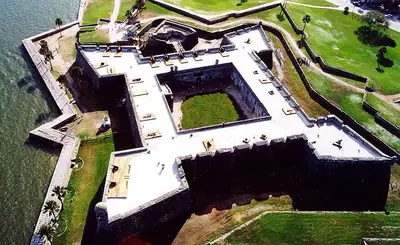
Castillo de San Marcos is St Augustine’s defining landmark and the oldest masonry fort in the continental United States. Built by Spain from 1672, with the main fortress completed in 1695, it was made from coquina, a limestone formed from seashells found along Florida’s coast.
The fort’s star-shaped design and cannon positions helped it withstand attacks. Cannonballs could sink into the coquina instead of shattering it, and the Castillo was never breached or captured by force. Its name changed as control of Florida changed: it was called Fort St. Mark under Britain, Fort Marion after the United States acquired Florida, and Castillo de San Marcos again from 1942.
Cathedral Basilica of St. Augustine
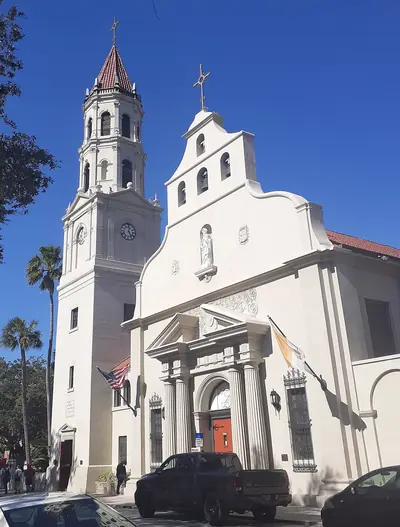
The Cathedral Basilica stands on the historic site of a congregation established in 1565. The current building was constructed between 1793 and 1797, after earlier churches had been lost to fires and conflicts.
Its pale coquina walls, red tile, twin bell towers and arched windows combine Spanish Colonial roots with Neoclassical refinement. Inside, a painted red ceiling with open timber, decorated beams, mission murals, a white-and-gold high altar and stained glass create an especially distinctive interior.
Plaza de la Constitución
Plaza de la Constitución is the historic center of St Augustine and is recognized as the oldest public space in the United States. Spanish colonists laid it out in 1573, and it has served as a setting for worship, politics, trade and daily life.
The square contains the Constitution Monument, placed there in 1813 to honor Spain’s liberal Constitution of 1812, along with cannons, a Spanish public well, gardens, shaded paths, kiosks and other monuments. Government House and the Cathedral Basilica stand around the plaza, while Castillo de San Marcos is within sight.
Government House
Beside Plaza de la Constitución, Government House has served as a residence, office, courthouse and social center. The east wing dates from construction between 1706 and 1713, although the site’s civic history reaches back to 1598.
The coquina building was the official residence of governors during Spanish, British and Second Spanish rule. During the British Period, it was home to James Grant, the royal governor of East Florida. When Florida returned to Spain, Government House again became a governor’s residence.
St. George Street
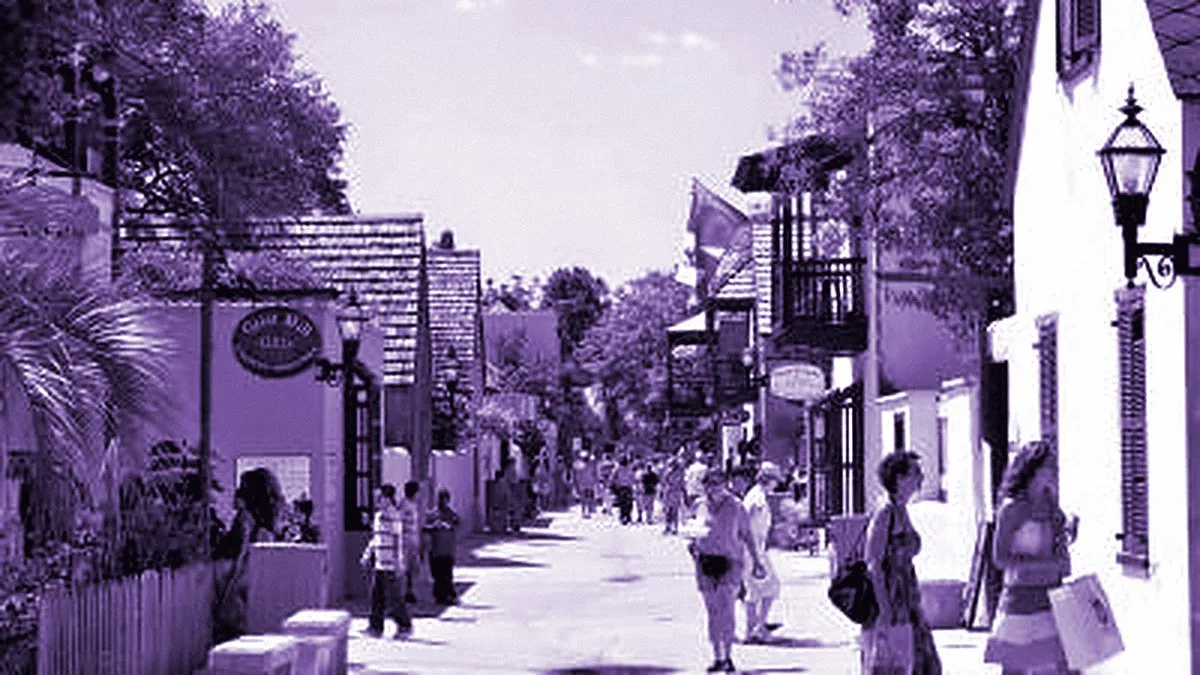
St. George Street was the backbone of the fortified town and remains the historic heart of St Augustine. Its pedestrian-only stretch brings together cafés, boutiques, galleries, restaurants and street performers among coquina buildings and colonial landmarks.
The street connects several layers of the city’s past, including the Pena-Peck House, the Colonial Quarter, the Oldest Wooden Schoolhouse, the Cathedral Basilica and Castillo de San Marcos. At its end stands the 1739 city gate.
Lightner Museum
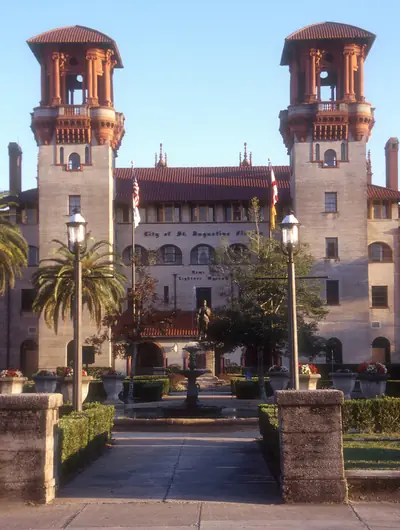
The Lightner Museum occupies St Augustine’s former Hotel Alcazar, a Spanish Renaissance Revival building dating from 1887. Henry Flagler created the hotel as a lavish resort for wealthy winter visitors; it included a Turkish bath, casino, tennis courts and what was described as the world’s largest indoor swimming pool.
Today, the building houses Otto C. Lightner’s eclectic collection. Tiffany stained glass, Victorian gowns and mechanical instruments are displayed within red-tiled roofs, towers, grand halls and a leafy courtyard. The museum is listed on the National Register of Historic Places.
Memorial Presbyterian Church
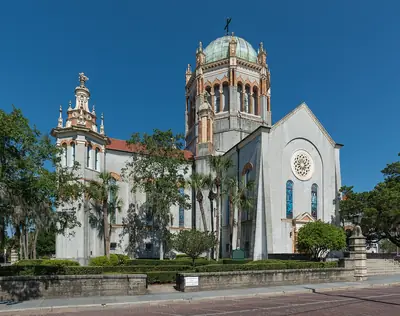
The turquoise dome of Memorial Presbyterian Church is one of St Augustine’s most recognizable architectural features. Henry Morrison Flagler had the church built in 1889 after the death of his daughter, Jennie Louise Benedict. Flagler’s mausoleum is also here, alongside his wife, daughter and granddaughter.
Designed by Carrère and Hastings in the Venetian Renaissance Revival style, the church features a 150-foot copper dome, coquina stone, a terra cotta façade, a rose window and a triple-arched portico. Marble flooring, mahogany pews, stained glass, mosaics, murals and intricate woodwork continue inside.
Villa Zorayda
Villa Zorayda, also known as Zorayda Castle, was built in 1883 as Franklin W. Smith’s winter home. Inspired by the twelfth-century Alhambra Palace in Granada, it was Florida’s first residence in the Moorish Revival style.
Smith developed a construction method using poured concrete and crushed coquina shell. The interior includes plasterwork, cast alabaster tracery, hand-painted wood panels, tiles, elaborate fireplaces, geometric windows and stained glass. The building now preserves art and antiques collected by Smith and the Mussallem family.
Spanish Military Hospital Museum
On Aviles Street, the Spanish Military Hospital Museum recreates medical practices from St Augustine’s Second Spanish Period, from 1784 to 1821. The complex includes buildings connected with the First Spanish, British and Second Spanish periods.
The present reconstruction used original foundations uncovered during archaeological excavations in the 1960s and Spanish hospital records. The reconstructed Hospital East opened to the public in 1968, and the medical museum later became part of the Restored San Agustín Antiguo living history program.
Avero House and Saint Photios Greek Orthodox National Shrine
Avero House is a coquina building that dates from 1749 and is now home to the Saint Photios Greek Orthodox National Shrine. The Avero family, Minorcan Spaniards, occupied the property as early as 1712.
After the Spanish evacuation in 1763, the building became a chapel for refugees from the failed New Smyrna colony, including Minorcans, Italians and Greeks led by Father Pedro Camps. It is one of only 30 remaining buildings in St Augustine’s historic district that pre-date 1821.
Pirate Soul Museum
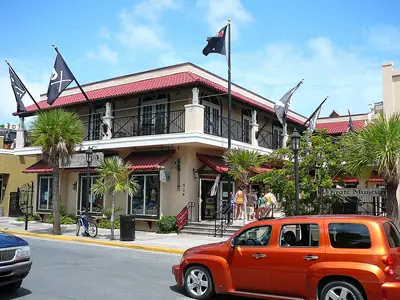
The St Augustine Pirate and Treasure Museum, formerly known as the Pirate Soul Museum, explores the Golden Age of Piracy in the seventeenth and eighteenth centuries. Its collection includes more than 800 artifacts, such as navigational charts, ivory compasses and objects connected with Blackbeard.
Highlights include blunderbusses associated with Blackbeard, gold recovered from his warship, an authentic Jolly Roger flag and Captain Kidd’s iron-bound treasure chest. Interactive displays recreate elements of life at sea, including a ship’s lower deck, sailors’ knots and a replica cannon.
Other unusual museums and churches
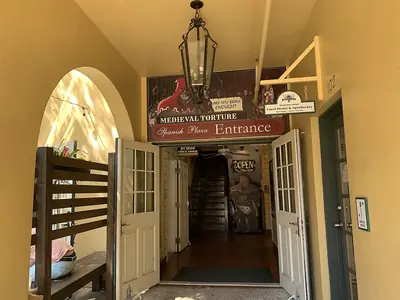
St Augustine also offers several more specialized stops. The Medieval Torture Museum on Saint George Street presents interactive displays about torture, execution and restraint, using historical reconstructions, mannequins and explanatory narration.
Potter’s Wax Museum contains more than 160 wax sculptures of politicians, entertainers, historical personalities, sports stars, horror characters and fictional figures. Established in 1948 by George L. Potter, it is described as the first wax museum in the United States.
Grace United Methodist Church, built between 1886 and 1887, adds another example of the city’s Spanish Renaissance Revival architecture. Donated to the people of St Augustine by Henry Morrison Flagler, it was designed by John M. Carrère and Thomas Hastings and is particularly notable for its Louis Comfort Tiffany stained-glass windows.
Explore St Augustine with a self-guided audio tour
A St Augustine self-guided walking tour lets you discover the city’s history without joining a group or following a fixed schedule. Neywo’s four walking tours cover the city’s Spanish foundations, forts and pirates, Flagler’s Gilded Age architecture, and the places connected with St Augustine’s beginnings.
The walks are:
- Spanish Heart: From the Plaza to the Oldest House — 1.77 km, 72 minutes and 11 stops
- Fort, Pirates and Ghosts: The Castillo and St. George Street — 1.51 km, 64 minutes and 9 stops
- Flagler’s Gilded Age: Domes, Moorish Fantasies and Concrete Palaces — 2.05 km, 63 minutes and 8 stops
- 1565: Where St. Augustine Began — 0.79 km, 27 minutes and 4 stops
The stories play as you reach each place, at your own pace. There is no group and no schedule, so the app can accompany your walk through St Augustine while you decide how quickly to explore. Narration is available in 11 languages.
Download Neywo and explore St Augustine
Download Neywo to use the free St Augustine audio guide and explore 41 narrated places across four walking tours. The app tells the story of each place as you reach it, letting you walk independently, at your own pace, with no group and no schedule.
St Augustine is part of Florida, in the United States.
Places with an audio guide in St Augustine
8 places in St Augustine with a Neywo audio guide. Each one starts telling its story as you reach it.
Self-guided tours in St Augustine
4 tours in St Augustine, free in the Neywo app. Each stop tells its story as you reach it.
- Walk
Flagler's Gilded Age: Domes, Moorish Fantasies and Concrete Palaces
In the 1880s Henry Flagler turned a sleepy Spanish town into America's winter playground. Start in historic Lincolnville, then stroll past a Greek Revival mansion where Flagler liked to stay, the turquoise dome of the church he built for his daughter, his own statue, a miniature Alhambra, a Tiffany-filled museum and a castle-like hotel.
Lincolnville Museum and Cultural Center · Solla-Carcaba Cigar Factory · Markland · Memorial Presbyterian Church · Henry Flagler statue at Ponce de León Hotel · Villa Zorayda …
Open this tour: Flagler's Gilded Age: Domes, Moorish Fantasies and Concrete Palaces - Walk
Spanish Heart: From the Plaza to the Oldest House
Walk the oldest part of the oldest continuously occupied European-founded city in the United States. From the Bridge of Lions you cross the 1573 plaza, pass the governor's house and the cathedral, then follow Aviles Street's colonial houses down to the Oldest House, the British-built King's Bakery and the old barracks on the bay.
Lion statues on the Bridge of Lions · Cathedral Basilica of St. Augustine · Plaza de la Constitución · Government House · Ximenez-Fatio House · Spanish Military Hospital Museum …
Open this tour: Spanish Heart: From the Plaza to the Oldest House - Walk
Fort, Pirates and Ghosts: The Castillo and St. George Street
Start on lively St. George Street with a living-history quarter and a pirate museum, then reach the great coquina fort that guarded Spanish Florida for centuries. Finish at the old city gate, where two historic cemeteries, the oldest wooden schoolhouse and a Moorish castle hold the town's best ghost stories.
Medieval Torture Museum · Avero House · Colonial Quarter · Pirate Soul Museum · Castillo de San Marcos · Castle Warden …
Open this tour: Fort, Pirates and Ghosts: The Castillo and St. George Street - Walk
1565: Where St. Augustine Began
A short northern loop to the places linked to the founding of the city: a Victorian jail built by Flagler, the park of the legendary Fountain of Youth and the mission where the first Mass was celebrated in 1565, with the oldest shrine in the United States.
Old St. Johns County Jail · Fountain of Youth Archaeological Park · Nombre de Dios · National Shrine of Our Lady of La Leche
Open this tour: 1565: Where St. Augustine Began
Walk St Augustine with Neywo
Neywo turns St Augustine into a self-guided audio tour. Stories arrive as you reach the place they belong to, and the route reshapes when you wander off it.

