Things to Do in Torre del Mar, Spain: Walking Guide
Things to do in Torre del Mar: what to see on the Costa del Sol
Torre del Mar is a seaside town on Spain’s Costa del Sol, known for its broad beach, lively promenade and connection to the Axarquía coast. It is a useful base for discovering coastal landmarks, historic fortresses, museums and whitewashed mountain villages. Neywo offers a free audio guide for Torre del Mar with 67 narrated places.
What to see in Torre del Mar and the surrounding Axarquía
The most important sights are spread across the coastal towns and inland villages around Torre del Mar. Together, they reveal the area’s maritime, Islamic, rural and cultural heritage.
Playa de Torre del Mar and the promenade
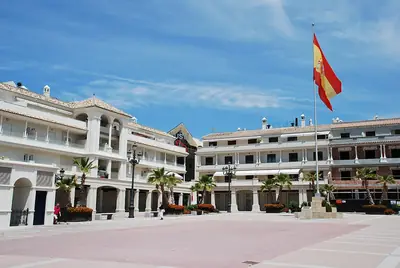
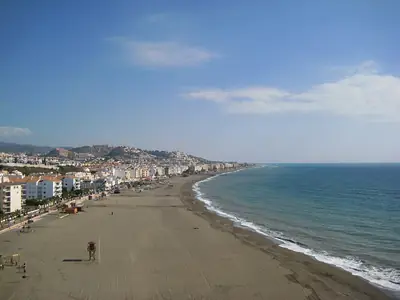
Torre del Mar’s beach is the town’s defining attraction. Its broad shoreline is suited to swimming, sunbathing and relaxed walks beside the Mediterranean. The promenade adds a sociable side to the coast, with cafés, seafood restaurants, shops and ice-cream parlors facing the sea.
The waterfront is particularly appealing in the evening, when residents and visitors gather for drinks, dining and conversation. It is one of the simplest ways to experience the town’s informal coastal atmosphere.
Casa Fuerte de Bezmiliana in Rincón de la Victoria
The Casa Fuerte de Bezmiliana is a historic fortified house in Rincón de la Victoria, on the coast west of Torre del Mar. Recognized as a cultural property, it reflects the defensive role that coastal fortifications once played in the region. Its name, meaning “strong house”, points to those origins.
Rincón de la Victoria is part of the Axarquía region and stretches from the Mediterranean into the southern foothills of the Montes de Málaga. The municipality includes Rincón de la Victoria, La Cala del Moral, Benagalbón and Torre de Benagalbón, and has ancient roots: archaeological finds show that the area was inhabited in prehistoric times.
Torre del Cantal
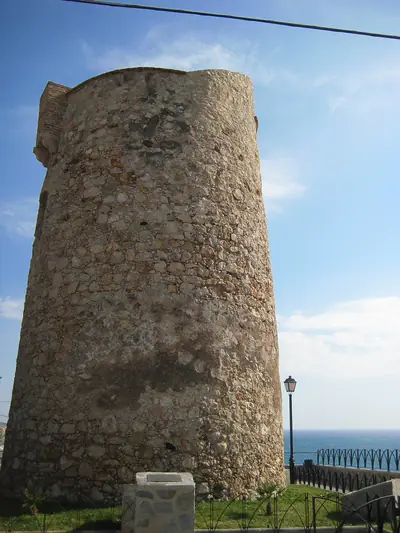
The Torre del Cantal is an old watchtower standing on a cliff along the coast near Rincón de la Victoria. It was built by the Moors to guard the coastline of La Axarquía. Today, houses surround the tower, but its position still makes it a distinctive historic landmark beside the sea.
Palacio de Beniel in Vélez-Málaga
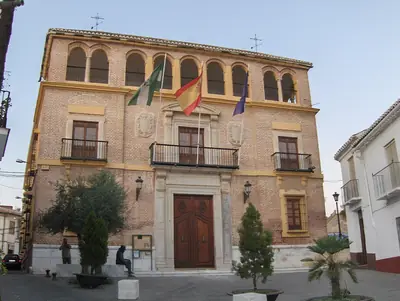
The Palacio del Marqués de Beniel is considered the most important civil building in Vélez-Málaga. This seventeenth-century palace continues to serve the local community: it houses the headquarters of the María Zambrano Foundation and the city’s Department of Culture.
Museo de Vélez-Málaga
The Museo de Vélez-Málaga explores the history of the city and its surrounding region. Opened in March 2017, it contains archaeological objects, historical documents and archives. It is a useful stop for placing the area’s fortresses, towns and cultural traditions in context.
Alcazaba de Vélez-Málaga
The Alcazaba de Vélez-Málaga, also known as the Fortaleza de Vélez-Málaga, occupies the highest point above the city. The remains of this Islamic fortress crown the hill and are recognized as a cultural property.
The climb provides one of the best viewpoints over Vélez-Málaga and the surrounding landscape. From the top, the fortress’s position becomes clear: it dominated the city and offered broad views across the area.
Castillo del Marqués
The Castillo del Marqués stands on the western shoreline of Vélez-Málaga, directly beside the sea. It is also called the Castillo del Marqués de Valle Niza and the Casa Fuerte del Marqués. These names reflect the building’s combined identity as a defensive fortification and a noble residence.
Museo de Nerja
The Museo de Nerja is dedicated to the town of Nerja and its heritage. It offers a way to understand the history of this coastal part of Málaga province beyond its beaches and seaside scenery.
Faro de Torrox
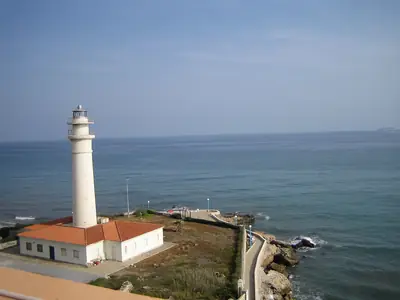
The Faro de Torrox is the lighthouse of Torrox, standing above the shoreline on the Andalusian coast. It is one of the town’s most recognizable landmarks and a natural addition to a coastal itinerary around Torre del Mar.
Bentomiz Castle
The ruins of Bentomiz Castle lie on a hilltop at 711 metres above sea level near Arenas. From this elevated position, the fortress overlooks the eastern Costa del Sol and the inland landscape of La Axarquía.
Built during the Muslim period, Bentomiz appears in the memoirs of Abd Allah, the Zirid king of Granada, in the eleventh century. Under the Nasrid Kingdom of Granada, from the thirteenth to the fifteenth century, it was the administrative centre of a district known as a ta’a. The surrounding area became known for its silk and raisins. The Catholic Monarchs took the fortress in 1487 after a negotiated surrender, without a battle.
Castillo de Comares
The remains of the Castillo de Comares sit in the heart of the old town of Comares. The site is also known as the Baluarte de la Tahoma or the Baluarte de la Tajoma. Its position in the town preserves a visible reminder of Comares’ fortified past.
Canillas de Aceituno
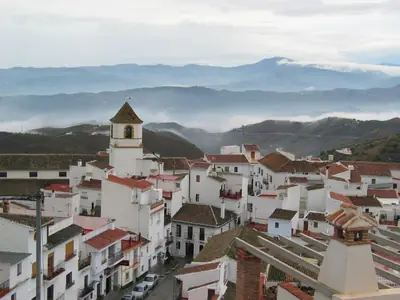
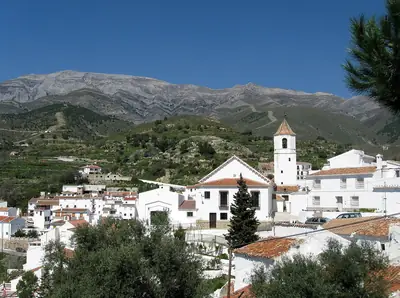
Canillas de Aceituno is a whitewashed mountain village at the foot of the Sierra de Tejeda. Its narrow streets, Mudéjar arches and flower-filled corners give it a classic Andalusian character.
The village stands at about 524 metres above sea level, beneath La Maroma. At 2,068 metres, La Maroma is the highest peak in Málaga province. The contrast between the mountain setting and Torre del Mar’s seafront makes Canillas de Aceituno one of the area’s most distinctive inland stops.
Macharaviaya
Macharaviaya is a small village in the hills of La Axarquía, at 235 metres above sea level. It has Arab origins, but its most prosperous period came in the eighteenth century, when the Gálvez family brought economic and commercial growth supported by wine-growing agriculture. The village became known as “little Madrid”.
Its principal reminders of that period are the Church of San Jacinto and the Royal Playing Card Factory, or Real Fábrica de Naipes. Macharaviaya is built across hills forming a natural amphitheatre, with Cerro de la Capellanía reaching 481 metres.
Sedella
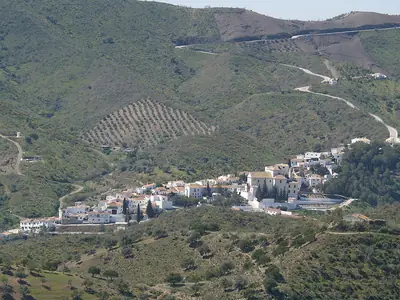
Sedella is a quiet village in the hills of La Axarquía, close to the border with Granada province. With just over 600 residents, it has the intimate character of a small Andalusian mountain community. It lies about 61 kilometres from Málaga.
Museo de la Miel in Colmenar
The Museo de la Miel in Colmenar is dedicated to honey and beekeeping. Its exhibits follow the honey-making process from ancient times to the present, explaining extraction methods and the role of bees in crop pollination and biodiversity.
The museum displays local flowers, beekeeping tools, protective suits, masks and gloves. A giant bee set on a hyperrealistic flower provides a particularly memorable feature. The museum also highlights the importance of encouraging younger generations to continue beekeeping and support rural communities.
Explore Torre del Mar with Neywo
There are no scheduled group departures or fixed timetable to follow. With Neywo’s free Torre del Mar audio guide, the app tells the story of each place as you reach it, at your own pace, with no group and no schedule. The guide includes 67 narrated places, and the narration is available in 11 languages.
Download Neywo and explore Torre del Mar independently, from its beach and promenade to the fortresses, museums and mountain villages of the surrounding Axarquía. You can also continue discovering Andalusia and Spain with Neywo.
Places with an audio guide in Torre del Mar
8 places in Torre del Mar with a Neywo audio guide. Each one starts telling its story as you reach it.
Walk Torre del Mar with Neywo
Neywo turns Torre del Mar into a self-guided audio tour. Stories arrive as you reach the place they belong to, and the route reshapes when you wander off it.

