Things to Do in Úbeda, Spain: Walking Guide
Things to Do in Úbeda: A Renaissance Town in Andalusia
The best things to do in Úbeda are concentrated around its remarkable historic center, where Renaissance palaces, churches, city gates and museums tell the story of this town in Jaén province. Its monumental ensemble, shared with Baeza, was declared a UNESCO World Heritage Site in 2003, making Úbeda one of the most rewarding historic towns to explore in Andalusia. Neywo’s free audio guide for Úbeda brings 34 narrated places to life as you walk.
What to See in Úbeda
Úbeda is best explored on foot. The following sights reveal the character of the old town, from fortified entrances and noble residences to the grand architectural statement around Vázquez de Molina Square.
Puerta de Santa Lucía
The Puerta de Santa Lucía is one of Úbeda’s historic city gates. It recalls the town’s fortified past, when walls and gateways controlled access to different parts of the settlement. It is a natural starting point for discovering the old town’s historic streets.
Casa de las Torres
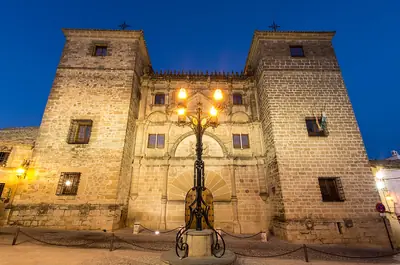
Also known as the Palacio de los Dávalos, the Casa de las Torres is a civil palace in Úbeda. Its presence helps explain the town’s distinctive collection of noble residences and monumental buildings.
Palacio de los Medinilla
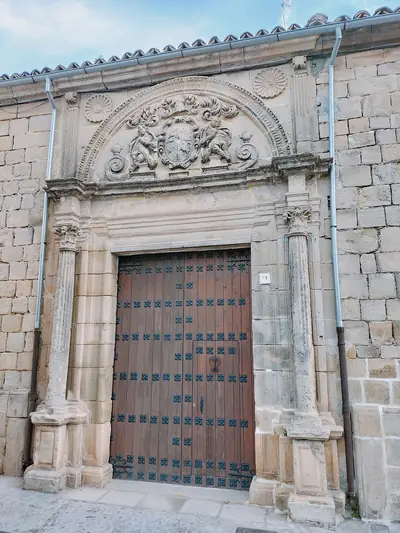
The Palacio de los Medinilla is another example of the noble architecture that defines Úbeda. As you move through the historic center, its presence adds to the succession of palaces that give the town its Renaissance character.
Palacio de los Manueles
Located in the heart of Úbeda, the Palacio de los Manueles is a historic palace and one of the buildings worth seeking out while exploring the city’s celebrated Renaissance architecture.
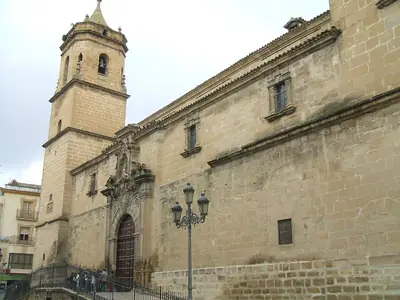
Church of the Santísima Trinidad
The Church of the Santísima Trinidad is a Baroque religious complex combining a church and convent. Its construction extended across the seventeenth and eighteenth centuries, giving the building a long architectural history within Úbeda’s historic center.
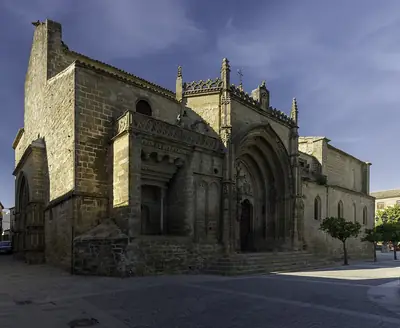
Iglesia de San Pablo
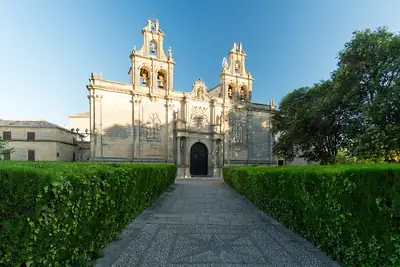
The Iglesia de San Pablo belongs to Úbeda’s Renaissance monumental ensemble. Its façade and historic setting make it one of the city’s standout religious landmarks, and it forms part of the heritage that Úbeda shares with Baeza under the UNESCO designation.
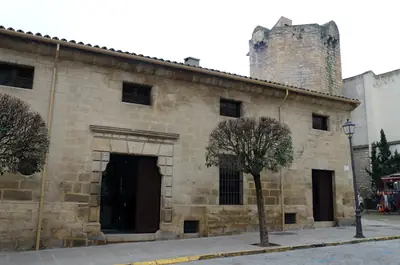
Museo Arqueológico de Úbeda
The Museo Arqueológico de Úbeda occupies a Mudéjar-style house dating from the fourteenth and fifteenth centuries. The building is arranged around a central courtyard and was discovered during construction work in 1964.
The museum was created in 1972 and opened on January 18, 1973. Its collection includes material from across the province of Jaén, including prehistoric objects from La Calera in La Carolina, Iberian pieces from Castellones de Ceal in Hinojares, and bronze and terracotta Iberian votive offerings from Collado de los Jardines and Castellar de Santisteban.
Centro de Interpretación Olivar y Aceite
The Centro de Interpretación Olivar y Aceite explores the history and culture of extra virgin olive oil, one of the region’s defining products. It is housed in the Casa de la Tercia de Úbeda and covers more than 1,200 square metres.
Its facilities include a museum area, exhibition rooms, cooking and children’s classrooms, and conference and training rooms. It offers a useful way to understand the importance of olive oil in the surrounding province.
Palacio de los Orozco
The Palacio de los Orozco is a historic palace in the heart of Úbeda. It belongs to the group of noble residences that make a walk through the old town feel like a journey through the city’s architectural history.
Palacio Vela de los Cobos
The Palacio Vela de los Cobos is a Renaissance noble palace in Úbeda’s historic center and part of the UNESCO-listed monumental ensemble. It was commissioned in the mid-sixteenth century by Francisco Vela de los Cobos, a town councilor, and designed by Andrés de Vandelvira. Construction was carried out by the stonemason Jorge Leal.
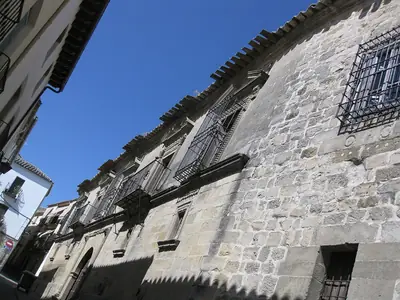
Its imposing stone façade rises across three levels. The ground floor has a lintel doorway framed by Corinthian columns. Above it, balconies feature the family coat of arms, telamones and Ionic columns, while the upper level forms an open gallery of semicircular arches.
Vázquez de Molina Square
Vázquez de Molina Square is the architectural heart of monumental Úbeda. The square brings together several of the town’s most important buildings, including the Holy Chapel of the Savior, the Iglesia de Santa María de los Reales Alcázares and the Vázquez de Molina Palace.
The buildings around the square were designed as a unified architectural statement, creating one of the most impressive spaces in the city.
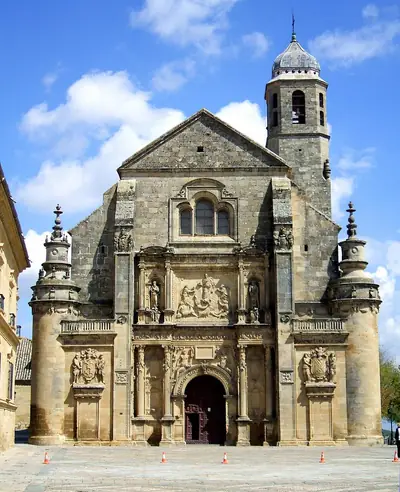
Holy Chapel of the Savior
The Holy Chapel of the Savior, known locally as the Sacra Capilla del Salvador, is one of Úbeda’s most recognized symbols. It was built as a funeral chapel for Francisco de los Cobos, personal secretary to Emperor Charles V, and stands beside his palace overlooking Vázquez de Molina Square.
Francisco de los Cobos commissioned the chapel in 1536 as part of an ambitious artistic program that also included a palace, a university and a hospital. Diego de Siloé was entrusted with the initial design, while Andrés de Vandelvira carried out the construction from 1540. The temple was consecrated in 1559.
The chapel is considered the most ambitious work of private religious architecture from the Spanish Renaissance. It was declared a historic-artistic monument in 1931.
Iglesia de Santa María de los Reales Alcázares
The Iglesia de Santa María de los Reales Alcázares is the main church of Úbeda. It stands prominently in Vázquez de Molina Square opposite the palace, forming part of the unified architectural composition that defines the space.
The basilica is a national monument and belongs to the UNESCO World Heritage Site covering Úbeda’s historic center, inscribed in 2003.
Palacio Vázquez de Molina
Also known as the Palace of the Chains, the Palacio Vázquez de Molina is one of Spain’s finest examples of Renaissance architecture. It was built in the sixteenth century by Juan Vázquez de Molina and has served as Úbeda’s town hall since 1850. The building is also recognized as a site of cultural interest.
Its nickname may refer either to chains that once surrounded its loggia or to the Castilian tradition of calling prestigious houses and palaces “de las Cadenas”. In its lower cellar, the Renaissance Interpretation Center explores the history and art of the period.
Palacio de los Marqueses de Bussianos
The Palacio de los Marqueses de Bussianos is another noble residence in the heart of Úbeda. Like the Palacio de los Orozco and the Palacio de los Medinilla, it contributes to the concentration of Renaissance character that makes the town’s historic center so distinctive.
Discover Úbeda with a Self-Guided Walking Tour
A self-guided route is a practical way to experience Úbeda’s monuments without having to follow a group. Neywo offers three walking tours, one bus route and 34 narrated places in total:
- “Vandelvira’s Úbeda: A UNESCO Renaissance Showcase” covers 1.83 km in 87 minutes, with 11 narrated stops including the Holy Chapel of the Savior, Vázquez de Molina Square, Santa María de los Reales Alcázares, Palacio Vázquez de Molina and Palacio Vela de los Cobos.
- “Gates, Walls and Noble Houses of Old Úbeda” covers 1.2 km in 76 minutes, with 10 stops including the Casa de las Torres, Palacio de los Medinilla, Palacio de los Orozco, the Church of the Santísima Trinidad and the Palacio de los Marqueses de Bussianos.
- “Olive Oil, Museums and City Gates” covers 1.11 km in 57 minutes, with 7 stops including the Iglesia de San Pablo, Museo Arqueológico de Úbeda, Puerta del Losal and Centro de Interpretación Olivar y Aceite.
- “Line 1 Through Úbeda’s Palace Quarter” is a 1.6 km bus route lasting 7 minutes, with 5 narrated stops including Palacio Vela de los Cobos, Santa María de los Reales Alcázares and the Holy Chapel of the Savior.
Download the free Úbeda audio guide and explore at your own pace. The app tells the story of each place as you reach it, with no group and no schedule. Narration is available in 11 languages, making it an easy way to discover Úbeda independently.
Places with an audio guide in Úbeda
8 places in Úbeda with a Neywo audio guide. Each one starts telling its story as you reach it.
Self-guided tours in Úbeda
4 tours in Úbeda, free in the Neywo app. Each stop tells its story as you reach it.
- Bus ride
Line 1 Through Úbeda's Palace Quarter
Urban bus line 1 (Hospital San Juan de la Cruz to Puerta del Sol) calls at Plaza de Santa María, so you can ride it past the Renaissance palaces and the Holy Chapel to the Puerta del Losal gate. A cheap way to hop between the old town's biggest monuments.
Palacio de los Orozco · Palacio Vela de los Cobos · Iglesia de Santa María de los Reales Alcázares · Holy Chapel of the Savior · Puerta del Losal, Úbeda
Open this tour: Line 1 Through Úbeda's Palace Quarter - Walk
Vandelvira's Úbeda: A UNESCO Renaissance Showcase
Walk the stage set of Spain's Renaissance: the trapezoid Vázquez de Molina square with its funerary chapel, the Palace of the Chains and a former mosque-turned-basilica, then drift through quiet palace streets to the Hospital de Santiago, Vandelvira's masterpiece, called the Escorial of Andalusia. A World Heritage walk in honey-coloured stone.
Puerta de Santa Lucía, Úbeda · Palacio de Francisco de los Cobos · Holy Chapel of the Savior · Palacio del Deán Ortega · Vázquez de Molina Square · Iglesia de Santa María de los Reales Alcázares …
Open this tour: Vandelvira's Úbeda: A UNESCO Renaissance Showcase - Walk
Gates, Walls and Noble Houses of Old Úbeda
Slip into the western quarter where nobles built their houses against the old Almohad wall: a church that doubles as a fortress, the Casa de las Torres, a Moorish-style house museum and palaces that fill the lanes up to the Baroque Trinidad convent. A quieter side of Úbeda, away from the main square.
Iglesia de San Lorenzo (Úbeda) · Casa de las Torres · Palacio de los Medinilla, Úbeda · Santo Domingo · Museo Andalusí · Palacio de los Orozco …
Open this tour: Gates, Walls and Noble Houses of Old Úbeda - Walk
Olive Oil, Museums and City Gates
The northern and eastern side of town: the church of San Pablo, a Mudéjar house holding the archaeological museum, the Palacio de Torrente and the medieval Puerta del Losal gate, finishing at the olive oil interpretation centre that explains why this landscape is a sea of olive trees.
Plaza del Primero de Mayo, Úbeda · Iglesia de San Pablo · Museo Arqueológico de Úbeda · Palacio de Torrente, Úbeda · Puerta del Losal, Úbeda · Centro de Interpretación Olivar y Aceite …
Open this tour: Olive Oil, Museums and City Gates
Walk Úbeda with Neywo
Neywo turns Úbeda into a self-guided audio tour. Stories arrive as you reach the place they belong to, and the route reshapes when you wander off it.