Visiting Marseille, France: Top Sights on Foot
Things to Do in Marseille: Historic Ports, Fortresses and Mediterranean Culture
The best things to do in Marseille include exploring its ancient port, historic districts, churches, fortresses and museums. Founded by Greek sailors around 600 BC, Marseille grew from Massalia into a major Mediterranean port, and its long history remains visible across the city. Neywo has a free audio guide for Marseille with 235 narrated places, available in 11 languages.
As you explore the city, you can also discover more of the region through Provence-Alpes-Côte d’Azur and nearby destinations such as Cassis and Toulon.
What to see in Marseille
The Old Port and Fort Saint-Jean
The Vieux-Port remains the natural starting point for discovering Marseille. Fishing boats, waterfront promenades, cafés and markets all reflect the city’s enduring relationship with the Mediterranean.
At the entrance to the harbour, Fort Saint-Jean stands on a rocky promontory where Le Panier meets the water. Louis XIV ordered its construction in 1660, although the site preserves traces of Marseille’s first Greek occupation in the sixth century BC. The fort also incorporates a fifteenth-century square tower built by King René and a round lantern tower added in 1644. Today, it forms part of the Museum of European and Mediterranean Civilisations, or MuCEM, and is connected to the museum and Le Panier by footbridges.
Nearby, the Palais du Pharo overlooks the entrance to the Old Port. Napoleon III commissioned the palace for Empress Eugénie, and construction began in 1858 on land offered by Marseille. Completed in 1870, it faces the Mediterranean, while the Jardin du Pharo extends towards the city. The name comes from the Occitan word “faròt”, meaning lighthouse.
Le Panier and La Vieille Charité
Le Panier is Marseille’s oldest quarter, with steep lanes and small squares that reveal the city’s changing history. Its buildings preserve traces of Greek, Roman, medieval and modern life.
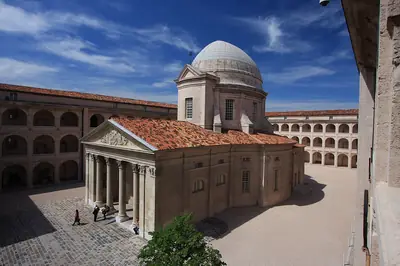
One of the district’s central landmarks is La Vieille Charité, a former almshouse now used as a museum and cultural centre. Built between 1671 and 1749, the complex consists of four three-storey arcaded galleries surrounding an inner courtyard. At its centre stands a chapel crowned by an unusual ovoid dome. The architect Pierre Puget designed the project, which was completed under the direction of his son, François.
La Vieille Charité gradually lost its original purpose at the end of the nineteenth century. After falling into very difficult conditions by the 1950s, the chapel and hospice were classified as historic monuments in 1951. Major restoration followed from the 1960s through the 1980s.
Marseille Cathedral, or La Major
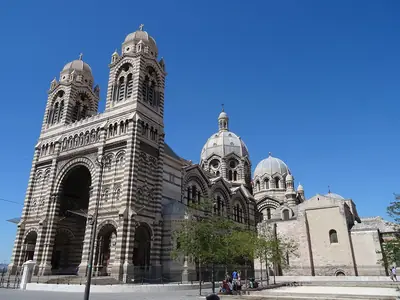
Between the Vieux-Port and the port of La Joliette, Marseille Cathedral presents a striking neo-Byzantine style. Known locally as La Major, it stands out for its use of marble and porphyry, both outside and inside.
The cathedral was built between 1852 and 1893 to plans by the architect Léon Vaudoyer. It occupies the site of an earlier cathedral dating from the twelfth century, which gave the building its Provençal name.
Saint-Laurent Church
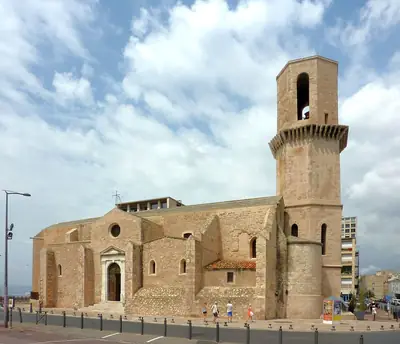
Near Fort Saint-Jean, Saint-Laurent Church recalls Marseille’s close connection with the sea. The church stands on the hill that takes its name and was traditionally associated with fishermen and people who worked on the water.
Built around 1150 from pink stone brought from La Couronne, it has a simple Provençal Romanesque character. The site is older still: tradition records a Greek temple here, followed by a fortification built in 870 by Bishop Babon. The church was altered in the seventeenth century, when the Sainte-Catherine side chapel and octagonal tower were added.
Saint-Laurent was badly damaged in 1943 during the destruction of the old town by German occupying forces and was restored later.
The Museum of the Roman Docks
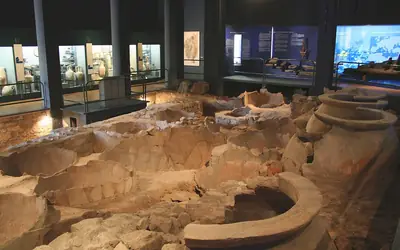
The Museum of the Roman Docks, or Musée des Docks romains, preserves the remains of a Roman commercial warehouse in situ. Rather than displaying ruins removed from their original setting, the museum allows visitors to see the surviving traces where the dockside storage complex once stood.
The remains were classified as historic monuments on October 22, 1959. They provide a direct connection with Marseille’s ancient commercial life and the city’s origins as a Mediterranean trading port.
Château d’If
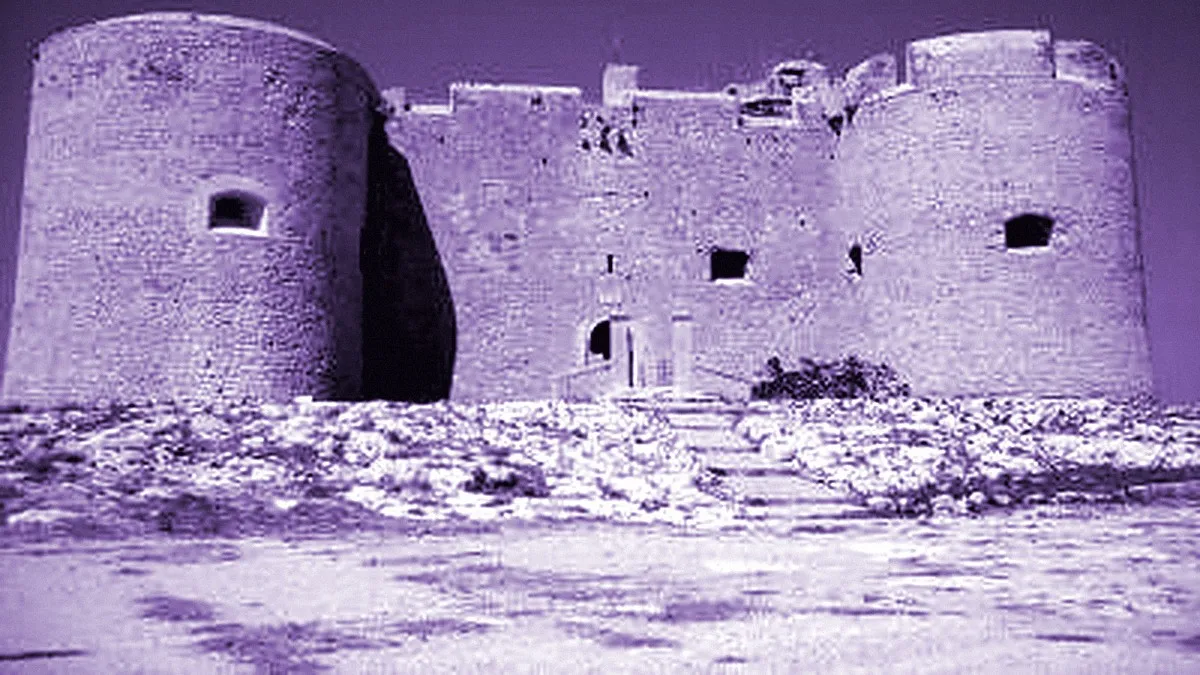
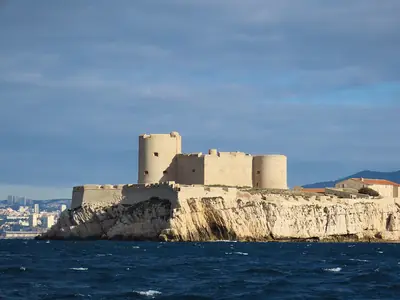
On the small Île d’If, in the Frioul archipelago, the Château d’If combines a stark island setting with a long military and prison history. Built on the orders of King Francis I between 1529 and 1531, the fortress was used mainly as a prison for around four hundred years.
The square fortress measures 28 metres on each side and rises three storeys high. Three corner towers, protected casemates and artillery openings form its defensive structure, while a fortified enclosure follows the island’s cliffs. Covering only three hectares, the island was nevertheless heavily defended.
The château’s fame spread far beyond Marseille through Alexandre Dumas’s novel The Count of Monte Cristo, which gave the fortress an enduring place in literary history.
The Abbey of Saint-Victor
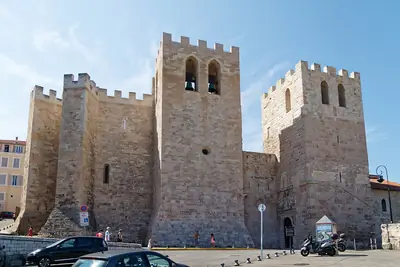
The Abbey of Saint-Victor is one of the major historic centres of Catholicism in southern France. Although the monastery disappeared during the French Revolution, the former abbey church remains dedicated to worship.
Tradition places the foundation of the abbey in the fifth century, when John Cassian established it near the tombs of Marseille’s martyrs, including Saint Victor of Marseille, executed in 303 or 304. Around the year 1000, the abbey was rebuilt under the Rule of Saint Benedict and its influence extended throughout Provence.
The complex was attacked by Vikings and Saracens and completely destroyed in 923. Its decline became irreversible from the fifteenth century, although its religious importance continued. One of its abbots, Guillaume de Grimoard, was elected pope in 1362 as Urban the Fifth. The abbey has been protected as a historic monument since the official listings of 1840 and 1862.
The Corniche and Porte d’Orient
Along the Corniche Kennedy, the Monument aux morts de l’Armée d’Orient et des terres lointaines commemorates those who died serving in the Army of the Orient and in distant lands during the First World War.
Designed by Gaston Castel and inaugurated on April 24, 1927, the memorial consists of a bronze statue set within a granite arch. It has been protected as a historic monument since May 24, 2011.
Porte d’Aix
At Place Jules-Guesde, Porte d’Aix marks the former entrance to Marseille on the road from Aix-en-Provence. Michel-Robert Penchaud designed the triumphal arch in a classical style inspired by Roman imperial monuments.
The project began in 1784 as a monument honouring Louis XVI and commemorating the Peace of Paris. Work resumed in 1823 after the Bourbon Restoration, this time celebrating French victories in the Spanish Expedition, particularly the Battle of Trocadero. Completed in 1839, the arch is also known as Porte Royale, or Pòrt Reial in Occitan.
Museums and estates
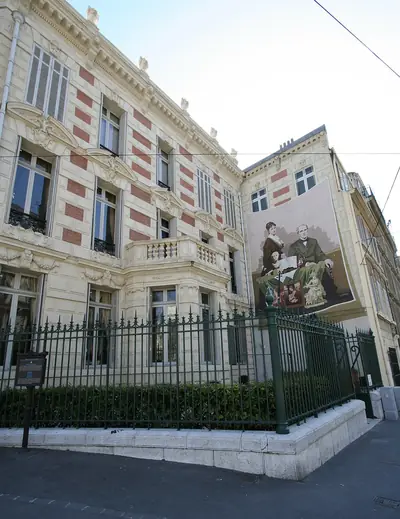
Across Marseille, historic buildings have become museums. Opposite Palais Longchamp, the Musée Grobet-Labadié occupies a nineteenth-century private mansion built in 1873 for Alexandre Labadié. Marie and Louis Grobet assembled more than seven thousand objects during their travels across Europe, including furniture, paintings, tapestries, sculptures, faience, carpets, silk fabrics and musical instruments. Marie later donated the mansion and collection to the city.
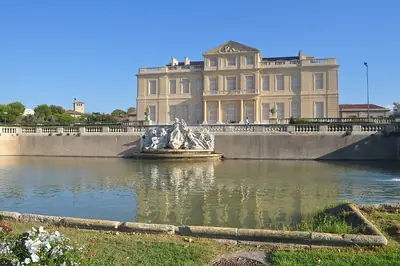
In the southern part of Marseille, Château Borély is an eighteenth-century neoclassical château associated with Borély Park. Its original decoration has been preserved, and since 2013 it has housed the Museum of Decorative Arts, Earthenware and Fashion. The château itself has been listed as a historic monument since 1936.
Other landmarks reveal different sides of Marseille’s heritage. Hôpital Caroline, on Ratonneau Island, was built between 1823 and 1828 to designs by Michel-Robert Penchaud. In Saint-Menet, Château de la Reynarde and Château Régis preserve the character of two historic estates, with Château Régis dating from the nineteenth century and listed as a historic monument.
Explore Marseille with a free audio guide
Neywo offers five walking tours, one bus route and one bike route in Marseille, with 235 narrated places across the city. The walks range from 2.05 to 3.44 km and take between 78 and 115 minutes. The bus route covers 7.9 km in 34 minutes, while the bike route covers 2.1 km in 11 minutes. Together, the tours include narrated stops at the city’s historic quarters, ports, churches, museums, monuments and palaces.
The app tells the story of each place as you reach it, at your own pace, with no group and no schedule. Download Neywo and explore Marseille through a self-guided walking tour, a ride along the Corniche or a bike route through the city.
Marseille is part of France, where ancient heritage, port life and Mediterranean culture meet in a city shaped by more than two thousand years of exchange.
Places with an audio guide in Marseille
8 places in Marseille with a Neywo audio guide. Each one starts telling its story as you reach it.
Self-guided tours in Marseille
7 tours in Marseille, free in the Neywo app. Each stop tells its story as you reach it.
- Bike ride
From La Plaine to Castellane by Bike
A short city ride on a dedicated cycle lane from Place Jean-Jaures and its markets past the Bernardines chapel, the Reformes church at the top of the Canebiere and the Flotte bastide to the great Cantini fountain on Place Castellane.
Place Jean Jaurès · Église Saint-Vincent-de-Paul · Chapelle des Bernardines · Bastide Flotte de la Buzine · Fontaine Cantini
Open this tour: From La Plaine to Castellane by Bike - Bus ride
Line 83: The Corniche Ride from the Prado to the Old Port
The RTM's coastal line 83 follows Marseille's seafront Corniche from the Prado beaches past the Armee d'Orient monument and the Pharo shore, then along the harbour to the Criee theatre, the mirrored Ombriere and the Augustins and Saint-Laurent churches of the Old Port. A cheap, scenic way to see the sea side of the city.
Statue of David · Marégraphe · Monument aux morts de l'Armée d'Orient et des terres lointaines · Église Saint-Georges de Marseille · Théâtre National de la Criée · Ombrière du Vieux Port …
Open this tour: Line 83: The Corniche Ride from the Prado to the Old Port - Walk
Le Panier: Marseille's Oldest Quarter
Climb through the narrow streets where Greek sailors founded Massalia 2,600 years ago. Pass the Roman docks, a diamond-faced Renaissance house and the surviving Accoules bell tower, then visit a baroque almshouse with an oval-domed chapel, the huge neo-Byzantine cathedral, the old cathedral behind it, a fishermen's church and the harbour fort, ending at the MuCEM by the sea.
Museum of the Roman Docks · Maison Diamantée · Chapelle des Pénitents blancs du Saint-Esprit · La Vieille Charité · Marseille Cathedral · Eglise Saint-Laurent (Marseille) …
Open this tour: Le Panier: Marseille's Oldest Quarter - Walk
Old Port and Ancient Massalia
Circle the beating heart of the city: Greek foundations from the sixth century BC, the oldest surviving house in Marseille, the mirrored canopy over the Vieux-Port, an Augustinian church on the quay, the stock-exchange palace and the Greek ramparts hidden behind a shopping centre.
Îlot urbain grec du collège du Vieux-Port · Hôtel de Cabre · Old Port of Marseille · Ombrière du Vieux Port · Église Saint-Ferréol les Augustins · Palais de la Bourse …
Open this tour: Old Port and Ancient Massalia - Walk
Pharo to the Good Mother: Palaces, Forts and Notre-Dame de la Garde
Start at the emperor's palace over the harbour entrance, pass Louis XIV's fort and the ancient abbey of Saint-Victor, then climb to the golden Madonna of Notre-Dame de la Garde for the best view of Marseille.
Palais du Pharo · Monument aux héros et victimes de la mer · Fort Saint-Nicolas · Abbey of St. Victor · Site archéologique de la carrière antique grecque de la Corderie · Notre-Dame de la Garde
Open this tour: Pharo to the Good Mother: Palaces, Forts and Notre-Dame de la Garde - Walk
Gates, Staircases and a Palace of Water
From the Roman-style Porte d'Aix triumphal arch and an Armenian cross-stone, past the monumental steps of Saint-Charles station, a historic fountain and the church at the top of the Canebiere, to the grand Second Empire Palais Longchamp that celebrates water arriving in the city, with its fine-arts and natural-history museums and a mansion full of collectors' treasures across the street.
Porte d'Aix · Khatchkar · Stairs of Gare de Marseille-Saint-Charles · Fontaine Fossati · Église Saint-Vincent-de-Paul · Palais Longchamp …
Open this tour: Gates, Staircases and a Palace of Water - Walk
Rue Paradis and the Prefecture Quarter
Cross the elegant southern districts of the old centre: the Trinity church, the fine arts museum of Cantini, a Melkite church that is the oldest oriental church in France, the Grande Synagogue and the great fountain of Place Castellane.
Église la Trinité-la Palud · Musée Cantini · Hôtel Roux de Corse · Monument to Alexander I of Yugoslavia and Louis Barthou · Église Saint-Nicolas de Myre (Marseille) · Église Saint-Joseph …
Open this tour: Rue Paradis and the Prefecture Quarter
Walk Marseille with Neywo
Neywo turns Marseille into a self-guided audio tour. Stories arrive as you reach the place they belong to, and the route reshapes when you wander off it.

