Arles, France: Self-Guided Walking Tour
Things to do in Arles: Roman Monuments, Van Gogh and Provençal History
The best things to do in Arles include exploring Roman monuments, medieval churches, Van Gogh locations and museums in the historic centre and beyond. The city brings together the ancient remains of Arelate, Provençal religious and civic architecture, and places connected with Vincent van Gogh. Neywo has a free audio guide for Arles with 60 narrated places, so you can discover the city while you walk.
Arles is in Provence-Alpes-Côte d’Azur, in the south of France, and its heritage is remarkably varied. A single visit can take you from a Roman theatre to a medieval gateway, a former archbishop’s palace, a photography museum and the landscapes that inspired Van Gogh.
What to see in Arles
Roman Amphitheatre
The Roman Amphitheatre is one of Arles’ defining monuments. Its scale reflects the importance of the ancient city of Arelate and makes it an essential stop for anyone interested in Roman Arles. It is also close to the Gallo-Roman theatre, allowing two major ancient entertainment buildings to be explored together.
Gallo-Roman theatre
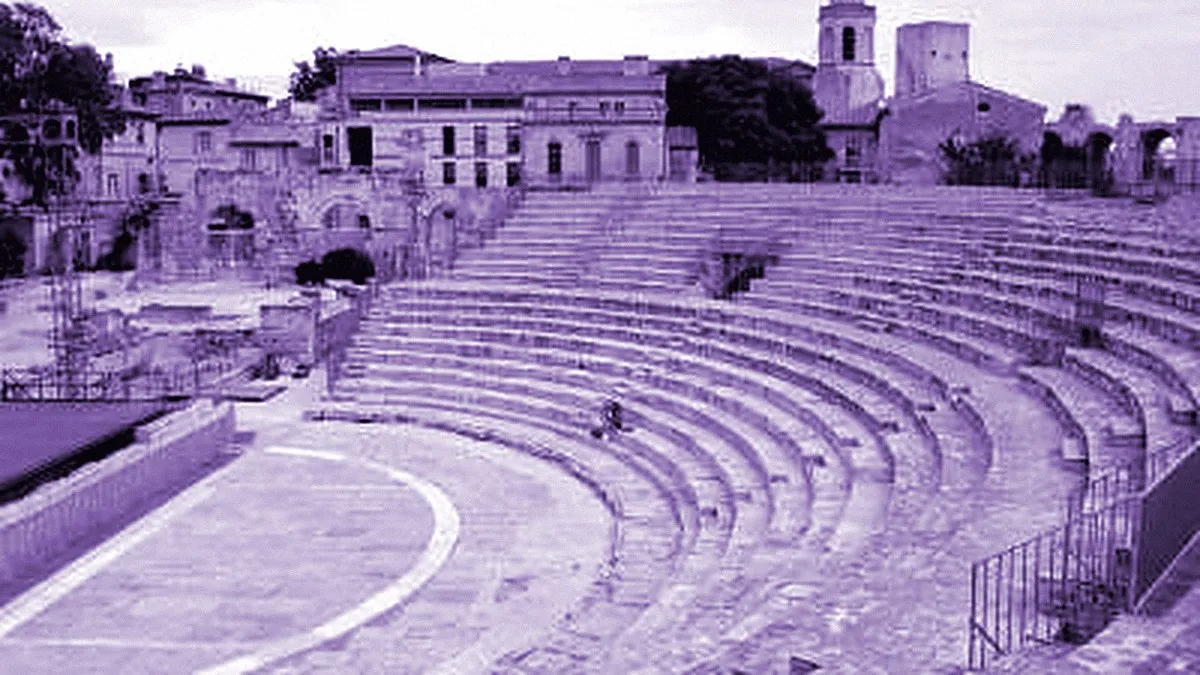
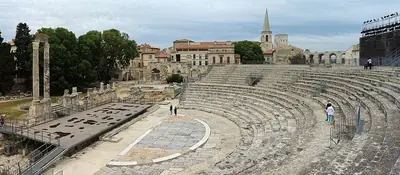
Built between around 40 or 30 BC and 12 BC, the Gallo-Roman theatre was among the earliest stone theatres in the Roman world. It once held 8,000 spectators across 33 rows of seating.
The monument was dismantled during the Middle Ages, when its stones were reused for walls, churches and fortifications. Today, the surviving structure includes the orchestra, traces of an altar dedicated to Apollo and two marble columns from the former stage backdrop.
Church and Cloister of Saint Trophime
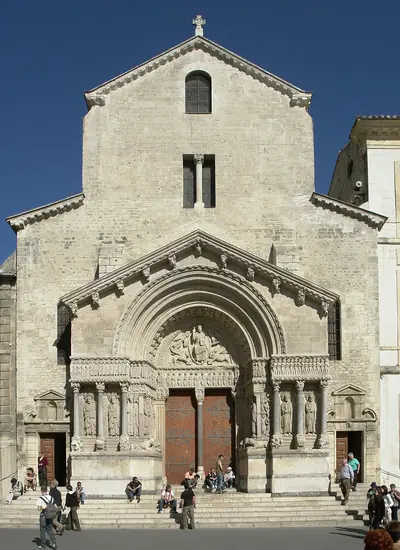
The Church of Saint Trophime is one of Provence’s great Romanesque buildings. It served as Arles’ cathedral for centuries and is now the city’s main parish church. The church and cloister were inscribed as part of the Arles Roman and Romanesque Monuments group on the UNESCO World Heritage list in 1981.
The Romanesque portal, sculpted around 1180, is the church’s most celebrated feature. Its detailed Last Judgment depicts Christ in Majesty surrounded by apostles, angels and symbolic creatures. Inside, the austere twelfth-century nave contrasts with the Gothic choir and ambulatory added in the fifteenth century. The cloister combines Romanesque galleries with finely carved sculptures.
Place de la République
Place de la République gathers several important landmarks in one civic ensemble. The former archbishop’s palace stands beside Saint Trophime and served as the seat of Arles’ archbishops from the tenth century until the eighteenth century. After the French Revolution, it became city property and has since served municipal purposes.
The square is also home to the Hôtel de Ville, completed in 1676. Its classical Provençal façade and clock tower overlook the square, while its grand staircase incorporates stones taken from ancient Roman buildings.
Obélisque d’Arles
The Obélisque d’Arles rises in the centre of Place de la République. This red-granite monument was originally erected in the fourth century by the Roman emperor Constantine the Second, who was born in Arles. It once stood at the centre of the Roman circus, marking the spine of the chariot-racing arena.
After the circus was abandoned, the obelisk fell and broke. It was rediscovered in the late fourteenth century and reassembled in the square in 1676. Its granite came from the Roman province of Asia, in what is now Turkey.
Cryptoportiques
Beneath the area around the Town Hall lie the Cryptoportiques, semi-subterranean vaulted galleries built around 30 BC. They supported the Roman forum above and also served as storage and administrative spaces.
The galleries are one of the clearest reminders that another city exists beneath modern Arles. Their stone arches and cool, shadowed passageways reveal how Roman engineers adapted the civic centre to uneven ground.
The Alyscamps
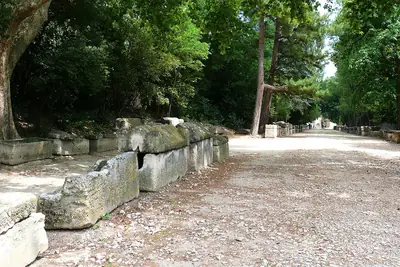
The Alyscamps was Arles’ principal burial ground for nearly fifteen hundred years. Its name derives from the Latin Elisii Campi, or Elysian Fields. Because Roman law prohibited burials inside city walls, tombs lined the roads outside the city, including the final stretch of the Aurelian Way.
Today, an avenue of plane trees runs for about 500 metres between rows of ancient stone sarcophagi. During the Middle Ages, the site also became a gathering point for pilgrims travelling along the Via Tolosana, the southern route of the Camino de Santiago. The Church of Saint Honorat and its crypt form part of this historic funerary and pilgrimage landscape.
Porte de la Cavalerie
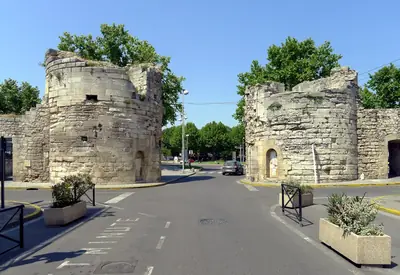
The Porte de la Cavalerie was once the northern entrance to Arles’ medieval city. Construction began in the thirteenth century, and the gateway was rebuilt in the sixteenth century before receiving further defensive additions in the eighteenth century.
The original gate and parts of the surrounding wall have disappeared, but two side towers and fragments of the northern and eastern fortifications remain. The gateway’s history is also linked to the Cavalry quarter and the presence of the Knights Templar nearby from the twelfth century.
Museon Arlaten and the Laval-Castellane mansion
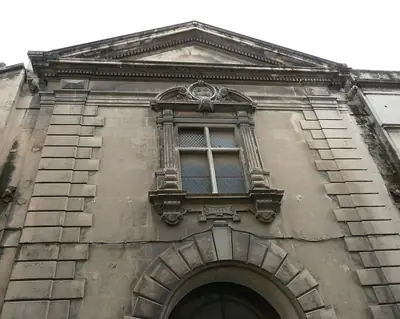
The Museon Arlaten occupies the Hôtel Laval-Castellane, a townhouse whose oldest stones date from the fifteenth century. The building later became a Jesuit college before being given a new role through the work of Frédéric Mistral.
The museum presents Provençal life through domestic interiors, traditional clothing, agricultural tools, ceramics and religious objects. Its displays include digital labels in several languages, mirrored staircases and scenographic installations. The renovated museum reopened in May 2021.
Musée Réattu
The Musée Réattu occupies a former commandery of the Knights of Malta beside the Rhône. From 1358 until the French Revolution, the fortified priory housed the order; its thick walls and vaulted rooms remain part of the museum’s character.
The collection includes more than 800 paintings and drawings by Réattu. The museum also became one of the first in France to treat photography as a fine art during the 1960s. Its photography collection has grown to around 4,000 works, including pieces connected with Arles’ photography festival. Pablo Picasso also donated original drawings and ceramics to the museum.
Église des Trinitaires
The Église des Trinitaires was formerly the chapel of the Trinitarian Order, a religious community founded to ransom Christian captives. Classified as a historic monument in 1958, the deconsecrated chapel now serves as an exhibition and cultural space.
Its vaulted interior gives the former religious building a different role in contemporary Arles, where art installations and cultural events replace religious services.
Follow Van Gogh in Arles
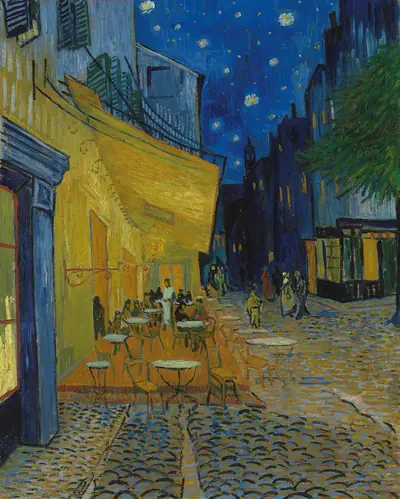
Arles is closely associated with Vincent van Gogh, who lived there for about 15 months from 1888. The city’s light and landscapes inspired paintings and drawings including The Bedroom, The Yellow House and Café Terrace at Night.
Place du Forum is connected with Café Terrace at Night. The square was once the centre of Roman Arelate, with temples and public buildings surrounding the forum. Two Corinthian columns beside the Hôtel du Forum are among the remaining visible fragments of a temple dedicated to Emperor Augustus. Today, café terraces occupy the square, creating a striking contrast with its ancient and medieval history.
The Langlois Bridge, also known as the Van Gogh Bridge, offers another direct connection with the painter. The original wooden drawbridge was one of eleven built along the canal from Arles to Port-de-Bouc. Van Gogh painted it repeatedly in 1888, producing four oil paintings, two drawings and a watercolour. Although the original bridge was later destroyed, a faithful reconstruction now stands nearby.
Roman circus and Bridge of Constantine
The Ancient Roman Circus of Arles was the largest Roman building in the city. The circus was built in 149 and once formed the setting for chariot racing, with the Obélisque d’Arles marking its central spine.
Farther along the Rhône, the remains of the Bridge of Constantine recall an ancient crossing between Arles and the Camargue. The stone piers date from the time of Constantine and supported a pontoon bridge made from anchored boats. The crossing served the city from the first century until the tenth century.
Explore Arles with a self-guided audio guide
Neywo offers four walking tours in Arles, one bus route and one bike route, with narration available in 11 languages. The stories play as you reach each place, at your own pace: no group and no schedule.
The walks are:
- Roman Arles: Arena, Theatre and the Cathedral Square — 1.01 km, 95 minutes and 10 narrated stops.
- In Van Gogh’s Footsteps: The Yellow House to Café Terrace — 1.8 km, 81 minutes and 9 narrated stops.
- Alyscamps and the Eastern Edge: Tombs, Gehry and Old Churches — 1.87 km, 65 minutes and 7 narrated stops.
- Roquette Quarter and the Roman Riverfront — 2.62 km, 77 minutes and 7 narrated stops.
There is also Bus A: From the Genouillade Chapel to the Roman Circus, covering 2.6 km in 11 minutes with 4 narrated stops, and Arles Old Town Cycle Lane: Alyscamps Edge to the Roman Circus, a 1.7 km bike route taking 8 minutes with 4 narrated stops.
Download Neywo and explore Arles through its Roman monuments, medieval streets, museums and Van Gogh locations. The app tells the story of each place as you reach it, letting you discover the city independently and at your own pace.
Places with an audio guide in Arles
8 places in Arles with a Neywo audio guide. Each one starts telling its story as you reach it.
Self-guided tours in Arles
6 tours in Arles, free in the Neywo app. Each stop tells its story as you reach it.
- Bike ride
Arles Old Town Cycle Lane: Alyscamps Edge to the Roman Circus
A short, flat ride on the city's cycle lane along the southern edge of the old town, from the 5th-century priory of Mouleyrès past the round Rotonde temple and the Carmelite church to the Roman circus.
Prieuré Saint-Pierre-et-Saint-Paul des Mouleyrès (Arles) · Temple protestant d'Arles · Église des Carmes Déchaussés · Ancient Roman circus of Arles
Open this tour: Arles Old Town Cycle Lane: Alyscamps Edge to the Roman Circus - Bus ride
Bus A: From the Genouillade Chapel to the Roman Circus
A local Transdev line across southern Arles. Ride west from the Genouillade chapel, a survivor of the Alyscamps, past the round Rotonde Protestant temple and the Carmelite church to the site of the Roman circus beside the Rhône.
Chapelle de la Genouillade · Temple protestant d'Arles · Église des Carmes Déchaussés · Ancient Roman circus of Arles
Open this tour: Bus A: From the Genouillade Chapel to the Roman Circus - Walk
Roman Arles: Arena, Theatre and the Cathedral Square
Arles was a Roman colony and its monuments are UNESCO listed. Climb the amphitheatre's arcades, sit in the Roman theatre beside its Two Widows columns, then step into the Romanesque portal of Saint-Trophime and the civic heart of Place de la République. Finish at the Forum, the Baths of Constantine and the Réattu museum on the Rhône.
Arles Amphitheatre · Gallo-Roman theatre at Arles · Church of St. Trophime, Arles · Former archbishop's palace (Arles) · Obélisque d'Arles · Town hall of Arles …
Open this tour: Roman Arles: Arena, Theatre and the Cathedral Square - Walk
In Van Gogh's Footsteps: The Yellow House to Café Terrace
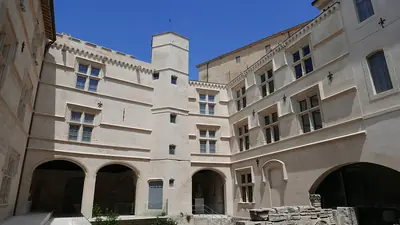
Follow the painter's 1888 year in Arles. Start where the Yellow House stood on Place Lamartine, see the spot where he painted Starry Night Over the Rhône, then cross town to the Fondation Vincent van Gogh in a 15th-century mansion. End on Place du Forum at the yellow café he painted at night.
The Yellow House · Porte de la Cavalerie · La Nuit étoilée sur le Rhône · Église des Dominicains d'Arles · Fondation Vincent van Gogh Arles · Église Saint-Martin d'Arles …
Open this tour: In Van Gogh's Footsteps: The Yellow House to Café Terrace - Walk
Alyscamps and the Eastern Edge: Tombs, Gehry and Old Churches
Walk from the chapel of La Genouillade past Frank Gehry's LUMA tower to the Alyscamps, the Roman necropolis once called the Elysian Fields that Van Gogh and Dante made famous. Then follow the old rampart line back to the Saint-Césaire enclosure and the hilltop church of Notre-Dame-de-la-Major.
Chapelle de la Genouillade · LUMA Arles · The Alyscamps · Église Saint-Césaire le Vieux des Alyscamps · Prieuré Saint-Pierre-et-Saint-Paul des Mouleyrès (Arles) · Enclos Saint-Césaire …
Open this tour: Alyscamps and the Eastern Edge: Tombs, Gehry and Old Churches - Walk
Roquette Quarter and the Roman Riverfront
A quieter walk through the Roquette quarter, west of the centre. Start at the blue Musée de l'Arles antique built on the Roman circus peninsula, then trace the circus, the Carmelite and Augustinian churches, and the Holy Apostles' bell tower, ending at the Roman Bridge of Constantine on the Rhône.
Musée départemental de l'Arles antique · Ancient Roman circus of Arles · Église des Carmes Déchaussés · Église Saint-Césaire d'Arles · Monastery of the Holy Apostles · Chapelle de la Charité (Arles) …
Open this tour: Roquette Quarter and the Roman Riverfront
Walk Arles with Neywo
Neywo turns Arles into a self-guided audio tour. Stories arrive as you reach the place they belong to, and the route reshapes when you wander off it.