What to See in Kalabaka, Greece: Free Audio Guide
Things to Do in Kalabaka: Exploring Meteora and Its Monasteries
Looking for things to do in Kalabaka? The town is the gateway to Meteora, a dramatic landscape of sandstone pillars crowned by Orthodox monasteries. It is worth visiting for the combination of extraordinary scenery, religious history and peaceful mountain paths. Neywo offers a free audio guide for Kalabaka with 26 narrated places, available in 11 languages.
What to See in Kalabaka and Meteora
Kalabaka
Kalabaka sits between a low mountain and the sandstone cliffs of Meteora, in the heart of Thessaly. It is the capital of the Meteora municipality and the natural base for exploring the monasteries above the town.
The town also has an important religious connection. In 1991, the Orthodox Metropolis of Stagi and Meteora was restored in Kalabaka, re-establishing a bishopric with roots reaching back to the early Christian era. From the main street, the rock faces above the town make it clear why Kalabaka developed here: the cliffs and monasteries are its defining landscape.
Meteora
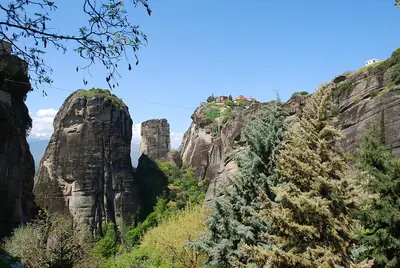
Meteora is a UNESCO World Heritage site, included on the list since 1988. Its name means “suspended in the air”, describing the monasteries built on top of towering rock formations.
Hermits first sought solitude in the caves and cliffs of the area. Later, religious communities established monasteries on the summits, reaching them with rope ladders and baskets. Stairs and bridges eventually made access easier, but the buildings still appear remarkably isolated above the surrounding plain.
The six active monasteries combine Orthodox religious tradition, unusual architecture and important wall paintings. Their setting is also one of the best reasons to explore beyond the town itself: different roads, paths and viewpoints reveal the rock pillars from constantly changing angles.
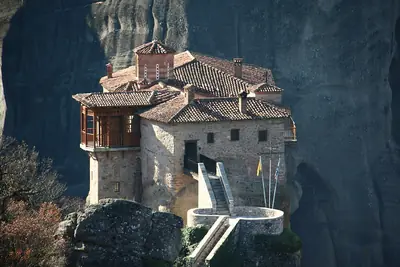
Moni Rousanou
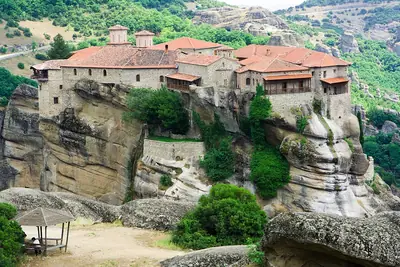
Moni Rousanou, also called the Holy Monastery of Roussanou, occupies the entire flat summit of its own rock. It remains an active Orthodox monastery and is home to a small community of nuns.
The present monastery was rebuilt in 1545 by Joasaph and Maximos on the remains of an older monastery. Its main church is dedicated to the Transfiguration of the Saviour and also honours Saint Barbara. Inside, the narthex has a dome decorated with frescoes from 1560, and the church follows the cross-shaped Athonite style.
Rousanou is reached by a staircase and two bridges. The bridges were built in 1930, replacing an earlier wooden bridge.
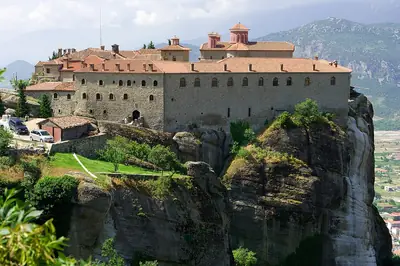
Varlaam Monastery
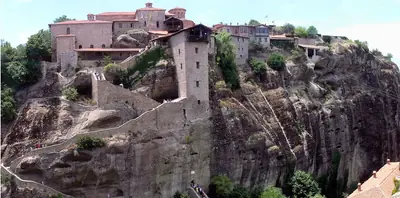
The Holy Monastery of Varlaam stands on a sheer rock pinnacle in the centre of Meteora. Its name comes from the hermit Varlaam, who climbed the rock in the mid-fourteenth century and built three small churches there.
After his death, the site remained abandoned for almost two centuries. In the early sixteenth century, the monks Nektarios and Theophanes Apsaradas revived the monastery. The main church, dedicated to All Saints, was completed in 1541 and follows the Athonite cross-in-square plan.
Varlaam is also associated with the remarkable engineering needed to supply a monastery on a vertical rock face. In 1536, a great tower was built to house the winch used to haul people and provisions up to the monastery. Inside the church, frescoes were painted in three different phases, beginning with work by the Theban master Frangos Katelanos in 1548.
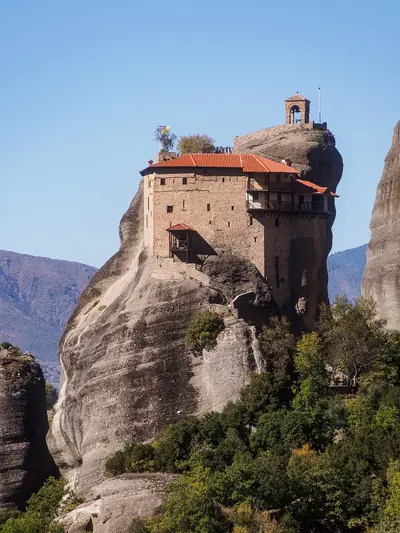
Agios Nikolaos Anapafsa
The Holy Monastery of Saint Nicholas Anapafsas occupies a narrow rock plateau, so its buildings rise vertically rather than spreading across the summit. The complex was rebuilt during the first decade of the sixteenth century by Metropolitan Dionysios of Larissa and the hieromonk Nikanor.
Its levels form a compact sequence of religious and communal spaces. The ground floor contains the small fourteenth-century chapel of Saint Anthony, with traces of its original frescoes and a crypt beneath. The katholikon, or main church, is one level higher. At the top are the former refectory, the ossuary and the chapel of Saint John the Baptist.
The monastery’s artistic highlight is a fresco cycle painted in 1527 in the Cretan style.
Great Meteoron Monastery
The Great Meteoron is the largest and highest of the six active monasteries. It stands 534 metres above sea level on a summit called Platys Lithos, or Broad Rock.
Its history begins in the first half of the fourteenth century, when Athanasius, a monk from Mount Athos, climbed the summit. He built a small church dedicated to the Virgin Mary and gathered a monastic community around it. The monastery later entered a period of prosperity in the sixteenth century, supported by imperial and royal donations.
The present katholikon, dedicated to the Transfiguration of the Savior, was built between 1544 and 1545 under Abbot Simeon. It follows the Athonite plan and incorporates the earlier church into its sanctuary. Frescoes from the fifteenth and sixteenth centuries cover the interior walls and depict scenes from the life of Christ.
Ypapantí Monastery
Ypapantí Monastery lies away from the main tourist circuit of the six suspended monasteries. A walking trail leads to it from the Great Meteoron, taking visitors through the distinctive rock formations of Meteora.
The monastery’s church celebrates the feast of the Presentation on February first. Its interior contains frescoes in the Macedonian style, including a striking image of the monk Neilos praying to the Virgin. Ypapantí is also known as Saint Dimitrios, and a statue outside commemorates Papa-Thymios Vlachavas.
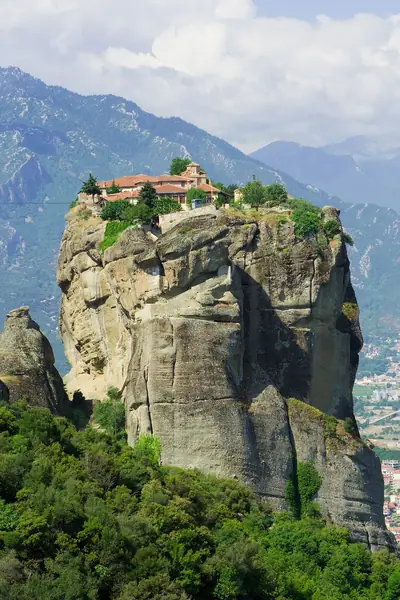
Monastery of the Holy Trinity
The Monastery of the Holy Trinity, or Agia Triada, is one of Meteora’s active Greek Orthodox monasteries and part of the UNESCO World Heritage site. It was founded by the monk Dometius, with construction beginning between the fourteenth and fifteenth centuries. Another source places its building period between 1458 and 1475.
The monastery’s wall paintings date from the eighteenth century. Its dramatic position also reflects how difficult access once was: until the 1920s, visitors reached it only by rope ladders and baskets. Stairs were added in 1925.
Agios Stefanos
Above the southern edge of Meteora, overlooking Kalabaka, stands Agios Stefanos, or the Monastery of Saint Stephen. It is one of the six active monasteries and has been home to a community of nuns since 1961.
According to tradition, the ascetic Jeremiah established a community here in 1191 or 1192. Construction began in the fourteenth century, while much of the monastery’s current appearance comes from additions made in the eighteenth and nineteenth centuries.
A small bridge connects the monastery with the modern road. Within the enclosure, the old katholikon stands in the southeastern section. It is a small single-nave church with a narthex, dating from the fifteenth century and renovated in the sixteenth.
The ruined hermitages and smaller monasteries
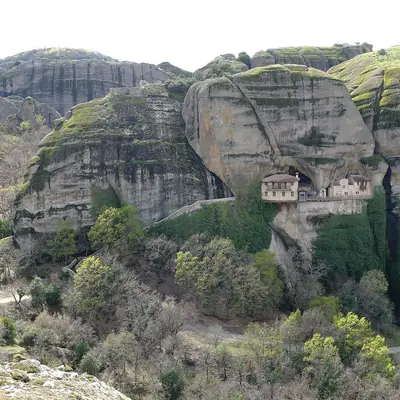
Meteora’s history extends beyond the best-known monasteries. Ypsilotera Monastery is now marked by ruins, while the Monastery of St. Anthony—also known as St Antony, the Cell of Constantius or St Nicholas Badovas—recalls another historic religious settlement.
The Monastery of the Holy Apostles in Kleino is an Eastern Orthodox monastery in the village of Kleino. Bytouma Monastery, also called the Monastery of Vitouma, is another Byzantine landmark in the Trikala region. Chrysino is recorded both as a small settlement and as the Holy Monastery of Panagia Chrysinou.
Together, these quieter sites show that Meteora was not defined only by its six surviving monasteries. The landscape was once filled with hermitages, cells and religious communities scattered among the rocks.
Explore Kalabaka with Neywo
Neywo has three walking tours in Kalabaka, with 15 tour stops in total:
- Monasteries in the Sky: Rousanou, Varlaam and the Great Meteoron — 2.78 km, 120 minutes and 5 stops.
- From the Byzantine Church of Kalabaka to the Holy Trinity — 2.89 km, 96 minutes and 5 stops.
- The Monks’ Path and the Ruined Hermitages of Meteora — 3.66 km, 95 minutes and 8 stops.
Download Neywo and explore with a Kalabaka self-guided walking tour. The app tells the story of each place as you reach it, at your own pace, with no group and no schedule. It is a simple way to connect Kalabaka’s streets, Meteora’s monasteries and the quieter ruins between them. You can also continue discovering Greece with the Greece guide, or plan another stop in Parga, Ioannina or Thessaloniki.
Places with an audio guide in Kalabaka
8 places in Kalabaka with a Neywo audio guide. Each one starts telling its story as you reach it.
Self-guided tours in Kalabaka
3 tours in Kalabaka, free in the Neywo app. Each stop tells its story as you reach it.
- Walk
Monasteries in the Sky: Rousanou, Varlaam and the Great Meteoron
Walk the heart of Meteora, where monks hauled themselves up by nets and rope ladders. Visit the nuns' monastery reached by two bridges, Varlaam with its Last Judgment frescoes, the stacked chapels of Anapafsas, the Great Meteoron on Broad Rock, and the quiet Ypapanti reached by a trail.
Moni Rousanou · Varlaam monastery · Agios Nikolaos Anapafsa monastery of Meteora · Great Meteoron monastery · Ypapantí Monastery
Open this tour: Monasteries in the Sky: Rousanou, Varlaam and the Great Meteoron - Walk
From the Byzantine Church of Kalabaka to the Holy Trinity
Begin in town at the Kalabaka library and the old Byzantine church, then stand at the foot of the sandstone pillars that gave Meteora its name. Climb to Agia Triada, reached by rope ladders and baskets until the 1920s, and finish at the nuns' monastery of Agios Stefanos above Kalabaka.
Church of Koimisis Theotokou Kalambakas · Meteora · Monastery of the Holy Trinity, Meteora · Agios Stefanos monastery
Open this tour: From the Byzantine Church of Kalabaka to the Holy Trinity - Walk
The Monks' Path and the Ruined Hermitages of Meteora
Follow the old footpath that climbs from Kalabaka into the rocks. Pass the Byzantine church in town, the hermit cells of St Nicholas of Badova, St Anthony and Agio Pneuma, then reach the abandoned monasteries of the Pantocrator, the Holy Monastery and Ypsilotera, where only ruins remain on the pinnacles.
Church of Koimisis Theotokou Kalambakas · Monastery of St. Nicholas of Badova · Monastery of St. Anthony · Monastery of St. George Mandilas · Agio Pneuma Monastery · Monastery of the Pantocrator …
Open this tour: The Monks' Path and the Ruined Hermitages of Meteora
Walk Kalabaka with Neywo
Neywo turns Kalabaka into a self-guided audio tour. Stories arrive as you reach the place they belong to, and the route reshapes when you wander off it.

