What to See in Sparta, Greece: Free Audio Guide
Things to do in Sparta: what to see in and around the city
The best things to do in Sparta include exploring the Byzantine ruins of Mystras, following the story of ancient Laconia, and taking in the landscape beneath Mount Taygetus. Sparta is a good base for discovering a region where classical history, medieval monuments and mountain traditions meet. Neywo offers a free audio guide for Sparta with 30 narrated places, available in 11 languages.
What to see in Sparta and around the city
The archaeological site of Mystras
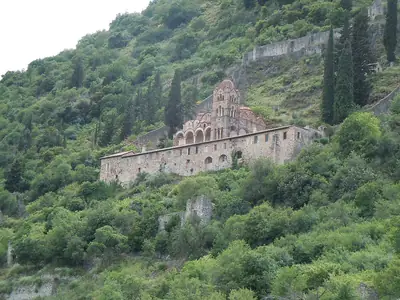
Mystras is the essential historical excursion from Sparta. This fortified medieval city stands on the slopes of the Taygetus mountains, above ancient Sparta, and was the capital of the Byzantine Despotate of the Morea during the 14th and 15th centuries.
The site is recognised as a UNESCO World Heritage Site and is an unusually well-preserved example of a Byzantine city. Its churches, monasteries and palaces reflect the artistic and intellectual flowering known as the Palaeologan Renaissance. Mystras remained inhabited during the Ottoman period before being abandoned in the 1830s, when the modern town of Sparta was built about eight kilometres to the east.
The Metropolis of Mystras
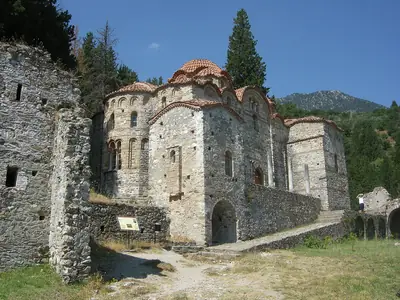
The Metropolis, also known as the Church of Saint Demetrius, was the cathedral and episcopal seat of Mystras. Built around 1280, it is the oldest church in the castle town.
Its architecture combines a basilica-style lower section with a five-domed upper church, a mixed form also found elsewhere at Mystras. Inside, sculptural decoration and frescoes were created in three phases. According to tradition, Constantine XI Palaiologos, the last Byzantine emperor, was crowned here in 1449.
Brontochion Monastery
On the northern slope of the fortress hill, the former Brontochion Monastery forms one of the quieter corners of Mystras. Its main church, the katholikon dedicated to the Virgin Mary as the Hodegetria, or “Guide”, became the centre of the monastery complex.
The church was rebuilt and rededicated around 1310. Its interior preserves frescoes with scenes from the Bible, including the healing of the blind man and the wedding at Cana.
Agios Nikolaos Church
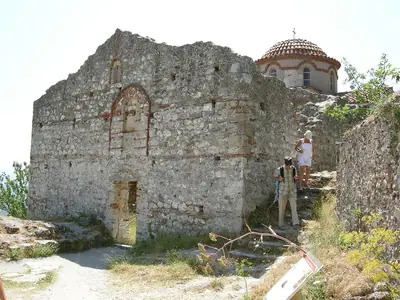
The Church of Agios Nikolaos is another stop within the archaeological site of Mystras. It belongs to the wider Byzantine landscape that made the fortified city an important centre of Late Byzantine and Post-Byzantine art.
As you move between the churches and ruins, Agios Nikolaos helps reveal how religious buildings were woven into the life of the medieval settlement rather than standing apart from it.
Pantanassa Monastery
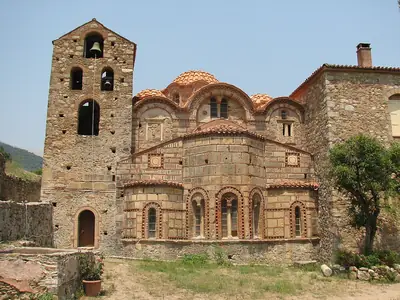
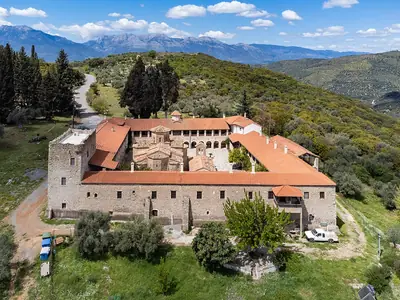
Pantanassa Monastery is the last church built within the walls of Mystras’ Upper Town and the best-preserved monument in the complex. It is also the only monastery at the site that remains permanently inhabited, with a community of nuns living there.
Founded by John Frankopoulos, a high-ranking official of the Despotate of Mystras, the monastery was dedicated in September 1428. Its ornate stone façade combines Byzantine and Western elements, while the four-storey bell tower shows particularly strong Gothic influence.
The church has a three-aisled basilica on the ground floor and a cross-inscribed, five-domed church above it. The monastery once had open arcades, although only one survives.
Taygetus
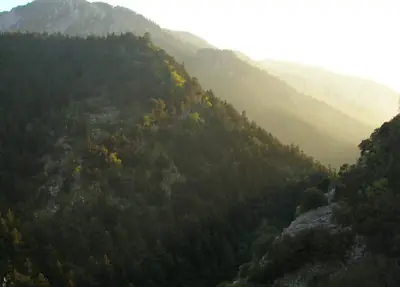
The Taygetus range rises above Sparta and is the highest mountain range in the Peloponnese. Its highest peak, Profitis Ilias, reaches 2,405 metres and takes its name from a chapel near the summit. The mountain was also known as Pentadaktylos, or “five-fingered”, because of its five major peaks.
Taygetus appears in Homer’s Odyssey and is associated in classical mythology with the nymph Taygete. The mountain was also deeply important to the Spartans. From modern Sparta, its presence is one of the defining features of the landscape.
The Evrotas River
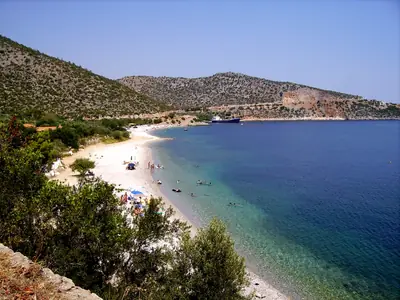
The Evrotas is the main river of Laconia and flows alongside Sparta, to the east of the city. It begins at springs near Skortsinos, travels about 82 kilometres from north to south, and eventually reaches the Laconian Gulf near Gytheio, where it forms a delta.
In mythology, the river was named after Eurotas, a king of Laconia. The story says that he created a channel to drain stagnant water around Sparta towards the sea. The river was also represented as a river god, and its name is associated with the ideas of good flow and fair streaming.
Gola Monastery
The Monastery of Panagia Gola lies on the eastern slopes of Taygetus, roughly halfway along an old path between the mountain villages of Koumousta and Gouranou. Its founding inscription records that it was “built from its foundations and restored” in 1632.
The narthex is particularly notable for its frescoes of ancient sages. Among the figures represented are Solon, Thucydides, Plutarch, the Sibyl, Aristotle, Plato, Chilon and Homer. The name “Gola” comes from a Slavic word meaning “bare”, an apt description of the exposed mountain setting.
Laconia and the Peloponnese
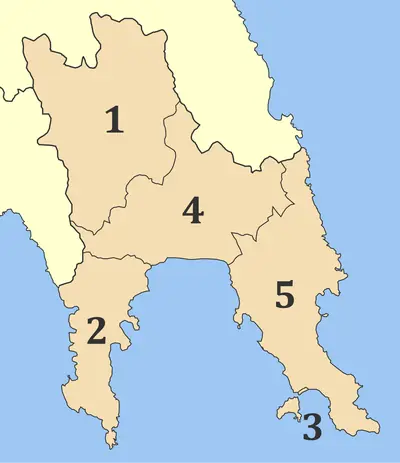
Sparta is the capital of Laconia, the southernmost region of the Peloponnese and mainland Greece. The region’s name survives in the word “laconic”, referring to the Spartans’ reputation for concise, blunt speech.
Laconia forms part of the Peloponnese Region, an area of mountains, valleys and coastline that includes the regional units of Arcadia, Argolis, Corinthia, Laconia and Messenia. The wider region is one of Greece’s richest areas for combining archaeological sites with dramatic landscapes.
The King Leonidas Statue
In modern Sparta, the King Leonidas Statue commemorates the Spartan king who led 300 warriors against the Persian army at the Battle of Thermopylae. The monument stands near the Municipal Stadium of Sparti and offers a direct connection with one of the most enduring stories associated with ancient Sparta.
Medieval castles around Sparta
The wider Laconian landscape includes several medieval fortifications. The Castle of Vordonia occupies a remote hilltop position in the mountains, with views across the surrounding valleys and ranges. The Paleologean Castle of Loganikos recalls the Palaiologos dynasty, the last ruling family of the Byzantine Empire, and the region’s medieval history.
Explore Sparta with a free audio guide
Neywo’s free Sparta audio guide includes 30 narrated places. Its walking tour, “Mystras, the Last Capital of Byzantium”, covers 2.41 km in about 100 minutes and includes nine stops: Mystras, the Metropolis of Mystras, Hodigitria, Evangelistria Church, Brontochion Monastery, the Palace of the Despots of Mystras, Agia Sofia Church, Pantanassa Monastery and Peribleptos Monastery.
Download Neywo and explore the route at your own pace. The app tells the story of each place as you reach it, with no group and no schedule.
Places with an audio guide in Sparta
8 places in Sparta with a Neywo audio guide. Each one starts telling its story as you reach it.
Self-guided tours in Sparta
1 tour in Sparta, free in the Neywo app. Each stop tells its story as you reach it.
- Walk
Mystras, the Last Capital of Byzantium
Climb the hill above ancient Sparta to the ruined Byzantine city where the last emperor was crowned. Walk between painted churches and monasteries, past the Despots' palace, to the cliffside monastery of Peribleptos. Mystras is a UNESCO site, with steep paths and few shaded stretches.
Mystras · Metropolis of Mystras · Hodigitria (Mystras) · Evangelistria church · Brontochion Monastery · Palace of Despots of Mystra …
Open this tour: Mystras, the Last Capital of Byzantium
Walk Sparta with Neywo
Neywo turns Sparta into a self-guided audio tour. Stories arrive as you reach the place they belong to, and the route reshapes when you wander off it.

