Thessaloniki, Greece: Self-Guided Walking Tour
Things to do in Thessaloniki: historic landmarks, churches and the seafront
The best things to do in Thessaloniki include exploring Roman and Byzantine monuments, discovering Ottoman heritage in the Upper Town, and walking beside the Thermaic Gulf. Greece’s second-largest city brings many layers of history together in a compact urban setting, with lively squares, historic churches and distinctive buildings throughout the centre. Neywo offers a free audio guide for Thessaloniki with 137 narrated places.
What to see in Thessaloniki
Hamza Bey Mosque
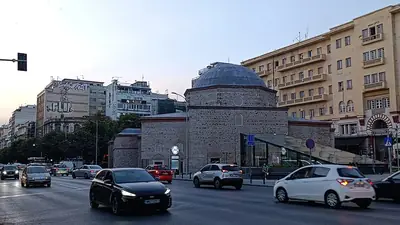
At the meeting point of Egnatia and Venizelou streets, opposite the Bezesteni, Hamza Bey Mosque is one of Thessaloniki’s most distinctive historic landmarks. Built in 1467 or 1468 by Havsa Hatun, the daughter of Hamza Bey, it began as a small mosque without a minaret and is described as the oldest mosque in the city.
Its later history is equally unusual. After the Muslim population left Thessaloniki in 1923, it ceased to function as a mosque. From 1928 to 1989, a cinema called Alkazar operated in its courtyard, giving the building the name by which many modern Thessalonians know it. The mosque was seriously damaged in the 1978 earthquake, and restoration began in 1997.
Navarinou Square and the Church of Saint Anthony
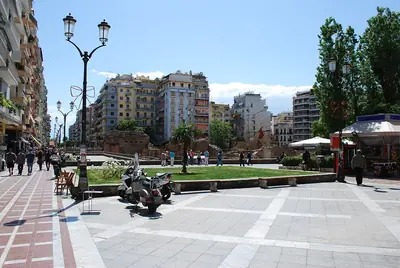
Navarinou Square, or Platia Navarinou, takes its name from the Battle of Navarino, described as a crucial moment in the Greek War of Independence. Today, it is a central urban gathering place in the historic city.
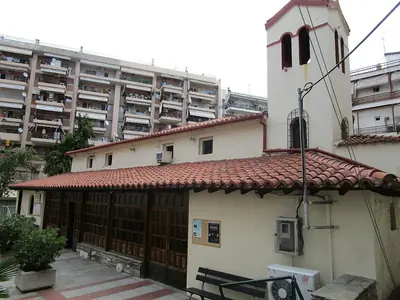
Nearby, the Church of Saint Anthony stands in the old Greek quarter as a chapel of the Monastery of Saint Theodora. The present two-aisled basilica was built during the second half of the nineteenth century on the site of an earlier church. Its façade is decorated with keramoplastic elements.
The Roman Forum and Thessaloniki Odeon
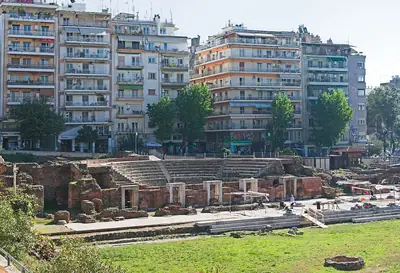
The Thessaloniki Odeon forms part of the Roman Forum, or agora, of the city. This archaeological site was a performance space within the wider ancient setting, making it an important stop for anyone interested in Roman Thessaloniki.
The Roman Forum is included in Neywo’s walk focused on Galerius and Rome’s Thessaloniki, alongside the Rotunda, the Arch of Galerius and Galerius’ palace.
Saint Euthymius Chapel
Beside the Church of Saint Demetrius, the much smaller Saint Euthymius Chapel offers a more intimate historic setting. The medieval chapel is notable for its architecture and wall paintings, which are important examples of the Palaiologan Renaissance. It is dedicated to Saint Euthymius of Thessaloniki and is closely connected with the larger church, also known as Hagios Demetrios.
The contrast between the chapel’s small scale and the major church beside it is one of its most striking features.
Alaca Imaret Mosque
On Kassandrou Street, northeast of Saint Demetrius, the Alaca Imaret Mosque is also known as the Ishak Pasha Mosque. Established in 1484 under Ishak Pasha, it functioned as an imaret, a medrese and a mosque.
Its name means “Colourful Imaret”. The building’s masonry is particularly distinctive: rectangular limestone blocks are framed by brick, creating a complex pattern that reflects its Ottoman architectural character.
Church of Prophet Elijah
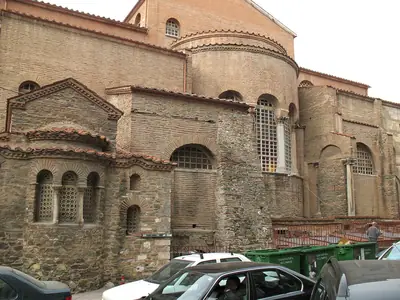
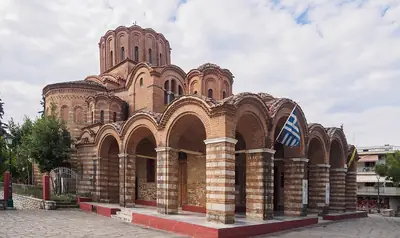
In Ano Poli, Thessaloniki’s Upper Town, the Church of Prophet Elijah is one of the city’s most important Byzantine monuments. Built on a natural hill during the second half of the fourteenth century, it may originally have been dedicated to Christ and served as the main church of a monastery possibly associated with the Palaiologos dynasty.
Its design is a four-column cross-in-square church with side spaces, an Athonite or Mount Athos-style form used exclusively for the main churches of monasteries. The elaborate brick decoration around the dome adds to its visual impact. After the Ottoman conquest of Thessaloniki in 1430, the building was converted into a mosque; when the city became part of Greece in 1912, it was converted back into a church.
Saint Mary Lagoudiani
At the intersection of Olympiada and Julianou Streets in the Upper Town, Saint Mary Lagoudiani is also known as Panagia Lagoudiani or the Church of the Life-Giving Spring. The present building stands on the site of a Byzantine women’s monastery, probably founded in the fourteenth century as a dependency of the Vlatadon Monastery.
During the Ottoman period, the site was known as Tavşan Manastır, or “Hare Monastery”. The current church was completely reconstructed at the beginning of the nineteenth century. It is a three-aisled basilica with a women’s gallery, while an attached chapel on the southern side contains a spring regarded as sacred.
The Ottoman Fountain on Dimitrios Poliorkitis Street
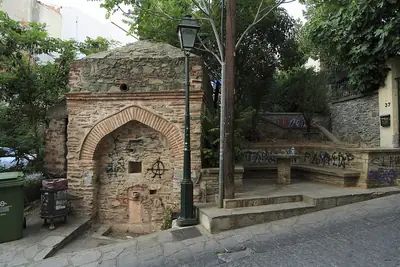
The Fountain on Dimitrios Poliorkitis Street, also called the Ottoman Fountain or Tsinarí Fountain, stands in the Upper Town’s historic Turkish quarter, close to the Thessaloniki Cartographic Archive.
Built from stone and brick, it has a false brick arch set into its façade. The fountain has been restored and is relatively well preserved, although its founding inscription has disappeared, leaving the exact year of construction unknown. Its modest appearance offers a direct glimpse of the post-Byzantine and Ottoman heritage of Ano Poli.
Yeni Mosque
The Yeni Mosque, or New Mosque, was built in 1902 during the Ottoman era. Designed by the Italian architect Vitaliano Poselli and commissioned by Haji Mehmed Hayri Pasha, it served Thessaloniki’s Dönmeh community, Jews who had converted to Islam.
The building combines Oriental, Renaissance, Byzantine, Islamic, Baroque and some Neoclassical influences. After the Dönmeh community left during the population exchange between Greece and Turkey, the mosque stopped serving as a regular place of worship. Greek refugees were temporarily housed there, and from 1925 to 1962 it accommodated Thessaloniki’s Archaeological Museum. It now serves as an exhibition centre for the Municipality of Thessaloniki.
Eleftherias Square
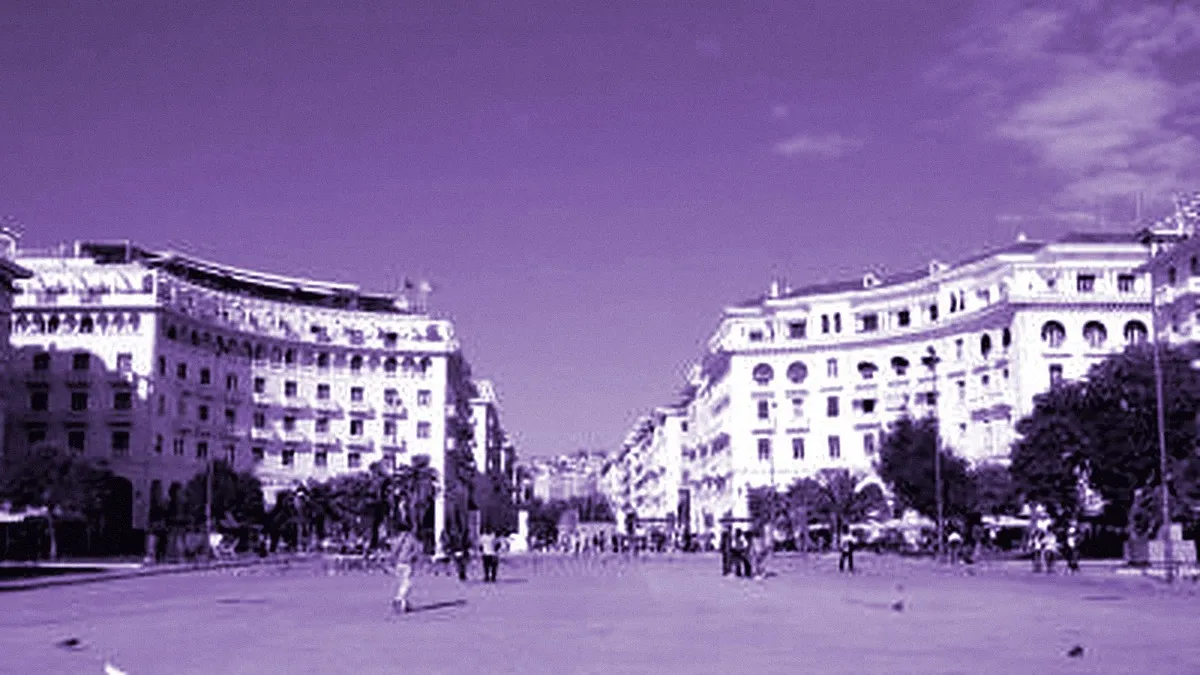
Beside the old waterfront, Eleftherias Square is both a central urban space and a place of Holocaust remembrance. The square took shape after the middle of the nineteenth century, following the demolition of Thessaloniki’s Byzantine walls along the waterfront.
On 11 July 1942, thousands of Greek Jewish men were rounded up there, publicly tortured and humiliated, and registered for forced labour during the Holocaust in Greece. The square’s present-day setting therefore carries a weighty historical significance.
Toumba Stadium
Toumba Stadium, officially PAOK Stadium, is the home of PAOK Football Club and one of Thessaloniki’s best-known football grounds. It was completed in 1959 for the club’s sporting facilities and has hosted PAOK’s home matches since 1979.
Although its official name is PAOK Stadium, the ground is generally known as Toumba, after the surrounding neighbourhood. Renovation work took place from 2003 to 2004, when the stadium was selected as a training venue for the 2004 Summer Olympic Games.
Historic memorials
Thessaloniki’s public spaces also include monuments dedicated to historical figures. The Statue of Philip II of Macedonia commemorates one of the figures associated with the city’s history. A marble memorial to Ioakeim III, created in 2006 by Daniil Saratsis, offers a more contemporary tribute, while the Statue of Constantine I was created in 1985 by Nikolaos Pavlopoulos.
Explore Thessaloniki with Neywo
A Thessaloniki self-guided walking tour is an easy way to connect the city’s monuments without joining a group. Neywo has seven walking tours, one bus route and one bike route in Thessaloniki, covering distances from 1.37 to 10 kilometres and lasting between 22 and 115 minutes. Together, they include narrated stops at the city’s churches, Roman sites, museums, squares, villas and waterfront landmarks.
The walks include routes through Galerius’ Roman Thessaloniki, the Byzantine centre, Ano Poli, the seafront, the Frankish Quarter, the Belle Époque villas of Vasilissis Olgas, and the university quarter. The Cultural Line by Bus 50 covers 10 kilometres in 43 minutes with 12 stops, while the Seafront Cycle Lane runs for 4.5 kilometres in 22 minutes with eight stops.
The app tells the story of each place as you reach it, at your own pace, with no group and no schedule. Narration is available in 11 languages. Download Neywo’s free Thessaloniki audio guide and explore the city independently, from its Roman Forum and Byzantine churches to the Upper Town and the Thermaic waterfront.
Thessaloniki is one of the highlights of Greece, and it makes a rich starting point for discovering more of the country, including Parga, Kalabaka and Ioannina.
Places with an audio guide in Thessaloniki
8 places in Thessaloniki with a Neywo audio guide. Each one starts telling its story as you reach it.
Self-guided tours in Thessaloniki
9 tours in Thessaloniki, free in the Neywo app. Each stop tells its story as you reach it.
- Bike ride
Seafront Cycle Lane: Villa Kapanci to the Vardar Fortress
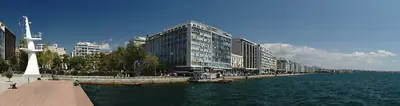
A flat ride along Thessaloniki's waterfront cycle lane from the Art Nouveau Villa Kapanci to the Vardar fortress tower. You pass the Umbrellas sculpture, the White Tower, the metropolitan church of Saint Gregory Palamas, Aristotelous Square, Liberty Square and Natsinas Mansion.
Villa Ahmet Kapanci · Umbrellas · White Tower of Thessaloniki · Saint Gregory Palamas Church · Aristotelous Square · Eleftherias Square …
Open this tour: Seafront Cycle Lane: Villa Kapanci to the Vardar Fortress - Bus ride
The Cultural Line: Thessaloniki's Sights by Bus 50
OASTH bus 50 is the city's Cultural Line, a public route that strings together the upper-town walls, the Byzantine core and the Roman forum. Ride it from the church of Lagoudiani under the walls, past Agios Dimitrios and the Saatli Mosque, then down through Navarinou Square and Hagia Sophia to the Odeon and the Monastir Synagogue.
Saint Mary Lagoudiani · Pyrgos Aliseos · Saint Euthymius Chapel, Thessaloniki · Saatli Mosque (Selanik) · Church of Agios Dimitrios, Thessaloniki · Sintrivani metro station …
Open this tour: The Cultural Line: Thessaloniki's Sights by Bus 50 - Walk
Galerius and Rome's Thessaloniki
Follow Egnatia Street through the tetrarch Galerius's imperial quarter: the domed Rotunda that was mausoleum, church and mosque, the triumphal arch, the palace ruins and a cluster of Byzantine and post-Byzantine churches around Hippodrome Square. Roman Thessaloniki still stands in the middle of a modern city.
Rotunda · Church of Saint Panteleimon · Nedelkos Clinic · Saint Mary Gorgoepikoos Church, Thessaloniki · Church of the Saviour · Arch of Galerius and Rotunda …
Open this tour: Galerius and Rome's Thessaloniki - Walk
Saints and Sultans: The Byzantine Heart
Start at the oldest mosque in the city and cross Aristotelous Square into the early Christian core: Hagia Sophia, a hidden baptistery, the great basilica of Agios Dimitrios, all part of a UNESCO World Heritage group. Each building changed faith more than once.
Hamza Bey Mosque · Aristotelous Square · Longos Mansion · Hagia Sophia · Saint John the Baptist Baptistery, Thessaloniki · Saint Athanasius Church, Thessaloniki …
Open this tour: Saints and Sultans: The Byzantine Heart - Walk
Ano Poli: The Upper Town Under the Walls
Climb to the old Turkish quarter inside the Byzantine walls. Visit frescoed chapels that were once mosques, a dervish mausoleum and a lion-and-thorn fresco, then finish at the Heptapyrgion, a fortress and prison whose name promises seven towers but delivers ten.
Church of Saint Catherine, Thessaloniki · Fountain on Dimitrios Poliorkitis Street · Church of Prophet Elijah · Church of Hosios David · Musa Baba türbe · Saint Mary Lagoudiani …
Open this tour: Ano Poli: The Upper Town Under the Walls - Walk
The Seafront: White Tower to the Museums
Stroll from the White Tower, the symbol of the city, along the waterfront past theatres, an eighteenth-century church and an Armenian church to the contemporary art museum, the war museum and the Olympic museum. Then double back to the Museum of Byzantine Culture and finish under the Umbrellas sculpture on the promenade.
White Tower of Thessaloniki · Royal Theatre · National Theatre of Northern Greece · Nea Panagia · Armenian Church, Thessaloniki · MOMus–Museum of Contemporary Art–Macedonian Museum of Contemporary Art and State Museum of Contemporary Art Collections …
Open this tour: The Seafront: White Tower to the Museums - Walk
Frankish Quarter and Sephardic Salonica
Begin in the Roman forum with its odeon, then cross the quarter where Europeans, Ottomans and Sephardic Jews once lived side by side: the Saatli Mosque, the great Monastir Synagogue, a Catholic cathedral, a mansion that survived the 1917 fire, Liberty Square and the film museum on the quay. The walk ends at the Vardar fortress tower.
Thessaloniki odeon · Governor's House Square · Saatli Mosque (Selanik) · Monastir Synagogue · Cathedral of the Virgin Mary’s Immaculate Conception, Thessaloniki · Natsinas Mansion …
Open this tour: Frankish Quarter and Sephardic Salonica - Walk
Vasilissis Olgas: Villas of the Belle Époque
Walk the seaside avenue where Thessaloniki's wealthy Ottoman, Jewish and Dönmeh families built Art Nouveau villas around 1905. Visit Villa Modiano, the Kapanci mansions, the Ascension church and Siagas Manor, Villa Mordoch and Villa Bianca, now home to the Municipal Art Gallery, beside the waterfront concert hall.
Villa Ahmet Kapanci · Ascension Church, Thessaloniki · Villa Mordoch · Municipal Art Gallery of Thessaloniki · Thessaloniki Concert Hall · Villa Morpourgo
Open this tour: Vasilissis Olgas: Villas of the Belle Époque - Walk
Atatürk's Birthplace and the University Quarter
Cross the eastern side of the city from Pashina Gardens and the church of the Annunciation to the house where Mustafa Kemal Atatürk is believed to have been born. Then visit the new Sintrivani metro station named after an Ottoman fountain, a twentieth-century Byzantine-style church, the university's collection of plaster casts and the Teloglion art foundation.
Pashina Gardens · Annunciation Church, Thessaloniki · Atatürk Museum · Sintrivani metro station · Saint Stylianos Church, Thessaloniki · Museum of Plaster Casts …
Open this tour: Atatürk's Birthplace and the University Quarter
Walk Thessaloniki with Neywo
Neywo turns Thessaloniki into a self-guided audio tour. Stories arrive as you reach the place they belong to, and the route reshapes when you wander off it.

