Taormina, Italy: Self-Guided Walking Tour
Things to Do in Taormina: Ancient Theatre, Palaces and Sicilian Churches
Taormina is a historic hilltop town in Sicily, known for its Greek theatre, medieval palaces, churches and views towards the Ionian Sea and Mount Etna. Its compact center is especially rewarding to explore on foot, with major sights arranged along Corso Umberto and in the streets and squares around it. Neywo has a free audio guide for Taormina with 30 narrated places.
Part of Sicily and the wider Italy, Taormina brings together ancient archaeology, Sicilian Gothic and Baroque architecture, museums and the natural landscape of Isola Bella.
What to see in Taormina
These are some of the most important places to include when exploring Taormina, roughly following the route through its historic center and surrounding viewpoints.
Castello di Monte Tauro
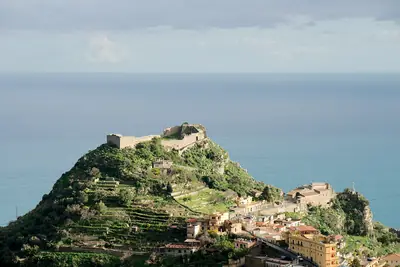
Also known as Casteltauro, Castello di Monte Tauro stands on the rocky height above Taormina. Its position on Monte Tauro, at almost 400 meters above sea level, is one of the castle’s defining features. The climb and elevated setting make it an important landmark to notice when looking up from the town.
Ancient Theatre of Taormina
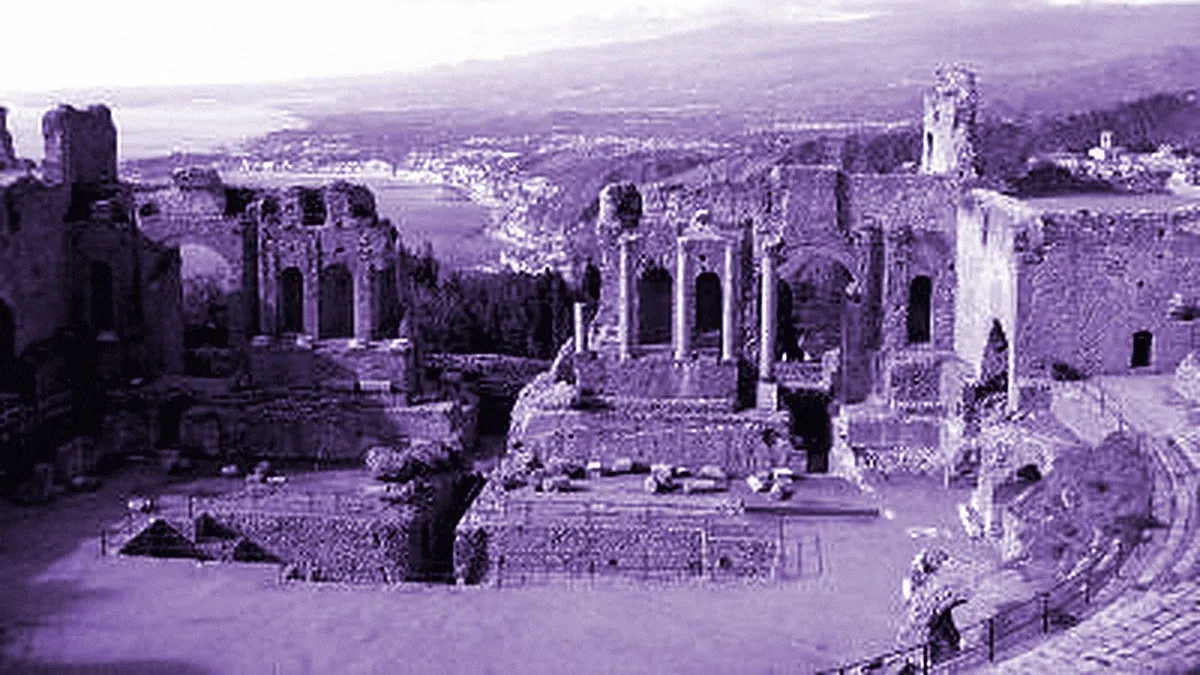
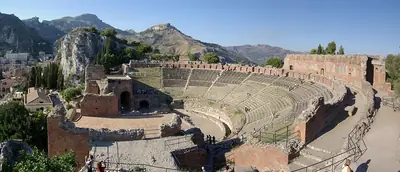
The Ancient Theatre of Taormina, or Teatro Greco, is the city’s defining monument. Construction began in the third century BC, in the Greek city of Tauromenion. It is the second-largest ancient theatre in Sicily, after the Greek theatre of Syracuse.
The theatre was carved directly into the hillside: more than 100,000 cubic metres of rock were removed by hand to create it. In its original Greek form, the semicircular seating area followed the slope, while the stage was used for drama and religious festivals. The landscape was part of the design, so the Ionian Sea and Mount Etna became part of the setting.
During the Roman period, particularly in the second century AD, the theatre was remodelled. The simple Greek stage was replaced by a monumental scene wall with marble columns and statues, and the orchestra was adapted for gladiatorial contests. Between 5,000 and 5,400 spectators could sit in nine sections with porticos.
Santa Caterina church
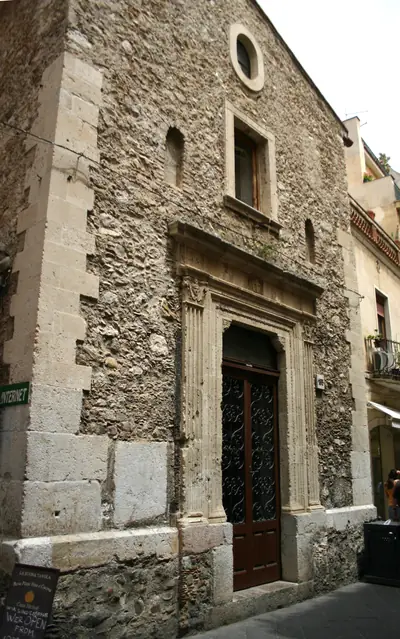
Beside Palazzo Corvaja on Corso Umberto, Santa Caterina church offers several layers of Taormina’s history in one place. The church stands above the remains of an ancient Roman Odeon and an earlier Greek temple.
Built during the first half of the seventeenth century, it has a Sicilian Baroque façade framed with pink Taormina marble and pale Syracuse stone. A statue of Saint Catherine by Paolo Greco, dated 1705, occupies the niche above the entrance.
Inside, the single-nave church preserves works of art and archaeological remains. The main altar includes an elaborate marble mensa and a painting of the Martyrdom of Saint Catherine by Jacopo Vignerio. Restoration work in the 1970s also uncovered a crypt used for the burials of notable citizens and aristocrats.
Corvaja Palace
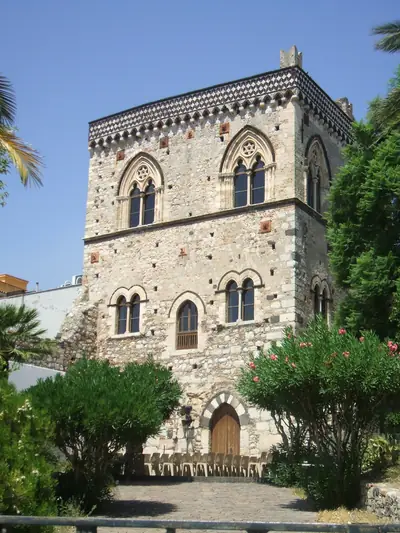
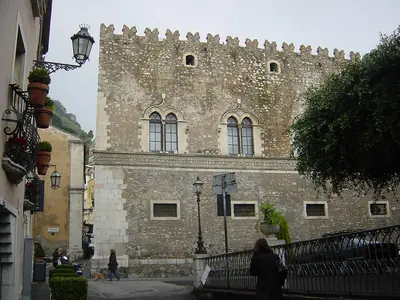
Corvaja Palace, or Palazzo Corvaja, stands in Piazza Vittorio Emanuele II, also called Abbey Square, beside Corso Umberto and near Santa Caterina church. Its architecture reflects Arab, Norman and Catalan Gothic influences.
The palace began with a square defensive tower built by Arab rulers in the tenth century. The Normans expanded it in the eleventh century, and later additions introduced Catalan Gothic windows and Norman halls. Look for pointed arches, carved mullioned windows and relief panels made from Siracusa stone. Some panels depict Biblical scenes, including the Creation of Eve, Original Sin and the Expulsion from Paradise.
The palace took its present name from the Corvaja family, who owned it from the seventeenth century until 1945. It also hosted the Sicilian Parliament in the early fifteenth century.
San Giuseppe
In Piazza IX Aprile, the Church of Saint Joseph stands beside Taormina’s Clock Tower. Its sweeping Baroque façade, double staircase and twin towers give the square a theatrical appearance.
Built between the late seventeenth and early eighteenth centuries for the Confraternity of Souls in Purgatory, the church is dedicated to Saint Joseph. The façade features a carved central portal, a triangular pediment and a marble niche containing Christ the King.
The interior has a single nave, marble altars, frescoes of prophets and Gospel scenes, and a dome above the tabernacle. The main altar is made with colorful Taormina marble.
Basilica of St. Nicholas of Bari
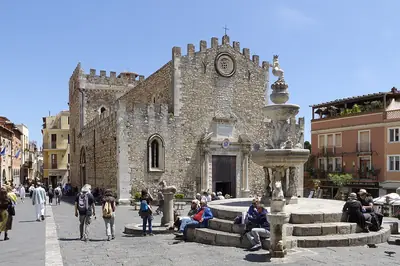
Near Porta Catania, along Corso Umberto, the Basilica Cathedral of St. Nicholas of Bari is Taormina’s Duomo and the principal place of worship in the historic center. Its origins are medieval, and its full name is Cattedrale di San Nicolò di Bari.
The cathedral is an important stop for understanding the religious and architectural character of the old town, especially when following Corso Umberto between its historic gates and squares.
Palazzo Duchi di Santo Stefano
Palazzo Duchi di Santo Stefano is a fourteenth-century palace and one of Taormina’s notable examples of Sicilian Gothic art. Its design combines Gothic elements with features associated with Arab-Norman architecture.
The building belonged for many years to the De Spuches, or De Spucches, family, who held the titles of Dukes of Santo Stefano di Briga and Princes of Galati. In 1964, the Municipality of Taormina acquired the palace, which then became the home of the Mazzullo Foundation.
Casa Cuseni
Casa Cuseni is a historic villa and museum dedicated to fine arts and the Grand Tour of Taormina. Built between 1900 and 1905 by the British painter Robert Hawthorn Kitson, it combines local stone, marble and terracotta with Palladian inspiration.
Colonnaded loggias open onto terraces with panoramic views. Inside, the museum preserves more than 2,700 objects, including watercolors, antiques, furnishings, Islamic stained glass and rare textiles. The dining room created by Sir Frank Brangwyn retains its original furniture and a symbolic mural, providing a surviving example of Brangwyn’s Arts and Crafts work.
After the Second World War, Daphne Phelps kept the house and opened it to artists, writers and intellectuals as a retreat and guesthouse.
Isola Bella and Museo naturalistico Villa Caronia
Museo naturalistico Villa Caronia connects Taormina with the natural setting of Isola Bella. The protected area surrounding the islet is known as the Pearl of the Ionian Sea and includes a pebble beach and rocky outcrop covered with Mediterranean greenery.
At low tide, a narrow sandbar links Isola Bella to the shore, creating a natural peninsula. At high tide, the path disappears beneath the water. The reserve was established by the Sicilian Regional Government in 1998 and is managed by the University of Catania.
Native Mediterranean plants such as lentisk and caper shrubs grow alongside species introduced in the nineteenth century by Florence Trevelyan, including cycas and giant strelitzia.
Other churches and historic places
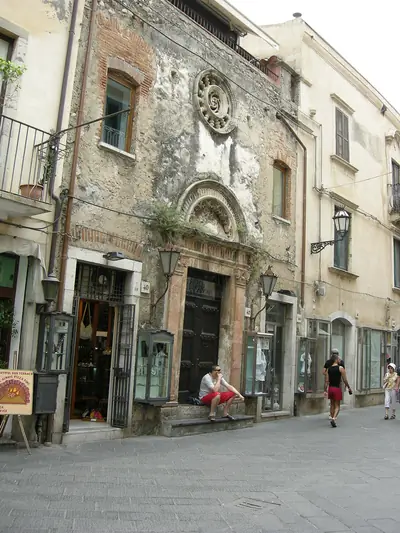
Taormina’s smaller religious buildings add detail to a walk through the town. The former church of San Giovanni di Malta, also known as the ex chiesa di San Giovanni di Malta, is part of the city’s historic religious heritage. The former Church of Santa Maria del Piliere was closed for worship in the early 1800s.
Sant’Antonio Abate and the Church of Sant’Antonio di Padova, in the Cappuccini district, represent further parts of Taormina’s religious history. Sant’Antonio di Padova forms part of a monumental complex that includes a Capuchin convent. The Church of Santa Domenica Vergine e Martire, also called the Church of Santa Domenica, is another historic church to encounter while walking through Taormina.
Castello di Villagonia, associated with the seaside district of Villagonia, was once a noble residence on the shore and formed part of the defensive system of Capo Schisò.
Explore Taormina with a free audio guide
Neywo offers three self-guided walking tours in Taormina, with 30 narrated places in total:
- Stage of the Greeks: Saracen Castle, Theatre and Corvaja Palace — 2.27 km, 86 minutes and 9 stops.
- Baroque Corso: Clock Tower, Fountain and Palaces — 1 km, 70 minutes and 10 stops.
- Taormina Highlights: From the Greek Theatre to Casa Cuseni — 2.3 km, 105 minutes and 12 stops.
The app tells the story of each place as you reach it, at your own pace, with no group and no schedule. Narration is available in 11 languages, making Neywo a practical Taormina audio guide for discovering the historic center independently.
Places with an audio guide in Taormina
8 places in Taormina with a Neywo audio guide. Each one starts telling its story as you reach it.
Self-guided tours in Taormina
3 tours in Taormina, free in the Neywo app. Each stop tells its story as you reach it.
- Walk
Stage of the Greeks: Saracen Castle, Theatre and Corvaja Palace
Climb first to the Saracen Castle and the cave-church of Madonna della Rocca, on the acropolis of ancient Tauromenion, then walk down to the Ancient Theatre with Mount Etna as its backdrop. Churches built on Greek temples and Roman remains, and an Arab-Norman palace, show how Taormina layered its history. The first stretch is a steep climb.
Castello di Monte Tauro · Santa Maria della Rocca · Ancient theatre of Taormina · San Pancrazio · Sant'Antonio di Padova · Santa Caterina church …
Open this tour: Stage of the Greeks: Saracen Castle, Theatre and Corvaja Palace - Walk
Baroque Corso: Clock Tower, Fountain and Palaces
Walk the western half of Corso Umberto from Piazza IX Aprile to the Cathedral square and its four-cornered fountain. Gothic palaces, a sculpture garden and Casa Cuseni, the villa that hosted Tennessee Williams and Roald Dahl, close the route.
Sant'Agostino · San Giuseppe · Visitazione · Former church of San Giovanni di Malta · Basilica of St. Nicholas of Bari · Quattro Fontane …
Open this tour: Baroque Corso: Clock Tower, Fountain and Palaces - Walk
Taormina Highlights: From the Greek Theatre to Casa Cuseni
The whole story of Taormina on one stroll along Corso Umberto. Begin at the Greek theatre with its view of Etna, pass the church built on a temple of Isis and the Roman Odeon, then walk west through Piazza IX Aprile, past the cathedral and the centaur fountain, to Casa Cuseni, the villa that hosted Tennessee Williams and Roald Dahl.
Ancient theatre of Taormina · San Pancrazio · Santa Caterina church · Corvaja Palace · Sant'Agostino · San Giuseppe …
Open this tour: Taormina Highlights: From the Greek Theatre to Casa Cuseni
Walk Taormina with Neywo
Neywo turns Taormina into a self-guided audio tour. Stories arrive as you reach the place they belong to, and the route reshapes when you wander off it.

