What to See in Trapani, Italy: Free Audio Guide
Things to Do in Trapani: What to See in Sicily’s Historic Port
Looking for things to do in Trapani? This historic port in western Sicily combines Baroque churches, noble palaces, medieval fortifications, and a castle standing on an islet at the edge of the harbour. Its compact centre makes it especially rewarding to explore on foot, with Neywo’s free Trapani audio guide adding stories to 23 narrated places as you walk.
Trapani is the capital of the province at Sicily’s westernmost point, where the Tyrrhenian Sea meets the Channel of Sicily. Its history as a Mediterranean port is visible in the buildings, churches, and defensive structures that line the old city.
What to see in Trapani
Trapani Cathedral
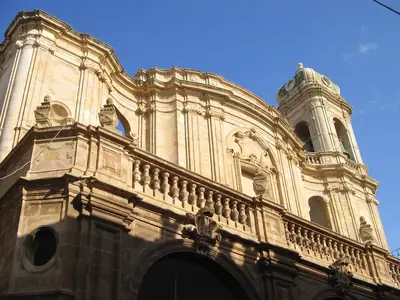
Trapani Cathedral stands on Corso Vittorio Emanuele in the historic centre and is the city’s main church and seat of the Diocese of Trapani. Formally dedicated to Saint Lawrence the Martyr, it holds the status of a minor basilica.
The cathedral was built in the seventeenth century over earlier churches and received its distinctive early Baroque appearance during an eighteenth-century transformation. The façade and several interior interventions were designed by Giovanni Biagio Amico. It became a cathedral in 1844, when the Diocese of Trapani was established.
Immacolata Concezione and the former Jesuit complex
The Baroque church of the Immacolata Concezione was the church of Trapani’s Jesuit college. It forms part of a wider religious and educational complex: the former college stands beside the church, while the old Jesuit convent is on Via Roma.
Next to the church is Palazzo Riccio di San Gioacchino. The historic building now houses Liceo Scientifico Vincenzo Fardella, a secondary school that continues to use the old premises.
Palazzo D’Alì
In Piazza Vittorio Veneto, Palazzo D’Alì is one of Trapani’s central historic buildings. The D’Alì family commissioned the palace, whose construction lasted from 1876 to 1904.
The long building period reflects the scale of the project and the family’s ambition to create a substantial urban residence in the heart of the city.
Palazzo della Giudecca
Palazzo della Giudecca is an ancient noble palace in central Trapani. Its name preserves a connection with the city’s past, while the building itself offers a glimpse of Trapani’s aristocratic architectural heritage.
It fits naturally into a walk through the old streets, where churches and palaces appear close together.
Chiesa della Badìa Nuova
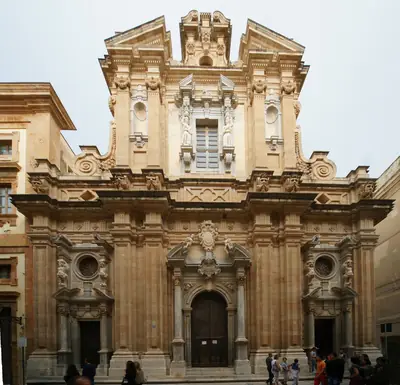
On Via Garibaldi, the Chiesa della Badìa Nuova is a Baroque church also known locally as Badia Nuova. Its formal name is the Church of Maria Santissima del Soccorso, dedicated to Our Lady of Help.
The church is one of the notable religious landmarks along this historic street and an important stop when exploring Trapani’s Baroque architecture.
Chiesa delle Anime del Purgatorio
The Church of the Souls of Purgatory stands in Piazzetta Purgatorio, along Via San Francesco d’Assisi. It has a particularly important place in Trapani’s religious traditions because it houses the twenty sculptural groups used in the famous Processione dei Misteri during Holy Week.
Even outside the procession, the church helps explain the role of religious confraternities, sculpture, and public devotion in the city’s cultural life.
Maria Santissima Addolorata
The Church of Maria Santissima Addolorata is dedicated to Our Lady of Sorrows. It is one of Trapani’s notable places of worship and forms part of the city’s rich religious heritage.
Its quieter atmosphere provides a contrast with the larger churches and busier streets of the historic centre.
Church of Santa Maria di Gesù
Just outside the old city walls on what is now Via Sant’Elisabetta, the Church of Santa Maria di Gesù was part of a church and convent complex entrusted to the Observant Friars Minor.
The Franciscan connection gives the site a distinctive place in Trapani’s religious history. The complex reflects the simpler and more austere tradition associated with this branch of the Franciscan order.
Castello di Terra
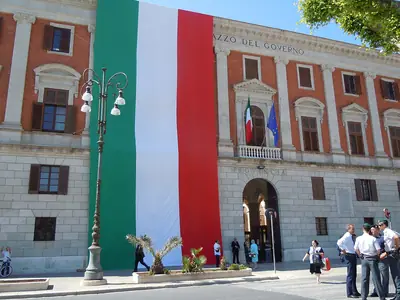
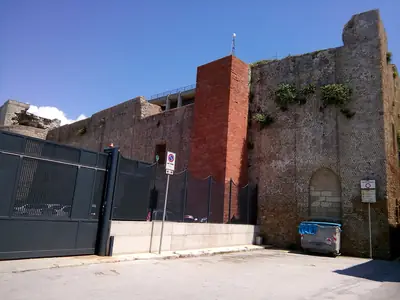
The remains of Castello di Terra can be found beside the seafront promenade named after Dante Alighieri. This medieval fortress once formed the main landward defence of Trapani, protecting the harbour and the urban centre as part of the city’s sixteenth-century bastioned system.
Only sections of the seaward defensive walls survive. Modern administrative buildings, including the Questura of Trapani, occupy much of the former fortress grounds. Castello di Terra is also one of the five towers represented on Trapani’s coat of arms, alongside Torre di Ligny, Torre Colombaia, Torre Nubia, and the demolished Torre Pali.
Colombaia Castle
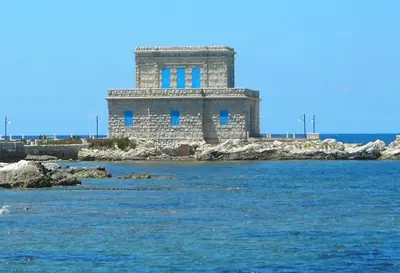
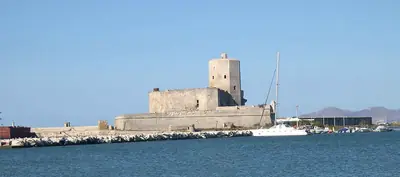
At the western end of the harbour, on a small islet, Colombaia Castle is one of Trapani’s most striking landmarks. It is also known as Torre Peliade or Castello di mare.
The fortress has very ancient origins. According to the historian Diodorus Siculus, the first military construction on the site was attributed to Hamilcar Barca around 260 BC, during the First Punic War. The present tower is 32 metres tall and consists of four overlapping floors. Its ground floor originally served as a cistern, while the main entrance was on the second floor.
The castle is considered one of Sicily’s finest examples of military architecture, and its isolated position gives the harbour a memorable focal point.
Casina Nasi
Casina Nasi, also called Villino Nasi, is a small historic villa with an Art Nouveau character. Its elegant architecture stands apart from Trapani’s many Baroque buildings and adds another period to the city’s architectural story.
It is one of the stops that makes a wider walk through Trapani worthwhile, beyond the central concentration of churches and palaces.
Casa del Mutilato and Palazzo Lucatelli
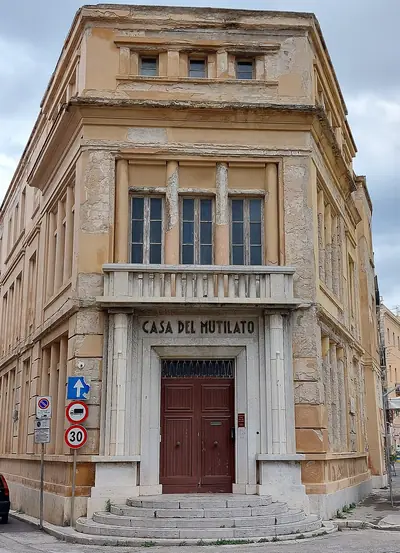
Casa del Mutilato is a notable historic building in Trapani, while Palazzo Lucatelli is another of the city’s landmarks. Both can be included in a broader exploration of Trapani’s urban architecture, alongside the better-known churches, castles, and noble residences.
Museum of Optical Illusions Trapani
For something different, the Museum of Optical Illusions Trapani occupies a place in the historic centre dedicated to optical, perceptual, and spatial illusions. Its rooms are designed to challenge the way visitors interpret what they see, turning ordinary spaces into visual and mental puzzles.
It offers a change of pace from the city’s historical monuments while remaining within the old centre.
Exploring Trapani with a self-guided tour
A Trapani self-guided walking tour lets you connect the city’s main sights without following a group. Neywo has two walking tours and one bus route in Trapani:
- Baroque Trapani: From the Land Castle to the Cathedral covers 1.81 km in 71 minutes, with 9 narrated stops.
- The Mysteries and the Sea Castle covers 3.05 km in 84 minutes, with 8 narrated stops.
- Line 10: Trapani’s Free Ride Through the Old Town covers 3.7 km in 16 minutes, with 6 narrated stops.
The two walks bring together places such as Castello di Terra, Palazzo D’Alì, Palazzo della Giudecca, the Chiesa delle Anime del Purgatorio, Casa del Mutilato, Casina Nasi, and Colombaia Castle. The bus route links several central stops, including Trapani Cathedral, Chiesa della Badìa Nuova, and Castello di Terra.
Trapani is part of Sicily, a region with a rich variety of historic cities and landscapes. It can also be placed within a wider journey through Italy, with Palermo offering another major Sicilian city experience.
Download Neywo and explore Trapani at your own pace
Download Neywo’s free audio guide for Trapani and discover 23 narrated places through two walking tours and one bus route. The app tells the story of each place as you reach it, at your own pace, with no group and no schedule. Narration is available in 11 languages, making it an easy way to explore Trapani independently.
Places with an audio guide in Trapani
8 places in Trapani with a Neywo audio guide. Each one starts telling its story as you reach it.
Self-guided tours in Trapani
3 tours in Trapani, free in the Neywo app. Each stop tells its story as you reach it.
- Bus ride
Line 10: Trapani's Free Ride Through the Old Town
ATM line 10 runs between Terminal City and the historic centre, along the Corso past the cathedral and on to the seafront. Ride it from San Pietro to the Castello di Terra and pass the baroque churches that make Trapani famous, without climbing a single street.
San Pietro Apostolo · Maria Santissima Addolorata · Trapani Cathedral · Chiesa della Badìa Nuova · Santa Maria dell'Itria · Castello di Terra
Open this tour: Line 10: Trapani's Free Ride Through the Old Town - Walk
Baroque Trapani: From the Land Castle to the Cathedral
Cross the old town of Trapani from the seafront ruins of the Castello di Terra, one of the five towers on the city's coat of arms, to the baroque cathedral on Corso Vittorio Emanuele. On the way you pass the grand Palazzo D'Alì, the old Giudecca quarter, the five-nave basilica of San Pietro and a Jesuit church beside a school palace.
Castello di Terra · Palazzo D'Alì · Santa Maria dell'Itria · Saint Dominic · Palazzo della Giudecca · San Pietro Apostolo …
Open this tour: Baroque Trapani: From the Land Castle to the Cathedral - Walk
The Mysteries and the Sea Castle
Head west along the narrow peninsula of Trapani to where the Processione dei Misteri begins its story: the church that keeps twenty sculptural groups, Franciscan and Sorrowful Virgin churches, then the sea walls and an Art Nouveau villa between two towers. The walk ends at the Colombaia, the sea fortress that Diodorus links to Hamilcar Barca.
Palazzo Lucatelli · Chiesa delle Anime del Purgatorio · San Francesco d'Assisi · Maria Santissima Addolorata · Casa del Mutilato · San Liberale …
Open this tour: The Mysteries and the Sea Castle
Walk Trapani with Neywo
Neywo turns Trapani into a self-guided audio tour. Stories arrive as you reach the place they belong to, and the route reshapes when you wander off it.

