Visiting Tarnów, Poland: Top Sights on Foot
Things to do in Tarnów: what to see in Poland’s historic city
Looking for things to do in Tarnów? This city in Lesser Poland combines Gothic churches, Jewish heritage, museums, parks and castle ruins in a compact setting. Its historic centre is especially rewarding on foot, with important landmarks gathered around the Market Square and Cathedral Square. Neywo also has a free audio guide for Tarnów, with 39 narrated places in 11 languages.
What to see in Tarnów
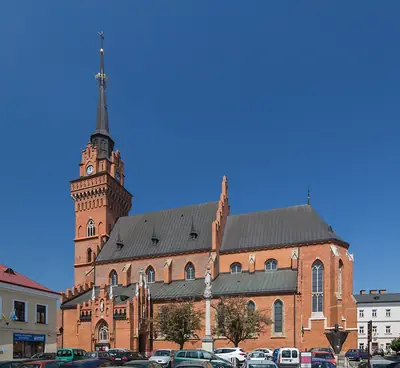
Cathedral Basilica of the Nativity of the Blessed Virgin Mary
The Cathedral Basilica stands on Cathedral Square, immediately beside the Market Square in Tarnów’s Old Town. The square was laid out when the city was founded on March 7, 1330, and construction of the Gothic cathedral began at the same time.
The building has been rebuilt and enlarged over the centuries, which explains its combination of Gothic and Neo-Gothic elements. Its three naves, elongated chancel and 72-metre western tower form one of Tarnów’s defining landmarks. Inside, the chancel contains monumental tomb monuments belonging to the Tarnowski and Ostrogski families. The church has been dedicated to the Nativity of the Virgin Mary since 1783 and received the title of Basilica in 1972. Pope John Paul II visited in 1987.
Academiola and the Tarnów Diocesan Museum
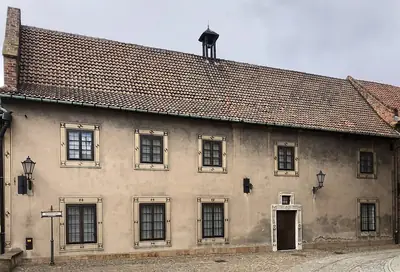
At 5 Cathedral Square, the Tarnów Diocesan Museum occupies a historic building known as the Academiola, Scholasteria or chapter house. The museum was founded on October 25, 1888, by Father Józef Bąba, making it the oldest diocesan museum in Poland.
The building probably developed by joining two older structures: a parish school and an infirmary for collegiate vicars, both dating from around the mid-16th century. Over time, it also housed educational institutions and served as the residence of several church and school officials.
The Church of the Assumption on Burek
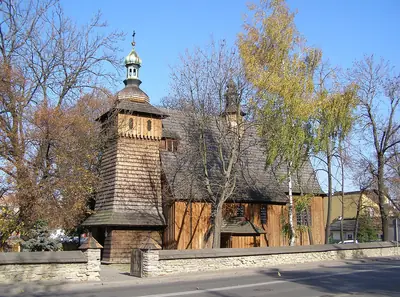
The Church of the Assumption of the Blessed Virgin Mary is popularly called the church on Burku, after the nearby marketplace. Located above the Wątok stream at the junction of Narutowicza and Najświętszej Panny Marii streets, it is one of Poland’s notable wooden Gothic churches.
The church dates back to 1458 and was consecrated in 1462. Its entirely wooden, log-built structure has a steep shingle roof, a narrower chancel ending in a polygonal apse and a post-frame western tower topped by a bulbous dome. A Baroque weathervane from 1653 stands at the top of the roof. The church was damaged by fire in the early 17th century and rebuilt in 1640.
The Bernardine monastery complex
On Bernardyńska Street, the Church of the Exaltation of the Holy Cross forms part of a historic Bernardine monastery complex. The Baroque church was built between 1752 and 1776 for Bernardine nuns, replacing an earlier wooden temple. Its founders were Barbara and Paweł Sanguszko.
The convent was dissolved in 1781 following a decree by Emperor Joseph II. Bernardine monks later moved in from the nearby monastery at the Church of Our Lady of the Snows, and the church was reconsecrated in 1828. Its single nave, narrower rectangular presbytery and octagonal western tower give the building a distinctive silhouette.
The Old Synagogue bima
Tarnów’s Old Synagogue once stood between Piekarska and Żydowska streets, close to the old city wall. It was destroyed during the Second World War, but one important element survived: the bima, the raised platform from which the Torah was read.
This lone surviving structure is a quiet reminder of Tarnów’s former Jewish community. It is one of the city’s most significant places of memory and an essential stop for anyone exploring Tarnów’s Jewish heritage.
The Jewish cemetery
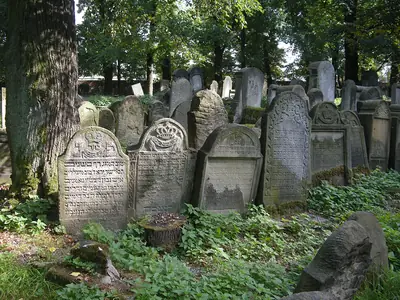
The Jewish cemetery on Szpitalna Street is one of the oldest Jewish cemeteries in Poland. It preserves the memory of Tarnów’s once-thriving Jewish community and offers a more expansive setting for understanding the city’s Jewish history.
Together with the Old Synagogue bima, the cemetery reveals a part of Tarnów’s past that is no longer visible in the city’s buildings but remains central to its identity.
Strzelecki Park and the General Joseph Bem Mausoleum
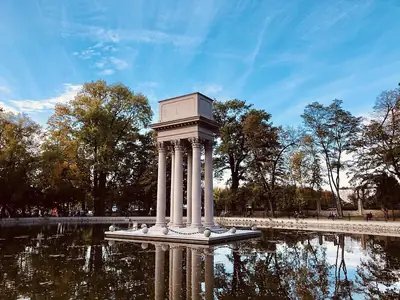
Strzelecki Park is a green space with old-growth trees officially recognized as a natural monument. A nature and educational trail runs through the park, with information stops about plant species found there.
The park is also home to the General Joseph Bem Mausoleum, the final resting place of one of Poland’s celebrated military figures. During the communist era, the park was known as the First of May Park; it is also still known by some locals as Ogród Strzelecki.
Tarnów Castle
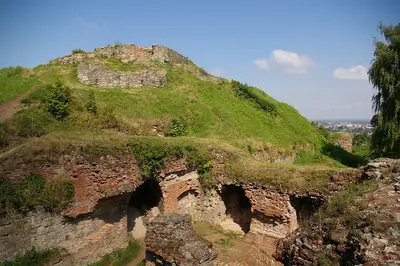
The remains of Tarnów Castle sit on Saint Martin’s Hill above the city. Today, the site is a quiet ruin, but it was once a medieval stronghold. Its elevated position allowed those inside to observe the surrounding landscape, including the river valley and roads leading towards the city.
The hill offers a different perspective on Tarnów’s history: instead of exploring the urban centre, visitors can see how the city’s defensive position related to the landscape around it.
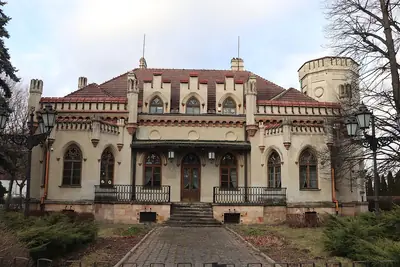
Nalepówka Villa
Nalepówka Villa is a Neo-Gothic building in Tarnów’s Gumniska district, at Gumniskiej Street 30. It is also known as Goldmanówka Villa or the Wedding Palace. The building now houses the Tarnów Centre for Dialogue.
More places beyond the old town
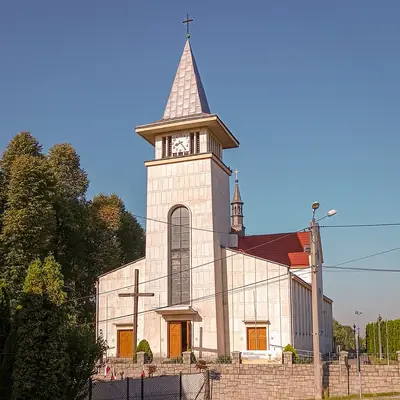
Several other stops show the range of Tarnów’s architecture and history. The Holy Cross and Our Lady of Perpetual Help church in the Krzyż district was built between 1968 and 1971 and consecrated on June 29, 1975.
The Academic Church of Saint Joseph was built around 1948 to a design by Edward Okoniew and consecrated on December 19 of that year by Bishop Jan Stepa. Its unusual north-south alignment means it does not follow the traditional liturgical orientation.
The Church of Blessed Karolina Kózka is a modern parish church whose construction began in 1983. Pope John Paul II celebrated Mass on its foundations on June 10, 1987, during the ceremony at which he beatified Karolina Kózka.
In Zbylitowska Góra, now part of Tarnów, the Society of the Sacred Heart convent was founded in 1901. It also housed a school and a boarding school for girls.
In Mościce, between Chemiczna Street and the Tarnów Mościce railway station, Wilhelm Sasnal’s A monument to something that never happened invites visitors to reflect on its ambiguous title and the date March 28, 1983.
Explore Tarnów with a self-guided walking tour
A Tarnów self-guided walking tour is a practical way to connect the city’s main historic sites without joining a group. Neywo offers two walking tours:
- Tarnów Old Town: Wooden Gothic, a Cathedral and a Lone Bima — 1.86 km, around 90 minutes and 10 narrated stops. The route includes the Church of the Assumption, the Bernardine monastery complex, the Old Synagogue bima, the cathedral and the Diocesan Museum.
- Park, General and Cemeteries of Memory — 2.27 km, around 73 minutes and 7 narrated stops. It connects Strzelecki Park, the General Joseph Bem Mausoleum, the Jewish cemetery and two World War I cemeteries.
The app tells the story of each place as you reach it, at your own pace. There is no group and no schedule, so you can pause, look around and continue when you are ready.
Download Neywo and explore Tarnów at your own pace
Download Neywo for a free audio guide to Tarnów with 39 narrated places, 2 walking tours, and narration available in 11 languages. Choose a route, start walking and let the app tell the story of each landmark as you arrive. It is a simple way to explore Tarnów independently, with no group and no fixed schedule.
If you are planning a wider trip through Poland, Tarnów can also fit naturally into an itinerary through southern Poland, alongside Kraków, Oświęcim or Zakopane.
Places with an audio guide in Tarnów
8 places in Tarnów with a Neywo audio guide. Each one starts telling its story as you reach it.
Self-guided tours in Tarnów
2 tours in Tarnów, free in the Neywo app. Each stop tells its story as you reach it.
- Walk
Tarnów Old Town: Wooden Gothic, a Cathedral and a Lone Bima
A compact loop through the medieval town founded in 1330. You start at a 15th-century wooden church above a stream, pass Baroque monasteries, then stand at the Jewish quarter's memorial sites before ending at the cathedral square and its Mickiewicz bust that was once passed off as Bach.
Pomnik Ofiar Wojny i Faszyzmu · Church of the Assumption in Tarnów · Bernardine monastery complex · Our Lady of the Snow church in Tarnów · Memorial to Auschwitz Prisoners in Tarnów · Old Synagogue in Tarnów …
Open this tour: Tarnów Old Town: Wooden Gothic, a Cathedral and a Lone Bima - Walk
Park, General and Cemeteries of Memory
A quieter walk north of the centre: a gallery, the old-growth Strzelecki Park with General Bem's mausoleum, then the old Jewish cemetery and two First World War war cemeteries where soldiers of three armies lie.
BWA w Tarnowie · Strzelecki Park in Tarnow, Poland · General Joseph Bem Mausoleum · Saint Joseph and Our Lady of Fatima church in Tarnów · World War I Cemetery nr 201 in Tarnów · Jewish cemetery in Tarnów …
Open this tour: Park, General and Cemeteries of Memory
Walk Tarnów with Neywo
Neywo turns Tarnów into a self-guided audio tour. Stories arrive as you reach the place they belong to, and the route reshapes when you wander off it.

