Things to Do in Oświęcim, Poland: Walking Guide
Things to do in Oświęcim: what to see beyond Auschwitz
The most important things to do in Oświęcim include visiting the Auschwitz-Birkenau State Museum, exploring the town’s medieval centre, and learning about the Jewish community that once shaped local life. Oświęcim is a place where difficult memory, older layers of history, religious heritage, and the Soła River come together. Neywo offers a free audio guide for Oświęcim with 15 narrated places, available in 11 languages.
What to see in Oświęcim
Auschwitz-Birkenau State Museum
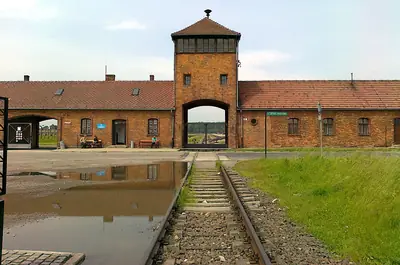
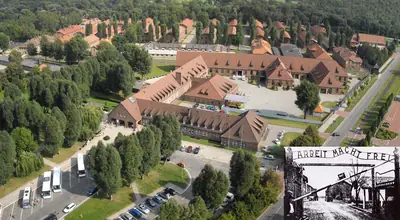
The Auschwitz-Birkenau State Museum is a museum and memorial preserved on the site of the former German Nazi concentration and extermination camps. Its two principal parts are Auschwitz I, also known as the Stammlager, and Auschwitz II, Birkenau.
Together, they preserve more than 150 buildings, around 300 ruins, original roads, the unloading ramp, and sections of the former fencing. The site commemorates approximately 1.1 million people who died there, including around 960,000 Jews. The museum was established in 1947 through the efforts of former prisoners, and the preserved site became a World Heritage Site in 1979.
This is a place for remembrance, research, and quiet reflection. The buildings and remains are historical evidence, but they are also part of a memorial dedicated to the people murdered during the Holocaust and the Second World War.
Auschwitz I and Block 10
Auschwitz I was the first and administrative centre of the Auschwitz camp system. It began operating in 1940, initially as a concentration camp for political prisoners and opponents of the German occupation, most of them Poles. Its gate, marked with the words “Work Sets You Free”, has become one of the most recognisable symbols of the Holocaust.
The camp later became part of a much larger system that included Auschwitz II, known as Birkenau, Auschwitz III, known as Monowitz, and dozens of subcamps. Most people were deported to Auschwitz by train from across occupied Europe, and about ninety percent of those sent there were Jews.
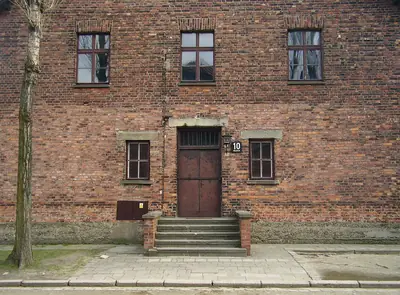
Block 10, a brick building within Auschwitz I, was used for Nazi medical experiments on prisoners. From 1943, prisoners were subjected to procedures including exposure to chemicals, attempted sterilisation, and lethal injections of phenol into the heart. Nearby, Block 11 was known as the prison inside the camp and the Block of Death. It was used for torture, punishment, and executions. Between the two buildings stood the Black Wall, also called the Death Wall.
Auschwitz III Monowitz
Monowitz, also known as Auschwitz III or Monowitz-Buna, was one of the three main camps in the Auschwitz system. Unlike Auschwitz II, which operated as an extermination camp, Monowitz was established as a concentration and forced-labour camp serving nearby industry.
The camp was built near Monowice, beside the Buna Works site. From November 1943, it was administered as Auschwitz III together with other nearby subcamps. In November 1944, it was renamed Monowitz concentration camp and gained a degree of administrative independence.
Work there was deadly. The life expectancy of Jewish workers at the Buna Works was estimated at three to four months, and for those assigned to the surrounding mines, about one month.
Oświęcim Castle
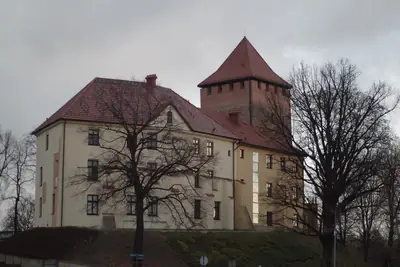
Oświęcim Castle stands on a hill above the Soła River, on the river’s right bank. Its oldest prominent feature is an early Gothic defensive tower built at the end of the thirteenth century. The castle also includes a two-storey, partly underground building on a rectangular plan. Its older wing dates from the beginning of the sixteenth century, while the connecting section was added between 1929 and 1931.
The castle was a royal castle within the Silesian district of the Kraków Voivodeship during the second half of the sixteenth century. Remnants of defensive walls and bastions remain visible on the hill, although much of the former fortifications disappeared as the Soła changed its course.
Two tunnels run beneath the hill. The older was built before 1914, while the second was excavated by the Germans between 1940 and 1944 and served as an air-raid shelter.
Oświęcim’s Market Square and Ratusz
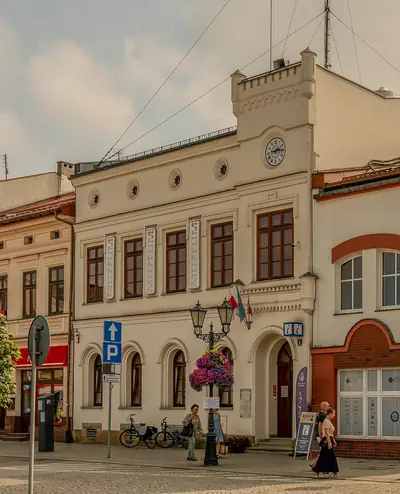
Oświęcim’s Main Market Square is home to the town hall, or Ratusz. Its brick façade and clock tower give it a distinctive presence in the square. The building was constructed between 1872 and 1875 and is a two-level Neo-Gothic structure with a basement. Its clock is one of the most noticeable details on the tower.
Church of the Assumption of the Virgin Mary
North of the market square, the Church of the Assumption of the Virgin Mary brings together several layers of Oświęcim’s history. It is first mentioned in records from 1325 to 1327, although its exact foundation date is unknown. The building has been rebuilt many times, including a reconstruction in the third quarter of the seventeenth century.
The square tower reached its final form between 1863 and 1877, while its lower section dates from the end of the sixteenth century. The church has a three-aisled hall, a rectangular chancel, buttresses, barrel vaults with lunettes, and broad arcades opening onto the side aisles.
Jan Skarbek Square and the Auschwitz Jewish Center
Jan Skarbek Square is part of Oświęcim’s Old Town, where Kościelna Street and Berka Joselewicza Street meet. Formerly known as Kościelny Square, it was renamed in 1992 in honour of the priest Jan Skarbek.
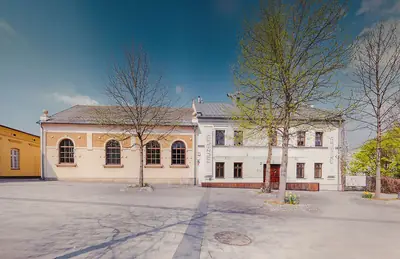
The square is also home to the Auschwitz Jewish Center, which remembers Oświęcim’s Jewish community and presents its history. The centre includes a Jewish museum and the city’s only preserved synagogue: the Chevra Lomdei Mishnayot Synagogue, also known as the Auschwitz Synagogue.
Completed in 1918, the synagogue is an Orthodox Jewish place of worship and a bet midrash, or house of study. Before Oświęcim became associated with the Holocaust, Jewish residents worked, studied, prayed, raised families, and built community life in the town. The museum and synagogue preserve the memory of that life and the community destroyed during the Holocaust.
Great Synagogue in Oświęcim
The Great Synagogue was once the largest synagogue in Oświęcim. Designed by the architect Carl Korn, it was completed in 1873 and served as an Orthodox Jewish house of prayer until the Second World War.
In November 1939, shortly after the German occupation of Poland, the synagogue was set on fire and destroyed by the Nazis. Its former location on what is now Berka Joselewicza Street is a reminder of the Jewish history that once formed an essential part of Oświęcim.
Churches in Oświęcim
Several historic churches add further depth to the town’s story. The Church of Our Lady Help of Christians was built in the first half of the fourteenth century for Dominican friars, probably brought to Oświęcim by Mieszko, Duke of Cieszyn. Construction of the monastery was continued by Władysław, Duke of Oświęcim, and his wife, Eufrozyna.
In Kościuszko Square, the Church of Our Lady of Sorrows forms part of the convent complex of the Seraphic Sisters. Completed in 1899, it is a Neo-Gothic brick church with a single nave, entrance porch, polygonal apse, and ribbed vault. The Seraphic Sisters moved from Kraków to Oświęcim in 1895 under the leadership of Mother Małgorzata Szewczyk.
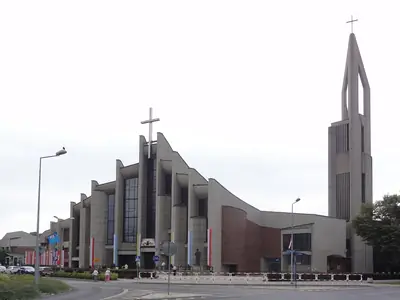
The Church of St. Maximilian Kolbe is another place of worship in Oświęcim and offers a quiet point of interest while exploring the city.
Kaplica Hallerów
The Haller Chapel stands in the former manor park at Dwory. It was built as a mausoleum for the Haller family, who owned the estate. The small building has a circular plan, a hemispherical dome, and eight Ionic pilasters dividing its exterior walls.
The entrance is on the western side, reached by five steps and closed by an iron Classical-style grille. The chapel is also the burial place of several members of the Haller family, including Cezary Haller, who was killed in a battle near Kończyce Małe in 1919.
The Soła River
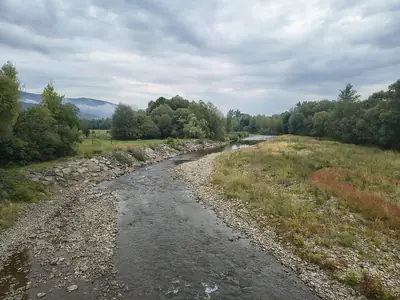
The Soła links the Beskides with Oświęcim. It begins in the Western Beskids, flows for about eighty-nine kilometres, and eventually joins the Vistula.
Near Oświęcim, the river forms part of a landscape marked by both nature and memory. It flows only a short distance from the Auschwitz concentration camp, and the Auschwitz-Birkenau State Museum reports that human ashes and ground human bones from those murdered there were often thrown into the Soła. The river therefore has a deeply solemn place in the history and memory of Oświęcim.
Explore Oświęcim with a self-guided walking tour
Neywo’s Oświęcim audio guide includes one walking tour: Oświęcim Before and Beyond Auschwitz: Castle, Churches and Jewish Memory. The route covers 2.75 km, takes 87 minutes, and includes nine narrated stops.
It leads through the town’s historic centre, with stops at Ratusz, the Church of the Assumption of the Virgin Mary, Jan Skarbek Square, the Auschwitz Jewish Center, the Great Synagogue, Oświęcim Castle, Our Lady Help of Christians church, the Church of Our Lady of Sorrows, and the Church of St. Maximilian Kolbe.
Download Neywo and explore Oświęcim at your own pace. The app tells the story of each place as you reach it, with no group and no schedule. It is a free audio guide for discovering Oświęcim independently, and it also makes it easy to continue exploring Lesser Poland, Poland, or nearby cities such as Kraków, Tarnów, and Zakopane.
Places with an audio guide in Oświęcim
8 places in Oświęcim with a Neywo audio guide. Each one starts telling its story as you reach it.
Self-guided tours in Oświęcim
1 tour in Oświęcim, free in the Neywo app. Each stop tells its story as you reach it.
- Walk
Oświęcim Before and Beyond Auschwitz: Castle, Churches and Jewish Memory
Oświęcim was a Piast duchy town centuries before its name became known worldwide. Walk from the neo-Gothic town hall on the market square through the churches of the old town to the castle on the Soła bluff, and visit the places that keep alive the memory of its Jewish community, who made up more than half of the town's residents before the war.
Ratusz · Church of the Assumption of the Virgin Mary in Oświęcim · Jan Skarbek Square in Oświęcim · Auschwitz Jewish Center · Great Synagogue in Oświęcim · Oświęcim Castle …
Open this tour: Oświęcim Before and Beyond Auschwitz: Castle, Churches and Jewish Memory
Walk Oświęcim with Neywo
Neywo turns Oświęcim into a self-guided audio tour. Stories arrive as you reach the place they belong to, and the route reshapes when you wander off it.

