Visiting Jelenia Góra, Poland: Top Sights on Foot
Things to do in Jelenia Góra: what to see in the historic city and its surroundings
Jelenia Góra is a city in Lower Silesia with Gothic churches, Baroque civic landmarks, spa architecture and historic districts stretching towards the Karkonosze Mountains. The city is worth visiting for its layered history and for attractions such as Chojnik Castle, Cieplice Śląskie-Zdrój and the old town. Neywo has a free audio guide for Jelenia Góra with 29 narrated places.
What to see in Jelenia Góra
Jelenia Góra Town Hall and the old town
Jelenia Góra Town Hall is one of the city’s central civic landmarks. This Baroque-classical building was built in 1749 and reconstructed in 1924; it still serves as the seat of local government and administration.
A historic Type N tram is also associated with the stop. Tram services in Jelenia Góra ran from 10 April 1897 to 28 April 1969. The final section connected the city with Cieplice Śląskie-Zdrój, formerly known as Bad Warmbrunn.
Church of Saints Erasmus and Pancratius
The Church of Saints Erasmus and Pancratius is the oldest and most significant church in Jelenia Góra. Its three-aisled Gothic basilica has pointed door and window frames, ribbed vaulting and substantial external buttresses.
The church was first mentioned in 1303 after a fire and was rebuilt during the fourteenth century. Further changes followed in the fifteenth and sixteenth centuries. The basilica is 56 metres long, while its central nave reaches 24 metres in height. A 52-metre Renaissance tower rises above it. After a fire in 1549, the tower was rebuilt, and it received its Baroque roof in 1736.
Wojanowska Gate and Saint Anne Chapel
At the eastern edge of the old town stands the Baroque Wojanowska Gate, at the outlet of Konopnicka Street towards the road to Wojanów. Its rococo cartouches display the coats of arms of Jelenia Góra, Prussia and Silesia. A Latin inscription includes a chronostich giving the year 1763.
The present gate replaced a Gothic gate from the middle of the fourteenth century. That earlier structure was part of the medieval defensive walls and was demolished in 1755. The stop also includes Saint Anne Chapel, also known as the Church of Saint Anne.
Exaltation of the Holy Cross Church
The Exaltation of the Holy Cross Church stands in a park containing nineteen burial chapels belonging to Jelenia Góra’s patrician families. Originally Protestant and known as the Church of Grace beneath the Cross of Christ, it was taken over by the state after the Second World War and transferred to the Catholic Church. It is now a Roman Catholic church.
Karkonoskie Museum
The Karkonoskie Museum brings together archaeology, ethnography, history and art from the Karkonosze and Izera Mountains and the Jelenia Góra Valley. Its main building has stood at 28 Jana Matejki Street since 1914. Designed by Carl Grosser, it remains the museum’s principal headquarters.
Its artistic-glass department is particularly notable for its collection of Silesian glass dating from the fourteenth to the twentieth century. The museum was established in 1889 by the German Karkonosze Society. Its collections moved between several locations before the purpose-built museum opened in 1914.
Churches in Maciejowa and Sobieszów
The Church of Saints Peter and Paul in Maciejowa has fortified walls and a building history reaching back to a first mention in 1318. The present church was erected between 1646 and 1681 and rebuilt in the eighteenth century. Its Baroque furnishings include the high altar, side altars, pulpit, baptismal font and wooden sculptures.
Sobieszów has two churches with different historical settings. Saint Martin Church stands on a flattened section of a slope above the Wrzosówka stream, overlooking the centre of what was once the village of Sobieszów. The Sacred Heart Church began as a Protestant church and now serves as a parish church.
Things to do in Cieplice Śląskie-Zdrój
Schaffgotsch Palace
In the heart of Cieplice Śląskie-Zdrój, the Schaffgotsch Palace stands between Piastowski Square and the Spa Park. This early Neoclassical palace is accompanied by an extensive palace and spa park, combining formal architecture with the atmosphere of the historic resort district.
Spa Theatre
The Spa Theatre, also known as the Zdrojowy Teatr Animacji imienia Bogdana Nauki, is a cultural landmark in Cieplice Śląskie-Zdrój. Its location in the spa district makes it part of the area’s distinctive architectural and cultural character.
Salvator Church and the Church of St. John the Baptist
The Salvator Church is the parish church of the Evangelical-Augsburg community in Cieplice Śląskie-Zdrój. It is an Evangelical-Lutheran church in a district also known by its former German name, Bad Warmbrunn.
The Church of St. John the Baptist is connected with the former Provostship of Warmbrunn. Until secularization in 1810, it was a branch of Grüssau Monastery in the Duchy of Schweidnitz. Its local Polish name is Kościół pw. Świętego Jana Chrzciciela.
The palace at 2 Jagiellońska Street
The historic palace at 2 Jagiellońska Street is one of the places associated with the name Stoczniowiec. It was built in the 1730s: one reference dates it to 1734, while another places its construction around 1730 and probably attributes the plans to Caspar Jentsch, the town builder of Hirschberg.
Chojnik Castle and the Karkonosze setting
Chojnik Castle
The ruins of Chojnik Castle stand above Sobieszów on the summit of Chojnik Mountain, within the protected landscape of Karkonosze National Park. The mountain rises to 627 metres above sea level, while a 150-metre cliff drops on its south-eastern side into Piekielna Valley. Forest, caves and rock formations add to the dramatic setting.
The castle’s origins are associated with the twelfth century. In 1364, Duke Bolko II strengthened an earlier hunting lodge and transformed it into a castle. After his death without children, it passed to the Schaffgotsch family. Lightning caused the stronghold to burn completely in 1675, and it was never rebuilt. The open ruins preserve that unfinished form.
Although Chojnik Castle has inspired legends and myths, the castle itself was never the scene of military conflict. Later writers drew on these stories, adding an imaginative dimension to the site.
More places to visit
The Gerhart Hauptmann House in Jagniątków is both a museum and the former home of the German writer and Nobel laureate. The house was built in 1901 to a design by Hans Grisebach, an architect from Berlin.
Jelenia Góra also includes the former districts and historic communities that surround its centre. Together, their churches, palaces and cultural sites reveal the changing religious, political and cultural history of Lower Silesia.
Explore Jelenia Góra with Neywo
Neywo offers a Jelenia Góra self-guided walking tour experience through three walking tours and one bus route, covering 29 narrated places in total. The walks include:
- Hirschberg’s Old Town: Gates, Gothic Towers and Linen Money — 4.5 km, 114 minutes and 7 stops.
- Warmbrunn: Counts, Cistercians and a Spa Town — 1.51 km, 99 minutes and 10 stops.
- Sobieszów and the Ruins of Chojnik Castle — 2.13 km, 70 minutes and 4 stops.
The bus route is From Hirschberg Theatre to the Foot of the Giant Mountains: 11.9 km, 51 minutes and 4 stops.
The app tells the story of each place as you reach it, at your own pace, with no group and no schedule. Narration is available in 11 languages. Download Neywo and explore Jelenia Góra with a free audio guide that stays with you as you walk or ride. For more of the country’s destinations, continue exploring Poland.
Places with an audio guide in Jelenia Góra
8 places in Jelenia Góra with a Neywo audio guide. Each one starts telling its story as you reach it.
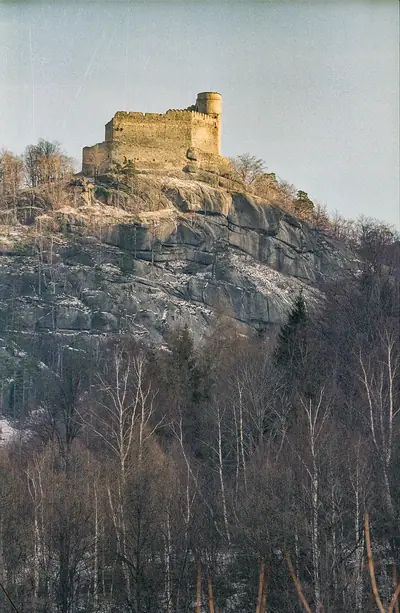 Chojnik Castle
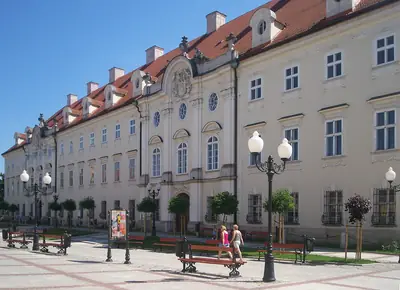 Schaffgotsch Palace in Cieplice Śląskie-Zdrój
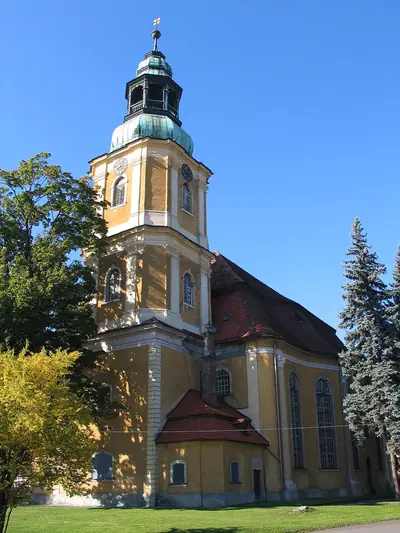 Salvator church in Cieplice Śląskie-Zdrój
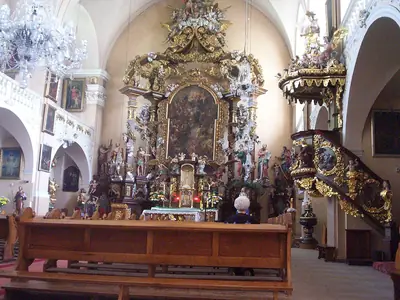 Church of St. John the Baptist in Cieplice Śląskie-Zdrój
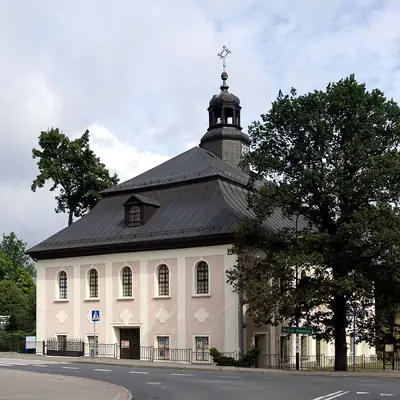 Sacred Heart church in Jelenia Góra
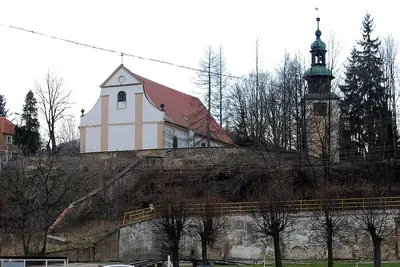 Saint Martin church in Jelenia Góra
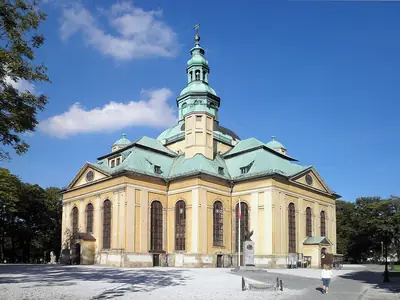 Exaltation of the Holy Cross church in Jelenia Góra
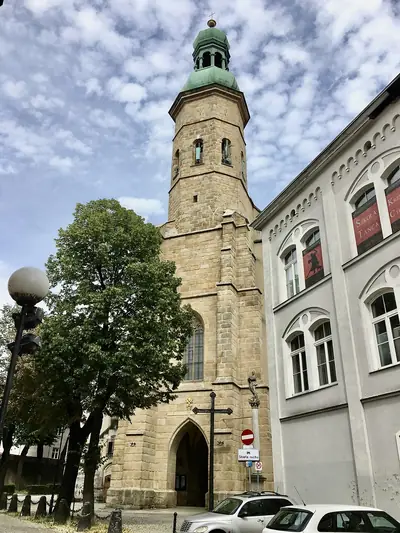 Church of Saints Erasmus and Pancratius in Jelenia Góra
Self-guided tours in Jelenia Góra
4 tours in Jelenia Góra, free in the Neywo app. Each stop tells its story as you reach it.
- Bus ride
Bus 9: From Hirschberg Theatre to the Foot of the Giant Mountains
Ride the city's MZK bus 9 from the Norwid Theatre in the old town out through Cieplice, the spa district, to Sobieszów at the foot of Chojnik. A cheap way to see three districts of Jelenia Góra in one ride.
Cyprian Kamil Norwid Theatre · Polish Catholic church in Jelenia Góra · Former Cistercian monastery in Cieplice · Sacred Heart church in Jelenia Góra
Open this tour: Bus 9: From Hirschberg Theatre to the Foot of the Giant Mountains - Walk
Hirschberg's Old Town: Gates, Gothic Towers and Linen Money
Walk the old merchant town of Jelenia Góra, once Hirschberg, from its baroque town hall to the Gothic tower of Saints Erasmus and Pancratius. See the 1763 Wojanowska Gate, the theatre built in 1904 and the glass museum. End among the patrician burial chapels paid for by the linen trade.
Jelenia Góra Town Hall · Church of Saints Erasmus and Pancratius in Jelenia Góra · Karkonoskie Museum in Jelenia Góra · Cyprian Kamil Norwid Theatre · Saint Anne chapel in Jelenia Góra · Exaltation of the Holy Cross church in Jelenia Góra …
Open this tour: Hirschberg's Old Town: Gates, Gothic Towers and Linen Money - Walk
Warmbrunn: Counts, Cistercians and a Spa Town
Stroll through Cieplice, the spa district once called Bad Warmbrunn. Pass the Schaffgotsch palace and its park, the 1537 Long House of the Cistercian provostry and the churches of a town that grew around hot springs. A calm, flat walk through Silesian spa history.
Spa park in Cieplice Śląskie-Zdrój · Spa Theatre of Cieplice Śląskie Zdrój · Edward Pavilion in Cieplice · Schaffgotsch Palace in Cieplice Śląskie-Zdrój · Salvator church in Cieplice Śląskie-Zdrój · Stoczniowiec …
Open this tour: Warmbrunn: Counts, Cistercians and a Spa Town - Walk
Sobieszów and the Ruins of Chojnik Castle
Start in the village of Sobieszów with its churches and the Schaffgotsch estate buildings, now the Karkonosze National Park headquarters. Then climb Chojnik Mountain to the castle ruins, burned by lightning in 1675 and never rebuilt, with a 150-metre cliff beside it.
Sacred Heart church in Jelenia Góra · Buildings of former Schaffgotsch estate administration in Jelenia Góra - Sobieszów · Saint Martin church in Jelenia Góra · Chojnik Castle
Open this tour: Sobieszów and the Ruins of Chojnik Castle
Walk Jelenia Góra with Neywo
Neywo turns Jelenia Góra into a self-guided audio tour. Stories arrive as you reach the place they belong to, and the route reshapes when you wander off it.

