Visiting Lublin, Poland: Top Sights on Foot
Things to do in Lublin: what to see in Poland’s historic eastern city
Looking for things to do in Lublin? The city combines a historic Old Town with centuries-old churches, castle buildings, Orthodox landmarks and places of remembrance. Its compact center is particularly rewarding to explore on foot, while Lublin’s wider history becomes clearer as you move between its hills, squares and former religious quarters. Neywo has a free audio guide for Lublin with 98 narrated places.
What to see in Lublin
Krakowska Gate and the Old Town
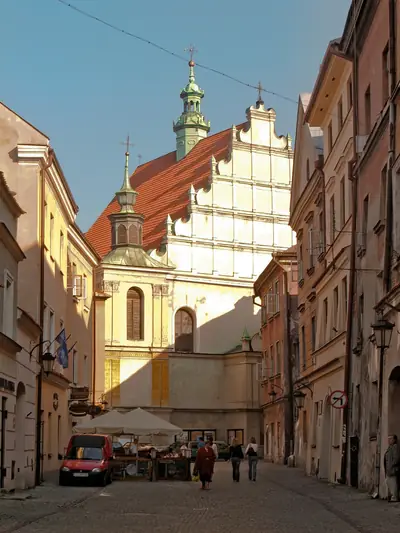
The Krakowska Gate is one of the essential starting points for exploring Lublin. It leads into the historic center, where narrow streets connect old tenement houses, towers and religious buildings. The Neywo route through the Old Town also includes the Gothic Tower, Lublin Rybna Gate, the Lublin Underground Route and Piwnica pod Fortuną.
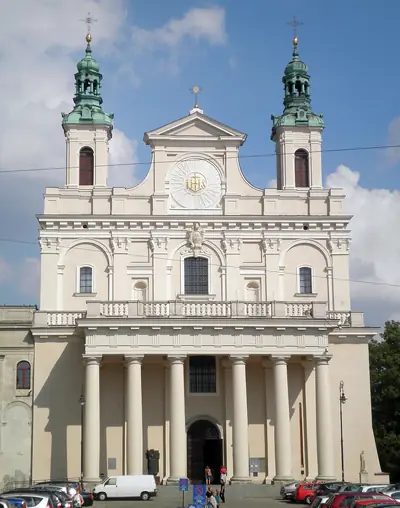
St. John the Baptist Cathedral
St. John the Baptist Cathedral, also known as Lublin Cathedral, is one of the largest churches in the city and an important example of Baroque architecture in the Lublin region. Built between 1592 and 1617 for the Society of Jesus, it was among the first Baroque churches in Poland. Its design was modelled on the Chiesa del Gesù in Rome, associated with Giovanni Maria Bernardoni.
Inside, the three-aisled basilica is particularly notable for its broad nave, which gives the church an unusually spacious character.
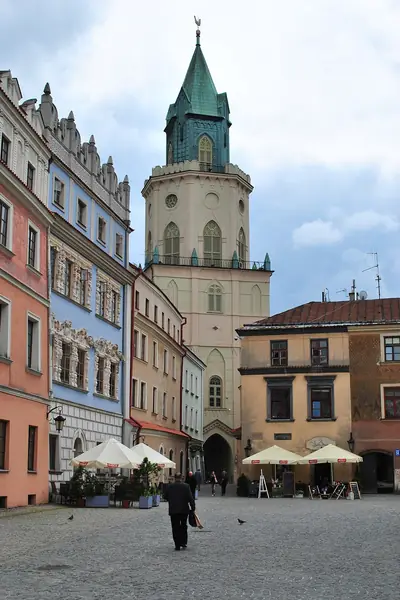
Trinitarian Tower and the Archdiocesan Museum
The Trinitarian Tower rises above Cathedral Square on Jezuicka Street. Its viewing platform is 40 metres above the ground, making it Lublin’s highest historic viewpoint. The tower takes its name from the Trinitarian Order, which once occupied the former Jesuit monastery buildings nearby.
The tower’s interior houses the Muzeum Archidiecezji Lubelskiej, or Archdiocesan Museum. Its collection of sacred art and religious objects offers a quieter way to understand the history of the Lublin diocese.
Basilica of the Dominican Friars
The Basilica of Saint Stanislaus, Bishop and Martyr is also known as the Dominican Church or the Basilica of the Relics of the Holy Cross. Together with its monastery, it forms one of Lublin’s longest-standing religious institutions. The church dates from the fourteenth century and was remodelled in the sixteenth century in the Renaissance style.
The monastery adjoins the church on its southern side, creating a large architectural ensemble rather than an isolated building. The complex celebrated its 750th anniversary in 2003, and the church has held the title of minor basilica since 1967.
Lublin Castle and Castle Hill
Castle Hill brings together several important parts of Lublin’s history. The National Museum in Lublin and the Chapel of the Holy Trinity are among the major places to see here, while the surrounding square provides a transition between the historic center and the castle complex.
The Castle Hill route also leads to the Cathedral of the Transfiguration and the Church of Saint Nicholas, revealing the different religious traditions that have shaped the city.
Cathedral of the Transfiguration
The Cathedral of the Transfiguration on Ruska Street is one of Lublin’s important Orthodox landmarks. It is the main church of the Diocese of Lublin and Chełm and the home of the local Transfiguration parish.
The present building was constructed between 1607 and 1633 on the site of two older churches. It was consecrated in 1633 by Petro Mohyla, Metropolitan of Kyiv. Inside, copies of the Jerusalem and Lublin Icons of the Mother of God receive particular reverence. The cathedral has been listed in Poland’s register of historic monuments since 1960 and 1967.
Church of Saint Nicholas
The Church of Saint Nicholas stands on Czwartek Hill, one of Lublin’s oldest parish sites. Settlement on the hill dates back to the sixth century, while the church’s history reaches the fifteenth century. Its dedication reflects the area’s commercial character: Saint Nicholas is the patron saint of merchants and traders.
The present building began in the late sixteenth century and was substantially rebuilt in the middle of the seventeenth century, when it gained the Renaissance appearance that defines its silhouette today.
Church of St. Josaphat
The Church of St. Josaphat on Green Street has belonged to several Christian communities. Greek merchants built it in 1786 with the consent of King Stanisław August Poniatowski. It was initially affiliated with the patriarch of Constantinople, later taken over by the Russian Orthodox Church during the second half of the nineteenth century, and transferred to the Roman Catholic Church in 1922.
The building has been listed as an architectural monument since 28 February 1967. Its changing affiliations are central to the church’s identity and reflect Lublin’s layered religious history.
Krakowskie Przedmieście and its churches
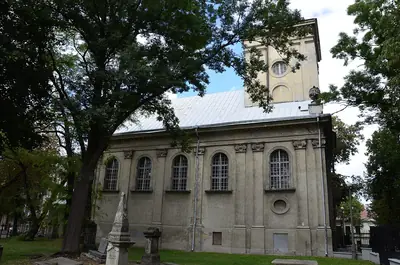
Krakowskie Przedmieście, the historic Krakow Suburb street, leads towards Lublin’s former gates and connects several notable buildings. The Church of the Holy Spirit once stood just outside the Holy Cross Gate, marking the medieval town’s boundary. It has been protected as an architectural monument since 1967.
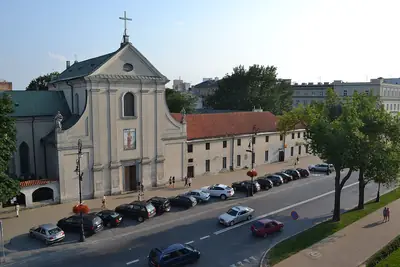
Across from Litewski Square, the Capuchin monastery complex was built between 1726 and 1733. Founded by Paweł Karol Sanguszko and Marianna Lubomirska, it was the fourth Capuchin foundation in Poland. The church and monastery were designed in the Tuscan Baroque style, and seven of the original nine altars have survived.
At 11 Królewska Street, St Peter the Apostle Church combines Renaissance and Baroque history. Built between 1636 and 1658, it was reconstructed after a fire in 1768 and received Neo-Baroque polychrome decoration in 1899.
Churches beyond the central route
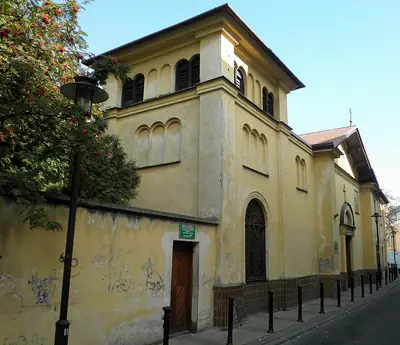
Lublin’s religious heritage extends beyond the principal Old Town walks. The Church of the Immaculate Conception, west of the Old Town, once belonged to the Discalced Carmelites and is now cared for by the Grey Sisters.
Northeast of the Old Town, the Church of Elijah the Prophet stands on a quiet hill on Meczysława Bernackiego Street. It is a rectoral church associated with Carmelite spirituality, and its church and monastery complex have been protected as architectural monuments since 1967.
The Post-missionary Church and Monastery on Prymasa Wyszyńskiego Street combines several periods of history. Its Baroque Church of the Transfiguration of Our Lord was built between 1717 and 1730 with a Greek-cross plan and a cupola above the transept. The northern wing includes a seventeenth-century palace with a carved stone frieze depicting figures from Polish history. A monumental Neo-Baroque monastery wing was added in 1908.
Majdanek State Museum
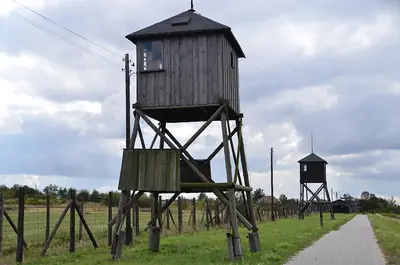
The former Lublin-Majdanek concentration and extermination camp lies beside the Majdan Tatarski district on the outskirts of Lublin. Built and run by the SS during the German occupation of Poland in the Second World War, it operated from October 1941 until July 1944.
The camp began as a forced-labour prisoner-of-war camp and was later renamed Konzentrationslager Lublin. It became part of Operation Reinhard, the German plan to murder all Polish Jews in occupied Poland. An estimated 78,000 people were killed there.
The memorial site preserves barracks, watchtowers, gas chambers and a crematorium. Visiting Majdanek is a serious and sombre experience, but it is essential for understanding Lublin’s wartime history.
Explore Lublin with a self-guided audio tour
A Lublin self-guided walking tour lets you explore the city without joining a group or following a fixed timetable. Neywo offers four walking tours, one bus route and one bike route in Lublin:
- Old Town: Gates, Towers and a Jesuit Cathedral — 0.82 km, 85 minutes and 12 narrated stops.
- Castle Hill: Frescoes, Union and Prison — 1.48 km, 65 minutes and 7 narrated stops.
- Jerusalem of Poland: Jewish Lublin — 1.65 km, 54 minutes and 6 narrated stops.
- Krakowskie Przedmieście and the Union of Lublin — 1.99 km, 100 minutes and 12 narrated stops.
- Line 23: From the Old Town to Majdanek — 5.1 km, 22 minutes and 7 narrated stops.
- Racławickie Avenue: From the Gestapo Prison to Contemporary Art — 1.9 km, 10 minutes and 4 narrated stops.
The app tells the story of each place as you reach it, at your own pace, with no group and no schedule. Neywo’s Lublin audio guide includes 98 narrated places, with narration available in 11 languages.
Download Neywo and explore Lublin at your own pace
Download Neywo to turn a walk through Lublin into a narrated journey through its churches, towers, castle, Jewish heritage and memorial sites. Choose a walking, bus or bike route, or use the 98 narrated places to build your own exploration of the city.
Lublin is one of many destinations to discover in Poland, alongside cities such as Warsaw, Rzeszów and Łódź.
Places with an audio guide in Lublin
8 places in Lublin with a Neywo audio guide. Each one starts telling its story as you reach it.
Self-guided tours in Lublin
6 tours in Lublin, free in the Neywo app. Each stop tells its story as you reach it.
- Bike ride
Racławickie Avenue: From the Gestapo Prison to Contemporary Art
A short ride on Lublin's cycle lanes west of the centre: from the museum in the former Gestapo prison to the statue of Marie Curie by the university that bears her name, past the garrison church and on to the Labyrinth Gallery of contemporary art.
Under the Clock · Marie Curie Monument in Lublin · Immaculate Conception church in Lublin · Labyrinth Gallery
Open this tour: Racławickie Avenue: From the Gestapo Prison to Contemporary Art - Bus ride
Line 23: From the Old Town to Majdanek
A city bus from Lublin's Jewish quarter on Lubartowska Street through the Kraków Gate and Cathedral Square to the Majdanek State Museum on the former camp grounds. It is the simplest way to reach Majdanek from the Old Town.
Chewra Nosim Synagogue in Lublin · St. Joseph's Church, Lublin · Lublin Krakowska Gate · St. John the Baptist Cathedral, Lublin · Marian Lutosławski Bridge in Lublin · Maximilian Kolbe Church in Lublin …
Open this tour: Line 23: From the Old Town to Majdanek - Walk
Lublin Old Town: Gates, Towers and a Jesuit Cathedral
Enter Lublin through the medieval Kraków Gate and follow the surviving walls to the Gothic Tower. Climb to the Trinitarian Tower's view over Cathedral Square, visit the early-Baroque cathedral, then wander the Market Square with its Mannerist, sgraffito and lion-gabled houses, the Rybna Gate, the painted cellar, the poet's museum on Złota Street and the Dominican basilica.
Lublin Krakowska Gate · Gothic Tower in Lublin · Trinitarian Tower in Lublin · St. John the Baptist Cathedral, Lublin · Konopnica tenement house in Lublin · Lublin Underground Route …
Open this tour: Lublin Old Town: Gates, Towers and a Jesuit Cathedral - Walk
Castle Hill: Frescoes, Union and Prison
Climb Castle Hill, where the Union of Lublin was signed in 1569. Visit the royal castle that later became a prison, the chapel with Byzantine frescoes painted in 1418, the Orthodox cathedral and the old merchants' church on Czwartek Hill.
Adalbert of Prague church in Lublin · Zamkowy Square in Lublin · National Museum in Lublin · Chapel of the Holy Trinity, Lublin Castle · Cerkiew Przemienienia Pańskiego w Lublinie · Church of Saint Nicholas in Lublin …
Open this tour: Castle Hill: Frescoes, Union and Prison - Walk
Jerusalem of Poland: Jewish Lublin
Lublin was one of the great centres of Jewish learning in Europe. Walk from the Jewish Gate past the Chewra Nosim Synagogue and the Zamkowy Square where the Jewish quarter stood, to the lost synagogues at the foot of Castle Hill and the grand Chachmei Lublin Yeshiva, once called the Oxford of the Jewish world.
Lublin Grodzka Gate · Chewra Nosim Synagogue in Lublin · Zamkowy Square in Lublin · Maharam's Synagogue · Synagogue in Chachmei Lublin Yeshiva · Small Synagogue in Jeszywas Chachmej Lublin
Open this tour: Jerusalem of Poland: Jewish Lublin - Walk
Krakowskie Przedmieście and the Union of Lublin
Stroll Lublin's main boulevard west to Litewski Square, the great parade ground where Polish and Lithuanian nobles camped in 1569. Pass the theatre where Rubinstein played, the Capuchin church and the monument to the Union that created the Commonwealth.
St Peter the Apostle Church in Lublin · Bernardine Church in Lublin · Church of the Holy Spirit in Lublin · St. Joseph's Church, Lublin · Potocki Palace in Lublin · Teatr im. Juliusza Osterwy …
Open this tour: Krakowskie Przedmieście and the Union of Lublin
Walk Lublin with Neywo
Neywo turns Lublin into a self-guided audio tour. Stories arrive as you reach the place they belong to, and the route reshapes when you wander off it.

