Things to Do in Katowice, Poland: Walking Guide
Things to do in Katowice: what to see in Poland’s Silesian capital
The best things to do in Katowice include exploring monumental churches, industrial heritage, modernist architecture, museums and the city’s distinctive cultural quarter. Katowice is not a medieval city of postcard streets: its character comes from the layers of religious, industrial and twentieth-century urban history visible across its neighbourhoods. Neywo has a free audio guide for Katowice with 153 narrated places.
What to see in Katowice
Christ the King Cathedral
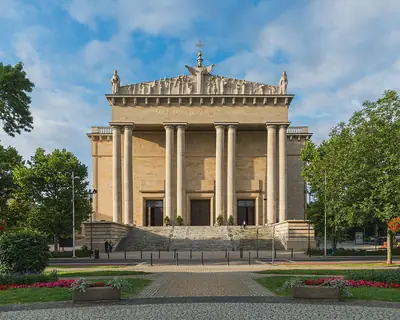
Christ the King Cathedral, or Archikatedra Chrystusa Króla, stands in the southern part of Katowice’s city centre and serves as the cathedral of the Archdiocese of Katowice. Built between 1927 and 1955, it was funded by the autonomous Silesian Parliament.
Its monumental classical design combines a portico with pairs of Corinthian columns and a dome set on a low drum. Although the exterior is faced with stone, the structure itself is made from brick. Inside, the decoration follows the art deco style. The cathedral is among the largest in Poland, with a volume of about 120,000 cubic metres, and is also known for its acoustics. Pope John Paul II visited in 1983; the throne on which he sat is displayed inside.
St. Mary’s Church
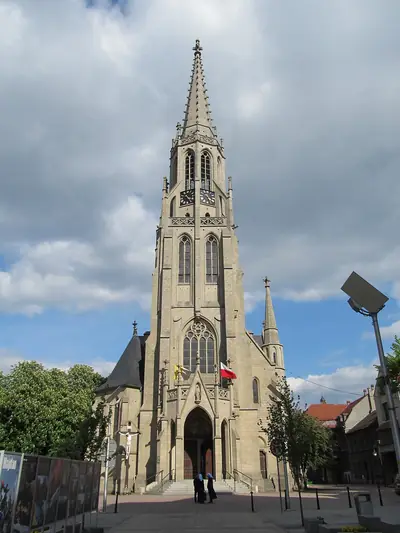
At Priest E. Szramek Square, where Mariacka Street reaches its eastern end, St. Mary’s Church is one of the oldest surviving Catholic churches in central Katowice. Built between 1862 and 1870, it remains the parish church of the Immaculate Conception of the Blessed Virgin Mary and is listed in the register of immovable monuments.
Alexis Langer designed the church in a neo-Gothic style on a Latin cross plan, using dressed stone. Its most striking feature is the octagonal tower, which rises 71 metres above the church. The building is 43 metres long and 31 metres wide, smaller than the scale originally planned.
Cathedral of the Resurrection
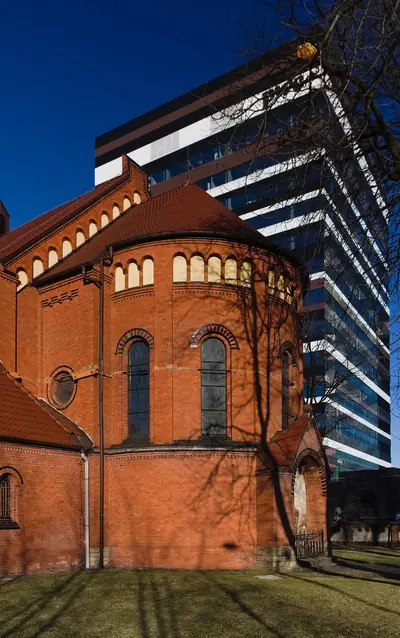
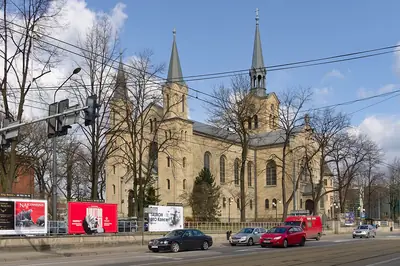
The Cathedral of the Resurrection is an Evangelical-Augsburg church in Katowice’s Śródmieście district and the cathedral of the Katowice diocese. Built between 1856 and 1858, it was the first masonry church constructed in Katowice.
Richard Lucae designed the building in a neo-Roman style, also described as arcaded. It was enlarged twice in later years and used by Catholics between 1945 and 1947. The church entered the register of immovable monuments in 1982, making it an important stop when exploring the city’s religious and architectural history.
Goldstein Palace
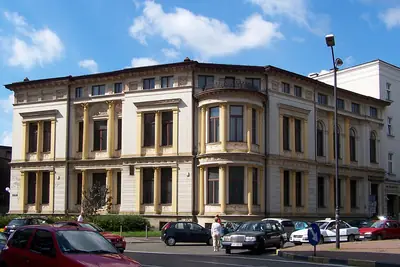
At the corner of Wolności Square and Jana Matejki Street, Goldstein Palace brings neo-Renaissance grandeur to western Katowice. Also known as the Goldstein Villa or the Palace of Industrialists, it was built for Abraham and Joseph Goldstein, owners of sawmills in several Polish cities.
The front elevations and interior staircases feature neo-Renaissance ornament, with extensive marble and sandstone. The palace originally had two floors, each arranged with a main room, kitchen, bathroom, pantry and two staff rooms. After the Goldsteins’ Katowice sawmill was destroyed by fire in 1892, the estate was sold to Kohlen Produzenten Georg von Giesches Erben. The building later housed the local Chamber of Commerce and took on further public and cultural roles.
Silesian Museum
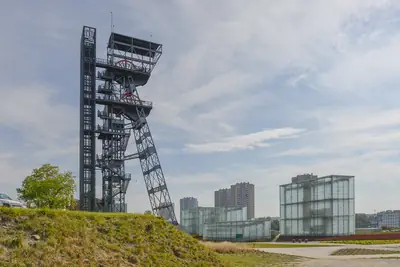
The Silesian Museum, or Muzeum Śląskie, has operated since 2015 in a complex on Tadeusz Dobrowolskiego 1 in the Bogucice district. The museum was established in 1929 by a resolution of the Silesian Parliament, closed after the outbreak of the Second World War, and restored in Katowice in 1984 after a temporary postwar period in Bytom.
Its collections cover Polish and Silesian cultural life, including Polish painting from before and after 1945, non-professional art, artistic and documentary photography, Polish posters, ethnographic material and Polish stage design. Artists represented include Józef Chełmoński, Artur Grottger, Jacek Malczewski, Jan Matejko and Stanisław Wyspiański.
Parachute Tower in Kosciuszko Park
The 35-metre Parachute Tower is one of Katowice’s most distinctive monuments and the only surviving parachute tower in Poland. Built in 1937, it was used for training parachute jumps and later for basic aviation training and parachutist instruction.
The tower is also associated with the first days of the Second World War. A widely repeated account says that members of the Polish Scouting Association used it as a defensive position against German troops entering the city, although the scale and course of the resistance remain disputed. Today, the structure commemorates the defenders of Katowice killed or murdered by the Germans in 1939, as well as the deaths of Silesian scouts.
St. Michael’s Church
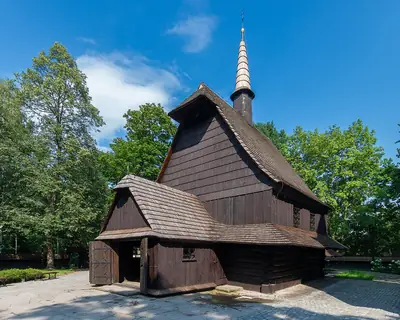
Inside Kościuszko Park, St. Michael’s Church stands on Beata Hill in the Brynów district. This wooden church was probably built in 1510 in the village of Syrynia, where the first records of a church date from the fourteenth century. The entire building was moved to Katowice in 1938.
Its historic construction includes an end-fitted log framework and a shingled roof. A free-standing wooden bell tower, completed before 1679, stands beside it, while a lych-gate and wooden fence enclose the churchyard. The site also includes an oval enclosure and a lapidarium.
St. Stephen’s Church in Bogucice
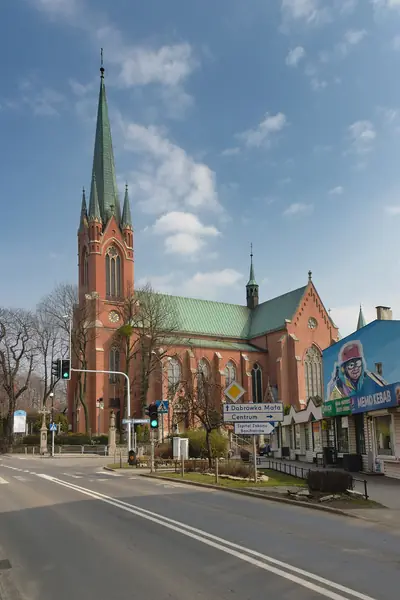
St. Stephen’s Church, also known as the Basilica of Saint Stephen and Our Lady of Bogucice, is a neo-Gothic landmark in the Bogucice district. The present building was constructed between 1892 and 1894 as the third parish church in the area, replacing the former Church of Saint Dorothy.
The high altar displays an image of Our Lady of Bogucice dating from around the fifteenth century, giving the church the additional role of a Marian sanctuary. The project is generally attributed to Paweł, or Paul, Jackisch. The church became a minor basilica in 2015, and later restorations and repainting form part of its continuing history.
6–8 3 Maja Street
The historic tenement at 6–8 3 Maja Street is known as Kamienica Pod Butem, or the Tenement House Under the Shoe. Its name comes from a shoe relief on a heraldic shield. The building reached its present form in 1907 and combines Art Nouveau curves with Neo-Gothic and modernist elements.
The façade’s decoration draws on the forms of an oak tree. The building is also known as Haus Kochmann or Dom Kochmanna and has been listed in the register of historic monuments since 1989.
12 Francuska Street
At 12 Francuska Street, the Dom Oświatowy, or House of Education, is a notable example of modernist architecture in Upper Silesia. Designed in 1928 by Stanisław Tabeński and Józef Rybicki, the building was completed in 1934 for the predecessors of the Silesian Library.
Its functionalist design and protected historic status make it a useful stop for anyone interested in Katowice’s twentieth-century architecture.
St Joseph’s Church in Załęże
St Joseph’s Church on Gliwicka Street was built as a votive church after a mining disaster at the Kleofas mine, then known as Cleophas, during the night of March 3 to 4, 1896. Construction followed between 1898 and 1900.
Ludwig Schneider designed the church in the Neo-Gothic style. It was blessed in 1900 and consecrated in 1902 by Cardinal Georg von Kopp. The building is listed in the register of immovable monuments.
Basilica in Katowice Panewniki
The Basilica of Saint Louis the King and the Assumption of the Blessed Virgin Mary in Panewniki is a Neo-Romanesque church belonging to a Franciscan monastery. Together with the adjoining Calvary, it forms a site devoted to the Passion of Christ and an important pilgrimage destination.
The church was built at the beginning of the twentieth century and serves as the parish church run by the Franciscans of the Province of the Assumption of the Blessed Virgin Mary. It is protected as a historic monument and has the honorary title of minor basilica. During the Christmas season, pilgrims come to see its annually created nativity scene, described as one of the largest in Europe.
Other Katowice landmarks
Katowice’s religious and architectural heritage continues in every direction. In Dąb, the Church of St John and Paul serves as the local Roman Catholic parish church. In Wełnowiec-Józefowiec, St. Joseph’s Church was built between 1935 and 1939 in the Neo-Baroque style, from a design by Jan Kapołka.
The Church of Saint Casimir, consecrated in 1933, is a functionalist garrison church designed by Leon Dietz d’Arma with Jan Zarzycki. In the same wider story of the city’s development, the modernist Dom Oświatowy and historic tenements on 3 Maja Street show how Katowice’s identity extends beyond its industrial past.
Explore Katowice with a self-guided audio tour
A Katowice self-guided walking tour is a practical way to connect the city’s central landmarks, cultural institutions and neighbourhoods. Neywo offers 7 walking tours, 1 bus route and 1 bike route in Katowice, with narration available in 11 languages.
The walks include:
- Wings, Saucer and Symphony: Katowice’s Culture Zone — 2.28 km, 84 minutes and 9 narrated stops.
- Palaces, Cathedral and a Skyscraper: Downtown Katowice — 2.22 km, 98 minutes and 8 stops.
- Nikiszowiec: A Miners’ Town Built Like a Fortress — 3.42 km, 87 minutes and 7 stops.
- Kosciuszko Park and Wujek Mine: Parachutes, Wooden Church and Miners’ Memory — 2.48 km, 86 minutes and 7 stops.
- Rynek to Resurrection: The Heart of Silesia’s Capital — 3.01 km, 101 minutes and 9 stops.
- St Mary’s, the Organ Museum and the University: Katowice Learning Quarter — 2.71 km, 108 minutes and 10 stops.
- Giszowiec: A Garden Settlement for Miners — 1.42 km, 40 minutes and 4 stops.
For a longer connection between neighbourhoods, Line 601: Station, Culture Zone and Bogucice covers 9.1 km in 39 minutes with 9 stops. The bike route From the Culture Zone to Nikiszowiec by bike covers 6 km in 30 minutes with 4 stops.
Download Neywo and explore Katowice at your own pace
Download Neywo’s free Katowice audio guide to explore 153 narrated places through 7 walks, 1 bus route and 1 bike route. Stories play as you reach each place, at your own pace, with no group and no schedule.
Katowice is one destination within Poland, a country whose cities offer very different architectural and cultural experiences.
Places with an audio guide in Katowice
8 places in Katowice with a Neywo audio guide. Each one starts telling its story as you reach it.
Self-guided tours in Katowice
9 tours in Katowice, free in the Neywo app. Each stop tells its story as you reach it.
- Bike ride
From the Culture Zone to Nikiszowiec by bike
A 6 km ride on dedicated cycle lanes from the Culture Zone, past the Congress Centre, east to the red-brick miners' estate of Nikiszowiec and its mine-turned-gallery.
Monument of Henryk Sławik and József Antall in Katowice · Monument to General Jerzy Ziętek in Katowice · Polish National Radio Symphony Orchestra building · Galeria Szyb Wilson
Open this tour: From the Culture Zone to Nikiszowiec by bike - Bus ride
Line 601: Station, Culture Zone and Bogucice
A circular line that starts at the railway station and runs through Wolnosci Square and the Culture Zone to the basilica in Bogucice. It links the Goldstein Palace, the concert hall and the Silesian Museum on one 40-minute ride.
Maria i Lech Kaczyńscy Square in Katowice · Goldstein Palace · Church of the Transfiguration in Katowice · Silesian Insurgents' Monument · St. Stephen's Church · Cemetery chapel in Katowice Bogucice …
Open this tour: Line 601: Station, Culture Zone and Bogucice - Walk
Wings, Saucer and Symphony: Katowice's Culture Zone
Walk from the flying-saucer Spodek past the three-winged Silesian Insurgents' Monument to the concert hall built on a former coal-mine timber yard. It ends at the Silesian Museum, set among old pit buildings, and shows how a mining city reinvented itself.
Monument of Family in Katowice · Kino Kosmos · Spodek · Silesian Insurgents' Monument · Monument to General Jerzy Ziętek in Katowice · Monument of Henryk Sławik and József Antall in Katowice …
Open this tour: Wings, Saucer and Symphony: Katowice's Culture Zone - Walk
Palaces, Cathedral and a Skyscraper: Downtown Katowice
From the vast dome of Christ the King to the first masonry church in the city and a German-era theatre. The route continues along 3 Maja Street to an industrialists' palace and ends at Poland's famous functionalist skyscraper.
Goldstein Palace · Church of SS. Peter and Paul in Katowice · Pałac Młodzieży w Katowicach · Drapacz Chmur · Church of Saint Casimir in Katowice · Christ the King Cathedral in Katowice …
Open this tour: Palaces, Cathedral and a Skyscraper: Downtown Katowice - Walk
Nikiszowiec: A Miners' Town Built Like a Fortress
Walk through the red-brick workers' estate of Nikiszowiec, built in the 1900s for coal miners. Visit the neo-Baroque church of St Anne, the market square, the ethnology museum and the old mine buildings that now house Poland's largest private gallery. Finish at a former zinc rolling mill.
Wyzwolenia Square in Katowice · Church of Saint Anne in Janów-Nikiszowiec · City Ethnology Department - Museum of the History of Katowice · Monument of Józef Wieczorek in Katowice · Monument to the Silesian Insurgents in Nikiszowiec · Galeria Szyb Wilson …
Open this tour: Nikiszowiec: A Miners' Town Built Like a Fortress - Walk
Kosciuszko Park and Wujek Mine: Parachutes, Wooden Church and Miners' Memory
Cross Kosciuszko Park from the Parachute Tower to the wooden church of St Michael, built around 1510 and moved here in 1938, past mountain memorials and a Soviet cemetery. Then walk on to the Wujek mine, where miners died on 16 December 1981 under martial law and where the Silesian Freedom and Solidarity Centre now stands.
Parachute Tower Katowice · Kościuszko Park · St. Michael's church, Katowice · Monument to the Alpinists · Soviet military cemetery in Katowice · Wujek Coal Mine Museum …
Open this tour: Kosciuszko Park and Wujek Mine: Parachutes, Wooden Church and Miners' Memory - Walk
Rynek to Resurrection: The Heart of Silesia's Capital
Walk Katowice's historic centre, from the monument to Silesian leader Wojciech Korfanty by the Silesian Parliament to Bolesław Chrobry Square, the Silesian Theatre, the old railway station and the Cathedral of the Resurrection, past the former synagogue and an Art Nouveau tenement on 3 Maja Street.
Monument to Wojciech Korfanty in Katowice · Józef Piłsudski monument, Katowice · Bolesław Chrobry Square in Katowice · Polish Radio Katowice Chamber Museum · Silesian Theatre · Old train station in Katowice …
Open this tour: Rynek to Resurrection: The Heart of Silesia's Capital - Walk
St Mary's, the Organ Museum and the University: Katowice Learning Quarter
From St Mary's, one of the oldest churches in the city centre, through the Silesian Organ Museum and the History Museum, past the functionalist House of Education, a former bank house and the University of Silesia to a mosaic and the BWA contemporary-art gallery in its historic pavilion.
St. Mary's Church · Silesian Organ Museum · History Museum of Katowice · Chapel of Saint Joseph at the cemetery at Francuska Street in Katowice · 12 Francuska Street in Katowice · 5 Bankowa Street in Katowice …
Open this tour: St Mary's, the Organ Museum and the University: Katowice Learning Quarter - Walk
Giszowiec: A Garden Settlement for Miners
A short stroll through Giszowiec, the garden settlement built for coal miners: its two churches, the linden-shaded Pod Lipami Square and Izba Śląska, a small museum in a former coach house.
Church of Saint Barbara in Giszowiec · Church of St. Stanislaus Kostka in Giszowiec · Pod Lipami Square in Katowice · Izba Śląska
Open this tour: Giszowiec: A Garden Settlement for Miners
Walk Katowice with Neywo
Neywo turns Katowice into a self-guided audio tour. Stories arrive as you reach the place they belong to, and the route reshapes when you wander off it.

