Things to Do in Łódź, Poland: Walking Guide
Things to Do in Łódź: Churches, Palaces and Industrial Heritage
Łódź is a Polish city shaped by textile manufacturing, wealthy industrial families and the transformation of historic buildings. The best things to do in Łódź include walking along Piotrkowska Street, discovering grand palaces and churches, and exploring quieter heritage sites such as Księży Młyn and Łagiewniki Forest. Neywo offers a free audio guide for Łódź with 168 narrated places, so you can explore the city while its stories play as you arrive.
For travellers exploring Poland, Łódź offers a distinct urban experience. Its architecture reflects the city’s industrial past, but its historic buildings are not confined to one period or style: Orthodox cathedrals, Catholic churches, Baroque monasteries, Neo-Renaissance residences and landscaped parks all form part of the city’s story.
What to See in Łódź
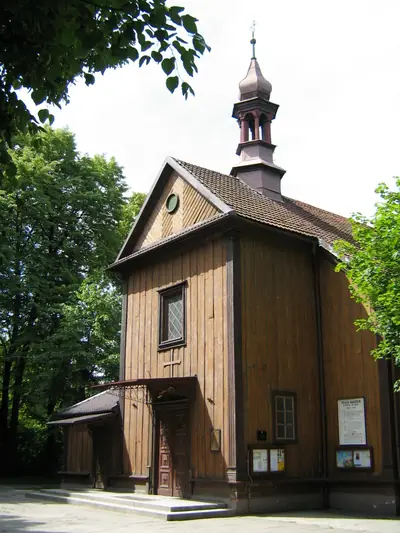
Saint Joseph Church
At 22 Ogrodowa Street, Saint Joseph Church is the oldest church in Łódź and the only surviving building from the period when the city was still a rural farming town. The church dates from the second half of the eighteenth century. It was originally dedicated to the Assumption of the Blessed Virgin Mary before taking its present name.
The building has a direct connection with the Church of the Assumption of the Blessed Virgin Mary in the Bałuty district. The earlier wooden church on that site was moved to the cemetery plot on Ogrodowa Street, where it survives as Saint Joseph.
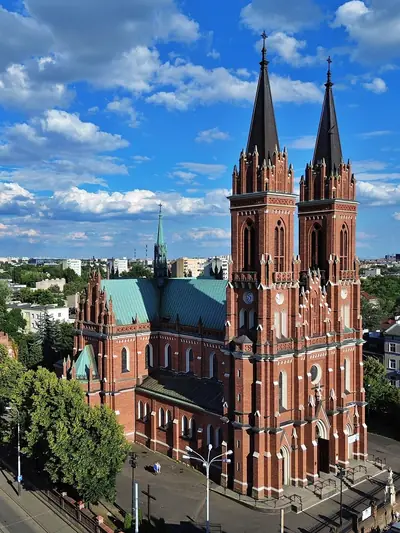
Church of the Assumption of the Blessed Virgin Mary
The Church of the Assumption of the Blessed Virgin Mary stands on Kościelny Square in Bałuty. It represents the oldest Catholic community in Łódź, which for almost five hundred years was the city’s only Catholic community.
The current church was built between 1887 and 1897, replacing the wooden church that became Saint Joseph. Designed by Konstanty Wojciechowski in the Vistula-Baltic style, it was partly financed by industrialists from different religious backgrounds. Its grounds include the tombstone of Maciej Wyszyński from 1822, while the crypt contains the coffin of Stanisława Leszczyńska.
Holy Spirit Church and Freedom Square
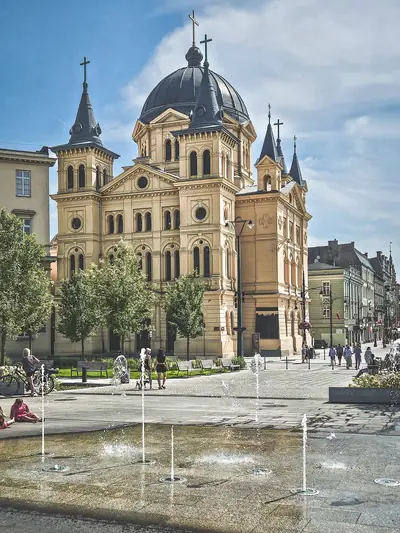
At the beginning of Piotrkowska Street, Holy Spirit Church forms part of the northern gateway to the city’s main thoroughfare, together with the nearby classical town hall and Freedom Square.
The church was built in 1827 and 1828 as the city’s first Evangelical church, dedicated to the Holy Trinity. A major rebuilding between 1889 and 1892 transformed it into the Neo-Renaissance building visible today. Its Greek-cross plan, large dome and six smaller towers create one of the most recognisable silhouettes near the start of Piotrkowska Street. After the Second World War, it became a Roman Catholic church and was consecrated on January 1, 1945.
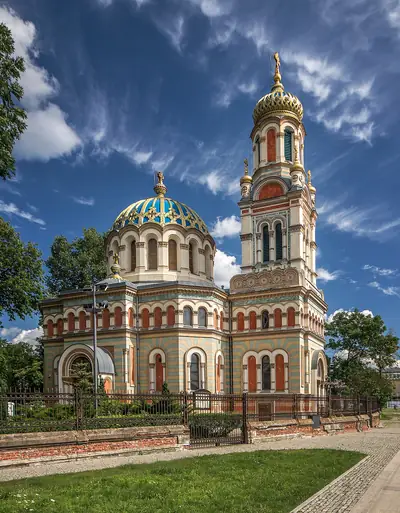
Alexander Nevsky Cathedral
The Alexander Nevsky Cathedral stands on Jana Kilińskiego Street, near Stanisław Moniuszko Park and Łódź Fabryczna railway station. Built between 1880 and 1884, it was designed by Hilary Majewski and consecrated in 1884 by Archbishop Leoncjusz of Chełm and Warsaw.
Łódź’s wealthiest industrialists funded the cathedral as an Orthodox place of worship for the city’s small Orthodox community and as a demonstration of loyalty to the Tsarist authorities. Unlike many Orthodox churches built in the Kingdom of Poland for Russian needs, it was not demolished or taken over by the Catholic Church during the interwar period. It remained open even during the First World War, after Russian officials and soldiers had left the city.
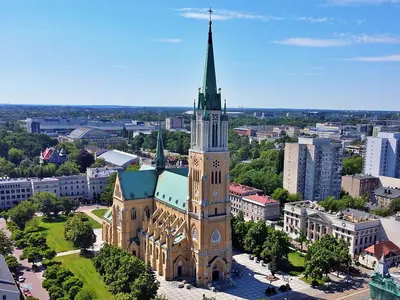
Archcathedral Basilica of St. Stanislaus Kostka
The Archcathedral Basilica of St. Stanislaus Kostka is one of the defining landmarks on Piotrkowska Street. At 101 metres tall, it is the largest religious building in Łódź, the city’s tallest building and the seventh tallest church in Poland.
Construction took place between 1901 and 1912. The basilica has three naves and a Latin-cross ground plan, with architectural influences from French and German Gothic. Its design was directly inspired by Chartres Cathedral in France, giving the building its strong vertical character.
Park Helenów
Park Helenów is a historic green space between Północna, źródłowa and Smugowa streets. Covering 12 hectares, it was created between 1881 and 1885 on the initiative of the Anstadt family, textile manufacturers who played a role in Łódź’s industrial history.
The park combines recreation with a record of the city’s natural heritage. Five trees are recognised as natural monuments: two pedunculate oaks, a common beech, a red oak and an ash tree with a trunk circumference of 385 centimetres. Park Helenów is also listed in the Registry of Objects of Cultural Heritage.
Edward Herbst’s Palace
Edward Herbst’s Palace is one of the highlights of the Księży Młyn district. This Neo-Renaissance villa was built between 1875 and 1877 for Matylda Zofia, the eldest daughter of industrialist Karol Scheibler, and her husband Edward Herbst.
The rectangular, two-storey villa contains sixteen rooms. Its representative ground-floor halls contrast with the private bedrooms and dressing rooms upstairs, while an attached orangery adds to the residence’s character. Among the interior details are stained-glass windows from the workshop of Antonio Salviati, known for Venetian glassmaking.
Księży Młyn is also home to factories, palaces and the old mill, making it one of the most revealing areas for understanding Łódź’s industrial landscape.
Steinerts’ Palace
Steinerts’ Palace stands on Piotrkowska Street and was built between 1909 and 1911 for brothers Emil and Karl Steinert. Designed by Berlin architect Alfred Balcke in the Deutsche Renaissance style, it was intended to house two families.
The building’s symmetrical façade has two entrance portals because it consists of two independent three-storey structures. A wall divides the courtyard, while the façade features pilasters, tripartite windows and a cartouche carrying the Latin inscription SALUS INTRANDIBUS and the building’s date. A more modest Steinert family house stands beside the palace.
Robert Schweikert’s Palace
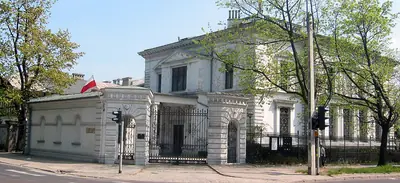
At number 262 on Piotrkowska Street, Robert Schweikert’s Palace reflects the wealth of the city’s industrial era. The residence was built in 1910 for German manufacturer Robert Schweikert and his wife Emma, following designs by Romuald Miller.
The two-storey building is topped with a mansard roof and set back behind an elegant cast-iron fence. A portico marks the main façade, while the property also includes a guardhouse, stables and a carriage house. Behind the palace, a garden contains mature trees, a pond, terraces, a pavilion, antique vases and sculptures.
Heinzl’s Chapel
Heinzl’s Chapel is a Neo-Renaissance family mausoleum and cemetery chapel in the Old Cemetery on Ogrodowa Street. It was built between 1899 and 1903 by Paulina Volkman, widow of industrialist Juliusz Heinzel, together with their descendants.
Designed by Berlin architect Franz Schwechten, the sandstone chapel was inspired by the Sigismund Chapel at Wawel in Kraków. Its exterior includes an attic balustrade, life-sized angel sculptures at the pilasters and a semicircular tympanum above the entrance with a bas-relief of Jesus Christ.
St. Anthony Church and the Franciscan Monastery
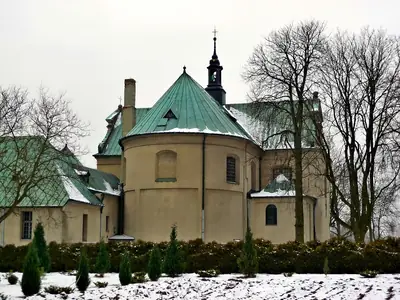
In Łagiewniki Forest, the Franciscan Monastery offers a quieter setting than the central streets. The monastery belongs to the Franciscan Order of Friars Minor Conventual, and its history reaches back to the late seventeenth century.
The associated St. Anthony Church was rebuilt in masonry from 1701 and consecrated in 1726. Its Baroque design follows a Latin-cross plan with a single nave, two side chapels and a semicircular presbytery. The complex includes the monastery, completed in brick in 1746, and a brick bell tower added in 1843. The church is a double sanctuary dedicated to St. Anthony of Padua and Blessed Rafał Chyliński.
Museum of Independence Traditions
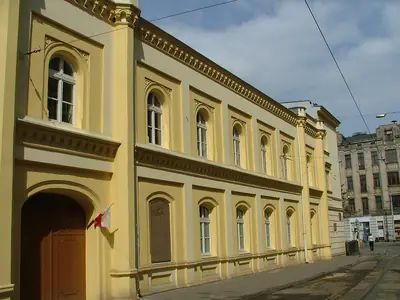
The Museum of Independence Traditions is Łódź’s longest-running historical museum. Founded in 1959 under another name, it collects documents, photographs, works of fine art and other memorabilia connected with Poland’s independence traditions.
The museum focuses mainly on Łódź and its surrounding region, while also holding material from elsewhere in Poland. Its Radogoszcz branch examines the history of the German occupation of Łódź and the surrounding district between 1939 and 1945.
Church of Saint Olga
The Church of Saint Olga is a small Orthodox church on Grzegorza Piramowicza Street in the Śródmieście-Wschód district. It is a filial church of the Alexander Nevsky Cathedral parish.
Construction began in 1896 alongside a home for orphaned Orthodox children. The chapel was consecrated as the Church of Saint Olga on October 16, 1898. Its simple single-nave structure has a rectangular plan and a tower topped with a bulb-shaped dome—the building’s only clearly Russian-Byzantine feature.
Explore Łódź with Neywo
Neywo’s Łódź audio guide includes 6 walking tours, 1 bus route and 1 bike route, covering 168 narrated places in total. The walks range from 1.84 to 3.22 km and last between 84 and 110 minutes. The bus route covers 7.8 km in 33 minutes with 12 stops, while the bike route covers 5.4 km in 27 minutes with 5 stops.
Choose a route through Piotrkowska Street, the Poznański Empire, Księży Młyn or Łódź’s eastern centre. The app tells the story of each place as you reach it, at your own pace, with no group and no schedule. Narration is available in 11 languages. Download Neywo and explore Łódź independently.
Places with an audio guide in Łódź
8 places in Łódź with a Neywo audio guide. Each one starts telling its story as you reach it.
Self-guided tours in Łódź
8 tours in Łódź, free in the Neywo app. Each stop tells its story as you reach it.
- Bike ride
Across Lodz by Bike: Palaces, Churches and Victory Square
Ride a long cycle route through the city centre, from the wooden Holy Saviour church and the Katyn monument past the Kindermann palace on Piotrkowska Street and the neo-Romanesque St John's church to Victory Square, where the Scheibler quarter begins.
Salvator church in Łódź · Katyń monument in Łódź · Gustaw Kindermann's palace · Saint John the Evangelist church in Łódź · Zwycięstwa Square in Łódź
Open this tour: Across Lodz by Bike: Palaces, Churches and Victory Square - Bus ride
Line 101: Tourist Information to the Cinema Museum
A public tourist-oriented line (every 40 minutes, 10:00-18:00) that runs from the Tourist Information Office via Kilińskiego, EC1 and Piotrkowska Street to Księży Młyn and the Cinematography Museum. Ride it to string together the Orthodox cathedral, the palaces of Piotrkowska and the Scheibler factory district on one ticket.
Alexander Nevsky Cathedral · Narodowe Centrum Kultury Filmowej EC1 · Church of the Exaltation of the Holy Cross in Łódź · 'Unicorn; a Place for Stars' · Ewald Kern's palace · 203 Piotrkowska Street in Łódź …
Open this tour: Line 101: Tourist Information to the Cinema Museum - Walk
Millionaires' Row: Palaces of Southern Piotrkowska
Start at Geyer's classicist villa and the white-plastered factory that launched Lodz's textile boom, then walk north along Piotrkowska Street past the grandest villas, the city's towering cathedral, a fortress-like factory and the Hartig palace. A walk through the money and architecture of the cotton kings.
Ludwik Geyer's villa · White Factory · Steinerts' palace · Archcathedral Basilica of St. Stanislaus Kostka, Łódź · Monument of Unknown Soldier in Łódź · Scheibler Palace …
Open this tour: Millionaires' Row: Palaces of Southern Piotrkowska - Walk
Bronze Kings and Silver Stars on Piotrkowska
Stroll Poland's most famous high street from Freedom Square southward. Meet the bronze factory owners round their table, a lamplighter on his ladder, the stars of the Lodz Walk of Fame and the city's beloved teddy bear, with the Holy Spirit church, a pharmacy museum and the grand tenements in between.
Museum of Archaeology and Ethnography in Łódź · Muzeum Farmacji im. prof. Jana Muszyńskiego · Holy Spirit Church in Łódź · Tadeusz Kościuszko · 19 Piotrkowska Street in Łódź · Lampiarz …
Open this tour: Bronze Kings and Silver Stars on Piotrkowska - Walk
The Poznański Empire: Palaces, Looms and Manufaktura
Follow the family that ruled Łódź's cotton industry, from the 'Louvre of Łódź' to the redbrick mill turned Manufaktura and the neo-Renaissance mansions of Poznański's sons. Continues to the avant-garde Museum of Art, Jakub Hertz's palace and the Art Nouveau Kindermann villa, the pearl of Polish Art Nouveau.
Izrael Poznański Palace · Ms² · Factory Museum · Saint Joseph church in Łódź · Karol Poznański's palace · Maurycy Poznański's palace …
Open this tour: The Poznański Empire: Palaces, Looms and Manufaktura - Walk
Domes, Poets and Stages: Łódź's Eastern Centre
From the film-making power plant of EC1 to the onion domes of the Orthodox cathedral, this walk links the quieter side of the centre: a composer's bust in the park, Łódź's oldest theatre and the only synagogue that survived the war.
Church of the Exaltation of the Holy Cross in Łódź · Józef Piłsudski Monument in Łódź · Alexander Nevsky Cathedral · Stanisław Moniuszko monument in Łódź · Church of Saint Olga in Łódź · Narodowe Centrum Kultury Filmowej EC1 …
Open this tour: Domes, Poets and Stages: Łódź's Eastern Centre - Walk
Piotrkowska Street Heart: City Hall, Kindermanns and the Unicorn
The middle of Piotrkowska Street: the palace that became City Hall, two Kindermann mansions, Ewald Kern's palace, the Unicorn sculpture beside the old tram depot, a red-brick Lutheran church and the green Sienkiewicz Park.
Juliusz Heinzl Palace · Juliusz Kinderman's palace · Gustaw Kindermann's palace · 'Unicorn; a Place for Stars' · Ewald Kern's palace · Saint John the Evangelist church in Łódź …
Open this tour: Piotrkowska Street Heart: City Hall, Kindermanns and the Unicorn - Walk
Ksiezy Mlyn: Factories, Villas and the Old Mill
Walk into the 19th-century industrial town built beside Scheibler's mills: a villa from 1903, Grohman's Neo-Gothic factory gate, the Scheibler palace, the Priest's Mill workers' estate, the Art Book Museum and the Herbst palace.
Oskar Kon's palace · Grohman's Factory Gate · Karl Wilhelm Scheibler's palace · Księży Młyn · Art Book Museum · Edward Herbst's palace
Open this tour: Ksiezy Mlyn: Factories, Villas and the Old Mill
Walk Łódź with Neywo
Neywo turns Łódź into a self-guided audio tour. Stories arrive as you reach the place they belong to, and the route reshapes when you wander off it.

