Things to Do in Poznań, Poland: Walking Guide
Things to Do in Poznań: Historic Churches, Museums and Riverside Walks
Poznań is a city shaped by the beginnings of Christianity in Poland, imperial rule, wartime destruction and cultural renewal. The best things to do in Poznań range from exploring Ostrów Tumski and the Old Market Square to visiting distinctive museums, historic churches and the Palm House. Neywo’s free audio guide for Poznań includes 332 narrated places, helping you discover the city as you walk.
What to See in Poznań
Archcathedral Basilica of St. Peter and St. Paul
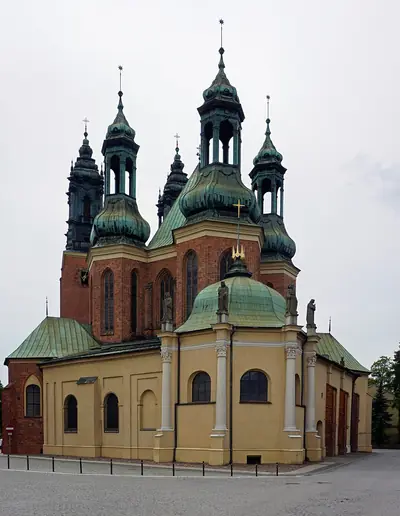
Begin on Ostrów Tumski, the island at the heart of Poznań’s early history. The Archcathedral Basilica of St. Peter and St. Paul is one of Poland’s oldest churches and the country’s oldest cathedral. Its origins reach back to the tenth century, when it became the seat of Poland’s first bishop. The site is traditionally regarded as a possible place of Mieszko I’s baptism and is also the burial place of Poland’s first rulers.
The Gothic building dates from the turn of the fourteenth and fifteenth centuries and was reconstructed after damage during the Second World War. In the underground crypt, you can see remains of the earlier Romanesque cathedral, a baptistery and the tombs of the first Polish kings. A fragment of the Romanesque wall is also incorporated into the south tower.
Ostrów Tumski is one of the essential stops on a visit to Poland, especially for anyone interested in the country’s religious and political beginnings.
Akademia Lubrańskiego – Archdiocesan Museum
Also on Ostrów Tumski, the Akademia Lubrańskiego – Archdiocesan Museum presents a collection of sacred art. Opened in 1898, it is among Poland’s oldest museums and one of the country’s earliest institutions devoted to sacred art. It offers a quieter cultural perspective on the island after the cathedral.
Old Market Square
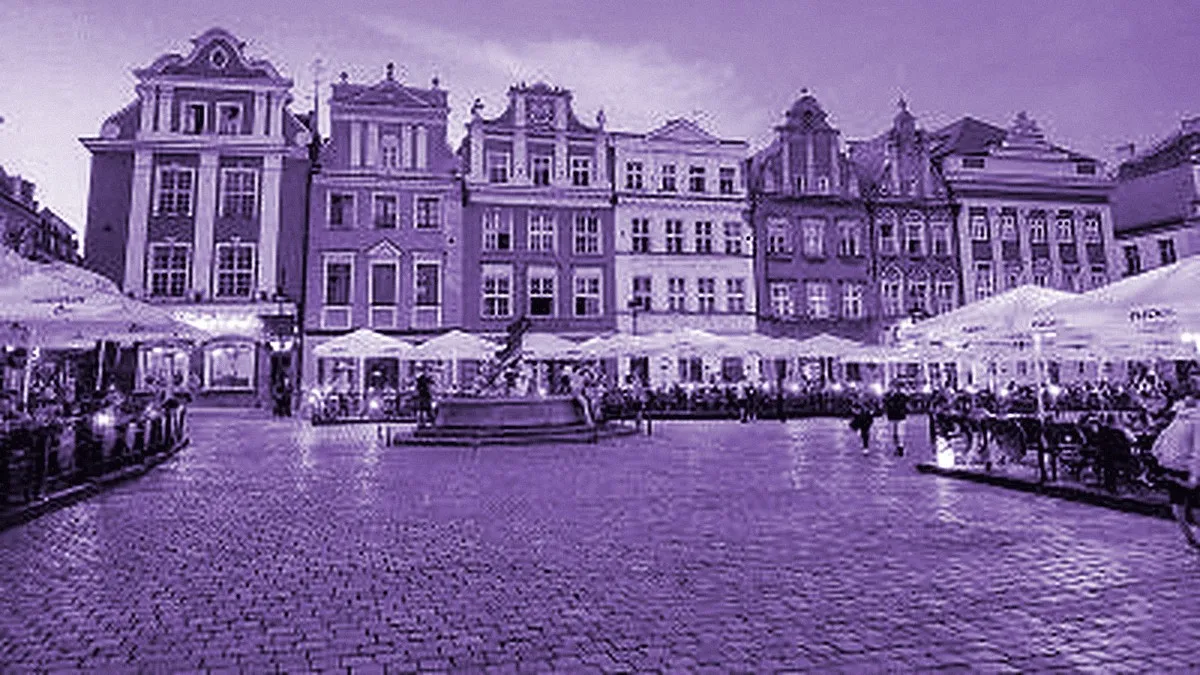
Poznań’s Old Market Square, or Stary Rynek, is the historic center and oldest part of the Old Town. It was laid out around 1253 as the central square of the newly founded city and forms an almost perfect 141-metre square. Three streets lead from each side, with two beginning at the corners.
The square was once the focus of Poznań’s economic and political life. It was almost completely destroyed during the Second World War and later rebuilt and restored. Today, its surrounding historic buildings make it one of the city’s most visited spaces.
Several important sights stand around or near the square, including Mielżyński Palace, Górka Palace, Poznań Fara and the Museum of Musical Instruments.
Mielżyński Palace
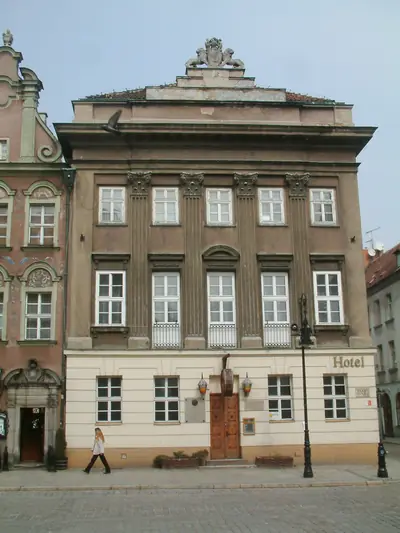
At number 91 on the Old Market Square, Mielżyński Palace is notable for its restrained Classical façade. It was the first building in Poznań to fully realize the principles of the Classical style. Simple pilasters, a projecting cornice and a tall attic give the palace a measured appearance, while a coat of arms supported by two lions adds a distinctive detail above the façade.
Górka Palace and the Archaeological Museum
Górka Palace is a Renaissance city palace now occupied by the Archaeological Museum. Its exhibitions range from the prehistory of Greater Poland to ancient Egypt and beyond.
The palace was created between 1545 and 1549, when Andrzej II Górka transformed several Gothic town houses into one residence. The complex included a garden and a Protestant chapel, later used by the Bohemian Brethren. After passing through several owners and uses, the building was badly damaged in 1945 and restored.
Poznań Fara
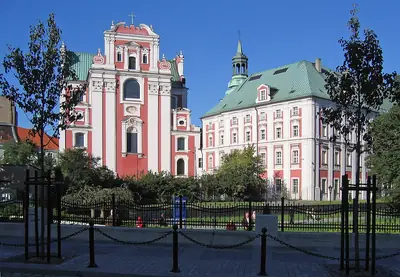
Poznań Fara is one of the city’s most recognizable landmarks and one of the finest preserved examples of Baroque architecture in Poland. Also known as the Basilica of Our Lady of Perpetual Help, Saint Mary Magdalene and Saint Stanislaus, it was built between 1651 and 1701 by Polish and Italian masters working for the Jesuits.
Inside, sixteen monumental artificial-marble columns line the nave. The vault contains three scenes from the life of Saint Stanislaus Bishop, painted by Karol Dankwart of Nysa, while the side altars were inspired by those in Rome’s Church of Saint Ignatius. The church also contains an organ built in 1876 by Friedrich Ladegast of Weißenfels.
Museum of Musical Instruments
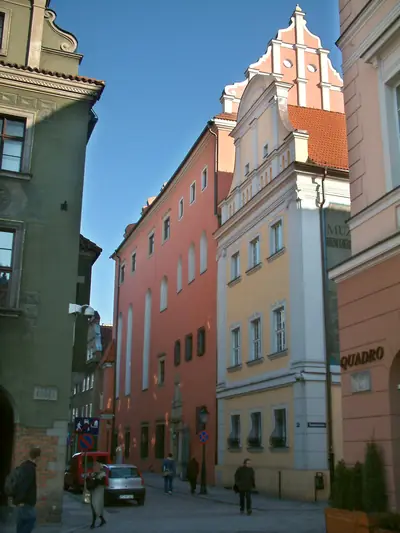
The Museum of Musical Instruments occupies three historic townhouses, including the Grodzicki Townhouse, on the Old Market. It is the only museum of its kind and scale in Poland and the third largest of its kind in Europe.
Its collection is arranged across nineteen exhibition rooms, covering European concert instruments, European folk instruments, instruments from outside Europe and musical materials. Highlights include violins from the Groblicz and Dankwart workshops, positive organs from the sixteenth and seventeenth centuries, harps, keyboards, trombones, music boxes and mechanical instruments.
Imperial Castle
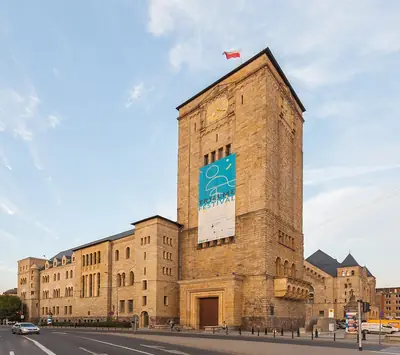
The Imperial Castle is more palace than traditional castle. Built between 1905 and 1910 for Wilhelm II, the German Emperor and King of Prussia, it was designed by Franz Schwechten and became the key structure of Poznań’s Imperial District.
The building served as a seat of government under German rule until 1918. It later housed Polish government offices from 1918 to 1939 and again from 1945 onward. Today, it is home to the Zamek Culture Centre. Its changing functions reflect Poznań’s different political periods and make it an important place to understand the city’s modern history.
Fort VII
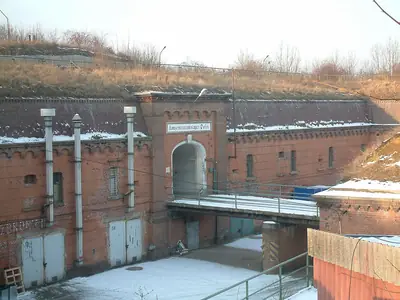
Fort VII, also known as Fort Colomb, was one of eighteen forts forming the Poznań Fortress. The site is also known as the Museum of Wielkopolska Martyrdom. It adds a darker historical layer to a city whose story includes war, occupation and political change.
Palm House in Poznań
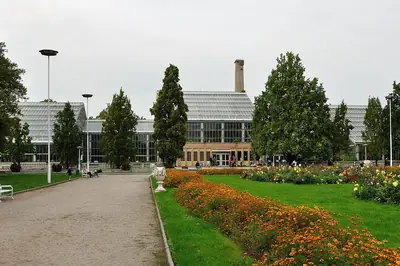
In Wilson Park, the Palm House in Poznań is the largest palm house in Poland and one of the largest in Europe. Its twelve pavilions cover 4,600 square metres and present around 1,100 plant species from Mediterranean, subtropical, tropical, savannah and desert climates.
The complex was originally built in 1929 to a design by S. Cybichowski and extensively remodelled between 1982 and 1992. Beyond the botanical collections, it contains an aquarium with around 170 fish species and about 50 species of aquatic plants. Moving between the pavilions creates a journey through markedly different living environments.
Poznań’s historic churches
Poznań’s religious architecture extends well beyond Ostrów Tumski and the Old Market. Corpus Christi Church stands in the Piaski area, while the Church of the Exaltation of the Holy Cross on Szamarzewskiego Street combines a Neo-Gothic design with the role of a garrison church.
In the Łazarz district, the Church of Our Lady of Sorrows is a Neo-Romanesque landmark on Głogowska Street. In Jeżyce, the Church of the Sacred Heart of Jesus and Saint Florian is another distinctive Neo-Romanesque parish church.
Explore Poznań with a Self-Guided Audio Tour
A Poznań self-guided walking tour is a flexible way to connect the city’s landmarks without joining a group. Neywo offers 7 walking tours, 1 bus route and 1 bike route in Poznań, with narration available in 11 languages.
The walks include:
- Goats at Noon: A Walk Around Poznań’s Market Square — 1.11 km, 115 minutes and 12 narrated stops.
- Cradle of Poland: Ostrów Tumski — 2.69 km, 115 minutes and 11 stops.
- Kaiser, Codebreakers and the 1956 Revolt: The Imperial Quarter — 2.8 km, 116 minutes and 12 stops.
- Freedom Square and the Museum Boulevard — 2.64 km, 104 minutes and 12 stops.
- Citadel Park: Fortress, Museums and Sculpture — 2.28 km, 81 minutes and 9 stops.
- Palm House, Old Zoo and Rondo Kaponiera — 2.14 km, 76 minutes and 7 stops.
- Between the Rivers: Chwaliszewo, the Warta and Lake Malta — 3.39 km, 94 minutes and 8 stops.
The Bus 163: Synagogue, Opera and the Kaponiera Obelisk route covers 4.5 km in 19 minutes and has 9 narrated stops. The Citadel Park Ride: Fort Winiary and its Museums bike route covers 1.6 km in 8 minutes and has 7 stops.
Download Neywo and explore Poznań at your own pace. The app tells the story of each place as you reach it, with no group and no schedule. After Poznań, you can continue discovering other Polish cities, including Toruń, Łódź or Warsaw.
Places with an audio guide in Poznań
8 places in Poznań with a Neywo audio guide. Each one starts telling its story as you reach it.
Self-guided tours in Poznań
9 tours in Poznań, free in the Neywo app. Each stop tells its story as you reach it.
- Bike ride
Citadel Park Ride: Fort Winiary and its Museums
Cycle the wide asphalt paths of Citadel Park, the green hill where the Prussian Fort Winiary stood. From the Poznań Army monument ride past the army and armament museums, the Bell of Peace, and two sculptures, ending at the scouts' memorial at the northern edge.
Poznań Army Monument · Muzeum Armii Poznań · Muzeum Uzbrojenia w Poznaniu · Bell of Peace and Friendship Among Nations · Nierozpoznani · Ziarno – Epitafium Życia …
Open this tour: Citadel Park Ride: Fort Winiary and its Museums - Bus ride
Bus 163: Synagogue, Opera and the Kaponiera Obelisk
A regular city bus from the old town edge through the Imperial Quarter. It passes the surviving New Synagogue, the Młyńska prison plaque, the Underground State monument, the neoclassical Opera, the crosses of 1956, the Lustra mirrors and the Światowid obelisk at Rondo Kaponiera, then reaches the Old Zoo's nature museum and the scouts' memorial on Bukowska Street.
New Synagogue in Poznań · Tablica ofiar więzienia przy ul. Młyńskiej · Pomnik Polskiego Państwa Podziemnego w Poznaniu · Grand Theatre, Poznań · Poznańskie Krzyże · Obszar obrazów efemerycznych …
Open this tour: Bus 163: Synagogue, Opera and the Kaponiera Obelisk - Walk
Goats at Noon: A Walk Around Poznań's Market Square
Start where Poznań began, climbing down from the Royal Castle on Przemysł Hill past a Baroque Franciscan church into the 13th-century market square lined with arcaded houses. Watch for the two mechanical goats that butt heads from the Town Hall tower every day at noon, and meet a bronze water-carrier, a museum of musical instruments, Renaissance and neoclassical palaces, the Baroque Fara church and the goats' monument on the site of a lost church.
Royal Castle, Poznań · Saint Anthony of Padua church in Poznań · Działyński Palace in Poznań · Odwach/ Muzeum Powstania Wielkopolskiego 1918-1919 · Former Poznań Town Hall · Fontanna Bamberki w Poznaniu …
Open this tour: Goats at Noon: A Walk Around Poznań's Market Square - Walk
Cradle of Poland: Ostrów Tumski
Cross to Cathedral Island, the spot where the Polish state took shape in the 10th century. You will see the heritage centre that tells its story, archaeological remains of the first stronghold, the oldest cathedral in Poland with the tombs of its first rulers, the Gothic churches and bishop's quarter around it, and the Philippine oratory and Saint Margaret's church across the river.
Brama Poznania ICHOT · Genius Loci Archaeological Reserve · Katedralna Lock in Poznań · Archcathedral Basilica of St. Peter and St. Paul · Chapel of the Annunciation in Poznań · Akademia Lubrańskiego – Archdiocesan Museum in Poznań …
Open this tour: Cradle of Poland: Ostrów Tumski - Walk
Kaiser, Codebreakers and the 1956 Revolt: The Imperial Quarter
Walk the grand district laid out for the German emperor. Start at the Mickiewicz monument and university, pass the Philharmonic, stand at the crosses of the June 1956 uprising, and visit the Imperial Castle. Next to it, learn how three Polish mathematicians broke the Enigma cipher, then see the Uprising museum, the neoclassical Opera, the Church of the Holy Saviour, the Polish Theatre and the monument to the Children of June '56.
Adam Mickiewicz Monument in Poznań · Adam Mickiewicz University in Poznań · Filharmonia Poznańska · Poznańskie Krzyże · Enigma cryptologist monument in Poznań · Centrum Szyfrów Enigma …
Open this tour: Kaiser, Codebreakers and the 1956 Revolt: The Imperial Quarter - Walk
Freedom Square and the Museum Boulevard
A stroll through 19th-century Poznań: the classical Raczyński Library, fountains on Freedom Square, a pharmacy museum, the National Museum and the Młyńska prison memorial. Continue past the Uhlan regiment monument and the University of the Arts to the Church of St Martin, and finish at two very different sculptures on Marcinkowski Avenue, Heinz Mack's tall Stella and David Černý's Golem.
Fontanna Wolności w Poznaniu · Hygieia monument in Poznań · Raczyński Library · Muzeum Farmacji · Hipolit Cegielski · Stella …
Open this tour: Freedom Square and the Museum Boulevard - Walk
Citadel Park: Fortress, Museums and Sculpture
Walk the green hill where the Prussian Fort Winiary stood. From the Poznań Army monument pass the army and armament museums, the French prisoners' memorial, the sculpture group Nierozpoznani, the Bell of Peace and the park's heart, ending at the scouts' memorial at the northern edge.
Poznań Army Monument · Muzeum Armii Poznań · Pomnik jeńców francuskich · Muzeum Uzbrojenia w Poznaniu · Bell of Peace and Friendship Among Nations · Nierozpoznani …
Open this tour: Citadel Park: Fortress, Museums and Sculpture - Walk
Palm House, Old Zoo and Rondo Kaponiera
Start in the glass Palm House, one of the biggest in Europe, and stroll through the Old Zoo and the nature museum. Then walk east to the Światowid obelisk, Abakanowicz's headless figures and the mirror installation at Rondo Kaponiera, ending at the 1872 Kaponiera fortification.
Palm House in Poznań · Poznań Old Zoo · Museum of nature in Poznań · Światowid · 5 Figur · Obszar obrazów efemerycznych …
Open this tour: Palm House, Old Zoo and Rondo Kaponiera - Walk
Between the Rivers: Chwaliszewo, the Warta and Lake Malta
Follow the waterways east of the Old Town: the Museum of Independence, the Golden Cross and Międzymoście Square, the Bollwerk monument by the old river port and the Sacred Heart church. Cross the Berdychowo footbridges to the SS Poznań memorial on Lake Malta and the old church of St John of Jerusalem.
Wielkopolska Museum of Independence · Złoty Krzyż · Międzymoście Square in Poznań · Akcja Bollwerk · Kościół Najświętszego Serca Jezusa i Matki Bożej Pocieszenia · Berdychowo Footbridges …
Open this tour: Between the Rivers: Chwaliszewo, the Warta and Lake Malta
Walk Poznań with Neywo
Neywo turns Poznań into a self-guided audio tour. Stories arrive as you reach the place they belong to, and the route reshapes when you wander off it.

