Things to Do in Zakopane, Poland: Walking Guide
Things to Do in Zakopane, Poland
Zakopane is a mountain town in southern Poland where Podhale highland traditions meet the landscapes of the Tatra Mountains. The best things to do in Zakopane include discovering its distinctive wooden architecture, visiting historic churches and museums, and exploring landmarks connected with the region’s art, faith and mountain culture. Neywo offers a free audio guide for Zakopane with 38 narrated places.
Part of the Lesser Poland region, Zakopane has a strong architectural identity shaped by the Zakopane style. Developed from local Górale building traditions, it combines wooden construction, steep roofs and carved decoration with a broader artistic vision associated with Stanisław Witkiewicz.
What to See in Zakopane
Museum of Zakopane Style at Villa Koliba
Villa Koliba is the first house built in the Zakopane style. Designed by Stanisław Witkiewicz and completed in 1893, it transformed traditional highland architecture into a sophisticated style connected with Polish national culture. The villa was expanded in 1901 and has housed the Museum of Zakopane Style, a branch of the Tatra Museum, since 1993.
The building itself forms part of the exhibition. Its carved wooden details, ornate veranda, sun motifs and steep roof show how local craftsmanship was adapted into a carefully designed architectural language.
Villa Oksza
Villa Oksza, on Zamoyskiego Street, was designed by Witkiewicz in the mid-1890s and built between 1894 and 1895. An expansion in 1920 gave it its present form. Since 2006, it has been protected as a historic monument and has housed the Gallery of 20th Century Art, displaying Polish art within the villa’s original wooden interiors.
Villa Pod Jedlami
Built in 1897 on Koziniec hill, Villa Pod Jedlami is one of the most complete examples of the Zakopane style. Witkiewicz designed it for Jan Gwalbert Pawlikowski and selected its hillside setting near the Bystre district.
Its stone foundation, carved wooden details and historic gardens make it especially notable from the outside. The villa can only be viewed externally, but its exterior reveals the character of the style, including motifs such as lynxes, decorative balustrades and a historic well designed by Witkiewicz.
Tatra Museum
The main building of the Tatra Museum, named after Dr. Tytus Chałubiński, belongs to one of Poland’s oldest museums. Founded in 1889 by the Tatra Museum Society, the institution documents the nature, art and culture of the Tatra Mountains.
Its collections cover natural history, ethnography and art. The museum now operates eleven branches, seven of them in Zakopane and others in Chochołów, Czarna Góra, Jurgów and Łopuszna. In 2019, its contribution to Polish culture was recognised with the Golden Medal for Merit to Culture, Gloria Artis.
Tatra National Park Nature Education Center
The Tatra National Park Nature Education Center presents the natural environment of the mountains through multimedia exhibitions. It opened in 1984 as the Natural History Museum of Tatra National Park, before becoming an education center in 2004.
A major reconstruction and expansion took place between 2015 and 2017. The current exhibition covers about six hundred square metres and focuses on Tatra nature and the history of conservation in the mountains.
Pęksowy Brzyzek Cemetery
Pęksowy Brzyzek Cemetery is Zakopane’s oldest cemetery. Also known as the Cemetery of the Meritorious or the Old Cemetery, it was established around 1850 on land donated by Jan Pęksa, whose name remains attached to the hill.
The cemetery preserves some of the town’s earliest stories in wood and stone, making it an important stop for understanding Zakopane’s local history.
Our Lady of Częstochowa and Saint Clemens Church
Often called the Old Church or Kościół na Pęksowym Brzyzku, this is Zakopane’s first parish church. It was built in 1847 on Kościeliska Street, when Zakopane was still a small highland settlement.
The wooden church has a single nave, a low shingled roof and a small bell tower. Its construction uses wooden joints and dowels rather than nails, following traditional building methods from the mountains.
Holy Family Church
The Holy Family Church stands on Krupówki Street and is the oldest brick church in Zakopane. Construction began in 1877 under the direction of parish priest Józef Stolarczyk, and the building took nearly two decades to complete. Józef Pius Dziekoński designed its Neo-Romanesque exterior, while Count Władysław Zamoyski helped cover the costs.
Inside, the decoration combines folk art and Art Nouveau influences associated with the Zakopane style. The church was consecrated in 1899, and Pope John Paul II celebrated Mass here in 1997.
Sacred Heart Chapel in Jaszczurówka
The Sacred Heart Chapel in Jaszczurówka is one of the clearest expressions of the Zakopane style. Designed by Stanisław Witkiewicz in 1904 and consecrated in 1907, it uses exposed log construction, a high stone foundation with arcade openings and a shingled roof topped by a modest bell tower.
The main altar is carved in the form of a traditional highlander’s cottage. Inside, the small single-nave chapel shows how local materials and mountain building traditions could create a highly distinctive religious space.
Church of St. John the Evangelist in Harenda
The Church of St. John the Evangelist is a Lesser Polish wooden Baroque church originally built in the early eighteenth century in Zakrzów near Kalwaria Zebrzydowska. In 1947, it was dismantled, moved and rebuilt in Zakopane’s Harenda district.
Covered walkways called soboty surround the building. Inside, guild paintings decorate the walls and ceiling; they were restored by Władysław Jarocki, who was also Jan Kasprowicz’s son-in-law.
Muzeum of Jan Kasprowicz in Villa Harenda
Villa Harenda is dedicated to the poet Jan Kasprowicz, who spent his final years there. The late-nineteenth-century wooden guesthouse is itself an example of the Zakopane style. Before Kasprowicz arrived, the English artist and writer Winifred Cooper lived in the villa during the 1920s.
Preserved as a museum since 1950, it contains Kasprowicz’s personal belongings and manuscripts, as well as rooms connected with his final creative period. The villa also houses a gallery of works by Władysław Jarocki, a painter and friend of Kasprowicz.
Pustelnia Brata Alberta
At Kalatówki, in a forested setting beside the Bystra stream, the Hermitage of Brother Albert is a small wooden retreat built in 1901. Stanisław Witkiewicz designed it in the Zakopane style but deliberately kept the building austere, reflecting the simple life of Brother Albert, Adam Chmielowski.
The two-room cottage stands beside the Albertine Sisters’ convent. Its interior includes a narrow vestibule, a small porch, a room once used by priests and Brother Albert’s small cell, almost entirely occupied by a plain wooden bed.
Sanctuary of Our Lady of Fatima
The Sanctuary of Our Lady of Fatima stands on the slopes of Krzeptówki. It was built between 1987 and 1992 as a votive offering after Pope John Paul II survived the assassination attempt in St. Peter’s Square on May 13, 1981.
The church combines a postmodern conception with Zakopane-style wooden details and steep rooflines. Pope John Paul II consecrated the sanctuary in 1997.
Giewont Cross
The cross on Wielki Giewont is one of Zakopane’s most recognisable mountain landmarks. The summit stands at 1,894 metres above sea level, and the metal cross rises 17.5 metres, with part of its structure anchored into the rock.
The idea came from Father Kazimierz Kaszelewski, who wanted to mark the 1900th anniversary of the birth of Jesus. Its iron sections were forged in Kraków and carried to the summit, where the completed structure weighs nearly two tons.
Bazar Polski
Bazar Polski is a historic building on Krupówki, built in 1911 on the initiative of Count Władysław Zamoyski. It was originally conceived as an art gallery and has housed the Municipal Art Gallery named after Count Zamoyski since 2001.
The gallery presents contemporary Polish art in forms including painting, graphics, drawing, sculpture, textiles, music and film. It also hosts film screenings, concerts and author meetings.
Explore Zakopane with a Free Audio Guide
For a Zakopane self-guided walking tour, Neywo lets you explore without joining a group or following a fixed schedule. The app has two walking tours and one bus route, covering 38 narrated places in total. Narration is available in 11 languages.
The walking tour The Birth of the Zakopane Style covers 2.74 km in 112 minutes and has 10 narrated stops. Villas, Galleries and Mountain Sanctuaries covers 4.25 km in 106 minutes and has 7 stops. The bus route Line 21: From Jaszczurówka’s Chapel to the Fatima Sanctuary covers 12.6 km in 54 minutes and has 6 stops.
Download Neywo and explore Zakopane at your own pace: the app tells the story of each place as you reach it, with no group and no schedule. When planning a wider trip through Poland, Zakopane can also be combined with Kraków, Tarnów or Oświęcim.
Places with an audio guide in Zakopane
8 places in Zakopane with a Neywo audio guide. Each one starts telling its story as you reach it.
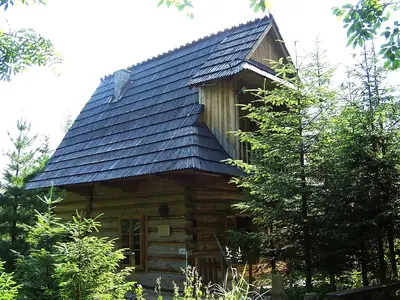 Pustelnia Brata Alberta
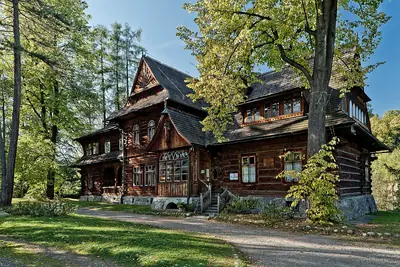 Museum of Zakopane Style at Villa Koliba
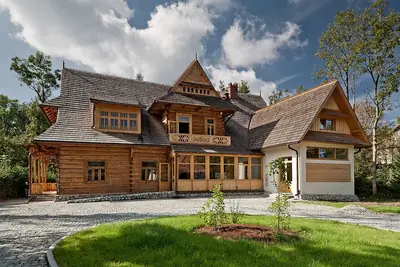 Villa Oksza in Zakopane
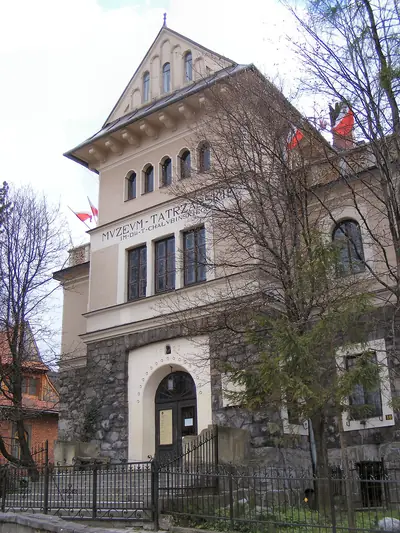 Gmach Główny Muzeum Tatrzańskiego im. dra Tytusa Chałubińskiego
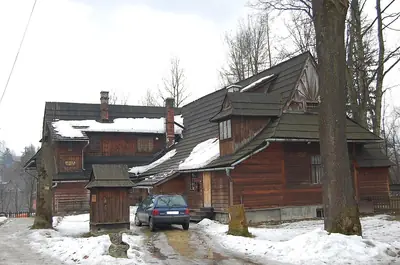 Muzeum of Jan Kasprowicz in Villa Harenda
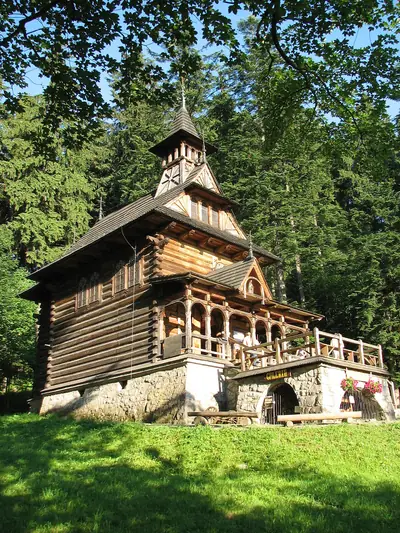 Sacred Heart chapel in Zakopane Jaszczurówka
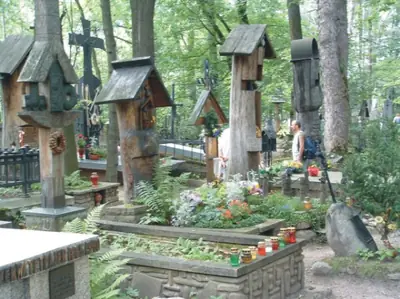 Pęksowy Brzyzek Cemetery in Zakopane
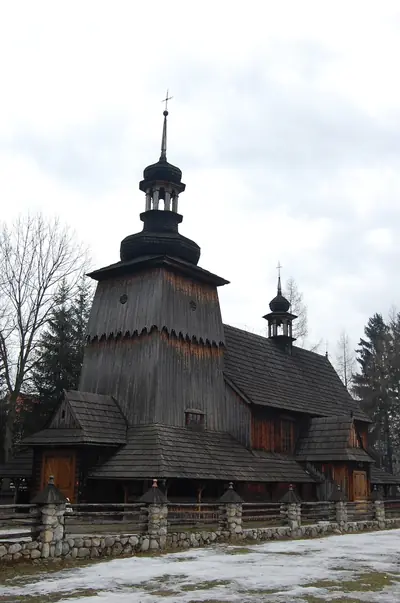 Church of St. John the Evangelist in Zakopane
Self-guided tours in Zakopane
3 tours in Zakopane, free in the Neywo app. Each stop tells its story as you reach it.
- Bus ride
Line 21: From Jaszczurówka's Chapel to the Fatima Sanctuary
Local line 21 starts at the wooden Jaszczurówka chapel, one of Witkiewicz's masterpieces, passes St Anthony's sanctuary and Villa Oksza, then goes by the Old Church and Villa Koliba out to the Fatima sanctuary in Krzeptówki. A cheap way to cross the town's sights.
Sacred Heart chapel in Zakopane Jaszczurówka · Saint Anthony of Padua Sanctuary in Zakopane · Villa Oksza in Zakopane · Our Lady of Częstochowa and Saint Clemens church in Zakopane · Museum of Zakopane Style at Villa Koliba · Muttergottes von Fatima
Open this tour: Line 21: From Jaszczurówka's Chapel to the Fatima Sanctuary - Walk
The Birth of the Zakopane Style
Follow the story of a mountain village that became Poland's winter capital. Start at Villa Koliba, where Witkiewicz invented a national style from highlander carpentry, pass the wooden Old Church and the cemetery of the meritorious, and finish on Krupówki, where the Tatra rescue service was founded.
Museum of Zakopane Style at Villa Koliba · Villa Czerwony Dwór in Zakopane · Villa Atma · Our Lady of Częstochowa and Saint Clemens church in Zakopane · Pęksowy Brzyzek Cemetery in Zakopane · Synagoga w Zakopanem …
Open this tour: The Birth of the Zakopane Style - Walk
Villas, Galleries and Mountain Sanctuaries
A longer stroll east of the centre: an artist's gallery, the wooden villas of the Zakopane style where writers and painters lived, and the Tatra National Park centre, ending at a pilgrimage sanctuary at the foot of the mountains.
Galeria Władysława Hasiora · Kościół pw. Najświętszej Maryi Panny Królowej Świata · Villa Oksza in Zakopane · Villa Witkiewiczówka in Zakopane · Villa Pod Jedlami in Zakopane · Tatra National Park Nature Education Center in Zakopane …
Open this tour: Villas, Galleries and Mountain Sanctuaries
Walk Zakopane with Neywo
Neywo turns Zakopane into a self-guided audio tour. Stories arrive as you reach the place they belong to, and the route reshapes when you wander off it.

