What to See in Giżycko, Poland: Free Audio Guide
Things to do in Giżycko
Giżycko is the lively heart of Masuria, northeastern Poland’s celebrated region of forests, waterways, and more than 2,000 lakes. Set between Lake Niegocin and Lake Kisajno, the town blends a relaxed waterfront atmosphere with a history shaped by Prussian, Teutonic and Polish influences. Neywo offers a free audio guide for Giżycko with 9 narrated places and 1 walking tour, letting you explore at your own pace.
What to see in Giżycko
The town’s sights are closely tied to its lake setting and its layered past. From military fortifications to modern places of worship, each stop tells a distinct story of the region.
Boyen Fortress
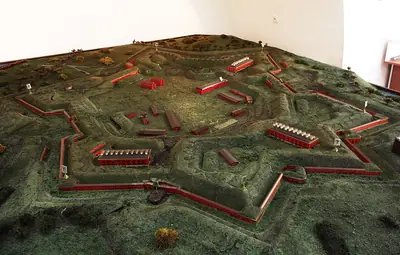
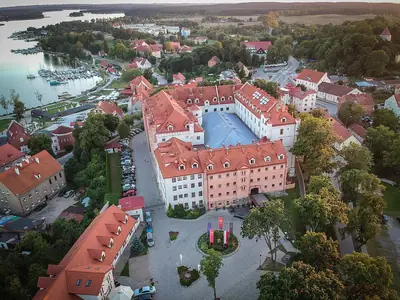
As you approach Boyen Fortress, you see a remarkable military landscape spread across a narrow strip of land between Lake Kisajno and Lake Niegocin. This former Prussian fortress was ordered by King Frederick William IV and built between 1844 and 1856. It formed a key link in the chain of fortifications protecting the eastern approach to the Prussian state, covering about 100 hectares and designed for a garrison of roughly 3 000 soldiers. The star‑shaped plan features four entrance gates: the Giżycko and Kętrzyn gates served as the main entrances, the Water Gate provided an auxiliary route with a drawbridge, and the Powder Gate stood beside the present‑day amphitheatre. Two historic roads lead to the fortress, one from Giżycko and another from Kętrzyn.
Kościół pw. Świętego Maksymiliana Kolbego
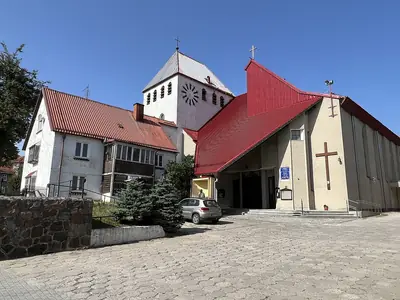
The Church of Saint Maximilian Kolbe, built between 1984 and 1886 and consecrated on 17 September 1986 by Bishop Edmund Piszcz, is a masonry structure plastered and covered with galvanized sheet metal. Its marble floor leads to a sanctuary that includes a tabernacle with a gloria, a cross and an image of Divine Mercy. The main altar, pulpit and baptismal font are all marble; the altar holds relics of Saint Fortunatus and Saint Lawrence. One side altar shows Our Lady of Perpetual Help together with a figure of Our Lady of Fatima, while the other displays an image of Saint Maximilian Maria Kolbe with his relics placed in the altar base. Wooden Stations of the Cross line the nave, the choir contains an organ with eighteen stops, and three electrically operated bells are installed in the tower.
Kościół pw. Świętego Kazimierza Królewicza
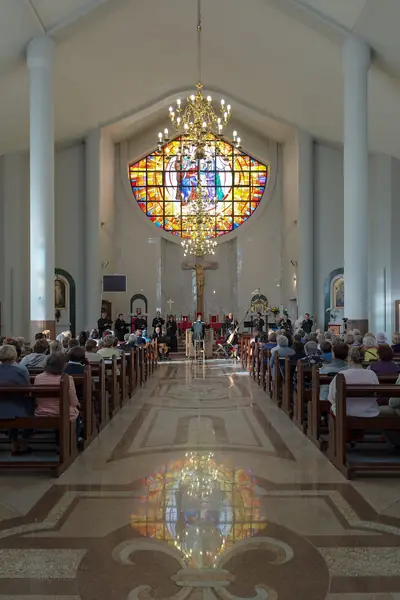
The Church of Saint Casimir the Prince began as a 250‑square‑metre chapel dedicated on 1 August 1991 by Bishop Józef Wysocki; this chapel served as the parish church while construction continued and is now known as the Chapel of Our Lady of Ostra Brama. The main church was consecrated on 21 May 2000 by Bishop Wojciech Ziemba. It is a single‑nave brick building with a steep gabled roof covered in coated sheet metal, the roof framework being welded metal. Inside, a spruce‑panelled ceiling adds warmth to the otherwise solid architecture. The windows are stained‑glass scenes from the Bible, supplemented by windows depicting Saint Casimir, Mother Teresa of Calcutta and the Jubilee Year. Seven copper‑sheet chandeliers illuminate the interior, placed along the centre and in the sanctuary.
Bruno of Querfurt church in Giżycko
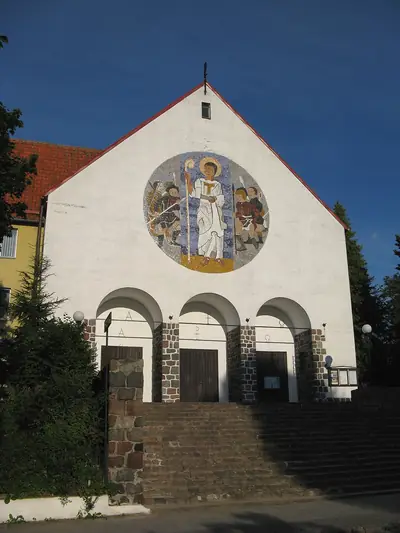
Known locally as the Church of Saint Bruno, this is the oldest Roman Catholic church in the city. It is considered one of the few church buildings in Germany dating from the National Socialist period and, until 1945, was the only Catholic church in the former Lötzen district, the area now forming Giżycko.
Saint Anne Orthodox church in Giżycko
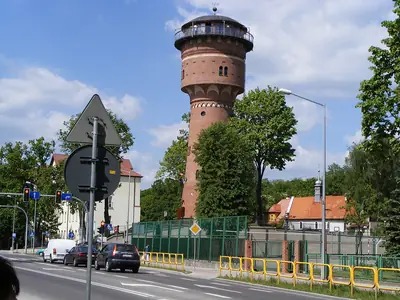
Located at 35 Warszawska Street beside the former water tower, Saint Anne Orthodox Church occupies a former Evangelical chapel from the late nineteenth century that was adapted for Orthodox liturgy and enlarged in the 1980s. It is a parish church belonging to the Olsztyn Deanery of the Białystok and Gdańsk Diocese of the Polish Autocephalous Orthodox Church.
Holy Trinity church in Giżycko
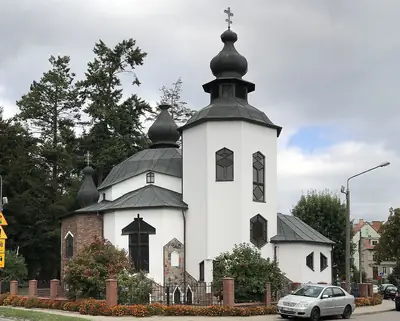
This Greek Catholic church, built between 1991 and 1995 to a design by Jacek Mermon of Przemyśl, is recognisable by its two domes. Inside, the iconostasis created in 1998 adds a traditional element to the modern space and completes the character of the interior.
Evangelical church in Giżycko
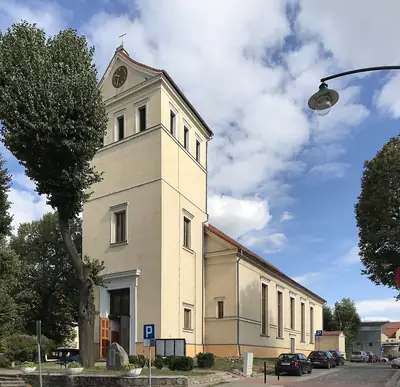
Built in 1827, the Evangelical Church remains the main church of the local Evangelical parish. It belongs to the Evangelical Augsburg Church in Poland and is part of its Masurian Diocese. Until 1945 it served as the church of the Evangelical parish of Lötzen in East Prussia.
Kościół pw. Świętej Anny
The Church of Saint Anne is part of the local Roman Catholic community. The Parish of Saint Anne was formally established on 1 July 1991 and belongs to the Giżycko deanery of Saint Christopher within the Ełk Diocese.
Giżycko County
Giżycko is the administrative seat and largest town of Giżycko County, which also includes the town of Ryn and several rural communities. The county was created on 1 January 1999 as part of Poland’s local government reforms. In 2002 its area was reduced when the territory that became Węgorzewo County was separated, and the municipality of Banie Mazurskie was transferred to Gołdap County.
Explore with Neywo
Neywo’s free audio guide for Giżycko contains 9 narrated places and includes one walking tour: “Giżycko: Fortress, Lakes and Four Faiths.” This route is 5.13 km long, takes about 111 minutes to complete and features 7 stops—Boyen Fortress, the Evangelical church, the Bruno of Querfurt church, the Church of Saint Casimir the Prince, the Saint Anne Orthodox church, the Holy Trinity church and the Church of Saint Anne. As you reach each point, the app tells the story of the place, allowing you to go at your own pace with no group and no schedule. The narration is available in 11 languages, so you can enjoy the guide in the language that suits you best.
If you’re planning a trip around Poland, Giżycko makes a fine base for discovering the Masurian Lake District and you can easily combine it with visits to other cities such as Białystok, Łódź or Poznań. For more information about the country, see our Poland page.
Download Neywo today and let the stories of Giżycko’s forts, churches and lakes accompany you on your walk.
Places with an audio guide in Giżycko
8 places in Giżycko with a Neywo audio guide. Each one starts telling its story as you reach it.
Self-guided tours in Giżycko
1 tour in Giżycko, free in the Neywo app. Each stop tells its story as you reach it.
- Walk
Giżycko: Fortress, Lakes and Four Faiths
Giżycko, the old Prussian Lötzen, sits on a strip of land between two Masurian lakes. Start at the star-shaped Boyen Fortress, then follow the town's churches: Lutheran, Catholic, Orthodox and Greek Catholic, a small tour of how East Prussia became Polish Masuria.
Boyen Fortress · Evangelical church in Giżycko · Bruno of Querfurt church in Giżycko · Kościół pw. Świętego Kazimierza Królewicza · Saint Anne Orthodox church in Giżycko · Holy Trinity church in Giżycko …
Open this tour: Giżycko: Fortress, Lakes and Four Faiths
Walk Giżycko with Neywo
Neywo turns Giżycko into a self-guided audio tour. Stories arrive as you reach the place they belong to, and the route reshapes when you wander off it.

