Things to Do in Albi, France: Walking Guide
Things to do in Albi: explore its brick-built historic centre
The best things to do in Albi include visiting the fortress-like Albi Cathedral, discovering the Toulouse-Lautrec collection in the Palais de la Berbie, and walking among the city’s red-brick churches and historic buildings. Set above the Tarn River, Albi combines medieval religious architecture, regional brickwork and museums dedicated to local history and culture. Neywo has a free audio guide for Albi with 18 narrated places.
Albi is in Occitania, in southern France, and its architecture is the starting point for understanding the city. The historic centre brings together imposing Gothic buildings, older stonework, later brick construction and quieter religious landmarks beyond the main sights.
What to see in Albi
Albi Cathedral
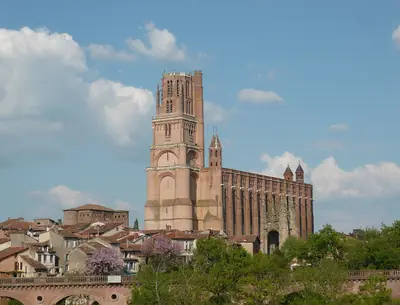
Albi Cathedral, officially known as Cathédrale Sainte-Cécile, stands on a rocky outcrop overlooking the Tarn River. Its exterior has the severe, defensive appearance of a fortress rather than a conventional church. That character reflects its construction as a statement of Christian strength after the Cathar movement, which the Catholic Church regarded as heresy.
Construction began in 1282 under Bishop Bernard de Castanet. The cathedral took two centuries to complete and was consecrated in 1480. Built almost entirely from brick, it is one of the largest brick structures in the world and a major example of Southern Gothic architecture, a style associated with the Languedoc region.
The contrast between the outside and inside is central to the experience. The austere exterior gives way to an intensely decorated interior filled with colour and artwork, making the cathedral one of the defining places to visit in Albi.
Palais de la Berbie and the Musée Toulouse-Lautrec
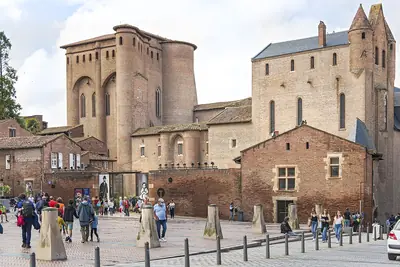
Above the Tarn River, the Palais de la Berbie combines the appearance of a fortress with the setting of a historic residence. It was built between 1228 and 1308 under three successive bishops. The palace began as a prestigious residence commissioned by Bishop Durand de Beaucaire and was later fortified by Bernard II and Bernard III during the Cathar period.
Its massive keep reaches 50 metres in height, while the walls are seven metres thick at the base. Over time, the bishops adapted the stronghold into a more comfortable residence, adding grand salons, terraces, French-style gardens and a Renaissance wing. In 1678, the gardens were redesigned by Hyacinthe Serroni, the first archbishop of Albi, following the French formal garden model.
Today, the palace houses the Musée Toulouse-Lautrec, which holds the world’s most important public collection of works by the artist. The museum gives Albi a cultural identity that extends beyond its medieval architecture.
Collégiale Saint-Salvy
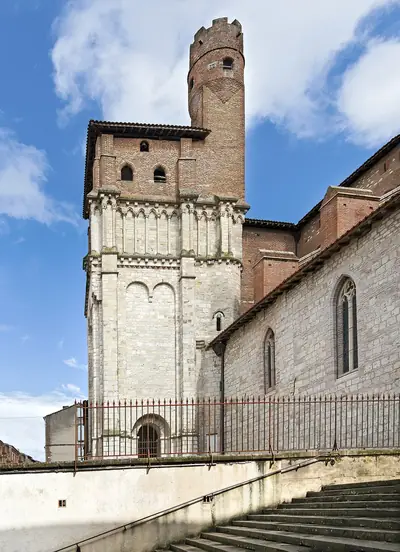
The Collégiale Saint-Salvy stands in the heart of Albi and reveals the city’s architectural history in a single building. Its appearance combines Languedoc Romanesque art with Gothic architecture, while the materials make the contrast especially clear: older sections are built from stone and later parts use Albi’s characteristic red brick.
Construction continued for nearly seven centuries, with changes made during both prosperous and difficult periods. The result is a complex building whose different phases can be read in its walls. The church is attached to a cloister and the Canourgue, a group of former residences for the canons, forming a substantial historic ensemble.
Musée Lapérouse and the Moulins Albigeois
Near the Pont-Vieux and the Tarn River, the Musée Lapérouse is dedicated entirely to the navigator Lapérouse. It is one of Albi’s seven museums and has welcomed visitors since 2010.
The riverside setting also brings together maritime history and the city’s industrial past. Nearby, the Vermicellerie d’Albi, commonly known as the Moulins Albigeois, occupies the site of a former pasta factory.
Municipal Theatre of Albi
The Municipal Theatre of Albi is a cultural landmark in the heart of the city. It adds a more modern civic dimension to an itinerary otherwise dominated by cathedrals, palaces and medieval buildings.
Temple réformé d’Albi
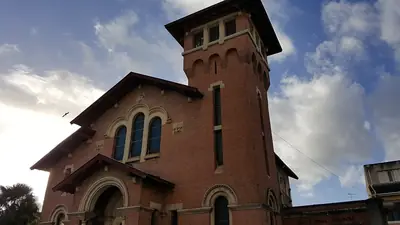
The Temple réformé d’Albi is the city’s Reformed church. Its parish was founded in 1871, and it is attached to the United Protestant Church of France, the country’s main Protestant denomination.
Église Notre-Dame du Breuil
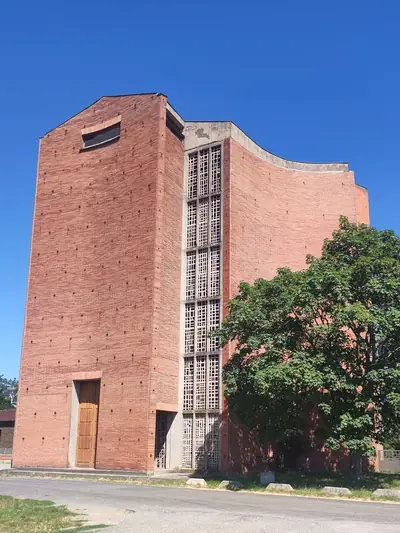
Built between 1959 and 1962, the Église Notre-Dame du Breuil served the growing neighbourhoods of Breuil and Mazicou. Its reinforced-concrete and brick structure takes inspiration from the fortress-like form of Albi Cathedral.
Inside, the concrete is deliberately left rough, creating a raw, textured atmosphere. The stained-glass windows by Raymond Clercq-Roques bring colour and light to the otherwise austere interior.
Château de Cantepau
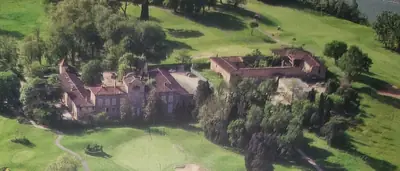
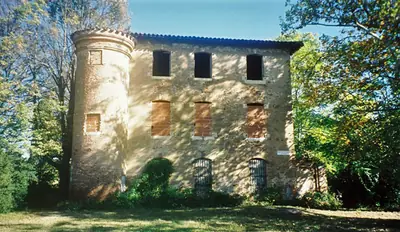
The Château de Cantepau is an eighteenth-century brick residence built by the Delecouls family. Its warm, reddish appearance reflects the regional preference for brick construction.
The château spent many years in ruins before being carefully restored. Today, it can be seen from Albi’s ring road as an example of the area’s brick architecture.
Other religious landmarks
Albi’s religious heritage extends well beyond the cathedral and Saint-Salvy. The Église Saint-Jean de Rayssac is a quieter Catholic church offering a glimpse into the city’s lesser-known religious history. The Église de Notre-Dame de Fonlabour, Église Saint-Antoine, Chapelle Saint-Martin and Église Saint-Joseph d’Albi are further stops for visitors exploring the city beyond its principal monuments.
The Église Notre-Dame-de-la-Drèche has medieval origins: construction began in the thirteenth century, although only the medieval choir survives. Most of the present building dates from the nineteenth century. The sanctuary’s name comes from the Occitan phrase Nostro Damo de Dresto, translated as Our Lady of the Right Bank of the Tarn, and the church was listed as a historic monument on October 23, 1995.
Explore Albi with a free audio guide
For an Albi self-guided walking tour, Neywo’s free app tells the story of each place as you reach it. You can explore at your own pace, with no group and no schedule, while the narration plays at the relevant stop.
Albi has two routes:
- One walking tour: 3.42 km, 118 minutes and 9 narrated stops, including the Musée Lapérouse, Palais de la Berbie, Albi Cathedral, Collégiale Saint-Salvy, Municipal Theatre of Albi, Temple réformé d’Albi and Église Saint-Joseph d’Albi.
- One bike route: 1.2 km, 6 minutes and 2 narrated stops, Château de Cantepau and Église Notre-Dame du Breuil.
The Albi audio guide includes 18 narrated places in total, with narration available in 11 languages. Download Neywo and explore Albi’s brick fortresses, churches, museums and riverside history at your own pace.
Places with an audio guide in Albi
8 places in Albi with a Neywo audio guide. Each one starts telling its story as you reach it.
Self-guided tours in Albi
2 tours in Albi, free in the Neywo app. Each stop tells its story as you reach it.
- Bike ride
Albi by Bike: Brick Château to a Concrete Fortress Church
Ride the cycle lane north of the Tarn from the eighteenth-century brick Château de Cantepau to the Notre-Dame du Breuil church, a 1960s concrete-and-brick building modelled on the fortress look of Albi's cathedral.
Château de Cantepau · Église Notre-Dame du Breuil
Open this tour: Albi by Bike: Brick Château to a Concrete Fortress Church - Walk
Albi, the Red City: Brick Fortress-Cathedral and Toulouse-Lautrec's Palace
Walk through the UNESCO-listed Episcopal City of Albi, built in warm red brick. Start by the Tarn and the Pont-Vieux, climb to the bishops' fortress that now holds the world's largest Toulouse-Lautrec collection, and enter the vast Sainte-Cécile cathedral with its Last Judgment. Finish through the old town's churches and theatres.
Église Sainte-Marie-Madeleine d'Albi · Musée Lapérouse · Palais de la Berbie · Albi Cathedral · Collégiale Saint-Salvy (Albi) · Municipal Theatre of Albi …
Open this tour: Albi, the Red City: Brick Fortress-Cathedral and Toulouse-Lautrec's Palace
Walk Albi with Neywo
Neywo turns Albi into a self-guided audio tour. Stories arrive as you reach the place they belong to, and the route reshapes when you wander off it.


More in Occitania
Elsewhere in France
- UzèsOccitania
- Villeneuve-lès-AvignonOccitania
- Aix-en-ProvenceProvence-Alpes-Côte d'Azur
- AntibesProvence-Alpes-Côte d'Azur
- ArlesProvence-Alpes-Côte d'Azur
- AvignonProvence-Alpes-Côte d'Azur
- Bouc-Bel-AirProvence-Alpes-Côte d'Azur
- CannesProvence-Alpes-Côte d'Azur
- CassisProvence-Alpes-Côte d'Azur
- CavaillonProvence-Alpes-Côte d'Azur
- ÈzeProvence-Alpes-Côte d'Azur
- FréjusProvence-Alpes-Côte d'Azur