What to See in Toulouse, France: Free Audio Guide
Things to Do in Toulouse: What to See in the Pink City
The best things to do in Toulouse include exploring Romanesque and Gothic churches, Renaissance mansions, art museums, archaeological collections, and the quays of the Garonne. Known as the Pink City for its distinctive brick architecture, Toulouse brings together a rich religious and artistic heritage with a strong connection to aviation. Neywo offers a free audio guide for Toulouse with 258 narrated places.
What to See in Toulouse
Basilica of St. Sernin
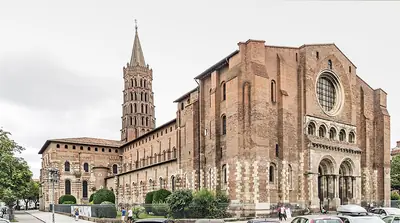
The Basilica of St. Sernin is one of Toulouse’s defining landmarks and one of the largest preserved Romanesque churches in Europe. Built over more than a century from the end of the eleventh century, it was designed as a major pilgrimage church and houses the relics of Saint Saturnin, Toulouse’s first bishop and a highly venerated martyr.
Inside, 260 Romanesque capitals preserve an exceptional record of medieval architecture and sculpture. The basilica stands beside the Musée Saint-Raymond, making this one of the city’s most rewarding areas for exploring its early history.
Musée Saint-Raymond
Toulouse’s archaeological museum occupies a former sixteenth-century university college next to the Basilica of St. Sernin. Its collections cover the region from protohistory to the early Middle Ages, with a particular focus on Celtic, Roman, and early Christian periods.
The building itself has served many purposes over the centuries, including a hospital, prison, student residence, barracks, and presbytery. The museum opened in 1892, and its displays include Roman inscriptions bearing Aquitanian or Basque names.
Notre-Dame du Taur
Rue du Taur connects the Capitole with Saint-Sernin, and Notre-Dame du Taur is one of its most distinctive landmarks. The church’s name refers to the bull in the tradition surrounding the martyrdom of Saint Saturnin: according to the legend, this was where the saint’s body became detached from the animal that dragged him.
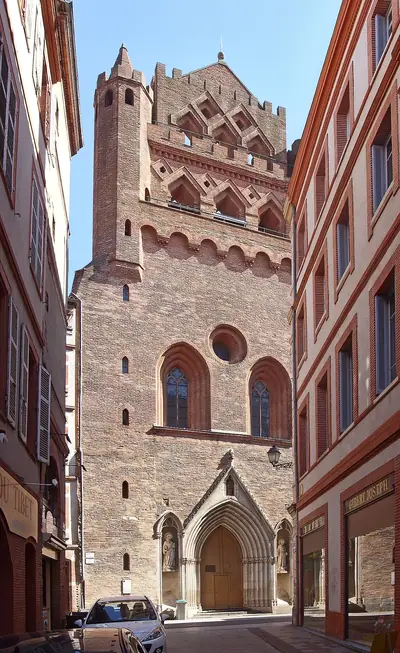
Built between the fourteenth and sixteenth centuries, the church is an important example of southern Gothic architecture. Its tall bell-wall façade rises directly among the surrounding buildings.
Monastery of the Jacobins
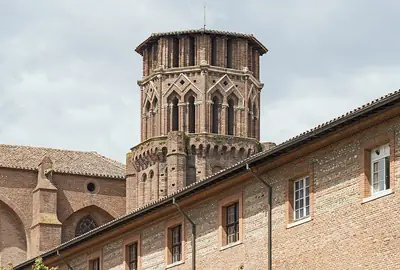
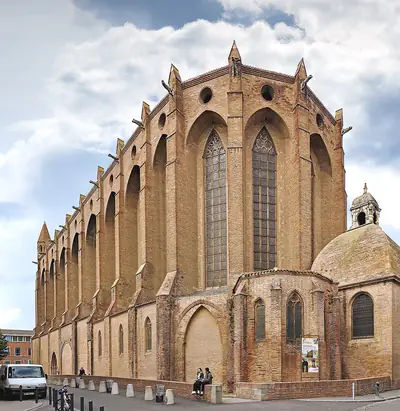
The Monastery of the Jacobins is a major work of southern French Gothic architecture, built entirely of brick. The complex includes the Church of the Jacobins, a cloister with paired columns, a chapter house, a refectory, the Saint-Antonin Chapel, and a 45-metre-high bell tower.
Its most famous feature is inside the church: a central column sends out twenty-two stone ribs that spread across the vault like the branches of a palm tree. The convent was founded in the context of the Dominican order’s beginnings in Toulouse, and construction of the church started in 1230.
Toulouse Cathedral
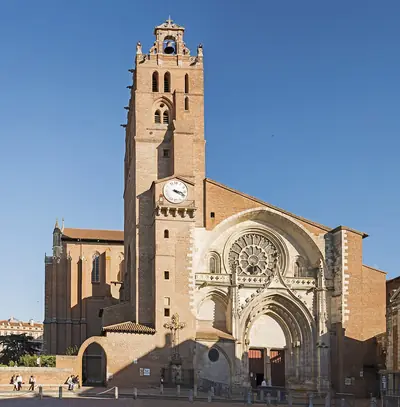
Cathédrale Saint-Étienne gives its name to the surrounding neighbourhood and stands out for its combination of architectural periods. Rather than presenting a single uniform style, the cathedral brings together elements from different stages of its development.
The earliest origins of the building are unknown, but the first recorded traces date from 1071, when Bishop Isarn of Lavaur decided to rebuild a structure that had fallen into ruin.
Musée des Augustins
The Musée des Augustins combines a fine-arts collection with the architecture of a former Augustinian convent. Its cloisters, church, and chapter rooms remain important examples of Gothic architecture in Languedoc, while reconstructed medieval gardens add to the atmosphere of the setting.
The collections range from the early Christian period to the twentieth century. The paintings come from across France, and the sculpture collection has a particularly rich group of Romanesque works reflecting the culture of Occitania. The museum reopened on December 19, 2025, after nearly six years of structural work and adaptation.
Hôtel d’Assézat and the Collection Bemberg
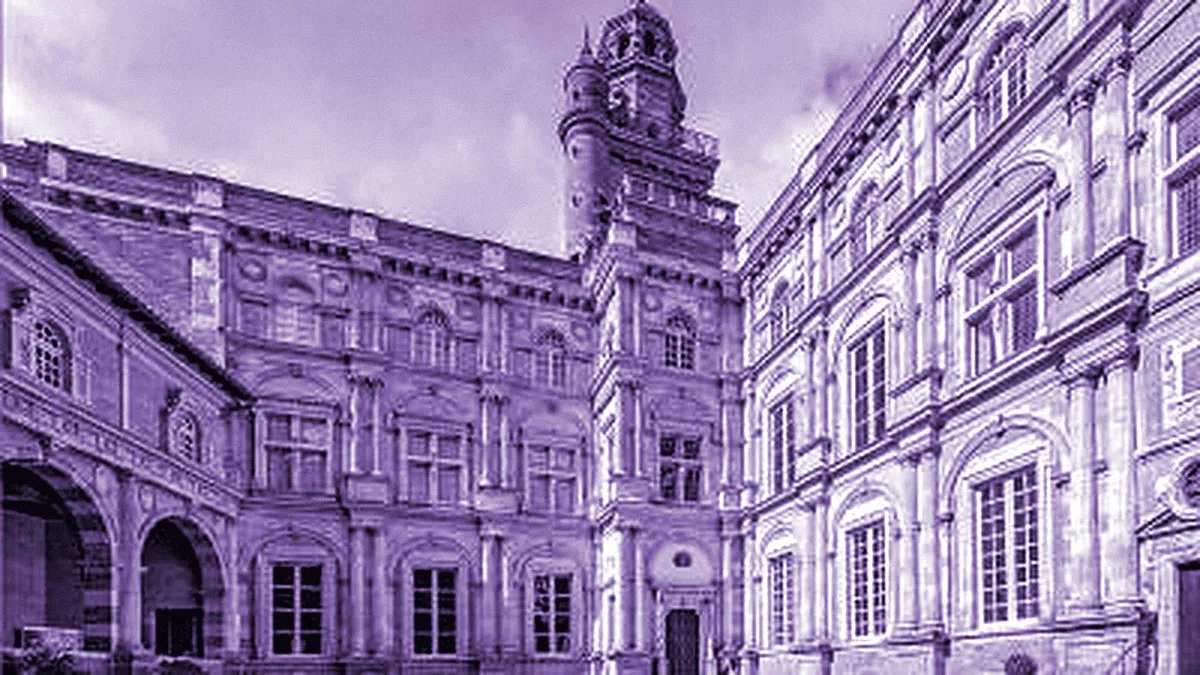
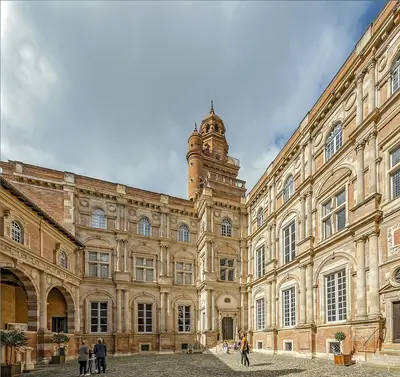
The Hôtel d’Assézat is one of Toulouse’s finest Renaissance buildings. Constructed between 1555 and 1562, it combines the city’s characteristic brick with elaborate courtyard decoration influenced by Italian Mannerism and classicism.
The courtyard is the heart of the mansion, with classical façades and carefully preserved ornamentation. The building now belongs to the City of Toulouse and houses the Collection Bemberg, an art foundation set within this remarkable historic setting.
Notre-Dame de la Daurade
Notre-Dame de la Daurade stands beside the Garonne, close to the quays, port, and École des Beaux-Arts. The site was established in 410, when Emperor Honorius allowed pagan temples to be converted to Christianity; the original building was a temple dedicated to Apollo.
The present church was built between 1764 and 1883. Its classical façade is especially striking when viewed from the opposite bank of the river. One unusual detail is its lack of a bell tower.
Château d’eau
At the junction of the cours Dillon and Pont-Neuf, the Château d’eau is a nineteenth-century brick tower overlooking the Prairie des Filtres. Despite its name, it was not strictly a water tower because it had no storage reservoir. It formed part of Toulouse’s water-distribution system.
Since 1974, the building has housed a photography gallery. The tower and its pumping station have been listed as historical monuments since 1987, giving the riverside site both industrial and cultural significance.
Saint-Pierre-des-Cuisines
Near Place Saint-Pierre, Saint-Pierre-des-Cuisines brings together ancient history and a modern cultural role. The church stands on a Gallo-Roman necropolis dating from the fourth century and is described as the oldest church in southwestern France.
Today, the building houses a 400-seat auditorium for Toulouse’s regional conservatory. Its setting beside the Garonne and the lively Place Saint-Pierre makes it a natural stop during a walk along the river.
Notre-Dame de la Dalbade
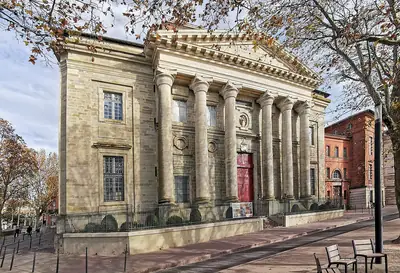
Notre-Dame de la Dalbade stands in Toulouse’s Carmes quarter on rue de la Dalbade. Its restrained exterior is characteristic of southern Gothic architecture. The name comes from an earlier church covered in white lime plaster, known as Santa Maria dealbata, or “Saint Mary the White.”
It is distinct from Notre-Dame de la Daurade, despite the similarity between their names.
Castel-Gesta
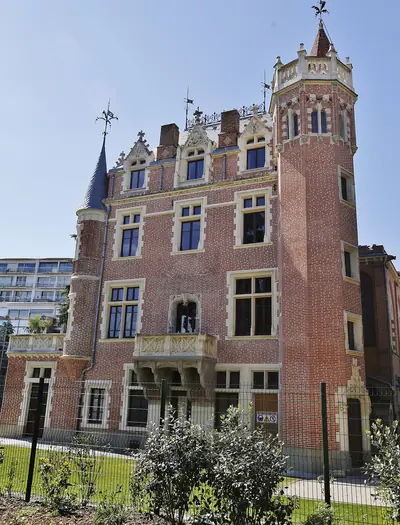
Castel-Gesta, also called the Château des Verrières or Maison du Verrier, is a villa designed to resemble a castle. It was created in the late nineteenth century by Louis-Victor Gesta, a painter and maker of stained glass, and was connected to a former stained-glass manufactory.
The building served as both a residence and exhibition space. After a turbulent history and a long period in poor condition, it was restored and listed as a historic monument in 1991.
L’Envol des pionniers
In Toulouse’s Montaudran district, L’Envol des pionniers explores the city’s aeronautical heritage through the story of Aéropostale. The museum opened on December 22, 2018, almost one hundred years after the inaugural civil flight to Barcelona.
It offers a different perspective on Toulouse’s identity, complementing the city’s medieval churches, Renaissance mansions, and archaeological museums with the story of modern air travel.
Other historic churches and convents
The remains of the Couvent des Cordeliers recall the Franciscan presence established in Toulouse in 1222. The former convent included a church, cloister, chapel, sacristy, chapter house, library, refectory, and monks’ cells, and became an important intellectual and religious centre in the south of the Kingdom of France.
Near Place Saint-Pierre, the Église Saint-Pierre des Chartreux was built by the Chartreux community at the beginning of the seventeenth century. In the Carmes quarter, Notre-Dame de la Dalbade provides another example of southern Gothic architecture.
Toulouse self-guided walking tours
Neywo has six walking tours in Toulouse, plus one bus route and one bike route. The walks range from 1.22 to 2.69 km and last between 81 and 120 minutes. Together, they cover the Capitole, Saint-Sernin, the Garonne, the Carmes quarter, historic mansions, museums, gardens, and Saint-Cyprien.
The bus route covers 8.2 km in 35 minutes with 12 stops, while the bike route along the Garonne covers 1.3 km in 6 minutes with four stops. Across all eight routes, there are 68 narrated stops.
The app tells the story of each place as you reach it, at your own pace, with no group and no schedule. Narration is available in 11 languages, so you can explore Toulouse independently while keeping your attention on the streets, buildings, and riverfront around you.
Download Neywo and explore Toulouse
Download Neywo to discover Toulouse with six walking tours, one bus route, and one bike route. Choose a walk through the historic centre, follow the Garonne quays, explore the cathedral and Carmes quarter, or visit the city’s Roman walls, gardens, and museums. The free audio guide includes 258 narrated places, and every story plays as you arrive at the next stop.
Toulouse is part of Occitania, in France, and can also be combined with visits to nearby Montpellier, Nîmes, or Narbonne.
Places with an audio guide in Toulouse
8 places in Toulouse with a Neywo audio guide. Each one starts telling its story as you reach it.
Self-guided tours in Toulouse
8 tours in Toulouse, free in the Neywo app. Each stop tells its story as you reach it.
- Bike ride
Garonne Quays by Bike: Bazacle to the Daurade and the Prairie des Filtres
Ride the river quays of Toulouse on cycle paths from the Bazacle weir past the old church of Saint-Pierre des Cuisines and the Daurade basilica to the water tower beside the Pont-Neuf.
Espace EDF Bazacle · Église Saint-Pierre des Cuisines · Notre-Dame de la Daurade · Château d'eau
Open this tour: Garonne Quays by Bike: Bazacle to the Daurade and the Prairie des Filtres - Bus ride
Navette Centre Ville: Free Shuttle through Old Toulouse
Tisséo's free electric shuttle loops the historic centre and the Saint-Cyprien bank, and the driver stops wherever you wave. Ride it past the Garonne water tower, the Pont-Neuf square, the Dalbade, Maison Seilhan, the Augustins museum, Place Wilson, Notre-Dame du Taur, Saint-Raymond, Saint-Pierre des Cuisines and the Daurade basilica.
Château d'eau · Place du Pont-Neuf · Notre-Dame de la Dalbade · Maison Seilhan · Hôtel Dahus · Musée des Augustins …
Open this tour: Navette Centre Ville: Free Shuttle through Old Toulouse - Walk
Pink City, Black Saint: From the Capitole to Saint-Sernin
Start on the pink brick of Place du Capitole and its opera house, then follow the path of Saint Saturnin, the bishop dragged by a bull. Pass the church that bears the bull's name, two old university colleges, the largest Romanesque basilica left in Europe, a museum of Roman Toulouse, and the brick monasteries of the Franciscans and Dominicans.
Théâtre du Capitole · Place du Capitole · Notre-Dame du Taur · Collège de l'Esquile · Basilica of St. Sernin · Musée Saint-Raymond …
Open this tour: Pink City, Black Saint: From the Capitole to Saint-Sernin - Walk
Woad Fortunes and the River: Mansions to the Garonne
Toulouse grew rich on woad, the blue dye, and the merchants built Renaissance mansions to show it. Visit three of the finest courtyards and towers, then follow the quays to the Daurade basilica with no bell tower, the oldest bridge across the Garonne, the old hospital on the far bank, and the oldest church in the south-west.
Hôtel de Bernuy · Hôtel d'Assézat · Hôtel de Gayssion · Notre-Dame de la Daurade · Port de la Daurade · Pont-Neuf …
Open this tour: Woad Fortunes and the River: Mansions to the Garonne - Walk
Cathedral, Augustins and the Carmes Quarter
A cathedral built from mismatched centuries, a fountain with three names, a convent turned fine-arts museum and a rare Gothic house. Then slip into the Carmes quarter for Renaissance mansions, a Gothic church named for the white of its walls and the house of Jean Calas.
Toulouse Cathedral · Fontaine de la place Saint-Étienne · Musée des Augustins · Maison romano-gothique de Toulouse · Hôtel Dahus · Hôtel du Vieux-Raisin …
Open this tour: Cathedral, Augustins and the Carmes Quarter - Walk
Roman Walls, Gardens and a Moorish Villa
A quieter walk through the south-east of the old centre: a Roman tower and the only Gallo-Roman ramparts in Gaul built of brick, Renaissance mansions, a 19th-century marshal's palace, the gardens and natural history museum, the Resistance memorial and a Moorish villa full of Asian art beside the Canal du Midi.
Tour des Hauts-Murats · Hôtel d'Ulmo · Hôtel de Lestang · Gallo-Roman ramparts of Toulouse · Palais Niel · University of Toulouse …
Open this tour: Roman Walls, Gardens and a Moorish Villa - Walk
Saint-Cyprien: Posters, Slaughterhouse Art and the Garonne
Cross to the left bank of the Garonne for the working-class district of Saint-Cyprien: a theatre, the contemporary art museum in the old slaughterhouses, the poster centre, the great square and a church on the riverbank. Finish by the old lock and the school of economics.
Garonne theatre · Les Abattoirs · Centre de l'Affiche · Place Intérieure-Saint-Cyprien · Saint Nicolas' Church, Toulouse · Musée d'histoire de la médecine (Toulouse) …
Open this tour: Saint-Cyprien: Posters, Slaughterhouse Art and the Garonne - Walk
Hidden Mansions of the Dalbade Quarter
Wander the lanes between Rue de la Dalbade and Place du Salin to find woad merchants' hôtels particuliers with towers and courtyards, the house where Saint Dominic stayed and the main Protestant temple of Toulouse.
Temple du Salin in Toulouse · Maison Seilhan · Hôtel Claude de Saint-Félix · Hôtel de Felzins · Hôtel de Bagis · Hôtel de La Mamye …
Open this tour: Hidden Mansions of the Dalbade Quarter
Walk Toulouse with Neywo
Neywo turns Toulouse into a self-guided audio tour. Stories arrive as you reach the place they belong to, and the route reshapes when you wander off it.


More in Occitania
Elsewhere in France
- Aix-en-ProvenceProvence-Alpes-Côte d'Azur
- AntibesProvence-Alpes-Côte d'Azur
- ArlesProvence-Alpes-Côte d'Azur
- AvignonProvence-Alpes-Côte d'Azur
- Bouc-Bel-AirProvence-Alpes-Côte d'Azur
- CannesProvence-Alpes-Côte d'Azur
- CassisProvence-Alpes-Côte d'Azur
- CavaillonProvence-Alpes-Côte d'Azur
- ÈzeProvence-Alpes-Côte d'Azur
- FréjusProvence-Alpes-Côte d'Azur
- MarseilleProvence-Alpes-Côte d'Azur
- MentonProvence-Alpes-Côte d'Azur